




Abstract

Islamist fighters from al-Shabaab control a fifth of Somalia and have their own radio station.
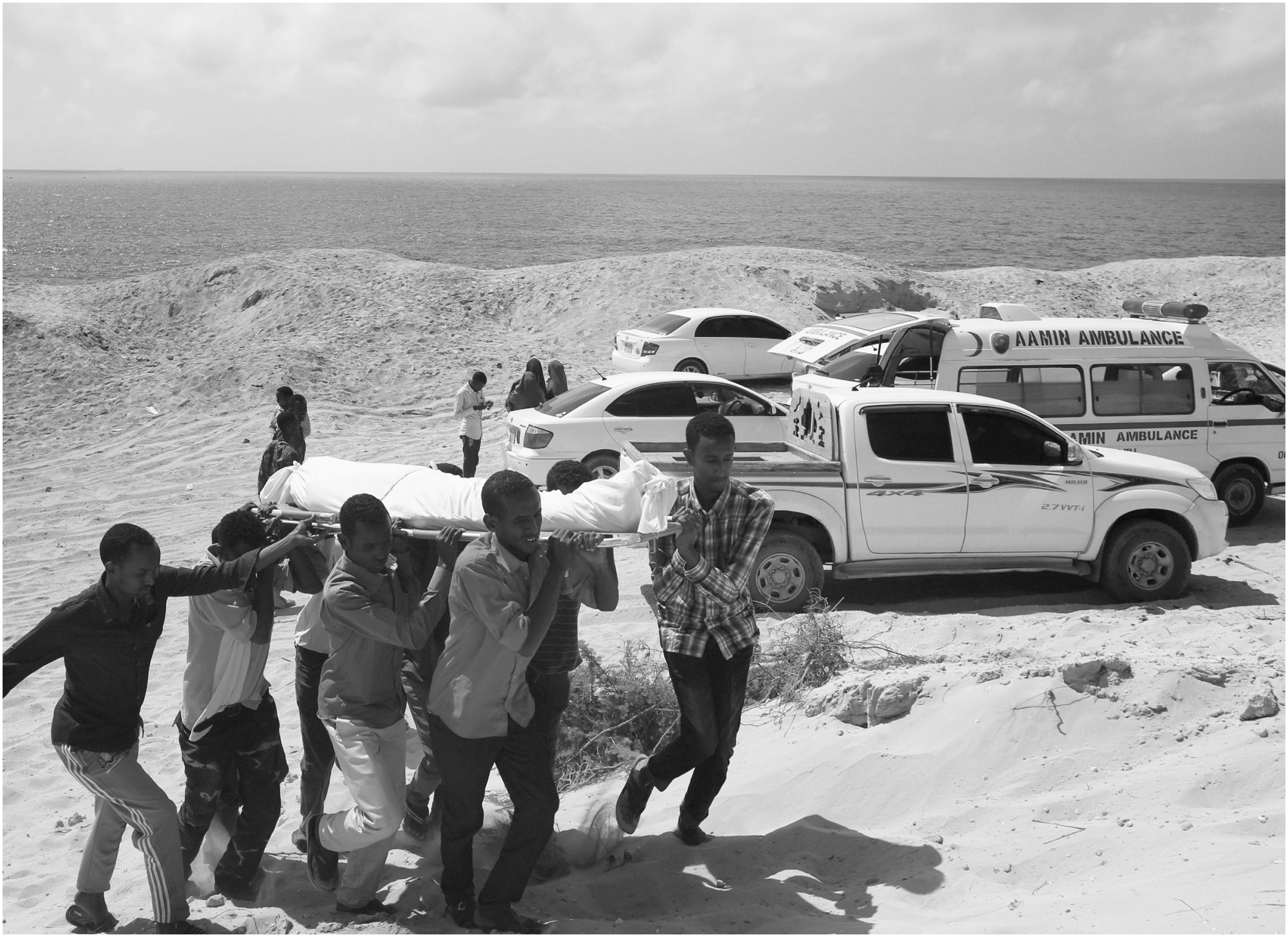
Relatives and journalists carry the body of Abdiasis Ali Haji, a Somali radio journalist who was killed by unknown gunmen in Somalia’s capital Mogadishu, September 2016
CREDIT: Feisal Omar/Reuters
Somali journalists like Hussein live under constant threat from the country’s powerful Islamist group al-Shabaab, which has close links with al-Qaeda. For the group, planting bombs under seats that can be remotely detonated is one of their signature ways to kill Somali journalists. Hussein said: “I know people who have died or were injured from bombs left in their cars.”
Journalists like Hindia Haji Mohamed, a mother of five, have fallen victim to this al-Shabaab tactic. She was working for Radio Mogadishu and Somali National TV, two state-run news outlets, when she was killed by a car bomb outside the Turkish embassy in Mogadishu on 3 December 2015. Her al-Shabaab killers had planted a bomb under her car seat. She was the widow of Liban Ali Nur, who was the head of news for Somali National TV. He was killed in an al-Shabaab suicide bomb attack in September 2012, along with three other journalists, at a popular cafe in Mogadishu.
Radio journalists like Hussein are vulnerable when they leave their homes, as they can be gunned down anywhere. Hussein is a reporter for a popular local radio station that broadcasts news to south-central parts of Somalia. He told Index: “If al-Shabaab see you, they will not let you pass. If they saw me, they would kill me. To work as a radio journalist in Somalia is very tough. The issue is that there can be one terrorist attack here one day and then another somewhere else the next day.”
Radio is still the main way people get information and news in Somalia. There are few printed newspapers and literacy is low. Somali only became a written language in 1972 and not many books are published in Somalia because of the civil war. The internet is popular but is largely an urban phenomenon, popular with the youth and diaspora returnees. Television news exists, but access to television sets is limited in one of the poorest countries in the world. So radio is really important. Laura Hammond, a Somalia expert at School of Oriental and African Studies, University of London, said: “Somali culture is an oral one, and the transmission of information through radio is an extension of the age-old tradition of oration and sharing information through poetry and spoken word.”
The most widely respected radio sources are the BBC Somali Service, which has recently marked its 60th anniversary, and the Voice of America Somali service. But while getting the news out to the public of what is going on in their country, Somali journalists face some of the worst violence and impunity anywhere in Africa. On the Reporters Without Borders 2017 World Press Freedom Index, Somalia is ranked 167 out of 180 countries.
Mohamed Ibrahim Moalimuu, the secretary general of the National Union of Somali Journalists, said: “Somalia still remains one of the worst countries that journalists operate in and journalists are often targeted. They constantly come across intimidation, arbitrary arrests, torture and sometimes killings.”
Some Somali journalists have been forced into hiding because of constant threats from al-Shabaab. One journalist Index interviewed, who did not want to be named for security reasons, said: “My life has become upside down since al-Shabaab began to hunt me down … Al-Shabaab call me from unknown numbers and they tell me: ‘Your life is in danger’.”
The journalist is a well-known radio reporter who covers al-Shabaab. He told Index: “I have got threats from al-Shabaab. They heard my reports about their terrorist attacks and they have since threatened me with death.” This journalist has spent two years in hiding, fearing for his life.
In February 2017, al-Shabaab operatives visited his mother at her home. He said: “They went to my mother’s house. They said: ‘Where is he?’ She told them I was not there and they told my mother: ‘The next time you see your son, he will be dead’.” His voice quivers as he recounts this story. Now exhausted by days spent hiding from an al-Shabaab bullet, he said: “I want my life back, but I am a young journalist who is living under threat … I cannot stop being a journalist. I will not stop using my voice.”
According to Angela Quintal, Africa programme coordinator at the Committee to Protect Journalists, 62 journalists have been killed in Somalia since 1992. More than half of those - 43 altogether - were murdered, with al-Shabaab suspected of being responsible for most of the deaths. Although killings of journalists have declined since 2012, three were killed in 2016.
The background to this is that after the Somali state collapsed into civil war in 1991, the country fell into an orgy of violence, terrorism and a recent devastating drought. In the lexicon of international affairs Somalia was known as the world’s “most failed state”, but in recent years it has transited into a “fragile state”. Chief amongst the many threats Somalia has faced is al-Shabaab, arguably Africa’s most potent terrorist outfit.
In recent years al-Shabaab has lost some territories in southern parts of Somalia like the strategic port of Kismayo, as well as much ground in Mogadishu. But it still controls swathes of land in the country.
Al-Shabaab not only targets radio journalists in Somalia, but it has its own radio station al-Andalus which broadcasts jihadi propaganda with devotional Islamic music, along with loud news broadcasts about the “kafirs” and how many “infidels” they have killed. The station has a wide reach in the southern parts of Somalia and the areas it controls, and is available online.
Moalimuu said al-Andalus still functions and they have transmissions in al-Shabaab controlled areas.
Mary Harper, BBC Africa Editor, who is currently writing a book on al-Shabaab, said the terrorist organisation’s broadcasting activities were “miles ahead of Boko Haram”.
When it comes to its own attacks against civilians or government or African Union forces, Harper said, it gives a fairly reliable account, but tends to exaggerate the numbers of people it kills.
They use al-Andalus as an instrument to suppress freedom of expression and spread their radical Islamist propaganda.
Moalimuu said: “Al-Shabaab bans music in all areas they still control. They check regularly young people’s mobile phones. Smart phones or any mobile, which have a camera, are forbidden in their areas. That policy is still in place in al-Shabaab areas. The people are very frustrated but they have no other choice except to obey, in order to save their lives.”
Nur Hassan, a former journalist and media producer in Mogadishu, said: “Music is totally banned by al-Shabaab. If you are caught listening to music in the areas they control then you will be given 40 lashes in public and then you will be shamed.”
Harper said that not all threats come from al-Shabaab: “Journalists are under threat from every corner in Somalia.”
But Hussain continues to worry about the threat of al-Shabaab. He says some radio journalists are so concerned that they spend nights in their radio studios and not in their beds. For him though, he said: “I am not worried about death until it comes for me.” Until then, he said: “I will keep checking for bombs when I leave my house, but my fate is in God’s hands.”