



Abstract

Free speech in Germany is being threatened by a toxic mix of rising tensions related to immigration and the influx of refugees, and actions to stop people being upset or offended, writes
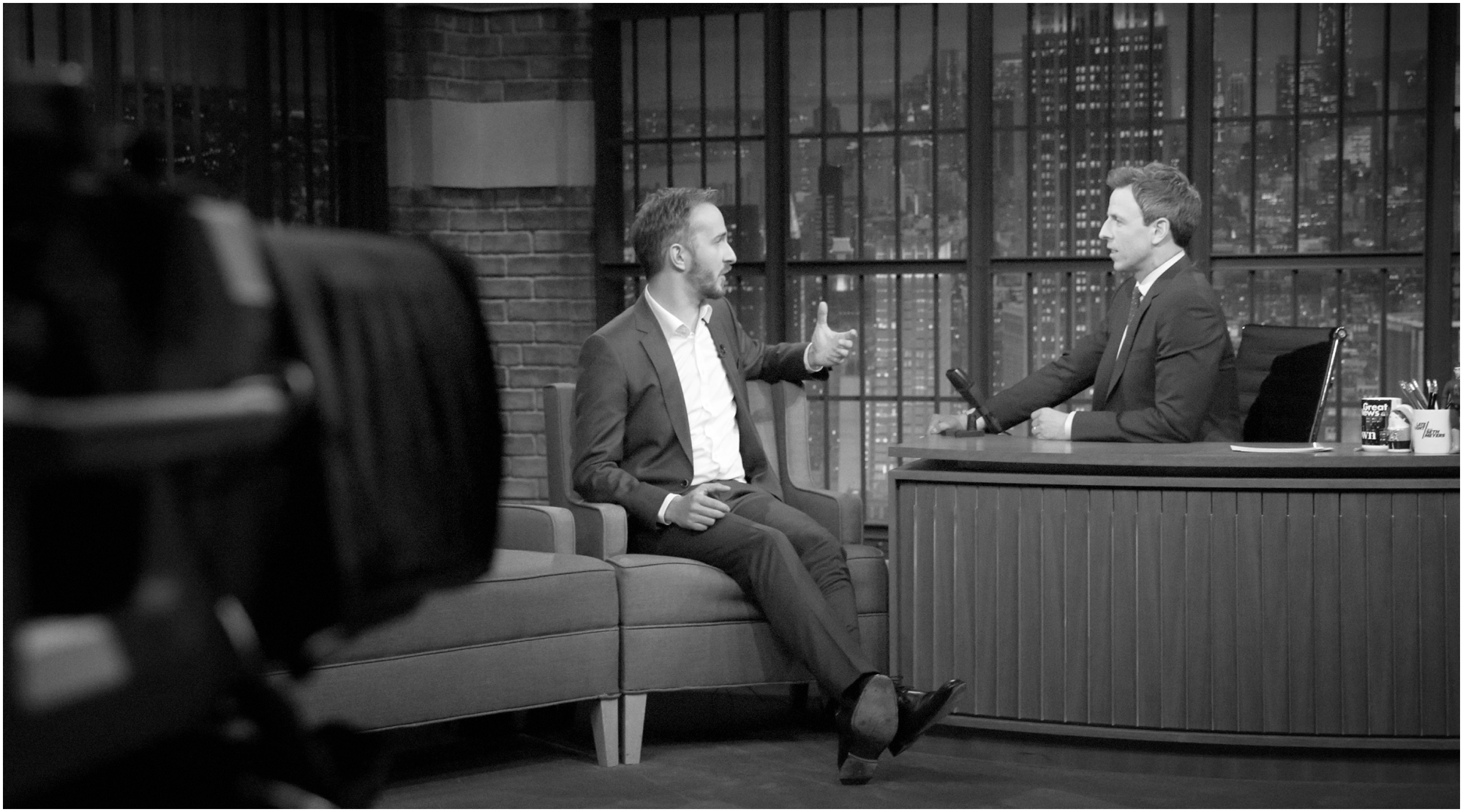
German comedian and talk-show host Jan Böhmermann, who was taken to court for insulting Turkish President Erdogan on his TV show, appears on Late Night with Seth Myers in the USA
CREDIT: Lloyd Bishop/NBC/NBCU Photo Bank
The latest threat to free speech is a draft bill passed by the German cabinet in April that threatens social media companies with multi-million euro fines for failing to block content. The government aims to pass the so-called Netzwerkdurchsetzungsgesetz (Network Enforcement Law, abbreviated to NetzDG) by the end of June.
The bill obliges operators of social networks to establish a reporting system for their users. When “obviously illicit” content is reported, the social network has to delete it within 24 hours. If reported content is “not unambiguously illicit” the operators will be given seven days to delete it.
If the manager in charge repeatedly fails to block content, they can face fines of up to five million euros ($7,750,295), or up to 50 million euros ($55,359,250) for companies. The definition of what constitutes content that should be removed is vague.
The legislation is meant to tackle illegal hate speech, but is wide enough to include harassment and revilement of religious faith and organisations.
Many free speech advocates oppose the bill because it cuts out courts and other independent bodies from the role of determining legal speech. Matthias Spielkamp, board member of the German section of Reporters Without Borders, said: “Facebook and other social networks are not supposed to become guardians of freedom of expression. It is shameful that the German minister of justice of all people proposes this legislation.”
Other critics fear that the draconian penalties will force social media managers to delete content to avoid costs and lengthy trials without any painstaking investigation. The draft bill “will have immense consequences on freedom of speech, especially on completely legal, but unpopular expressions of opinion that will be deleted swiftly,” said Ulf Buermeyer, chairman of the Society for Civil Rights. He fears that “the draft bill will pave the way to ‘overblocking’ in social networks”.
Another part of the picture is a softly softly attitude to comedy. Germany’s ability to censor satire was put in sharp relief when, in February, a civil court in Hamburg upheld a ruling barring German comedian Jan Böehmermann from repeating parts of a poem, which was rude about Turkey’s President Recep Tayyip Erdogan. Boehmermann first caught the media’s attention last year when the Turkish embassy called for him to be prosecuted under a little-known law making it illegal to insult foreign leaders.
This move was seen as a way of the Turkish government exporting some of its attitudes to free speech to another country. However, more encouragingly in January the German government agreed to drop the law that gives special protection to foreign leaders against insults.
Part of the background to this new period of censorship are fears about the global refugee crisis and its political consequences, especially the success of Germany’s anti-immigrant party AfD (Alternative für Deutschland).
Since the start of the global displacement crisis in 2015, racism and xenophobia, as well as anti-Islamic and anti-European populism, have grown dramatically in Germany.
The other threat to Germany comes from Russia. Germany’s domestic intelligence agency president Hans-Georg Maassen recently warned he has concerns about voters being manipulated by fake news and cited the example of a Russian website carrying the wholly false story about the father of Martin Schulz, the Social Democrats’ candidate for chancellor, having run a Nazi concentration camp.
Maassen has also said there could be a negative influence on the election from the “large amounts of data” supposedly seized by Russian hacker group APT28 during an attack on the country’s parliament in 2015.
Fearing further radicalisation on the right, as well as fake news, in September 2015 German minister of justice Heiko Maas set up a task force to combat defamation and deliberate misinformation on social media platforms. Later Maas put more pressure on social networks: “In order to force them to delete illicit content, we need legal obligations.” The legislation he proposes to pass in order to do this is NetzDG bill.
But in a refreshing sign that people are still fighting for free speech, after the cabinet proposed the NetzDG bill, activists and bloggers published a declaration on freedom of expression. It criticised the government’s plans to transfer “predominantly state tasks of enforcement to private companies” and instead called “for a cross-societal approach, which intensifies criminal prosecution and law enforcement while also strengthening counter speech, fostering media literacy, and preserving a regulatory framework that respects freedom of expression in the deletion or blocking of unlawful content”.
In May, at the Re:Publica conference on digital society in Berlin, Markus Beckedahl, co-founder of Re:Publica called upon people to “show civil courage on the internet and to fight for an open society that prioritises basic rights, democracy and state of law”.
Nothing less should be on the agenda of the German government. Whether the NetzDG contributes to this goal is doubtful.
Hoaxes And History
Freedom of speech in Germany is guaranteed under article five of the Grundgesetz (basic law), which forms the basis of the constitution.
Basic law was established in 1949 in the Federal Republic of Germany, four years after the end of World War II. It was part of the groundwork for the formation of a new democratic state and became the constitution for the whole of Germany after reunification in 1990.
According to article five: “Every person shall have the right freely to express and disseminate his opinions in speech, writing and pictures, and to inform himself from generally accessible sources. Freedom of the press and freedom of reporting by means of broadcasts and films shall be guaranteed. There shall be no censorship.” The second paragraph, however, goes on to say that free speech may be limited by provisions in other more general laws, and in order to protect young people.
It was not until more than 20 years after the war that the debate about the Nazi period, and who was responsible for the Holocaust and murder of six million Jews and others, really started in German homes. Then, in 1979, the US mini television series Holocaust, about a family in Nazi Germany, was aired on German TV and brought the past into people’s living rooms.
In total contrast, a whole pseudo-academic body of literature began to appear on the far right including in 1973, Thies Christophersen’s Die Auschwitz-Lüge (The Auschwitz lie); Wilhelm Stäglich’s Auschwitz-Mythos (Auschwitz myth) along with non-German works like Arthur Butz’s The Hoax of the Twentieth Century. These books claimed the Holocaust and gassing of Jews did not happen.
It was against this background that the German government made Holocaust denial a crime as part of legislation on Volksverhetzung (or incitement of hatred). This was challenged in 1994, but was upheld and tightened, and the principle has been subsequently confirmed that “approval, denial, downplaying or justification” of Nazi crimes and the Holocaust, is and remains a criminal offence with a maximum sentence of five years in prison.