




Abstract

In an exclusive interview, legendary South African cartoonist
CREDIT: Davin Andrew for Index on Censorship
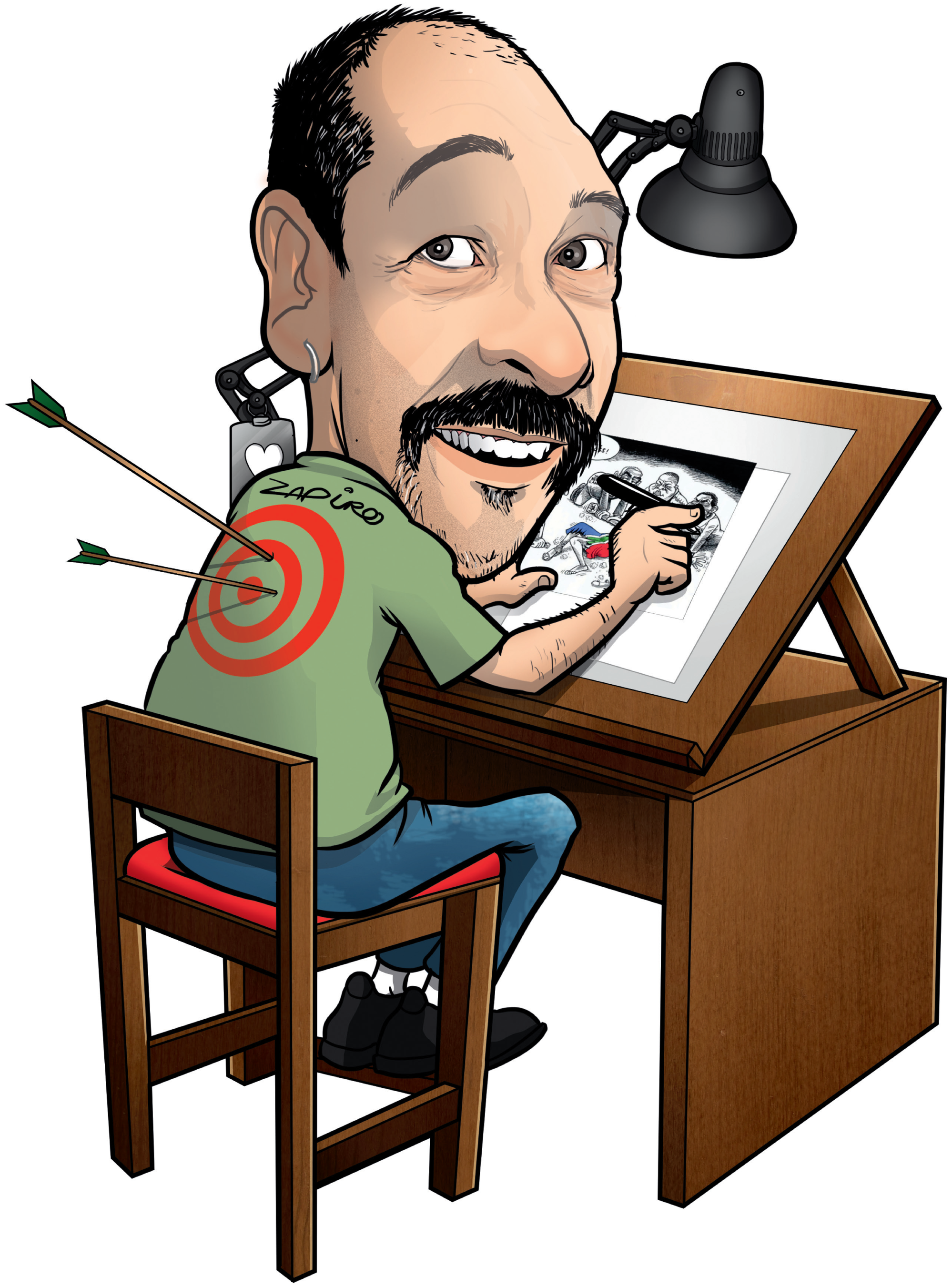
Political correctness was increasingly forcing them to second guess how their work might be interpreted, argued Shapiro, who has held art shows in London, Frankfurt and New York, as well as across South Africa.
In his studio in Oranjezicht, a Cape Town suburb on the slopes of Table Mountain, the cartoonist outlines his fears for the future. Behind him, on bookshelves, are a set of mini collectable figurines of some of his cartoon characters, including Archbishop Desmond Tutu and Nelson Mandela.
“I have the stomach for the fight. But I see the discussions among younger cartoonists and they worry. Some are quite young and haven’t figured out what is going to offend people,” he said.
“People are scared of fanatics. But political correctness also plays a role and they fear even minor things. This has led to increased self-censorship by cartoonists because they are increasingly worried about sensitivities and the fear of causing offence,” said the veteran cartoonist, who has drawn for the Cape Argus, Cape Times and Mail & Guardian.
With a dark history of oppression and censorship under apartheid, there is increasingly narrow space for robust debate in South Africa today. Charges of racism often stifle, or sometimes replace, debate and as a cartoonist, Zapiro is often the target of people offended by his cartoons.
That is in spite of his long history as an activist and his opposition to oppression and racism that goes back to his earliest days as a cartoonist in the early 1980s, when his work first appeared in the alternative press. He worked tirelessly to produce posters and pamphlets for anti-apartheid organisations and campaigns. This led to him being arrested and harassed by the feared special branch, which hunted down opponents of the apartheid government. It is a part of his history that many don’t know about, while others choose to ignore it.
The latest controversy swirling around Zapiro is centred on his revisiting of a 2008 cartoon that showed powerful members of government and the ruling ANC holding down Lady Justice, as President Jacob Zuma prepares to rape her. In the 2017 cartoon, Zapiro drew the president zipping up his flies as Lady Justice, draped in the South African flag, is held down, while a member of a powerful family accused of state capture to get lucrative tenders with Zuma’s help, prepares to have a turn raping her. He said he has no regrets about returning to the rape of South Africa as a theme.
He was sued for seven million rand ($528,163) by Zuma after the first cartoon and the case dragged on for four years until the president dropped it the day before it was due to be heard in court. Zuma had also earlier sued Zapiro for a series of three cartoons dealing with rape charges the president had faced, and which he had been acquitted of, before coming into office. The action against Zapiro dragged on for six years before it was also withdrawn.
On the first rape cartoon that caused a huge outcry, Zapiro said: “It was the most powerful thing I could have done and I don’t regret it at all, or for revisiting it. I did always have more of a concern about how women would see it than anything else. I certainly wasn’t concerned at all about how the targets would see it. The overarching reason for the cartoon was that Zuma, with the help of his allies, was bullying and threatening the judiciary to try and get the corruption charges lifted so he could become ANC president and then president of South Africa. It was as simple as that. He wanted, and got, a political solution dressed up as a legal one.”
Never a stranger to controversy, his publisher ran into a bid to ban his cartoon strip of the Prophet Mohammed for South Africa’s Mail & Guardian in 2010. They didn’t back down, winning a last-minute court decision. Last year, Zapiro said his depiction of the National Prosecuting Authority boss as a monkey dancing to Zuma as an organ grinder was a mistake, and apologised.
“Cartoonists and satirists and columnists who are prepared to be irreverent or to push the boundaries are not the source of the real problem in society,” said Zapiro.
“It is coming from a source people are not prepared to admit to; people who spend their lives waiting to be offended. Some of those people have authority and some are part of fanatical groups or attach themselves to fanatical groups. But to somehow cast the cartoonist or satirist as the provoker of that sort of violence when we are actually provokers of thought is utterly ridiculous.”
Zapiro said he felt that with social media, some people were waiting to be offended and some were living in echo chambers hearing just themselves. This got amplified onto a bigger stage where even things used ironically or used to criticise others were then pounced on, twisted and convoluted, in order to have everyone conform to multiple banal sets of canards. “Different people have different things they are politically correct about. But this becomes a minefield when all of these people assert their beliefs. This is very difficult to deal with and the nuance gets lost in a cartoon.”
Zapiro is aware of how political correctness could affect his work if he doesn’t guard against it. “I try to differentiate between self-censorship and emotional intelligence and I now ask myself where the negative stuff will come out of a cartoon and overpower the positive aspects. In the case of the latest rape cartoon there has been a lot of negative response, but I also believe it will stand the test of time and it was worth doing.”
He has received numerous death threats as a result of his cartoons, some of which he took very seriously. “I have had lots of death threats and I’ve also had calls in the middle of the night with threats, telling me they know where my children go to school.”
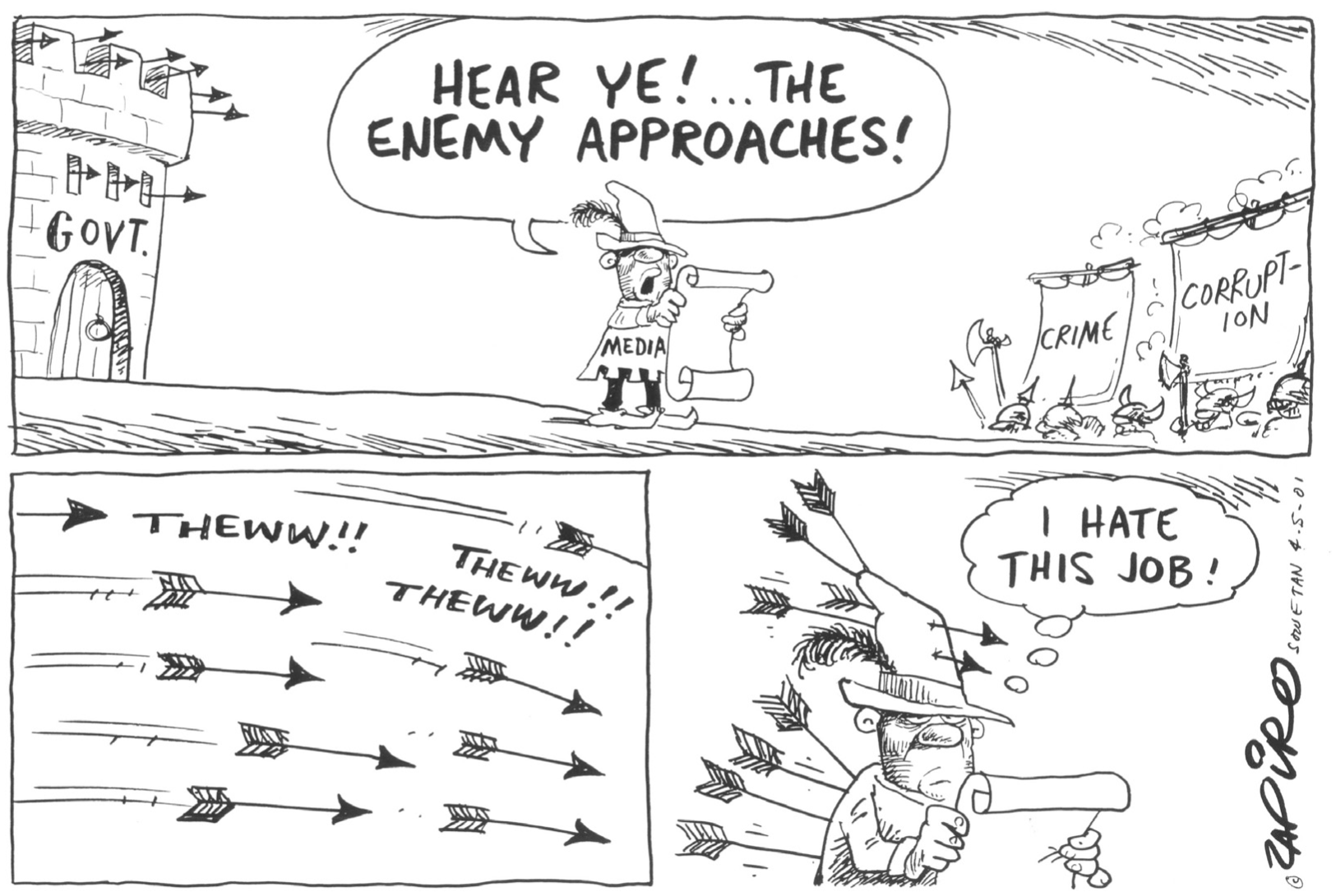
In this cartoon on the state of press freedom, Zapiro depicts the media attempting to expose government corruption
CREDIT: Zapiro
In the latest incident, in April, a court heard that Zapiro was included on a hit list compiled by twin brothers Brandon-Lee and Tony-Lee Thulsie, who are accused of planning acts of terror against US, British, Russian and Jewish targets in South Africa.
“People are losing sight of an idea that has been very important over the past few decades that you have no right not to be offended,” he said. “The violence and the real transgression is coming from people who take their religious and other beliefs so seriously and are so fragile in their beliefs set that they can’t tolerate anyone else not having the same view as them. It also comes from authoritarian regimes,” he said.
Do cartoonists enjoy a privileged position in society, I asked. On the one hand, he said, cartoonists do not have any more rights than any other citizen has. “But on the other hand, by convention in a democracy, cartoonists do get to occupy that jester space where you can sometimes say things using hyperbole and hypothetical stuff, which can be so extreme as to seem as if you have more rights than other people.
“In other words freedom of expression allows one to be so startling and outrageous and potentially startling that it gives you that rarified position of being untouchable. Speech that should be acted against is that which incites hurt or killing, but that is not what cartoonists are doing. We provoke thought, even if that thought is pretty outrageous. Others can do it too. We just occupy a space where you can really push the boundaries.”
