




Abstract

Staged press conferences, tapped phone calls and restrictions on mixing with locals were some of the difficulties of reporting from Russia for a US newspaper during the Cold War, writes
When we arrived at his apartment door, a well-dressed gentleman greeted us. I first assumed Amalrik lived in a collective apartment, which was not uncommon in Moscow in those days. But Amalrik ran up and whispered “obisk, obisk”. At first I did not know the words, but then I remembered reading them in dissident literature. They mean “search, search”.
His apartment was being taken apart by a group of police agents. After being questioned as to why I was there, we left and were trailed home by agents. Amalrik was later convicted for defaming the Soviet Union and sent to a prison. He was released in 1975 and allowed to emigrate to western Europe.
I was never sure if the police or KGB were in his apartment that night because they knew I was coming or whether it was purely by coincidence. Nevertheless, after this incident I never let my guard down again. In my time in Moscow, we correspondents and diplomats all assumed that our apartments were bugged by the KGB. My wife and I developed a technique of never mentioning a Russian’s name out loud. We had a full-time maid who was named Shura, and we jokingly used to refer to her as “Colonel Shura”, because we assumed she was being questioned on a regular basis.
During my time there from 1969 to 1971 – one of 25 US journalists – I also had to endure tight restrictions that the Soviet authorities placed on me, my wife and other correspondents. We lived in an apartment compound at 12-24 Sadovo-Samotachnaya inhabited only by Western correspondents and diplomats. There was a 24-hour police guard at the entrance to keep out any Russians, other than those who had specific reasons to be there. In other words, we were told from the moment we arrived that the authorities did not want us to mingle with Russians. The building then and now is affectionately called “Sad Sam” by its dwellers.
While it was easier to report compared to the early years of the Soviet Union, when all copy from foreign correspondents had to first be scrutinised by a censor, there were still many obstacles. There were few press conferences and certainly no televised ones. I only attended one high-ranking press conference during my time. Prime Minister Alexei Kosygin held it on 4 May 1970 to attack President Richard Nixon for sending US troops into Cambodia. Instead, what was de rigueur was to cover a speech by Communist Party leader Leonid Brezhnev to other communists at a party conference. The speech might go on for four hours and produce little news.
There was one other press conference of note, though again it was not really about news. In March 1971, when the Soviet Union had launched a campaign to herald its close relations with Egypt and to establish a major presence in the Middle East, we foreign correspondents were invited to the ornate House of Friendship. Under glaring lights, 40 Soviet Jews – including Deputy Minister Veniamin Dymshits, the highest-ranking Jew in the government – were sitting on a raised platform in front of us. One by one, with varying degrees of enthusiasm, they pledged heir loyalty to the Soviet Union and asserted their hatred for Israel, Zionism and the USA.
To garner information, a correspondent and his staff had to read the Soviet press closely and the multitude of journals published there. We learned that Pravda, the official newspaper of the Communist Party, liked to publish major policy articles late at night so that they would appear before Russian news agency Tass’s ticker. The suspicion was that allowed the party enough time to change the official line if need be.
I also developed a fondness for weekly newspaper Literaturnaya Gazeta, which published sociological pieces about Russian life.
Otherwise we relied on dissidents’ samizdat – self-published reports. These were usually typed, carbon copied and handed to foreign reporters. I met several times with Zhores Medvedev, a Soviet biologist who had been sent for some time to a mental hospital because his views contradicted official ideology. On one occasion he handed over rolls of 35 mm film. They contained information about secret meetings of the Communist Party. Several articles came out of the information in that film.
I asked a current correspondent in Moscow if things had changed much since my time there. He wished to remain anonymous and explained how there has been a significant drop-off in the number of Western correspondents in Moscow. He said this started when Dimitry Medvedev became president in 2008. Medvedev is now prime minister and accused by the current wave of Russian protestors of being corrupt.
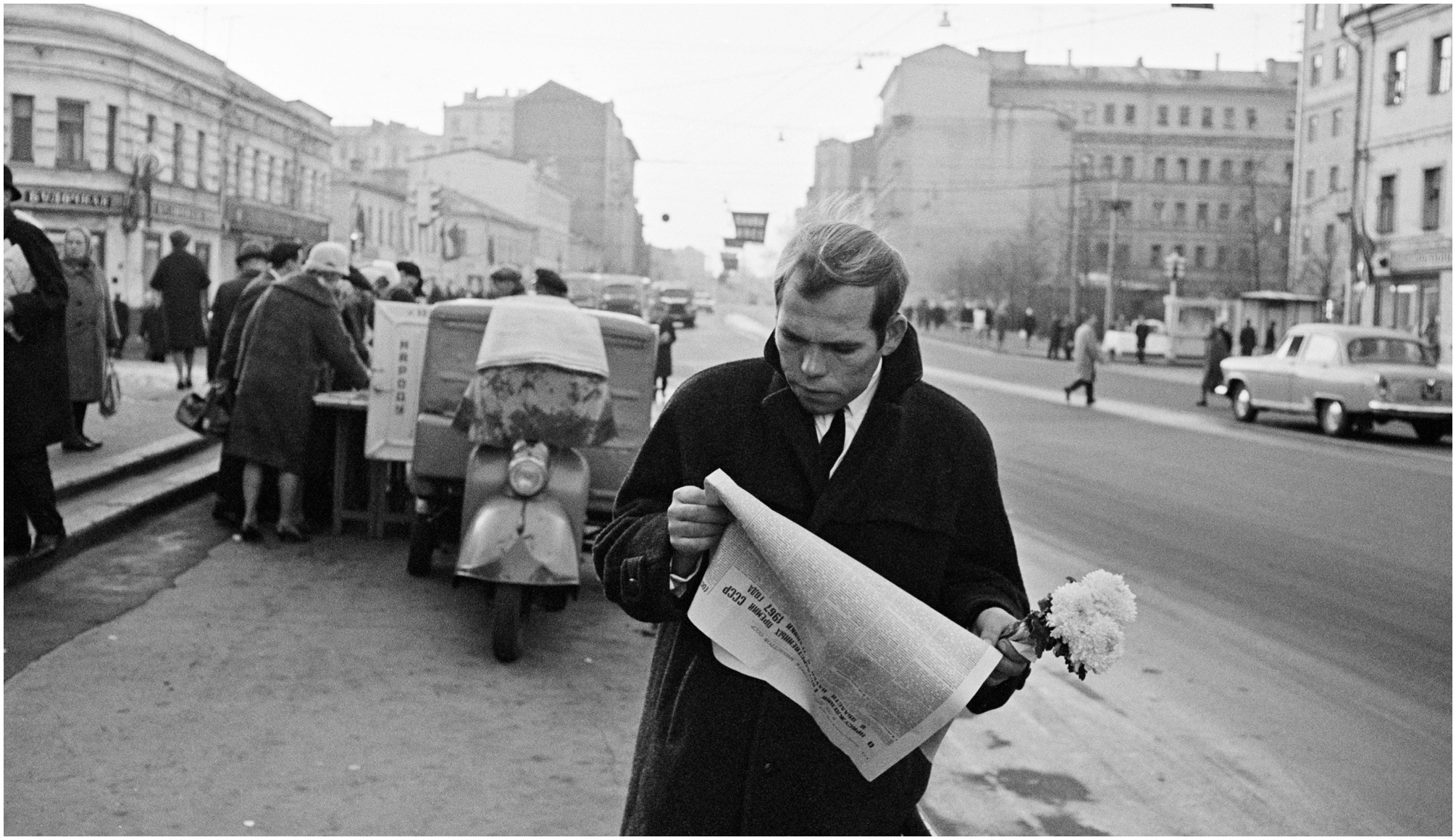
A man reads a newspaper in Moscow’s Chekov Street, 1967
CREDIT: Bruno Barbey/Magnum Photos
Whereas the Sad Sam compound once housed dozens of Western correspondents, now there are just six or so. Papers no longer represented include The Baltimore Sun and The Los Angeles Times. The correspondent noted that “access to the government has gotten steadily worse along with the decay in political relations” between Russia and the USA. Correspondents can speak to the spokesman for the foreign ministry, “but any request to interview someone inside the ministry itself or in the Kremlin is usually ignored or refused”. He said: “To find out what is going on you need to always be circulating around the edges, not just at conferences, but talking to newspaper editors, political consultants and others who do have contact with the Kremlin types. It is a series of rings and there are not a lot of people in that innermost ring around Putin, so real information from deep inside is hard.”
The saving grace is that social media is very active, with all manner of debates unfolding on Facebook and VKontakte, the Russian equivalent. The internet and social media would have been a godsend when I was a correspondent in Moscow.