




Abstract

Angola’s long-ruling president has crafted a personality cult straight out of Stalin’s playbook to promote his own style of propaganda and distract the nation from the news, writes
People walk in front of a portrait of Dos Santos in Luanda, Angola. The poster reads “The Architect of Peace”
CREDIT:Estelle Maussion/AFP/Getty Images
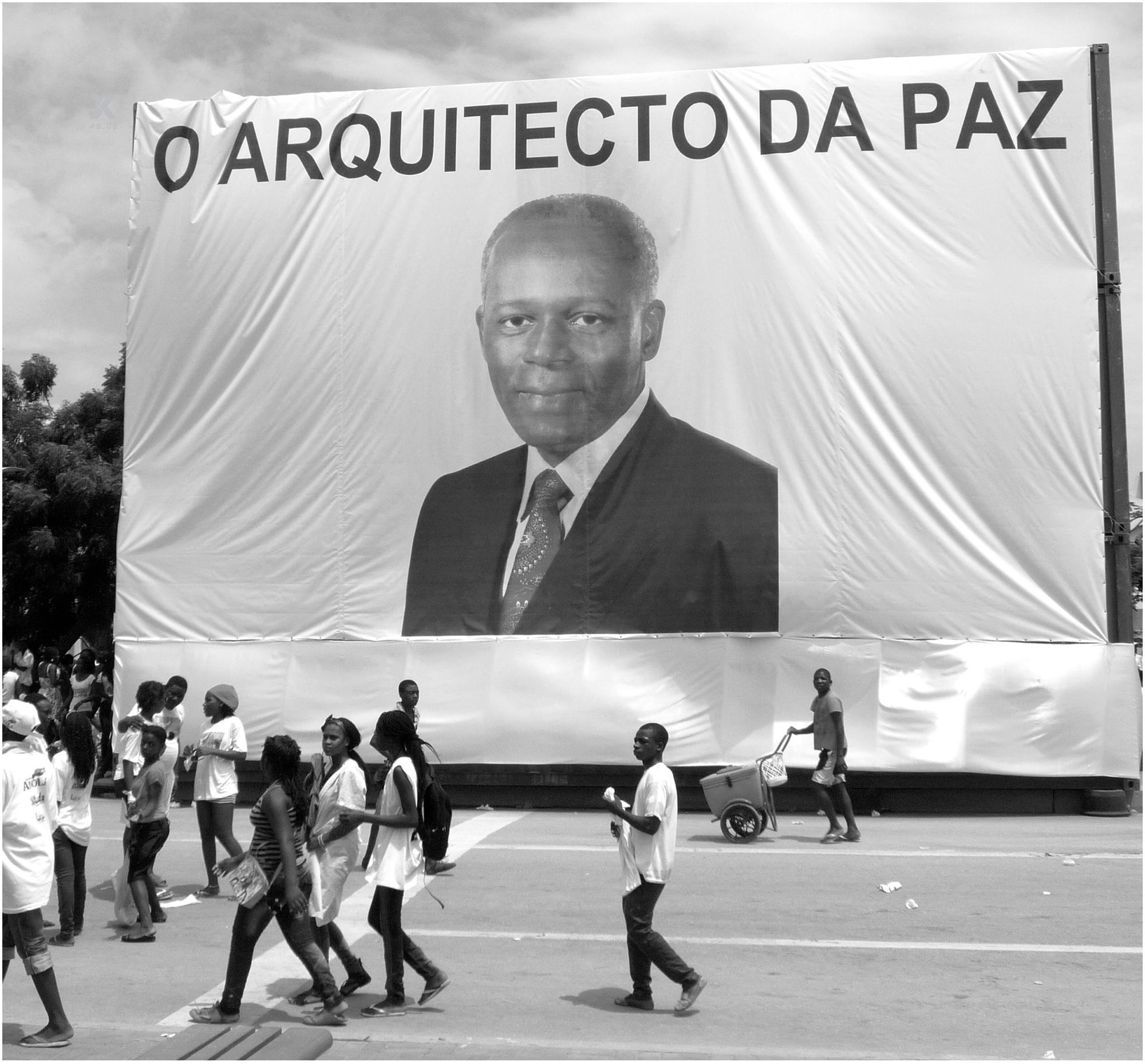
Dos Santos’ personality cult and the propaganda underpinning it have been long-term features of the regime’s coercive relationship with society. They are what remains of its communist past. Inimical to freedom of expression, they are consistently deployed to subvert democratisation and constitutional rights.
The propaganda targets all age groups and spheres. In 2006, as a preventive measure to counter negative information that Angolan youth might see online, The People’s Movement for the Liberation of Angola’s (MPLA) Office for Citizenry and Civil Society disseminated a brochure to teach moral values to Angolan children. It was entitled Educated Child, Happy Family. It taught children that they must always respect Dos Santos “as the president of all Angolans, and the symbol of national unity”.
The chilling manipulation of children’s education is only one example of the extremes that the Soviet-educated Dos Santos’ personality cult has reached. Recently, a member of the MPLA, António Luvualu de Carvalho, shocked Angolans with his claim that “the oxygen we breathe is also the gain of peace”. Luvualu de Carvalho made the statement on the state-owned Angolan Public Television to dispel criticisms against Dos Santos. The idea that the very air Angolans breathe is a gift of the president is reminiscent of the infamous Avidenko’s praise of Josef Stalin. It went:
“O great Stalin, O leader of the peoples, Thou who broughtest man to birth. Thou who fructifies the earth, Thou who restorest to centuries, Thou who makest bloom the spring … “
That De Carvalho made such a statement was perhaps expected. He is an integral part of the MPLA’s propaganda machine, representative of the significant investments made in promoting the regime’s image. In 2015, he was appointed to the post of roving ambassador which, in effect, positioned him as the “propaganda tsar” who would deflect criticisms of the Angolan regime made abroad.
The manipulation of information is further evidenced in the current official narrative of Angola’s tragic civil war, which entrenches Dos Santos’ personality cult. Described as the “architect of peace”, the president is credited with ending the war in 2002. The narrative thus ignores his central role in the perpetuation of the conflict, which raged in Angola from the time the MPLA seized power in 1975 following independence. Dos Santos came to power in 1979, after the death of the first president Agostinho Neto.
With Dos Santos having been put forward as the symbol of peace and stability, anyone who dares to criticise him is branded as either ungrateful or an enemy of peace and stability. These accusations are commonly used to discredit critical voices.
The development of Dos Santos’ personality cult has met with some resistance. Although the MPLA had been labelled “Afro-Stalinist” in some Western academic literature, Stalin himself was the subject of internal condemnation by most MPLA members during its socialist period. But as noted by General Manuel de Carvalho “Pakas”, a former political commissar and member of the central committee of the MPLA, the promotion of a personality cult was done out of political expediency. “The need to end with factionalism within the MPLA, and coalesce around a leader, led to the copying of some of Stalin’s practices in building the cult of personality to craft a symbol of unity,” he told Index.
With the achievement of peace in 2002, after 27 years of civil war, the former ruling communists openly became capitalists but had to concede some liberties for the people. Back then the regime allowed more freedom of assembly, to discuss critical issues for instance. Nowadays, it is hard to get a room to hold a meeting on subjects they do not like, and anyone who dares to protest gets beaten up. The president’s personality cult, however, remains in place, underpinned by a state media that remains monolithic and populated by Avidenko-type sycophants.
The media landscape is mostly dominated by state-owned media. Angola only has one daily newspaper, the state-owned Jornal de Angola, also known as “the Pravda” for its rabid defence of the regime. The private media sector is dominated by outlets owned by ministers, generals and other high-ranking MPLA officials, thus making the internet the only forum for freedom of expression in the country.
The majority of Angolans, however, have no access to the internet and, arguably, beyond the capital most rely on the broadcasting media to stay informed. Isolated critics are picked off, co-opted, persecuted or disposed of as the need arises.
State media promotes ignorance in the country. The maintenance of ignorance is a powerful means through which the regime supresses potential critics. It ensures the security of those in power, who have abandoned what the academic Crawford Young identified as the essential commitments of the nationalisms that underpinned liberation in Africa: the tackling of poverty, ignorance and disease.
Nowhere is abandonment of the promises of independence more obvious than in some of the president’s own public statements. Just four years ago, during Angola’s economic oil boom, Dos Santos defended the plundering of states in Africa, especially in Angola, by their ruling elites as a right. He claimed that “the primitive accumulation of capital in western countries took place hundreds of years ago and at that state the rules of the game were different. The primitive accumulation of capital that is taking place today in Africa needs to be adequate to our reality”.
Nevertheless, in the age of the internet, Dos Santos is losing control over the flow of information. His personality cult may yet find itself on shaky ground. De Carvalho’s comments inspired a torrent of memes against him and about the air Angolans breathe. Humour has become a powerful tool of subversion, easily disseminated through everyday interactions.
With Dos Santos set to retire in September, the state media is frenetically building a personality cult around his anointed successor, the Soviet-educated João Lourenço. It is all about the derogation of “the others”– those not affiliated with the MPLA – as unpatriotic and unfit to run the country. The official line is that Lourenço, following on from the “architect of peace”, is the “peace driver”, further evidence of the ongoing use of propaganda in Angola’s political landscape.