




Abstract
Throughout the 20th century, Turkey’s border with Russia made it an ideal military base for the anti-Soviet bloc. But now NATO’s second largest military power is becoming one of Russia’s greatest allies,
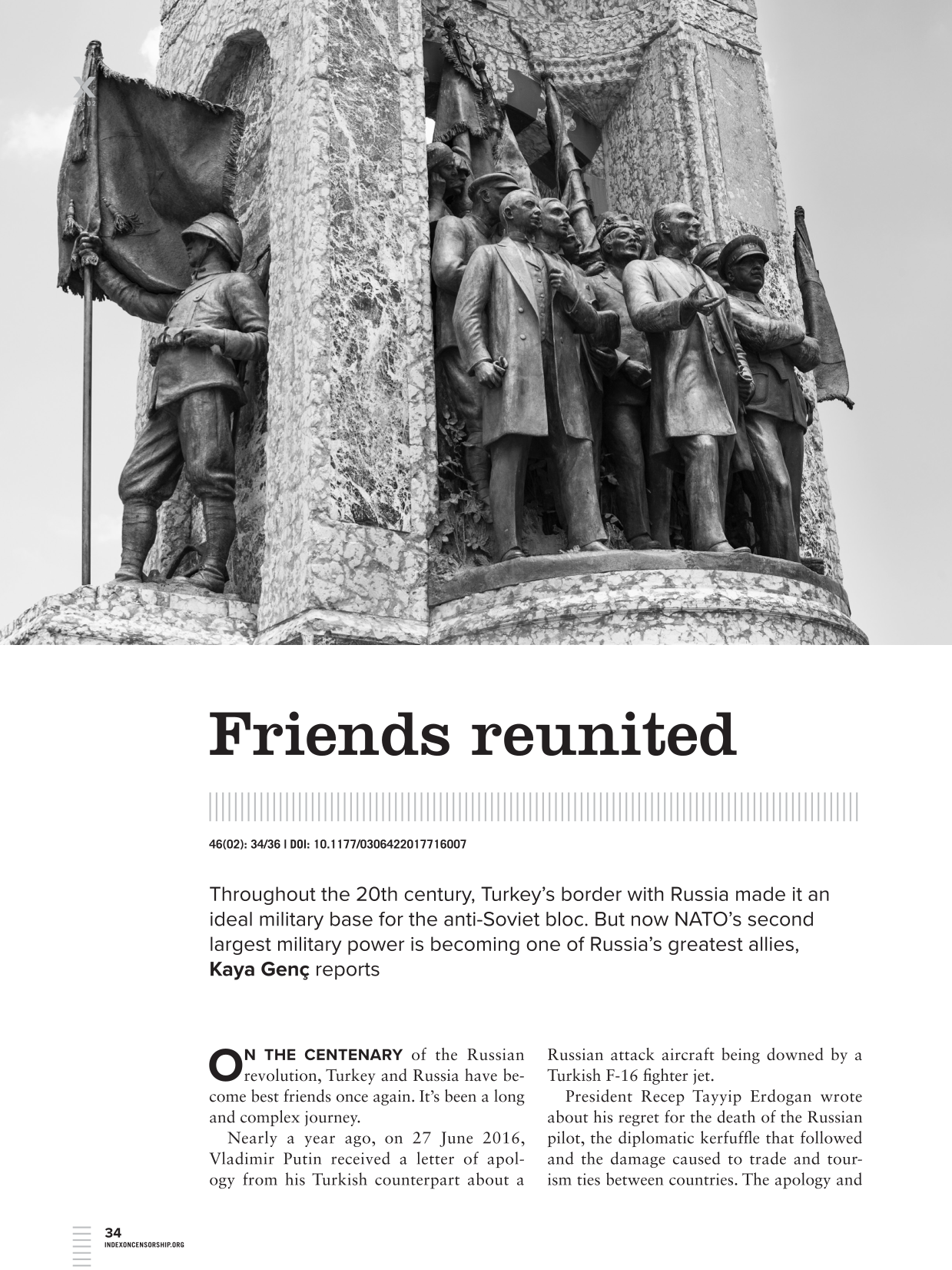
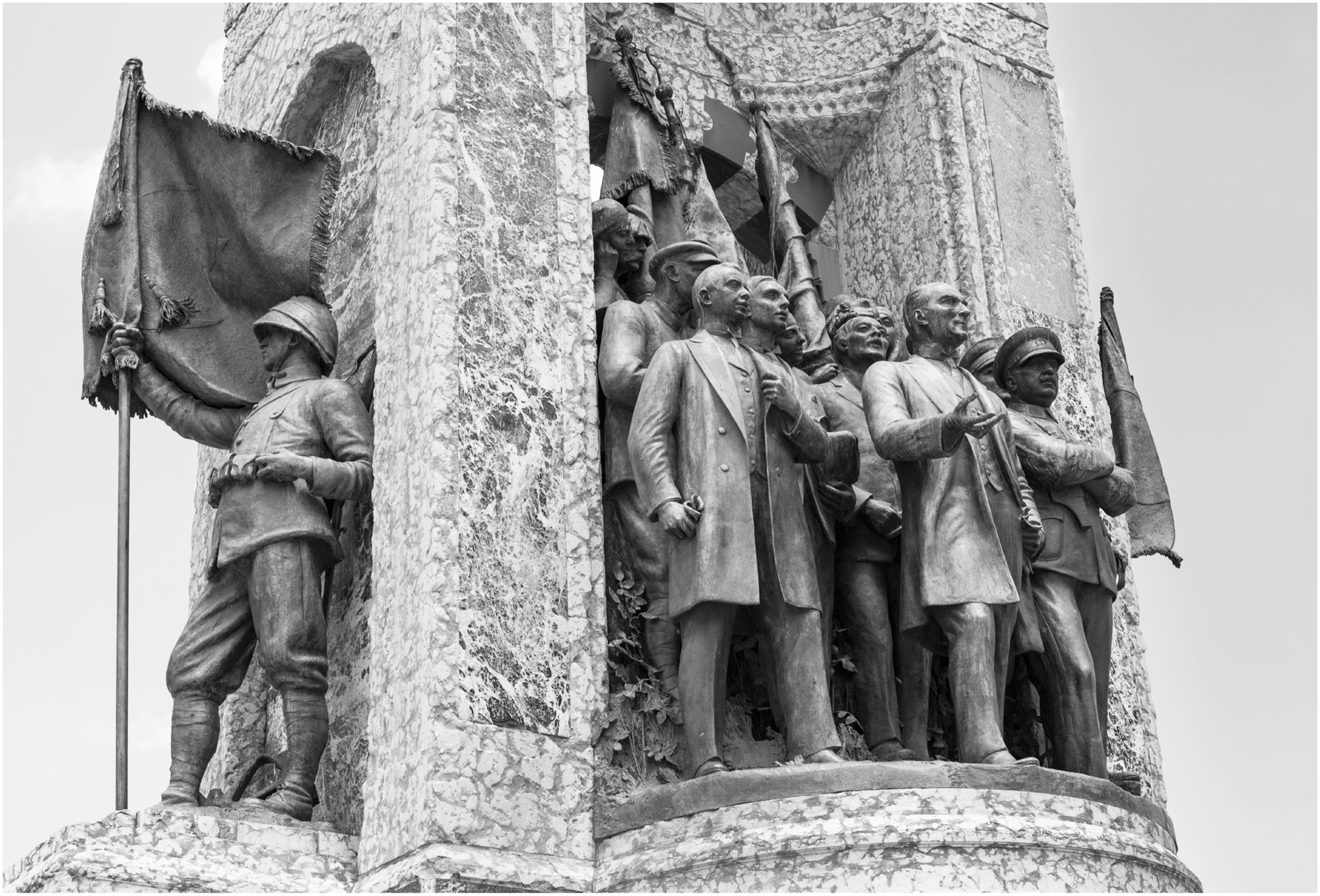
The Republic Monument in Istanbul’s Taksim Square, which includes Bolshevik leaders Mikhail Frunze and Kliment Voroshilok in the crowd behind Mustafa Kemal Ataturk
CREDIT: Mel Longhurst/akg-images
Nearly a year ago, on 27 June 2016, Vladimir Putin received a letter of apology from his Turkish counterpart about a Russian attack aircraft being downed by a Turkish F-16 fighter jet.
President Recep Tayyip Erdogan wrote about his regret for the death of the Russian pilot, the diplomatic kerfuffle that followed and the damage caused to trade and tourism ties between countries. The apology and material compensation offered in the letter were coupled with a wish for closer ties in the future.
At the moment of their creation, these two countries were close allies. Istanbul’s Taksim Square, a few metres away from Gezi Park, the site of 2013’s environmentalist protests, is dominated by the Republic Monument. This huge sculpture features the figures of Kliment Voroshilov, a Soviet marshal, and Mikhail Frunze, one of the leaders of the October Revolution, standing behind Mustafa Kemal Atatürk, the founder of modern Turkey. In the 1910s, Atatürk had been an ardent supporter of the Russian Revolution. As an Ottoman career soldier, he had seen the Russian uprising as part of the struggle of the eastern world against the oppressive West.
The Turkish republic’s youthful love for the Soviets, which explains current day Turkish communists’ admiration for Atatürk, proved to be a brief affair. Under the reign of his successor, İsmet İnönü, the Turkish regime shifted its alliances towards Nazi Germany. Then the single party regime of the Republican People’s Party imprisoned communist sympathisers, and came very close to entering World War II on the German side. In fact, paranoia about the influence of Soviet culture was the original cause of Turkish state oppression.
Throughout the late 1930s and early 1940s, the first generation of Turkish dissidents, including novelists and poets, rebelled against the class system inherent to the Kemalist regime, taking their inspiration from Soviet revolutionaries. Under the single party rule of the Republican People’s Party, Soviet sympathisers were ruthlessly prosecuted. In 1938, two years after Atatürk’s death, three of Turkey’s four greatest authors were behind bars for their pro-Soviet views: Orhan Kemal, Kemal Tahir and Nazım Hikmet. A fourth writer, Sabahattin Ali, was prosecuted for his communist sympathies. Ali, whose novel Madonna in a Fur Coat was published as a Penguin Classic last year, was murdered by a state agent on Turkey’s border with Bulgaria while attempting to escape to the USSR.
During the 1950s, with Turkey’s entry into NATO and the election of Prime Minister Adnan Menderes in the country’s first free elections, Turkey again became an enemy of its neighbour, this time on non-fascist, pro-Western grounds. But it was during the much more recent premiership of Ahmet Davutoğlu, the architect of Turkey’s interventionist foreign policy in Syria, that Turkey had its worst moments with Russia. “I have personally given the order to down the Russian plane,” Davutoğlu boasted after the incident in 2015.
“Turkish sympathy and antipathy towards Russia have always been equally powerful,” Sabri Gürses, Turkey’s leading Russian to Turkish literary translator, told Index.
“The situation in Russia is probably the same. This is like being in a family, maybe being in the family Karamazov. Some members are more favoured at times and there is always tension in the house. What we lived through with the downing of the jet last year was that the antipathy found a leak in the system and tried to define the relationship.”
Gürses, who translated books by Andrei Bely, Mikhail Bulgakov, Vladimir Nabokov and Svetlana Alexievich into Turkish, belongs to the latest generation of Turkey’s Russian translators whose work has proved crucial in bringing together the two cultures in the past century. Most of Turkey’s great Russian translators had been career soldiers trained at NATO missions, their Russian skills intended to serve anti-Soviet objectives.
These translators’ mastery of Russian culture unexpectedly produced among them a love for their purported enemy. Such figures became socialists and were eventually purged from the army, particularly in the wake of a failed coup attempt in 1971. Ergin Altay and Mehmet Özgül, both former career soldiers who studied at Kuleli Military Academy, which was closed down after the failed coup attempt in 2016, had translated Russian classics by Leo Tolstoy and Fyodor Dostoyevsky into Turkish.
The antipathy between the two nations have their roots in history. Ottomans were a threat and balancing power for Russia throughout the 19th century; Russians supported the independence of Balkans and then invaded Anatolia, erecting a statue on the coast of the Bosphorus, which was later destroyed.
“This strained history left traces in the national and individual memory of Turks, and didn’t leave the Turkish mind during the 20th century when Soviet threat was real,” Gürses, the translator, said. “So I believe it’s miraculous that classical Russian literature is highly valued in Turkey. We have Russian classics at schools in the curriculum. Every student knows her Dostoyevsky, Pushkin, Tolstoy and even Gorky, but this is not the case in Russia. They have just learned about Orhan Pamuk. Nazım Hikmet and Reşat Ekrem affected them, but they are not so popular nowadays. And this was the most unfortunate thing; we didn’t have much to balance the Russian antipathy against Turkey after the downing of the jet. Even Orhan Pamuk did not have much to say after the event. For ordinary Russians, Turkey is a place to live, to go on holiday, [in places like] Istanbul, Antalya, Bodrum. This is not enough.”
After the downing of the jet, Russian cultural centres connected to Turkish culture were closed and Turkish students living in Russia had their visas cancelled. “I thought: What would happen if this family fell apart?” Gürses said. “Would I see in my lifetime Dostoyevsky’s St. Petersburg or Tolstoy’s Yasnaya again? Hopefully I would. It’s difficult to describe how happy I would be to sit under the Pushkin statue in Moscow again.”
Many Turkish authors, who have long held a passion for Russian literature, felt similar anxieties. “Gogol, Chekhov, Pushkin, Dostoyevsky, Tolstoy, Turgenev and later on Mayakovsky, Anna Akhmatova all played an important role in my literary and intellectual journey ever since I was a high school student in Turkey,” the Turkish novelist Elif Şafak told Index. “Their concerns felt very familiar, their conflicts and quandaries pertinent to a place, and a region, yet also surprisingly universal.”
With the newly established closer relationship with Russia, Turkey has gone some way to undoing the damage to its economy, and renewed its tourism ties.
But in today’s Turkey, writers like Şafak are suffering the kind of political oppression their Russophile literary ancestors experienced in 1940s Turkey. Novelists and poets have joined the ranks of those being prosecuted, accused of trying to undermine the state.
“Both Turkey and Russia come from traditions of empire, and to a certain extent continue to have ‘imperial dreams’ and a romanticised, nationalistic notion of the past,” Şafak said. “In both places writers lack the luxury of being apolitical. In both places, the individual freedoms are squandered under a strong, pervasive, aggressive state ideology… The biggest challenge for writers, past and present, Turkish and Russian, is to carve out a niche of freedom within top-down, pseudo-democratic regimes.”