




Abstract

Influential Soviet director Sergei Eisenstein is often portrayed as the godfather of propaganda in film.
It was George Orwell, not a dictator (though they doubtless would smilingly have agreed with him) who wrote that, “he who controls the past controls the future. He who controls the present controls the past.” It is pretty obvious that the way the powerful medium of film depicts the “then” has important implications for what people can be brought to believe about the “now”.
I was brought up partly on films made in the Soviet Union and saw some of the most celebrated early movies when I was young. The director Sergei Eisenstein was the most famous name and before I was 12 I’d seen almost all his films, from the silent Strike made in 1924 to the extraordinarily ambivalent and terrifying two-part classic Ivan the Terrible. Every single one of them can be said to have had some kind of agenda that dovetailed – sometimes perfectly, sometimes awkwardly – with that of the Soviet state.
The two that were most obviously about Bolshevism and Russia were The Battleship Potemkin, dealing with events in the city of Odessa in 1905, and October, an account of the “ten days that shook the world” – the Bolshevik seizure of power – in Petrograd (St Petersburg) in 1917.
Both deploy Eisenstein’s famous techniques of intercutting, juxtaposition and montage to create mood and drama. Sometimes cutaways of objects or expressions are inserted to refer obliquely to what the viewer is supposed to think of the person or the moment being depicted.
A poster for Sergei Eisenstein’s 1925 film Battleship Potemkin
CREDIT: Universal History Archive\UIG/REX/Shutterstock
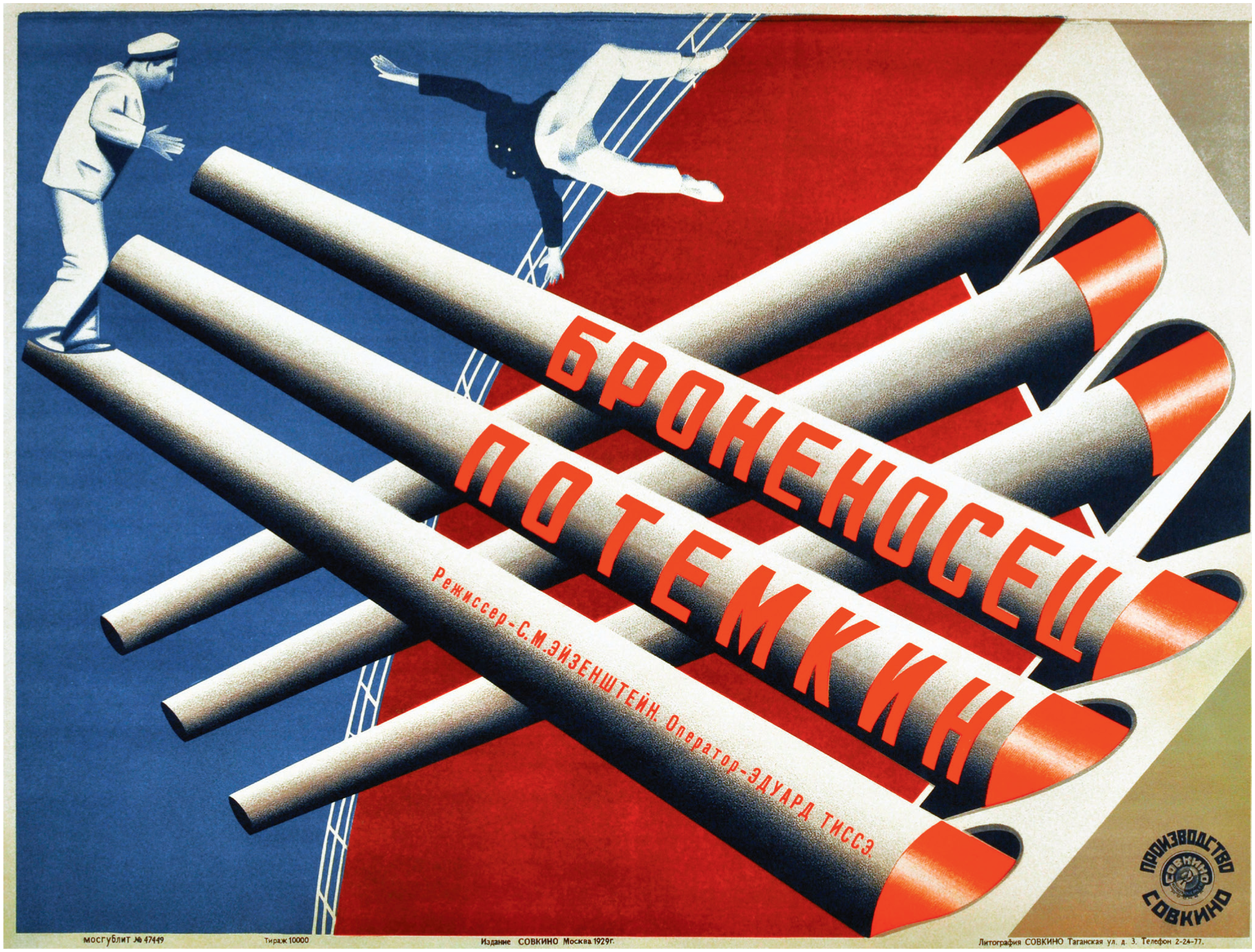
And in both films the actual history is bent for the purposes of the filmmaker. The massacre on the Odessa steps (once seen, never forgotten) from the movie Potemkin didn’t actually happen. The film version of the storming of the Winter Palace in October involved many more actors than the actual event itself. And October was criticised in Keatsian terms by no less a luminary than Lenin’s widow, Nadezhda Konstantinovna Krupskaya. “Crude tricks will not do,” she said. “The dead horse suspended over the water, hanging from the shafts of the opening bridge; the murdered woman’s hair spreading out, covering the bridge’s slats. It’s too much like an advertisement, it’s theatrical.” It is, if you like, “palpable design”.
But was it “propaganda” in the sense that Eisenstein’s intention was primarily to make us believe something about the past? I’d say probably not. Any more than Mel Gibson messed around with the story of William Wallace for Braveheart for reasons other than to make a more dramatic movie.
Here let me introduce a film released last year in Russia called Panfilov’s 28. This is a hero war movie about a legendary incident in World War II when 28 Red Army guardsmen held up an attack by Nazi tanks on Moscow, destroyed dozens and died to a man. This was reported by Soviet newspapers at the time, but years later an opening of the archive showed that the story had been substantially manufactured for propaganda purposes. This problem did not deter the makers. “It’s a movie, not a documentary,” said the film’s director when taxed with its inauthenticity.
As my writer friend (who is an American) also reminded me, a film director of a wartime epic or even a biopic, when it comes to sticking closely to real life, “gives a flying fuck in a rolling doughnut”. If the narrative arc of a William Wallace picture requires an act of the coldest violence from its anti-hero, then out of the 10th floor castle window goes his son’s gay lover.
No, Braveheart is not Scottish nationalist propaganda, any more than Saving Private Ryan is American propaganda. Until, of course, it is shown at, say, a public meeting of Cumbernauld Young Nationalists. Then its intention is altered.
The capacity for context to matter can be illustrated by a speech made at the opening of Panfilov’s 28 by the Russian minister of culture, Vladimir Mendinsky. His target was those who dared to criticise the movie’s lack of historical accuracy. “It’s our air,” he told them, “our history, our culture. If you don’t like it, don’t breathe. Don’t defile our air with your stench.” The elision of accurate history and culture and the metaphysical airthat-we-breathe is a totalitarian formulation. And whatever the director originally thought he was doing, Mendinsky has turned it into something very different.
The Mendinsky approach to the representation of history is now all too familiar in eastern Europe. Since the Law and Justice Party came to power in Poland in 2015, for example, it has set about a form of historical “cleansing” of Poland’s past, affecting the arts and museums.
We should allow a counter argument: is it possible that the messages, unconsciously or not, so deliberately conveyed about history, are just as propagandistic as those that are more obvious and intentioned. More, maybe, since not being “palpably designed” they are not as likely to be “hated”?
My dad thought so in his Stalinist period as the Communist Party’s cultural secretary in the early 1950s. He saw “saccharine” songs and musicals of post-war Hollywood as conveying a consistent message designed to sell capitalism as the fulfilment of all human wishes. Funnily enough, 60 years on, my American writer friend kind of agrees. Once again there was no outright intention, but the effect was an idea of plenitude and harmony that bent reality out of shape.
And then there’s omission. Sometimes in modern Britain you’d hardly believe that, until fairly recently, we had an empire. We believed we were entitled to rule other people and that they should submit to our rule. But when did you last see a successful British movie dealing with the consequences of imperial rule? Is absence also possibly a form of propaganda?