




Abstract
As a new Polish history museum opens in Gdansk, a jigsaw of censorship and counter stories are rewriting the country’s story of itself. Historian
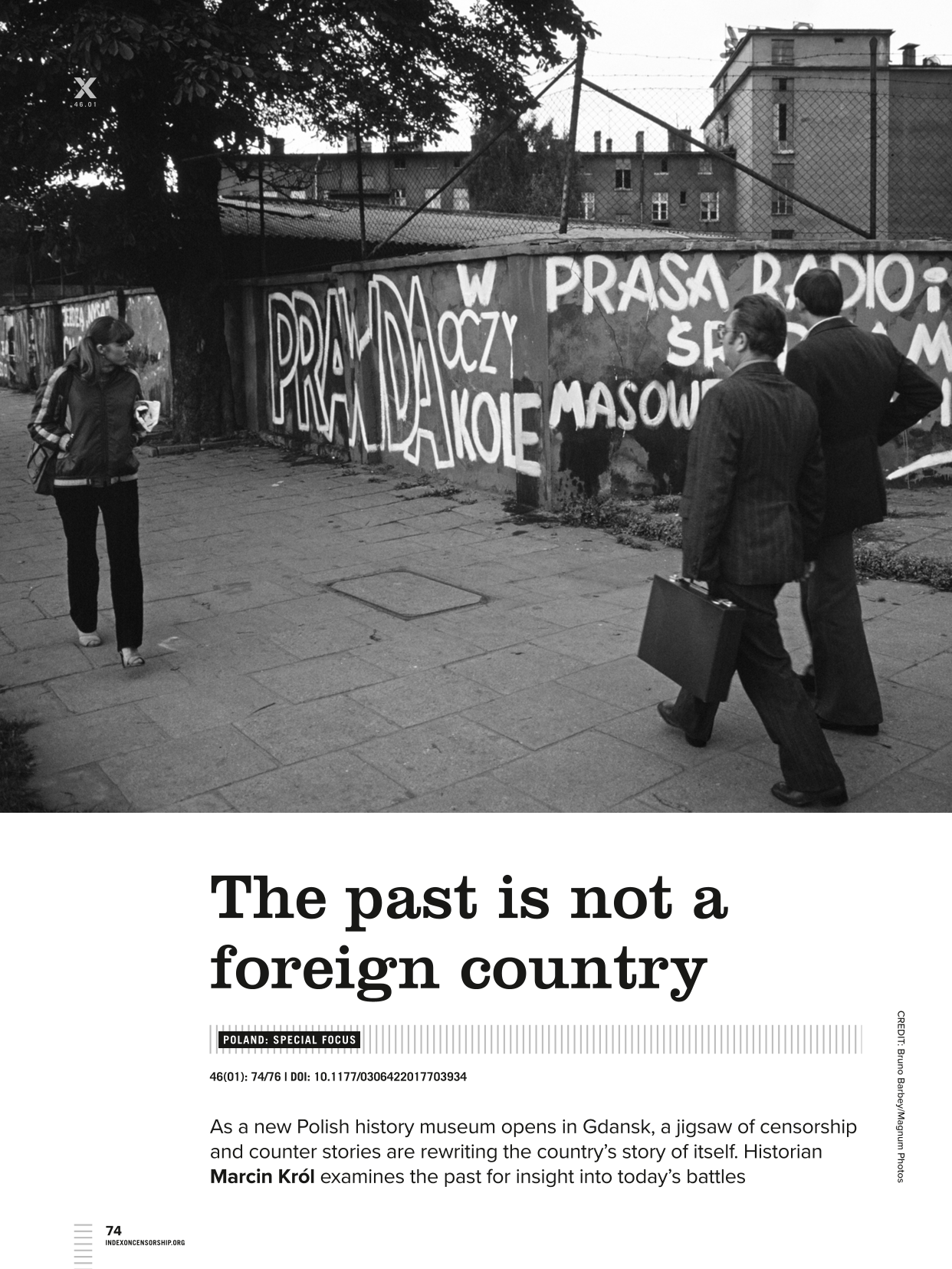
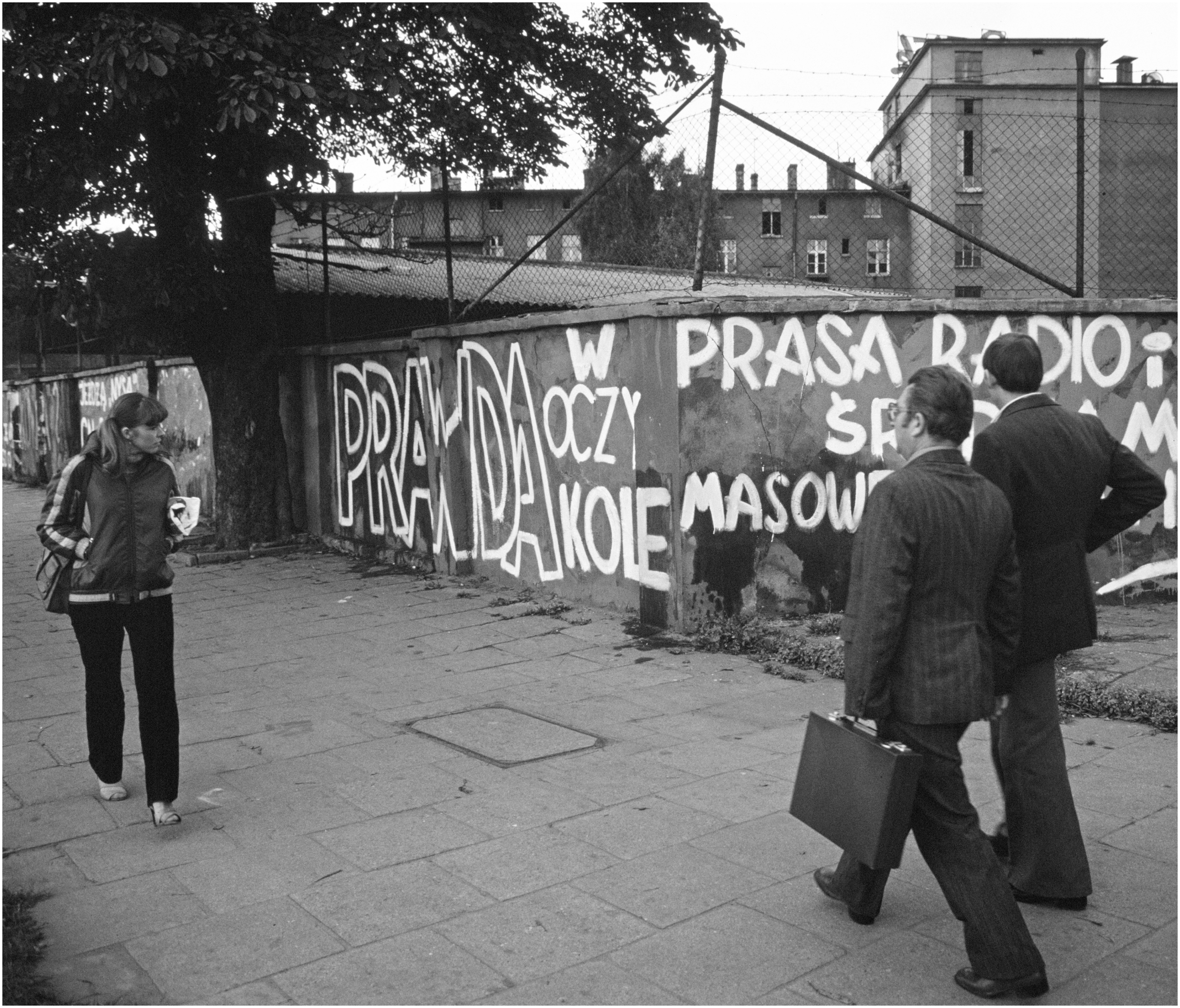
Graffiti demanding freedom of expression for Polish press, radio and TV in 1981
CREDIT: Bruno Barbey/Magnum Photos
After the fall of the Soviet bloc, Poland shot up the ratings in the indexes for freedom of expression and enjoyed a period of international acclaim. But when the Law and Justice party (PiS) won the elections in 2015, censorship returned almost immediately as the new government took aim at neutral institutions and news outlets.
After 1945, a small handful of people formed an underground resistance movement against Soviet occupation. Now the government is trying to overstate their role to create an impression that many Poles resisted the Communists. Through this and many similar examples a new historic narrative is being created. Real facts are being replaced by a patriotic fairy tale.
The danger now is that many people are not in a position to fact-check information. They are prone to trust it. Fact-checking is made even harder as the state has always had de facto control over public television and public radio. And while there is competition from privately owned and independent television networks and newspapers, such as the Gazeta Wyborcza, a large number of people still watch and are influenced by public television, as well as listening to public radio.
In a recent case, a journalist who worked for the state-owned national television company announced in a report that a leader of one of the biggest opposition parties had been accused of spying for the Russians and arrested. The reporter mentioned his first name, so everybody knew about whom he was speaking. After an hour he backtracked on the story saying he was talking about “alternative facts”.
This is important, because the current government’s intention also includes disseminating a false story about Poland past and present. Because of that officials can say that freedom of speech is maintained, but challenge reports that do not agree with their version of events.
Following World War II, censorship under the Communists was omnipresent. State media was a channel for the ruling party. All media outlets were controlled, even the very few that were, from the point of view of ownership, independent, and mainly Catholic. In response, writers got savvy. A characteristic interplay developed between authors and their readership, with the media using hints and allusions to let their audience know what the real story was. These became well known and could be immediately picked up.
A period of much greater media freedom between 1990 and 2015 was internationally acknowledged. In a report by the Pew Research Centre, which compiled data in 2015, Poland secured second place in the ranking measuring freedom of speech and expression, just behind the USA and ahead of Germany, France and the UK. Censorship never completely went away though. During this period, laws on offending religious feelings were used at times against critical artistic works. Artist Dorota Nieznalska fell foul of these laws in 2003 when she was sentenced by a court to six months’ imprisonment for her piece entitled Passion, depicting male genitals in the shape of a cross. Her trial lasted seven years until she was eventually acquitted.
Given the historical backdrop, it was hardly surprising that, when PiS won the elections in 2015, censorship returned almost immediately. This type of censorship is reminiscent of absolute monarchs or the notion put forward in George Orwell’s novel, 1984. Within a few months of their accession to power, PiS had passed an amendment to Poland’s media law. It removed senior figures who managed the country’s public television and radio broadcasters, and gave power to the treasury minister to hire their successors. Writing an opinion piece for Radio Maryja, Krystyna Pawlowicz, an outspoken PiS member of parliament said that the idea of an apolitical media is a “harmful idealised myth” which makes it harder to govern.
Censorship aimed at re-creating a new story of the Polish past, its symbols and myths, is also evident in the case of Smoleńsk, the 2010 plane crash, in which the then-President Leck Kaczyński died. He was the twin brother of the ex-prime minister and powerful current chairman of PiS, Jarosław Kaczynski. The crash was declared an accident at the time. Now Kaczyński and others are presenting it as an assassination, with speculation cast on the Russians or the Polish leadership, in particular that of Donald Tusk, who was prime minister of Poland at the time of the crash. Meanwhile in Gdansk the new Museum of the Second World War is seen to be under pressure to present a story of Polish history that the government prefers.
I was offered the job of head of the broadcasting authority in 1989. However, the then prime minister, Tadeusz Mazowiecki, demanded that the position be subordinate to government interests, which resulted in my rejection of the job.
Now things have gone much further. Hundreds of people have been dismissed from their positions at public television and radio broadcasters. This did not just include those who were actively against the ruling party, it also included those who hadn’t take a stance. But while this has resulted in a drastic fall in the standards of public television, only parts of the viewership are aware of it.
Current censorship stretches far beyond the media. Through being a member of various monitoring bodies, the government exerts huge influence on cultural politics. This is the case with theatres, some of the biggest of which are state-owned and state subsidised. Even Polish cultural institutions abroad are subject to censorship. The government is recommending right-wing writers from the second ranks and forgetting about great authors who hold different views. This results in an absurd situation in which works are promoted that no one is interested in.
Privately owned businesses are not free from the state’s grasp either, and this might be the most dangerous censorship of all as it is the most opaque. Private television and magazines face a precarious future, with advertising being hard to come by. At present, large to medium-sized private TV channels are largely unaffected, but it’s been disastrous for dailies and weeklies, where the situation is already precarious because of the crisis within print journalism.
The only beacon of hope right now is the internet, which is, as yet, uncensored.
Censorship in Poland threatens not only our access to information, but also our politics. While the opposition is busy pointing out the lies told by ruling authorities, there is a risk that it will eventually stop thinking long term. It could result in the erosion of fact, as well as the erosion of control. We are at risk of sinking into a world of lies from which it will be very hard to escape. Such unreality arises as a result of manifold censorship acts everywhere, in public life and, gradually, in the private realm.
Footnotes
Translated by