




Abstract
Crimean writer
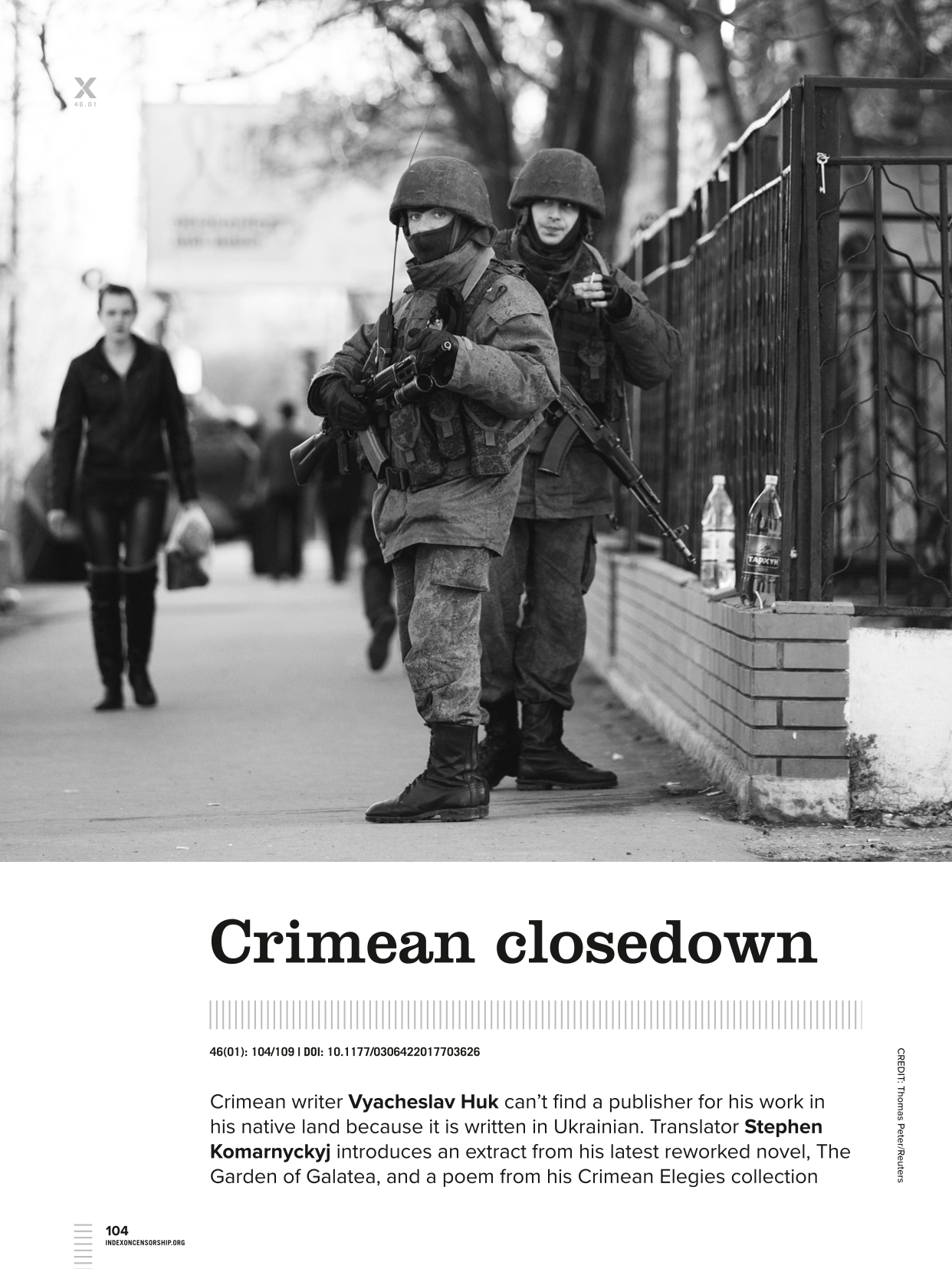
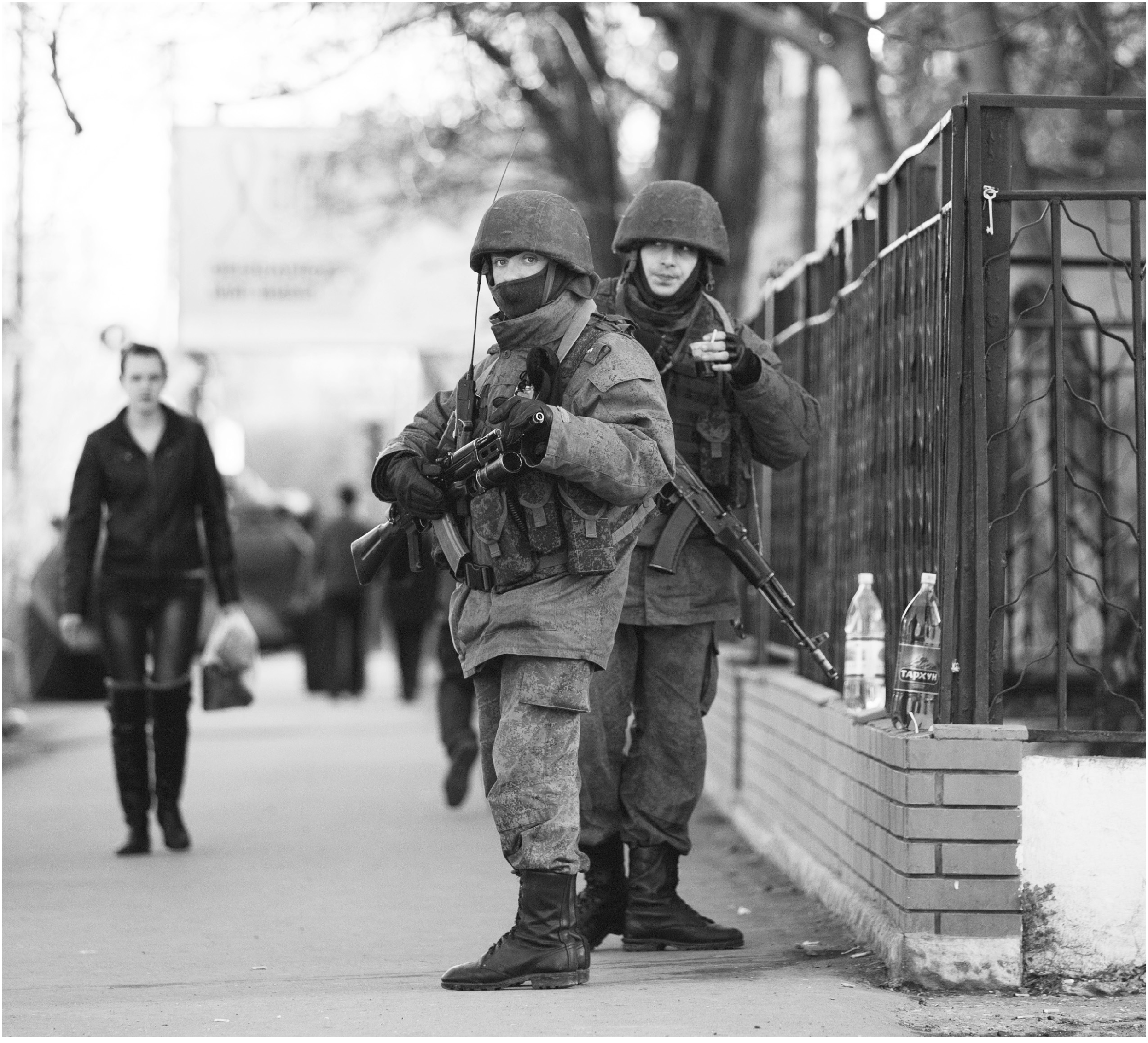
Men believed to be Russian soldiers guard a Ukrainian military base in Simferopol, Crimea, shortly after the annexation in 2014
CREDIT: Thomas Peter/Reuters
The new government in Crimea has removed Ukrainian from schools. Ukrainian media is banned because it “doesn’t correspond to Russian legislation” and Reuters reports that the only Ukranian language library in Russia is closing.
The Crimean publishing industry has understood that the seizure of the peninsula by the Russians has rendered the publication and marketing of Ukrainian books unfeasible. Bookshops have ceased stocking publications in the language and demand has plummeted.
Even though Ukrainian is officially a state language, Crimea’s Ukrainian speaking population have almost no access to books in their own tongue. The language is being strangled.
For Huk, this is a particular tragedy. In 2008, the first version of his novel Sad Halatyi (The Garden of Galatea) was published in Crimea. When a massively revised version of the same novel emerged in 2015, it was only published in the Ukrainian capital Kiev.
Fellow poet Dmytro Pavlychko has compared Huk’s writing to the German writer Thomas Mann and the Argentine short story writer and essayist Jorge Luis Borges. Huk’s novel The Garden of Galatea is an elegy for obsessive love similar to that portrayed in Mann’s Death in Venice and a first person account of dehumanisation, which has echoes of Borges’ Deutsches Requiem.
Like most of Huk’s work, the novel, while written in Ukrainian, is not about Ukraine. Its protagonist, Asar Janson, is one of the tiny number of Jews who clandestinely joined the SS, and it is set mainly in Latvia. Asar sets fire to an old people’s home on 4 November 2006 possibly killing Marta, with whom he was obsessively in love. He tells the story of his life in a self-serving manner, sprinkling it with historical and literary allusions. We are never sure how accurate his recollections are, nor of the degree of his participation in the Holocaust. The novel is a subtle portrayal of how complicity in evil corrodes memory and the possibility of love.
In the passage translated below we hear Asar Janson narrating a memory of a memory. During his post-war life with Marta, he dreams frequently about the Holocaust. He remembers how he used alcohol and misogynistic sex in an attempt to blank out the horrors he saw. He is grieving over the loss of his humanity. His voice is a metaphor for Ukraine and eastern Europe’s troubled past.
As well as an extract from The Garden of Galatea, Index is publishing exclusively in English a poem from Huk’s Krymski Elehii (Crimean Elegies), a poetry collection that came out in 2013. The poetry contains little about Crimea, but focuses presciently on war and exile. It now reads as if Huk anticipated his sadness and feelings of bereavement at the severance of his birthplace from Ukraine.
The reference in the poem Birds to a “military Grasshopper”, a World War II-era plane, feels like an augury of war. The poem also alludes to Greek mythology, part of Crimea’s heritage and its perhaps lost European future.
Extract from The Garden of Galatea
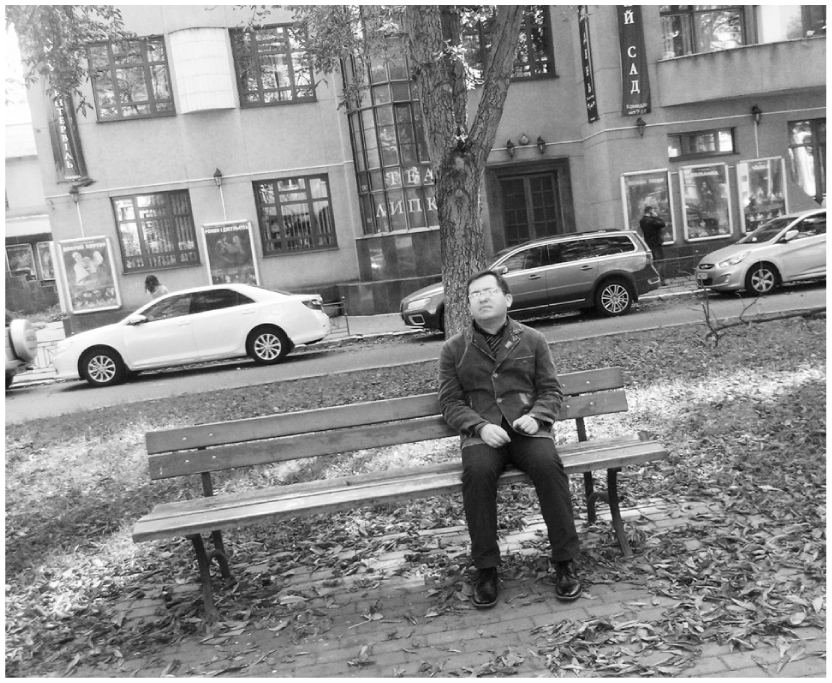
The writer Vyacheslav Huk in Kiev in 2015. Huk is struggling to publish in Ukrainian, his mother tongue, under the current pro-Russian government
CREDIT: Halyna Huk
Our life consists of acts that are and always were mundane and simultaneously insane. The dependency on something or other that had the same value as manure. I was filled with a demented yearning for someone who could understand and listen to my spirit, but who? Marta? No, unfortunately this woman was only interested in the possibility of having a family with me. It was as if she were a flower, or a female tree, which needed to continue its species. I had no wish to be the equivalent of pollen…
I have a free spirit. At that moment I wanted to become a chrysalis, to disappear from Marta’s view… yes, it was imperative to flee as fast as possible, to be anywhere but here…
Delighted at this pleasant thought I hummed a now almost forgotten song and went to bed.
I open the window wide and I shed my clothes, although the nights near the estuary had become cold in anticipation of autumn. I lie on the creaking bed and close my eyes, crossing my hands on my breast like a corpse silvered by moonlight, and pondered. It would be good if this house had not only windows but a glass ceiling. Then all the stars in the sky, and not just that portion looming tranquilly at the window, would be visible. With my closed eyes I had a vivid glimpse of the muddy, unwelcoming waters of the estuary in the morning. They quietly bore driftwood onto the sands, the rubbish that the sea proffers for the thoughts of those who will view it later. They will ponder what structure those fragments were once part of. Only time transforms a happy song into a funeral dirge and renders molasses saline and toxic.
I open my eyes and see the black, motionless gauze of night studded with minute, copper-tinged stars. The bird concealed under my ribs had long become calm. She no longer strove for an unnecessary and extremely dangerous freedom. I would write a note for Marta and flee, thereby saving myself from this overwhelming melancholy and utter solitude forever. Marta unbalanced me, like a mechanism with her sharp, painful words and unconsidered acts. However, she would never seize my treasured liberty.
I struggled to get to sleep, but dreams mingled with reality, resembling a kind of delirium, though I am aware that this is, in fact, an old memory. I see the train station in some town and glittering railway lines that fly towards the West. I am wearing a German military uniform. For some reason there are no wagons at the station. The railway workers, who have been shot, have been laid near the buffet. Insects, viscous and black, buzzed and swarmed over the swollen and mutilated corpses. Nausea gripped me. It was stiflingly hot outside, like a blazing July day. I felt the need to use the toilets and found them quickly. All the rancid holes for human waste were occupied. Footsteps. I heard the train throbbing. I listened to the slithering sound of the water in the broken sink. They dragged people into these holes while they were still alive and tortured them for a protracted period. Then finally they murdered them. Paper signs were tied to their legs and inscribed with the words “Jude, Jüdin, Verräter, Prostituierte…” I pulled someone’s headless body by its legs from one of the holes. My eyes fixed on the white vertebra and the black blood, still warm, upon it. I had no spittle with which to wet my burning lips. I dragged more and still more men, women and children onto the tiled floor that was wet with blood and vomit. One dark-complexioned teenager still had the inscription “Jude, Jüdin, Verräter, Prostituierte…” attached to her. Her head was partially severed but still somehow attached to her neck muscles. I wept quietly. My tears were as sticky as the blood soiling my hands.
I went out into the street where tall poplar trees reached into the sky. The faint sun slept in the dark birds’ nests among their tangled branches. It was difficult. Terrifying. Repellent. There was fresh blood on my soldier’s boots. As if I were a slaughterhouse operative who had just emerged from the abattoir having deprived a cow, pig or sheep of its life. My heart was torn to pieces by darkness and anguish. I stopped, pulled off my boots, threw them into a hawthorn bush and roamed in my bare feet, aimless and stupefied. That same night I downed a few tumblers of strong, pungent vodka to forget everything around me. I fucked dementedly with some slut from the East I had bought for a bottle of something, as if this transgression would be the last act of my life. Later I remembered with fear and shame how I had adopted postures in bed that would have been worthy of a gifted acrobat. Yes, it was simply repulsive.
And the next day everything was repeated. I had agreed to meet with this whore at roughly four o’clock in the afternoon by a dilapidated hangar. The structure had once been used for military vehicles and smelled of fuel and sodden timber. However, the lady was late or, more accurately, we were both late. In that dark hangar, designated for very old vehicles, I tried somehow to quieten my sullied desire to make love. I stood on the hood of a Willys Jeep looking who knows where and then pressed my body into the body of the whore I had bought. Ants ran down my spine as we touched. I enfolded the whore in my appalling embrace. As if in some tainted, ambiguous dream I inhaled the gentle fragrance of her hair and skin. I unfolded her from her dress and pulled off her underwear. The hooker tensed as if she was a respectable woman, but this was for show. There, on the hood, in a drunken lust I took her. Grabbing her arm, kissing her frantically, spreading her legs. It seemed then that I was too simple, too ordinary to do what I did.
I made myself repulsive to myself for a moment. I remembered how, to begin with, I drank an aperitif accompanied by slices of lemon with her for quite a while in some cafe. Then the clock on the old town hall rang for half past six and sounds muted by evening melted into the autumn sky. We went, already pretty drunk, to the hangar. We misused it as if it were a room reserved in a hotel. However, everything was a little better than the year before when I tried to make love in the overnight compartment of a fast train to Riga. That night then finally defined the genuine, strange scope of my love and diseased longing for voluptuous women.
The floor beneath our feet was fetid, dank and dirty. It was far from an attractive place for such an occupation. However, I rapidly took control of this woman, ridding myself forever of the impression that these couplings, purchased for a glass of wine, were mechanical in nature. I became predatory to forget that I was a human being. My body sweated intensely and profusely. The whore moaned, surrendering herself to the brutal force of just another ordinary man. I tried to stimulate her and my sensations so we could break free of life’s ugly truth momentarily… and forget all in the weird morphine of bogus love. Her kisses prickled my lips. Her tears were sticky on my cheeks. I was in some warm, tranquil bay on an ordinary boat. The tangled hair of this woman was a breeze for my sail, its touch hot on my skin. At each thrust I tried to reach the essence of a life that I had lost somewhere, but distanced myself from the truth still more. I worked at that lady as if she were a complex, but very desirable, job.
Every time I had intercourse with these bought women it seemed to me that I lost part of myself. I gave myself to them, to satisfy my body’s needs. When a very drunk, lusty whore satisfied with this lovemaking weeps quietly, her arms clasping her arms around my neck, I whispered utter nonsense… that this scene should be portrayed with the eyes of an artist. That it is necessary to look into yourself when you feel oppressed. To be with that person you love so strongly, in spite of separation, war and borders. The biological right of men and women to be with one another monogamously is unrealisable for us now. How, I asked my lovers, can you obey that biological instinct when some force pulls you backwards and forwards? A force that never ceases, for there is a certain boundary beyond which all that is most important loses significance. Where body and soul alike are subject to the extreme physical aggression that occurs during war.
Then a typical woman becomes bio material. A piston simply enters its allocated socket. That’s how procreation occurs at such times and you lose yourself utterly as a human being.
Birds
This late summer, and the melody of song protracted,
Like soothing words or victory after struggle,
A planned assault or the delusions of Penelope,
Wherein distant perspectives are awash with birds,
And a military Grasshopper
Disappears into the sky and fades to unconsciousness,
A coffee’s warm vapour drifts from one of the tables,
And a white rose exhales its fragrance.
You are entitled to all of this,
The wind subdued by the tree’s dark tree crown
Forms melodies of yellow leaves,
Extracted from a box, whether for an undefined period,
A short August vacation abroad.
The engine hums through broken passages of summer,
Where the wind cradles birds’ nests in tree crowns,
Giving you the possibility to whisper: this is an augury
Or the comprehension of an image and the end point of flight
Which remains dark and immutable in any season.
The negative of a plane bombing a foreign location.
Through all horizons, without exception, and in all perspectives,
The low sky you encompass in a glance continues
With a plane at a high altitude, and there is no possibility
Of analysing life’s boundlessness in dreams.
So you watch birds through binoculars,
Their wings sculling through blue sky,
Anticipating autumn’s coldness
As they fly towards the southern coast.
Footnotes
Translated by