




Abstract

South Korean entertainment websites are having to be extra careful about which music and films they broadcast to China as they tiptoe around rising political tension, writes
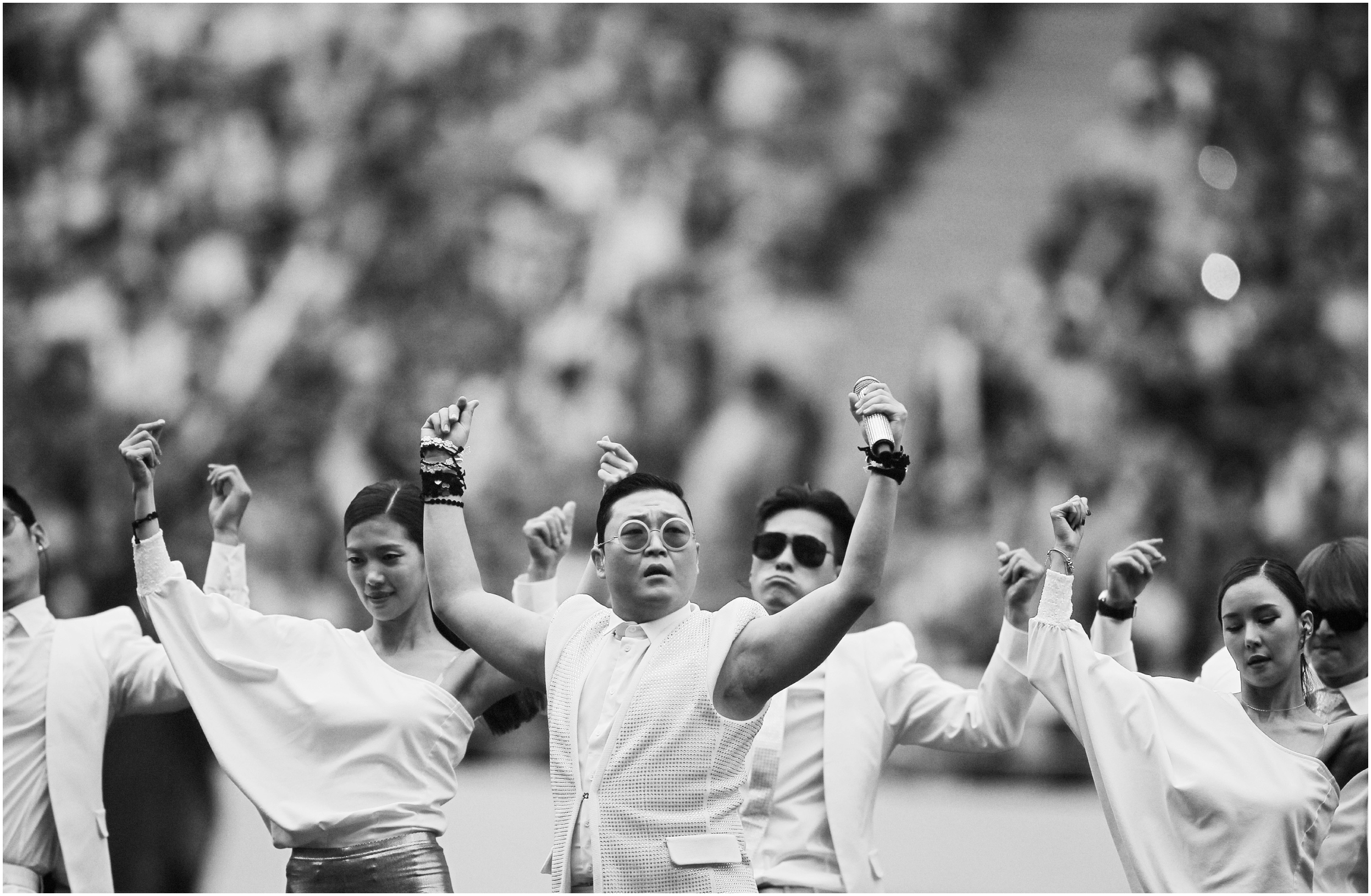
South Korean pop star PSY performing during a charity football match in Shanghai
CREDIT: Aly Song/Reuters
Korean entertainment has strong appeal across the East China Sea partly because Chinese viewers see a bit of themselves and their own country in the content, albeit a wealthier and more modern version of them. And with plotlines that revolve safely around tame love stories with minimal sexual content, Korean programmes often tend to sail past Chinese censors without much fuss, unlike comparatively raunchy fare from the USA. However this popularity can be used as a negotiating weapon by the Chinese authorities.
“Business people in China know they have a huge market that the rest of the world wants in on, so I think they feel like they can push other countries to play by their rules. If another country does something they don’t like, they have the leverage to cut off access to their market,” Choi said.
China is South Korea’s largest trading partner. In early 2017, South Korean exports to China reached a high of $12 billion.
But Choi and other South Korean purveyors of pop culture have been struggling to adapt to political upheaval since Seoul agreed last year to the installation of the Terminal High-Altitude Area Defence, a US missile-defence system. In recent months it has become increasingly difficult for South Korean entertainers to access the Chinese market, and the reason for this, many speculate, is Chinese disapproval of the deal.
“China has made it clear that this is a kind of red-line issue for them. Going with THAAD meant that South Korea would take a hit in its ability to seek cooperation from China,” said John Delury, a professor at Yon-sei University in Seoul.
“It was like everything became disconnected. All of a sudden, so many projects were called off,” Choi said in an interview at his office on the southern outskirts of Seoul. Choi’s websites rely on revenue from Chinese advertisers, many of which have been caught in the diplomatic crossfire.
The conflict over THAAD, which is set to be deployed later this year, shows no sign of thawing. If there is a resolution, it could emerge in coming months when South Koreans go to the polls to elect a new president following the decision in March to uphold the impeachment Park Geun-hye. Until a new president is elected, all major political decisions have been tabled.
“I think Chinese see Korea as somewhat more modern when it comes to fashion, plastic surgery and cosmetics. They look to Korea for what’s hot before it gets to China,” Delury said.
“To many Chinese, Korean culture is a more authentic kind of cool to aspire to. It’s modern and Asian, and a way of being cool without mimicking what comes from the West,” added Michael Hurt, an assistant professor of sociology at Hankuk University of Foreign Studies in Seoul.
It’s not just Korea’s fashion-forward image that appeals to Chinese audiences. China and Korea have a shared history that goes back thousands of years as ancient Confucian civilisations. In modern times, both have found common ground opposing Japan’s historical revisionism over “comfort women” and other World War II atrocities.
But the THAAD decision isn’t the only factor squeezing Choi’s room to operate freely in the Chinese market. When selecting the goods he promotes online, he must use content that Chinese audiences will find interesting, while being careful to filter out anything that might cause offence. His golden rule is “nothing political”, but it is not always clear what amounts to “political”. Chinese audiences can react sensitively to anything they perceive as disrespectful.
In August 2016, Chinese netizens responded with a flurry of criticism over a South Korean television advert for US footwear brand K-Swiss. The ad depicted a South Korean actor winning a chess match against a plump Chinese man, who is later slapped by a woman during a dance battle. Many in China called the ad “humiliating”, urging restrictions on Korean entertainers’ access to China.
In 2015, Choi left a well-paid job as a television producer at KBS, a national broadcaster in South Korea, to take a risk on what he saw as an upcoming wave of commercial opportunity: China’s growing appetite for cultural exports from South Korea.
Everything went well at first. Choi set up his online platform with carefully curated feeds of the latest South Korean music, films, fashion and celebrity news, and found local partners in China. But he would always carefully approach his business links with China.
“As a small country, we have to always respect our partners and follow global standards. We know we can’t survive without outside partners,” he said.
Mainland China’s long-running dispute with Taiwan is another sensitive issue for Choi. In early 2016, Chou Tzu-yu, a teenage Taiwanese member of a South Korean girl group, was pressured to make a groveling public apology after she appeared on South Korean television waving a Taiwanese flag. In the controversy that ensued, Chou’s management cancelled all her activities in China.
There are other cases of South Korean entertainers being frozen out of China, most without clear explanation. Last year, South Korean director Kim Ki-duk was denied a visa to shoot a film in China; after filming a TV series in China, actress Yoo In-na was informed her scenes had been cut; and an appearance by K-pop band Snuper on a Chinese show was scrapped at the last minute.
For Choi and others, there is a key difference in the extent to which they can manage factors limiting their freedom to operate. Choi can curate his offerings to avoid anything Chinese audiences may find offensive, but he has no power to negotiate his government’s THAAD decision, nor Beijing’s backlash against it. This means the recent turn of events is particularly damaging.
Nevertheless, Choi believes that the opportunities presented by the world’s most populous country are enough motivation to keep him in business for the foreseeable future. “There’s still more opportunity there than anywhere else. It’s worth the struggle,” he said.
Little Black Book
South Korea’s entertainment industry was plunged into a scandal of McCarthyist proportions during the winter, after a newspaper revealed that the government had compiled a blacklist of more than 10,000 artists.
The daily Hankook Ilbo revealed in October 2016 that among the affected were high-profile personalities such as Park Chan-wook, the director of the hit movie Oldboy, and Booker Prize-winning author Han Kang. The blacklist was designed to prevent these artists from receiving state subsidies and private investment, and place them under state surveillance.
The creation of the list was apparently ordered by the president’s office in 2014, shortly after the MV Sewol ferry disaster, in which 304 people died. Many of the names on the list had been openly critical of the government’s handling of the tragedy. The mayor of Busan, a member of President Park Geun-hye’s party, had also tried to prevent the 2014 Busan Film Festival from screening a documentary named The Truth Shall Not Sink With Sewol, sparking huge protests and threats of boycott from industry professionals.
The president is facing an impeachment trial on ever-increasing charges of corruption and abuse of power. Culture minister Cho Yoon-sun was arrested on 21 January, accused of abuse of authority and perjury for compiling the list.
“The most serious problem is that authorities are trying to control our thoughts,” filmmaker Ryoo Seung-wan told The Hollywood Reporter.
Border Crossing
North Korean author Bandi has no way of knowing his collection of short stories has been published, because no news from the West is ever likely to reach him.
Bandi, a pseudonym and a Korean word for firefly, is a state writer in North Korea. He put pen to paper in the late 1980s, just as the country was entering a particularly tumultuous and traumatic period. It was during this decade that a famine killed an estimated one million people, which also led to a rise in defections.
The Accusation, which was published this Spring in the USA and the UK, is the only known work of fiction critical of the North Korean regime written by someone still living in the country. The collection of seven short stories is unique because it gives a fictional voice to a whole variety of people who live under the regime; and it is the latest piece of contraband to be brought across the 38th Parallel, the world’s most heavily fortified border crossing that divides North and South Korea.
Index spoke to Do Hee-yun, who helped smuggle the text out of North Korea. He said that even now Bandi is not fully safe. “North Korea pays attention to these stories,” he told Index. As yet he is not aware of any effort to trace the writer, though there’s a possibility that the authorities might look for Bandi if the book attracts a lot of attention. To this end some details have been altered, and Do explains there are measures in place to protect Bandi.
The manuscript was completed in 1993. When one of Bandi’s relatives told him she was defecting, he asked her to smuggle his collection of stories out of the country. And so the book’s perilous journey began. It eventually landed in the hands of Do.
“There may be an imaginative sense for idolisation, but North Korean society never allows writing to be imaginative or creative in other social areas,” said Do.
More than 28,000 North Koreans have defected to South Korea since the country was split. Of those many have gone on to write books and some have become best-sellers. There’s a concern that, writing specifically for an audience that want to read “bad North Korea stories”, authors might resort to hyperbole. This makes Bandi’s book a different beast.