




Abstract

As the Fees Must Fall movement in South Africa approaches its second anniversary, fears for the future of freedom of speech on campus are escalating.
A student offers flowers to police in a gesture of nonviolence during the #FeesMustFall protests in October 2016
CREDIT: Thulani Mbele/Sowetan/Gallo Images/Getty Images
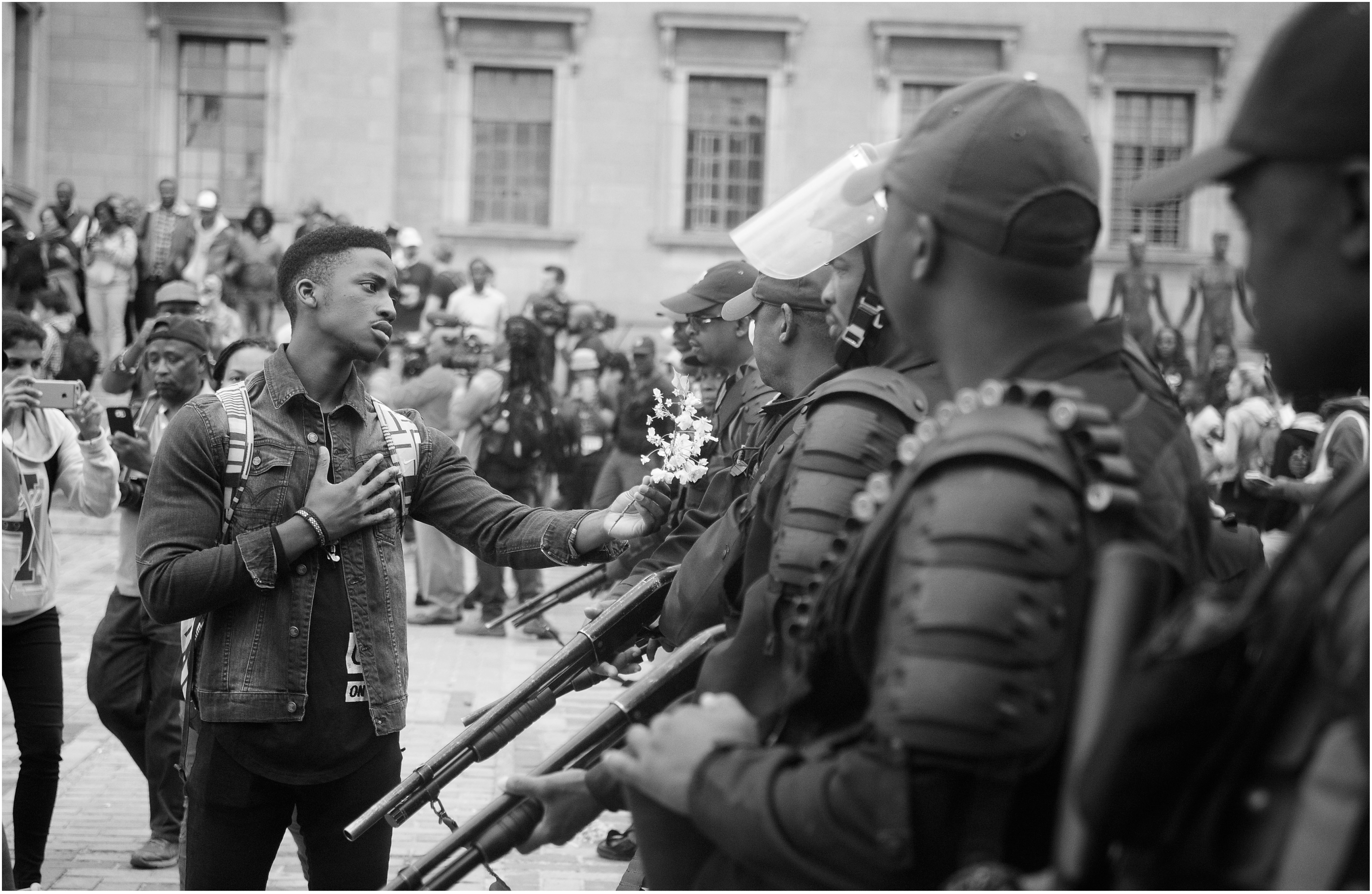
Towards the end of last year, it was common to see more police officers and armoured vehicles than students or academics at Johannesburg’s University of the Witwatersrand (Wits). In an eerie echo of apartheid tactics, “gatherings” of any sort were forbidden. Students were not allowed to enter the main administration building where supporters of the movement known as Fees Must Fall had previously held meetings.
Over at the University of KwaZulu-Natal’s Westville (Durban) campus, a student described how police and private security guards had interrupted a gathering designed to discuss issues on campus in October 2016.
“The cops came in numbers and when they came, they pepper-sprayed us. They gave no warnings to students. They shot the students with rubber bullets and they brutally assaulted anyone who was coming from the library.
“I don’t believe they are allowed to do that but they are forcefully entering. It’s like they are instructed to stop students from expressing their views. They assault anyone standing in the way. They are instilling fear into the students.”
But this was not a one-way battle to squeeze debate. In the weeks leading up to shutdowns at Wits, non-protesting students had been labelled “sell-outs” by those actively fighting for free education and decolonisation, and they found themselves under attack. Across the country, university buildings and vehicles burned. What had previously been a cohesive, united movement became fractious and its natural “enemy”, university administrators, were not the only target. Students turned on each other, even within the movement.
Those vital spaces for debate, dissent and learning narrowed. The squeeze was on. One academic, who didn’t want to be named, told Index that her faculty’s staff room at a Cape Town university no longer buzzed with conversations between colleagues. “Everyone is too afraid to say anything that might be construed as political, so we just keep quiet instead,” she said. “There’s a really terrible climate of suspicion.”
Student activist Thenjiwe Mswane began to realise that she could no longer align herself with Fees Must Fall because the main organisers were unwilling to listen to a myriad of views. Last April Mswane took a stand against the exclusion of feminist and queer concerns. Armed with a heavy leather whip known as a sjambok, she confronted a group of male protesters at Wits. Photographs of what followed, which show Mswane being forcibly removed by a group of men, are evidence of what Christi van der Westhuizen, an associate professor at the University of Pretoria, has called an “anti-democratic element” in the student movement.
These campaigners seem to believe that you are either entirely for decolonisation or utterly against it. Mswane’s commitment to the broader cause didn’t matter to the men who physically attacked her when she questioned the absence of queer voices and black women’s voices from the movement’s work.
“I think that April was the last time that I would align myself with the movement that became #FeesMustFall. Not because it was not necessary, not because it was not valid, but because it was no different…from the movements of [black male protesters’] forefathers which were built on the blood drawn from the spines of black women. There is nothing new that happened on that day in April,” she told Index.
In the months that have followed, the movement’s celebrated cohesion has all but vanished. Mswane and others like her have withdrawn, leaving what was a robust, nuanced space for contestation filled with different voices down to just two sides. And those sides represent extremes: generally older, usually white academics vehemently opposed to the idea that European and other Western thinkers ought to be replaced by theorists from Africa and the rest of the global South versus those who want university curricula gutted of anything non-African.
Those somewhere on the middle ground are missing in action, often because they’ve been physically or verbally shouted out of the debate. Van der Westhuizen has written about students at the University of the Western Cape who interrupted a debate involving Judith Butler and Wendy Brown, both known for radical critiques on present and historical forms of oppression. Students insisted they’d had enough of “white foreigners” telling black people what to do. Two local, black African academics – Achille Mbembe and Xolela Mangcu – were called “sell-outs”.
Penelope Andrews is the dean of the University of Cape Town’s law faculty. She noticed a definite shift during September and October when protests aimed at her institution and others peaked.
“It became increasingly apparent that nuance, reasoned dialogue, tolerance and moderation were casualties of the protests,” Andrews told Index. “There were increasing demands – outright, subtle and clandestine – to either support the students, on the one hand, or condemn and penalise them, on the other.
“The middle majority – [non-protesting] students and staff – felt marginalised and silenced. The puzzling thing is that most, especially the students, I would argue, are deeply committed to the project of equity, transformation and social justice. They support the cause of accessible and affordable quality education, including free education, for the majority of students.”
Despite this, UCT and several other universities had to delay their year-end exams and cancel some classes to stave off disruptions. Andrews was surprised by protesting students’ attitude to the “sell-outs” who just wanted to get on with their work.
She was a student in South Africa during the apartheid era and was a protester herself during that time. But, she said, “the actual physical shutting down of the university is new to me. When I was a student at the (then) University of Natal in Durban in the late 1970s and early 1980s, ongoing protest against the apartheid regime was the currency at the university. We protested all the time. But we did not shut down the university as a tactic. Even with the slogan ‘Liberation first, education later’, the University of Natal continued to operate.”
She added: “The shutting down of intellectual space is a different story. These actions emanate from across the ideological spectrum.
“From the conservative right, one observes a refusal to admit and confront the historical and contemporary vestiges of privilege and racism (the idea of “white innocence”), or the use of certain labels to silence (for example, accusing a speaker of using the race or gender card).
“From the political left, I would argue that there has been some silencing of individuals based on the practice of a kind of identity politics and the tension around who gets to represent and express the view of the relevant oppressed or subordinated group or individual.”
Mehita Iqani takes a different view. She’s associate professor of media studies at Wits and the founder of a podcast called the Academic Citizen. The “squeeze”, she argued, isn’t a genuine closing down of space so much as a number of “different iterations of free speech and healthy – though not always comfortable – debate”.
“I have witnessed only a couple of ‘closing down’ moments,” Iqani told Index. One of those was when the leader of the Wits branch of political party the Economic Freedom Fighters interrupted a peace meeting in a church and led a group of students in shouting at the vice-chancellor until he left.
She said: “I’ve seen a couple of mean Twitter comments from students directed at academic staff who dare to voice critique of student’s tactics. I’ve seen academics on Face-book defriend colleagues that they claim are not progressive enough. But all of these are quite petty instances, I think. On a surface reading, it could be read as closing down debate, but I think more discussion and reflection tends to be generated as a result. Some may become more polarised – the individual who defriended everyone he decided wasn’t radical enough, for example – but in the bigger picture it gives us something to think with.”
Thinking will be crucial in the coming months and years. The senate is any university’s highest academic decision-making body and comprises full professors, senior management and a handful of elected representatives. Iqani, who serves as an elected member of the Wits senate, believes it’s visible proof that change is crucial and that the real “squeezing” of debate has been perpetuated by those in power, not the student body.
She added: “Senate does not ‘look like’ the rest of the university. It is dominated by older, white men who truly believe that they are best positioned to make decisions on behalf of the academic community. They have had control over the academic project since forever and they do not like their authority to be threatened. I think that it is very important that other voices are raised, and through generations of dispossession and frustration, when those voices are finally raised loud enough to be heard, they might sound angry and aggressive.
“We need to learn ways to hear those voices even if they are being expressed in ways that don’t sound polite. If there are things said that need to be disagreed with, there should always be space for counterpoints to be shared.”