




Abstract

In countries where there are tight restrictions on what women can wear, high heels can be one of the few ways to show a public fashion sense, argues
Meanwhile in Europe and North America, women are rebelling against high heels especially when they are being forced to wear them for work. They are even trying to get governments to change the law to stop employers making them compulsory.
So are high heels a way of expressing your freedom and femininity as a woman or are they a terrible constraint on women’s movement imposed by men who want to control women and do not care if they suffer injury as a result?
Young female Saudi fashion designer Nora Aldamer, who won the Jeddah Vogue Fashion experience award this year for her Chador collection and was at Milan Fashion Week for the first time this autumn, sets her beautiful clothes off with heels.
Saudi Arabia is opening up to the wider fashion world and there is even some official encouragement to do so, but it is difficult. There are very strict religious rules about what Saudi women wear in public. They have by law to put on a full abaya, a black robe-like dress, when they go outdoors. Women are not allowed to drive cars and there is a strict guardianship system which prevents women doing vital tasks without the permission of a male relative.
Yet the one way women, even under their abayas, do express themselves freely is through their footwear. It is not uncommon to see the flash of a Christian Louboutin shoe from under the black robes of a rich Saudi woman.
Aldamer told Index that women have been taking care of their looks and following tradition but adding accessories from international fashion labels like heels since her grandmother’s generation.
“I don’t see it as a new trend,” said Aldamer. “It’s just that the spotlight has been on Saudi women lately following the political situation in the region. High heels are very important for Saudi women as a daily accessory as they have been for most societies until recent years when it has changed to more comfortable sneakers and flats. Still high heels are in every Saudi woman’s closet regardless of social status.”
Iran is another country where you can be stopped in the street for wearing the wrong thing. Women have to wear headscarves and have their arms and legs covered. There are, however, no restrictions on how high a woman’s shoe can be.
Tala Raassi, an Iranian American designer, was given 40 lashes in Iran at the age of 16 for being at a mixed party wearing a miniskirt. Now 35, she lives in Washington DC, has just published a book called Fashion is Freedom and designs bikinis. She said women in Iran wear make-up, accessories and high heels because they have few other ways of expressing themselves through what they wear. It is a way of following the religious rules without getting punished.
“High heels and make-up are the only way that women can express themselves. They can’t show it through other fashion. Usually women wear lots of make-up, jewellery and high heels. It is showing their feminine side and they can feel sexy while following the rules and the laws,” she told Index.
Fashion restrictions appear to be easing up for some young women in Tehran. The Instagram account for the Tehran Times shows photos of how some are pushing the boundaries of what is and isn’t allowed, though as Raassi said this is still not the same as being able to freely choose what clothes you put on and what clothes you can take off.
Nevertheless, Rosie Findlay, a lecturer in cultural and historical studies at London College of Fashion, said that across the Muslim world there is a kind of negotiation for women between dressing modestly in accordance with their religion and dressing fashionably. Magazine Elle Oriental, for instance, is concentrated very much on beauty products and women’s accessories such as high heeled shoes, make-up and handbags. “They are mixing things together. Muslim women are finding creative ways of expressing their identity through how they dress, combining being modest and looking cool,” said Findlay.
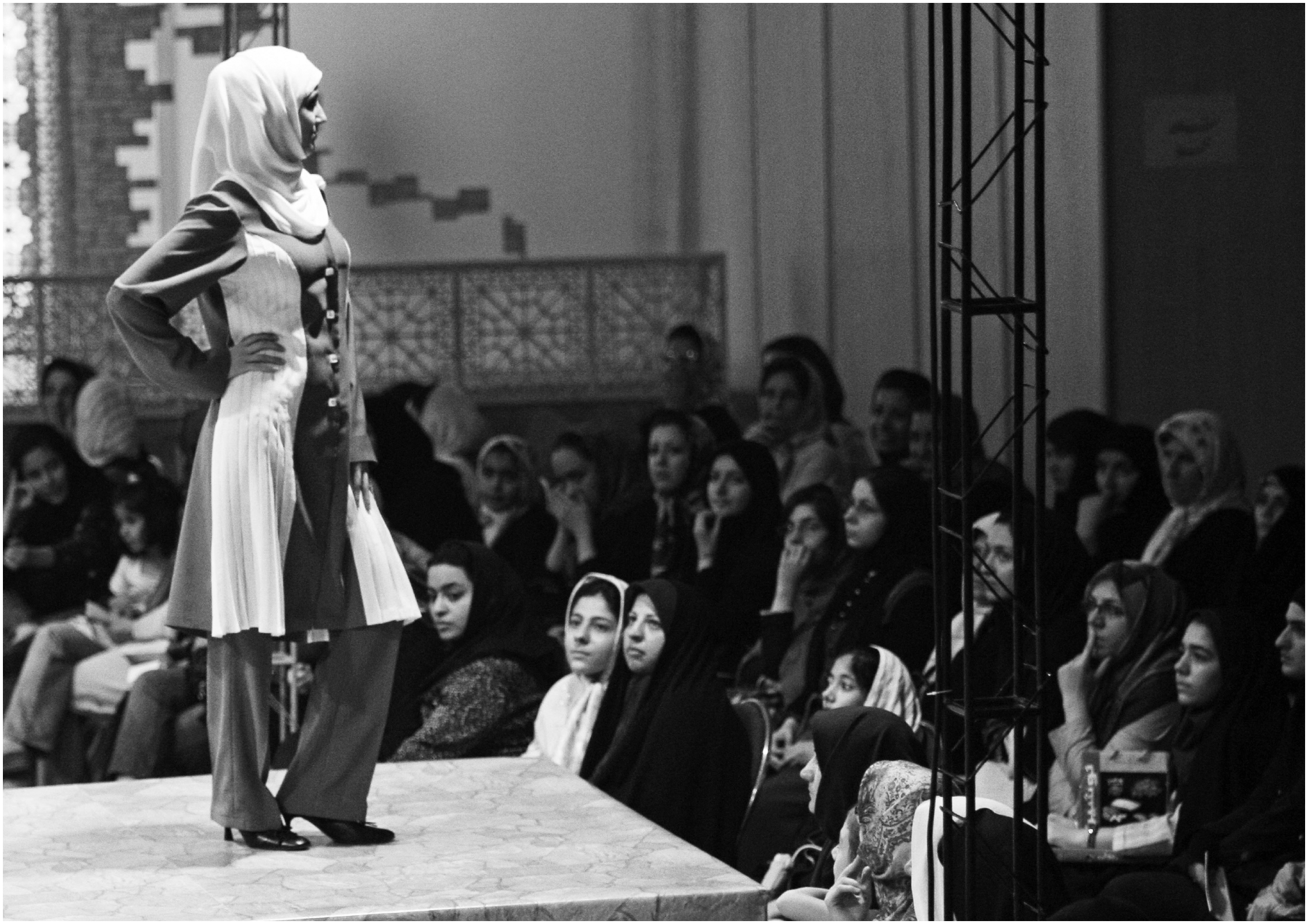
Iranian women in Tehran watch a catwalk model
Credit: Behrouz Mehri/AFP/Getty Images
Helen Persson, the Swedish curator of the exhibition Shoes: Pleasure and Pain which is touring the USA and China, has said one of the most interesting things about heels is that for the last 100 years they have been an international phenomenon, worn by women regardless of culture to show their status, youth, wealth and modernity.
Yet while heels can be regarded in Saudi Arabia and Iran as a way of expressing individuality and freedom, in other parts of the world they are increasingly seen as a way of limiting women’s freedom and even harming them.
It is some of the least well-off women in the lowest paid jobs who are being asked to wear heels, from receptionists in London to waitresses in fast food joints in Edmonton, Alberta in Canada.
Earlier this year a friend of one waitress at the Edmonton branch of Joey’s restaurant posted a picture of the waitress’s bleeding feet on Facebook, causing national outrage in Canada and forcing the company to clarify its policy. High heels were not obligatory, the company said. Wedges and flats were also acceptable and there had been a misunderstanding, it said.
Meanwhile, a receptionist in the UK was sent home without pay from a temporary job at city accountancy firm Pricewater-houseCoopers, which outsources its front of house positions through employment agency Portico (which has subsequently reviewed its policy) for refusing to wear high heels. She got her revenge by setting up a petition which has gathered more than 150,000 signatures calling on the British government to make it illegal for a company to require women to wear high heels at work. A committee of British parliamentarians took evidence about the matter and is due to report soon.
Nicola Thorp, the woman who set up the petition, said she was not taken at all seriously when she remonstrated with her supervisor, but had had a huge reaction to her story from friends and acquaintances who have had similar experiences.
Findlay explained why the imposition of high heels at work is problematic: “If you are not choosing to wear them yourself, it is more questionable. If high heels are part of the uniform, you might question why. It could not be about mobility and comfort, but it’s probably about the sexual connotations of the shoe being a feminine article and being erotically appealing. That’s why it is retrograde.”
Women, she said, should be valued in the workplace for their capability, the way they do the job and other things which are much more important than looks. “We have moved away from the idea that the attractiveness of the women is a sign of a company’s confidence and prestige, but it is still contested.”
High heels were originally the preserve of the very rich in western Europe, and were a way for aristocratic women to show off their leisured status.
Persson said high heels for women and children became fashionable in the 17th century and by the mid-18th century aristocratic women sported heels as high as 12 cm. They were so elaborate and expensive that they were a way of flaunting wealth and the freedom that brought. But because women could not walk anywhere in the heels, it meant they were restricted in their own movements and totally dependent on others, servants and men.
As Persson told Index: “The heels didn’t have a shank or a steel rod in them so you were tottering and had to go on the front of your foot so you didn’t break the heel. Dancing was done on the point of your feet. It determined how you moved. You sat in your big dresses and looked pretty. You couldn’t walk anywhere. You took two steps from the front of your house to your carriage.”
It was only in the 1950s that high heels became available to all. Movement was much easier in them. Design had moved on so much that high heels no longer broke when you walked on them. They were, as Persson said, revolutionary and symbolised technological advancement. Advertisements showed women vacuuming and cleaning windows in high heels. They were sold to women as giving them freedom to do the house work while still being attractive to men. The US TV series Madmen highlights how this was also happening at work for women who were working in customer facing industries like advertising.
Consultant podiatrist Mike O’Neill from the College of Podiatry in the UK, said high heels were now recognised as causing damage not only to your feet but also your whole body: “For example, if you wear high heels day in day out and are on your feet like cabin crew and teachers often are, in the short term you are going to get blisters and sore feet, but in the long term you are shortening your calf muscles which can result in muscular problems and puts pressure on your joints and lower back. This can cause a range of mobility problems as you get older.”
Interestingly the film industry is still one where heels are considered obligatory for stars. It is very difficult to get away with wearing flats on the red carpet and in Cannes women wearing flats have been refused entry to screenings. The film star Julia Roberts went barefoot on the red carpet at the Cannes film festival this spring to protest at their high-heels only policy.
And actress Kristen Stewart was quoted in Vanity Fair magazine, saying after she was made to take off her flats at the festival and swap them for heels: “Things have to change immediately. It has become really obvious that if [a man and I] were walking the red carpet together and someone stopped me and said, ‘Excuse me, young lady, you’re not wearing heels. You cannot come in.’ Then [I’m going to say], ‘Neither is my friend. Does he have to wear heels?’”
As Stonewall, the British gay rights organisation, pointed out to members of parliament, dress codes which demand high heels can also be highly discriminatory for people who identify as lesbian, bisexual or transsexual.
Yet high heels are still popular. Persson said high heels were the one piece of attire which is still symbolic of femininity and womanliness in the world and generally taboo for masculine men (though not of course for men wishing to express womanliness and femininity like Grayson Perry). There are notable exceptions like Lenny Kravitz who has divided the world of male fashion with his love of high heeled boots.
Findlay agreed that high heels and other shows of fashion may represent a sense of freedom for women and others who wanted to feel feminine, giving enormous pleasure, but they should not, she said, be imposed on women. “People are always telling women what they can and can’t wear, what’s appropriate and what’s not. It happens in most cultures whether it is a religious mandate or an employer telling you to wear heels. This is part of a bigger problem.”