




Abstract

Bright indigenous clothes in Bolivia help define social class. Writer
Pejorative terms such as india, chola, birlocha and chota are used to characterise women according to whether they are “pure” or “mixed race”.
These terms are still commonly used, despite the political changes of the past 15 years, and the election of Evo Morales Ayma in 2006, the first indigenous president.
Definitions of these terms are prescriptively rigid. India, for instance, is used for a woman from the countryside who maintains “original” clothes and language.
Chola denotes a woman of mixed race and from the city, seen in the popular imagination as indigenous, typically dressed in the style of the colonial period, inspired by the dresses worn by Spanish women during the 17th century. The chola wear pollera - layered skirts, a manta - a shawl and a sombrero borsalino - a small bowler-style hat.
Next, birlocha means a woman who has abandoned the pollera to wear trousers, most often jeans, while simultaneously keeping her typical multi-coloured woven shawl, often used to strap an infant to her back, among other traditional features.
Meanwhile the chota, now detached from ethnicity, adopts lower middle-class western customs, wearing dresses that fit the body tightly.
Sociologist Maria Galindo, leader of the feminist movement Mujeres Creando (Creative Women), one of the main independent collectives in Bolivia, explained how these categories are applied to women, but not in the same way to men. She said: “There are numerous racist terms in daily use in our language, but the most common ones employed with reference to clothing would be: chola, chota and birlocha. These expressions are used as insults in everyday language, with a strong racist charge to them since all three are indicative of exclusion, of not belonging to the world of white women.”
She added: “In addition, these insults demonstrate the strong constraints of social control over indigenous women’s way of dressing, one that was never applied to indigenous men. While an indigenous man is able to move from wearing a poncho to a man’s jacket or suit (often three-piece, a traditionally Western form of dress), without being pointed out or suffering humiliation, any indigenous woman who decides to wear a frock or a pair of trousers is exposed to ridicule and public scorn.”
Political analyst and writer Fernando Molina said that in Bolivia, still a deeply conservative Catholic country, women are seen as playing certain roles according their place in the heavily stratified society. Different tasks, he said, were assigned to “decent” whites, to mestizos, to cholos (those of mixed race), to indigenous people, as well as to men and women.
Bolivian women wearing traditional dresses on the day of Evo Morales’ second presidential election
CREDIT: Pablo Caridad / Alamy Stock Photo
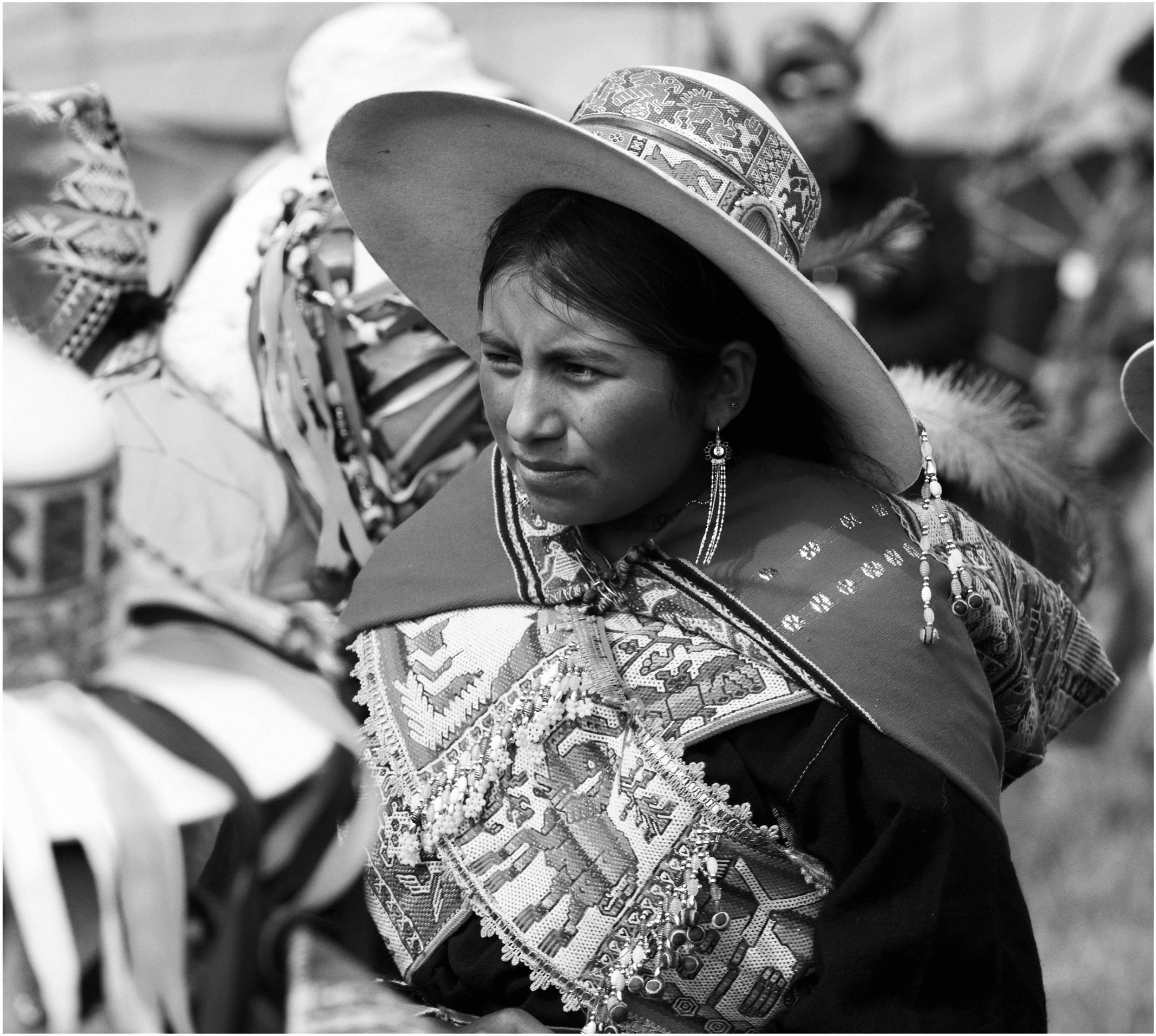
“Universal suffrage was only introduced into our country in 1952 and women were only fully included in the workplace during the 1970s. Land ownership according to legal franchise was reserved exclusively for men until 1996. Changes brought by modernity have been long delayed in Bolivia,” he said.
However change is coming, and that means that Bolivian dress is being re-evaluated. Fashion is playing a large part in this. The typical dress of the chola for instance has even been included, with a number of variations, on the international fashion circuit and at national, regional and local political level.
According to Molina: “The most likely thing is that it [the stratification] will disappear with time. Very few urban youths of indigenous origin decide to continue dressing like their mothers and grandmothers,” he said.
He added: “There have never been instances of repression regarding the wearing of chola dress. Society coexists with it and, in certain cases respects and values it. The outfit is a cultural and political symbol, and you can see any number of extremely elegant variations of it glittering at popular fiestas. However, in everyday life, it is perceived as a sign of origin contributing to discrimination. This, and the fact that it can be uncomfortable to wear, explains its slow decline. ”
Numerous laws bringing more equality for women have been passed over the last 15 years: against racism, discrimination and violence, in support of sexual and reproductive rights; concerning identity and gender, quotas and political participation, amongst others.
However, the reality does not always keep up with the pace of legal reform. In 2015 Bolivia celebrated 34 years of democratic rule, and in those years female representation in the legislative assembly jumped from 2% to 52%, placing Bolivia second in the world for female political representation. But it is the Latin American country with the highest rate of violence against women, and the second, after Haiti, in sexual violence.
It was under Morales’ government, one which has valued and recognised the symbolic value of indigenous origins, that a woman, a former domestic servant who wore a pollera, was made minister of justice, something inconceivable even at the end of the last century.
It is obvious that the political representation of indigenous communities has progressed. In effect many of them are or have been leaders and ministers of state.
According to Molina, however, although ethnic groups are more represented in public life, “racism, the nostalgia for a stratified society in which whites remain the privileged sector, persists surreptitiously and surfaces time and again in daily life, including road rage and types of insult.”
Discrimination particularly against women is often tied to styles of dressing, because it is yet another way to censor, stereotype, separate out and establish hierarchies.
Until the advent of Morales’ presidency, it was at best difficult and often impossible for a woman dressed like a chola to go into a cafe or a restaurant. It remains problematic, despite anti-discrimination legislation, to do so in places where the body is exposed, or in discos or elegant evening venues.
Galindo said that despite Morales presidency, there is still widespread discrimination. “There is a legitimate and glorious fury on the part of all underdogs, in favour of the destruction of a powerful white oligarchy that has governed our country since it was founded, and this strength pushed us to opt for a man such as Morales to be our president. His greatest political capital is his life story and skin colour. It is felt and lived in our daily lives. Nonetheless, from my point of view the institutional response remains too feeble and above all diminished. It remains trapped in folkloric gestures, symbolic acts lacking any real effect.”
Much has changed. Our laws, the tolerance of racism, the unrestrained use of contemptuous language, the exclusivity of the white Western world and still one only has to scratch the surface a little with a fingernail and everything looks as if it has stayed just the same. The way ahead has far to go.
Translated by Amanda Hopkinson