




Abstract
Author
Set in a nameless country, but depicting her native Egypt with eerie accuracy, her dystopic novel, The Queue, was translated from Arabic by Elisabeth Jaquette and had its English-language debut in May – to critical acclaim. But while her work is only now reaching an international audience, Aziz has been a prolific writer of non-fiction and fiction for years. Her collection of short stories, May God Make It Easy, was published in 2007, and the following year saw the publication of her book on police violence in Egypt, The Temptation of Absolute Power. She has been a columnist for Al-Shorouk newspaper since 2010, criticising the regime in an increasingly difficult environment.
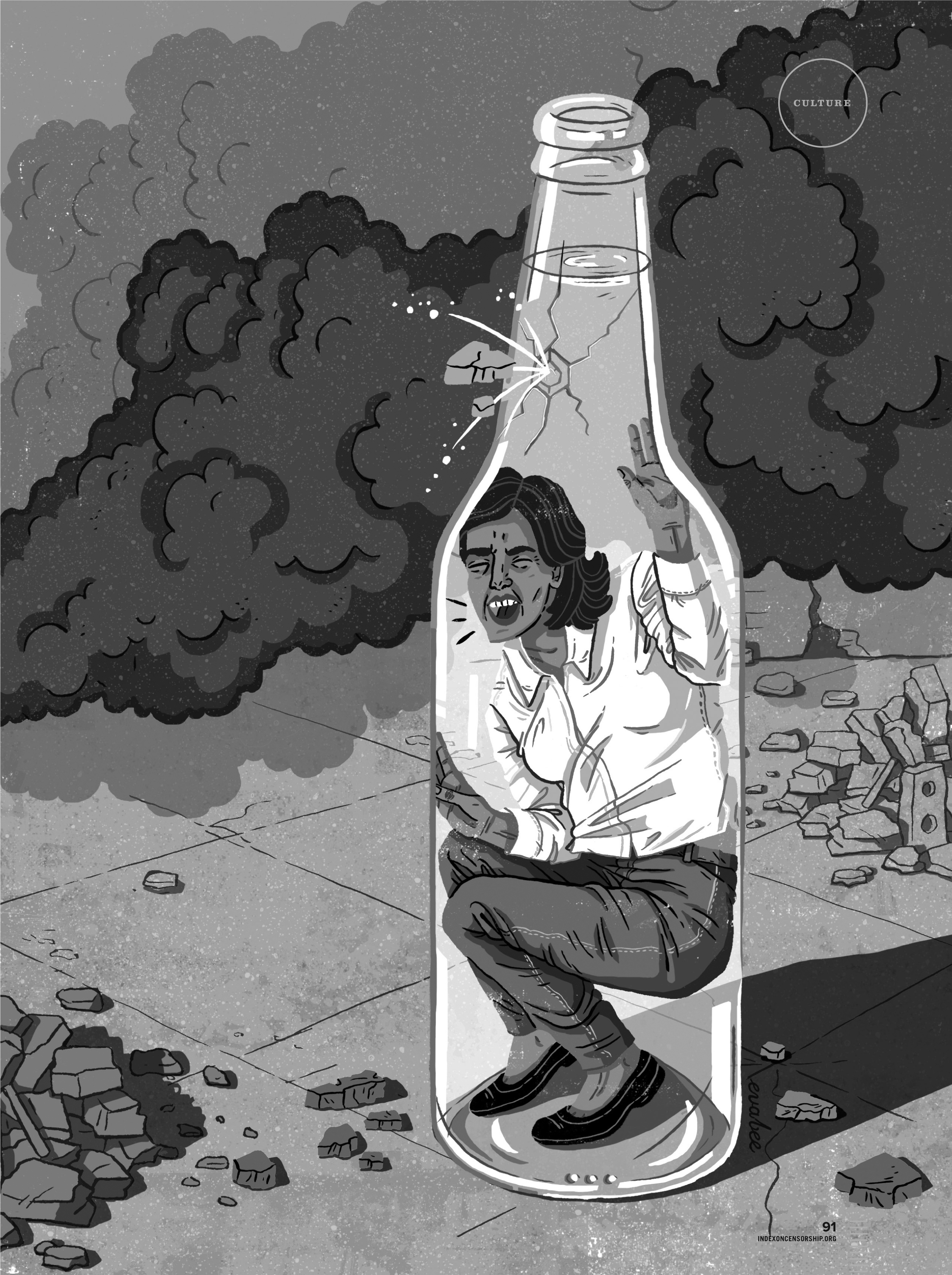
In a new short story, published here in English for the first time, a woman trapped in a glass bottle is able to see, but unable to influence, the world around her. By failing to resist, she views the women, who are concerned only with the superficial details of life, as complicit in the regime. Her inspiration was a pivotal moment of understanding that “we have given away our transient victory to such a totalitarian authority and that we keep turning in the same vicious closed circle, without an end”.
The idea, that in an autocratic regime choosing a superficial apolitical life is itself a political act, runs through both this latest story and The Queue. Passive complicity is not something of which Aziz can be accused, but she has found speaking out increasingly difficult.
She said: “During the last three years, or two years, it is quite different. Writing my column before the revolution I wasn’t facing problems, but now, sometimes, I am facing red lines telling me ‘no, don’t do this, don’t mention that’.”
While the Egyptian constitution, enacted in 2014 following a referendum, enshrines freedom of expression, the penal code has not caught up, and writers and journalists are increasingly being locked up under ill-defined clauses that leave their fate up to largely conservative judges. According to the Committee to Protect Journalists, 23 journalists were imprisoned in Egypt as of December. Fiction writers also face a deteriorating environment; novelist Ahmed Naji faces two years in prison for “violating public modesty”.
Credit: Eva Bee
Public modesty and blasphemy laws in particular are constraining and punishing writers, but Aziz says all parts of public life work together to enforce the power of Egypt’s President Sisi. “Whether you are talking about religion, whether you are talking about politics, whether you are talking about social issues, it is all the same, because all these figures are in unity,” she said.
She had believed fiction to be a more permissible way of criticising the regime. But, in May, a friend asked if he could deliver her books to his brother who was in prison. She declined to give him her non-fiction work, but said he could take The Queue. The novel, however, was never delivered. Aziz said the responsible officers had told her friend: “This book contains certain ideas and thoughts that are not acceptable.”
Nonetheless, for Aziz, fiction remains a powerful way of writing about authoritarianism. “With fiction I am playing on a ground without borders. This fits in well talking about a ruling totalitarian regime, where the citizen’s life is transformed [into a] continuous dystopic nightmare, and where [facts] are very hard to find.”
Fiction can be a useful medium. In researching her latest non-fiction book, an exploration of military and religious discourse, it was difficult finding people to go on the record. Her research was intended for a master’s degree, but the university refused to accept the thesis. So she decided instead to publish the work in a book. “But the publishers were also scared and told me they would not publish it. So I kept searching for a publisher that would accept this risk. I found one, but this is the way things are going now,” she said.
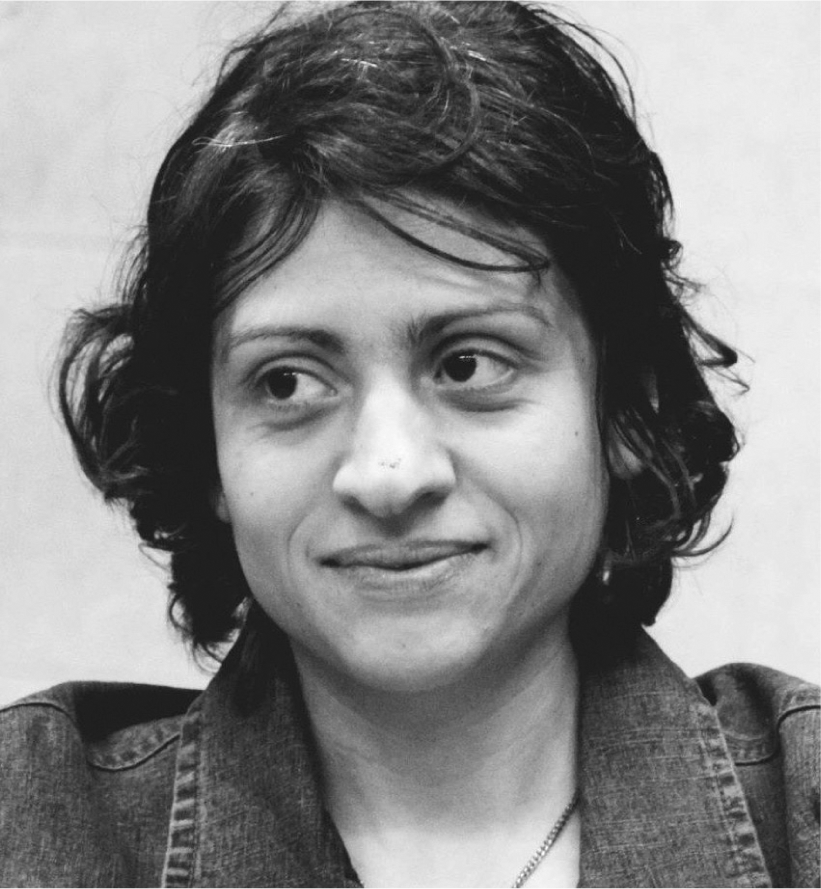
Author Basma Abdel Aziz
Although “a huge number” of her friends are now in prison, she insists the risks will not stop her. “I am continuing to oppose this regime’s extreme violence and torture. And I will keep doing it as long as I can.”
On the next page, we publish a new short story by Aziz, never previously published in English.
Bottled up
What if I were to start my day on a different footing for a change? I could break my habit of a lifetime and leave the house without my usual cup of tea in the kitchen. What if I tried out being lazy? I could shove aside the reams of paper people are always streaming into the office with. I could just ignore it all and let it pile up and clog up the system – accidentally, of course, on purpose.
Or perhaps I could go and sit in the bathroom, and idle away a couple of hours in there. I could wander aimlessly from one colleague’s office to another, stopping here and there for a chat, maybe a cup of coffee or a bite to eat. I’d sit back with a carefree yawn, my notebooks and files piled up in front of me, gnawing on a pencil that splinters between my teeth. I wouldn’t bother with any correspondence or with responding to any queries, no matter how pressing. Instead I’d gaze on idly as the people wait, crushed by their exasperation. But why should I feel the need to do anything about it?
I could also let myself go, put on a bit of weight. As my clothes got tighter, my bulging ass would shake when I walk. My stomach would rise in shapely contours, rather than clinging as it does to my spine. No longer would my bones almost protrude from my flesh, grating on the metal chair when I sit. Instead, they would be generously cushioned by my ample backside. And I could make the most of my new look to try out new outfits, like flowing skirts and tight, flowery tops with revealing necklines that give a glimpse of my neck and shoulders. And impractical, high-heeled shoes.
I lie in bed a while after waking up and indulge these vivid daydreams. I stretch out my legs and fidget between the warm and cold patches, ignoring the knock at the door and the fact that the cleaning lady might go if I don’t let her in. I get up and stretch lazily as I walk to the bathroom. I turn on the tap and wait for the hot water to trickle out, feeling even more relaxed once the knocking stops and I know that I’m on my own. I massage my face with some moisturiser a colleague gave me a few years ago after a trip to the Gulf and which I’ve never used. Then I sit down and surrender myself to the sun. I ring round my girlfriends to catch up on the TV news and the latest chart hits. The hum of their voices spills into my ear from the handset, the chatter of girls who have no idea that there is a revolution taking place in the next country, girls who are oblivious to that fact that our neighbours have taken to the streets, that their tyrant has fallen and that others have followed.
Like them I change the channel when the news comes on. I stick plugs in my ears and wander off into the kitchen to make myself a snack. I try not to notice the dust kicked up by all the people falling around me. I get out the vacuum cleaner and run it over everything in my path, trying to suck up the words swirling in the air around me, determined not to let them spoil my new mood.
It isn’t long before the vacuum cleaner is full and overflowing. Reaching its bursting point, it starts to spew out everything it has sucked up, choking the space I have just cleared around me. I realise that my attempt to slip out of my skin has come crashing down. The moisturiser hasn’t made the slightest difference. A frown beckons, tantalisingly – a scowl that has lurked within me for years. If only I’d just let the chubby cleaning lady in and let her do her job, she would have saved me from having to change everything and I could have carried on with life as it was.
I sit at the table, my elbows resting on the vast quantities of notes I’ve scribbled. I am always writing one thing or another, because I am overwhelmed by impossible possibilities, because their failure to materialise is wearing me down and because their materialisation has become my only dream. And all this time I’ve been living at the bottom of a huge glass bottle. This bottle is where I wash my clothes, where I eat, where I exercise, where I work, where I write and study and scream out loud. It’s where I sleep, where I wake up, where I relieve myself. This bottle is running out of space for me and my non-proverbial excretions; but no matter the pressure, the stopper never pops open to let me pour out. The bottle insists on keeping me trapped inside. When it once decided to expand a little, I relaxed, telling myself I could finally breathe. But it wasn’t long before it went back to how it was before – hard and inflexible. It pressed against me so tightly and for so long that I was reduced to a mere figment of myself. Nothing remained of me but a hoarse, broken voice.
I resolved years ago that I’d escape, but I never get anywhere, no matter how I twist and contort myself. I’ve tried every position, every posture – to no avail. But maybe if I get fat and lazy, if I keep quiet and keep my head down and my skin well moisturised – maybe then the bottle will break.
And while I wait for this bottle to shatter around me, I write about an idyllic day, when I can finally let my guard down, when I don’t need to shout or scream. I walk among the protesters, a little light headed from the exhaust fumes. I buy myself some sugar cane juice and lean against the metal police barrier, the sun beating down, making me frown. But then I half smile, my mouth slightly open. The sugar cane juice has doubled in price, but I pay for it without losing that light-headed, happy feeling. I wipe my lips and throw the paper napkin onto the ground, which is covered in little puddles. I watch the edges of the paper soak up the water. I see the sodden tissue expand and stick to the ground. I wipe my shoes with it until they shine and I walk on in peace.
The sheet of paper I’ve scrawled on is covered in random, misshapen blobs inching along, trickling from one word to another. Some words have merged, others are illegible. Despite disappearing from the page, these words are still trapped in this bottle. Perhaps someone will find it and crack it open. Perhaps that someone will pour some of the contents down his gullet. And as he belches, the bottle’s trapped contents will seep out into the air, filling it with the fresh scent of revolution for everyone to inhale.
Footnotes
Translated by