




Abstract

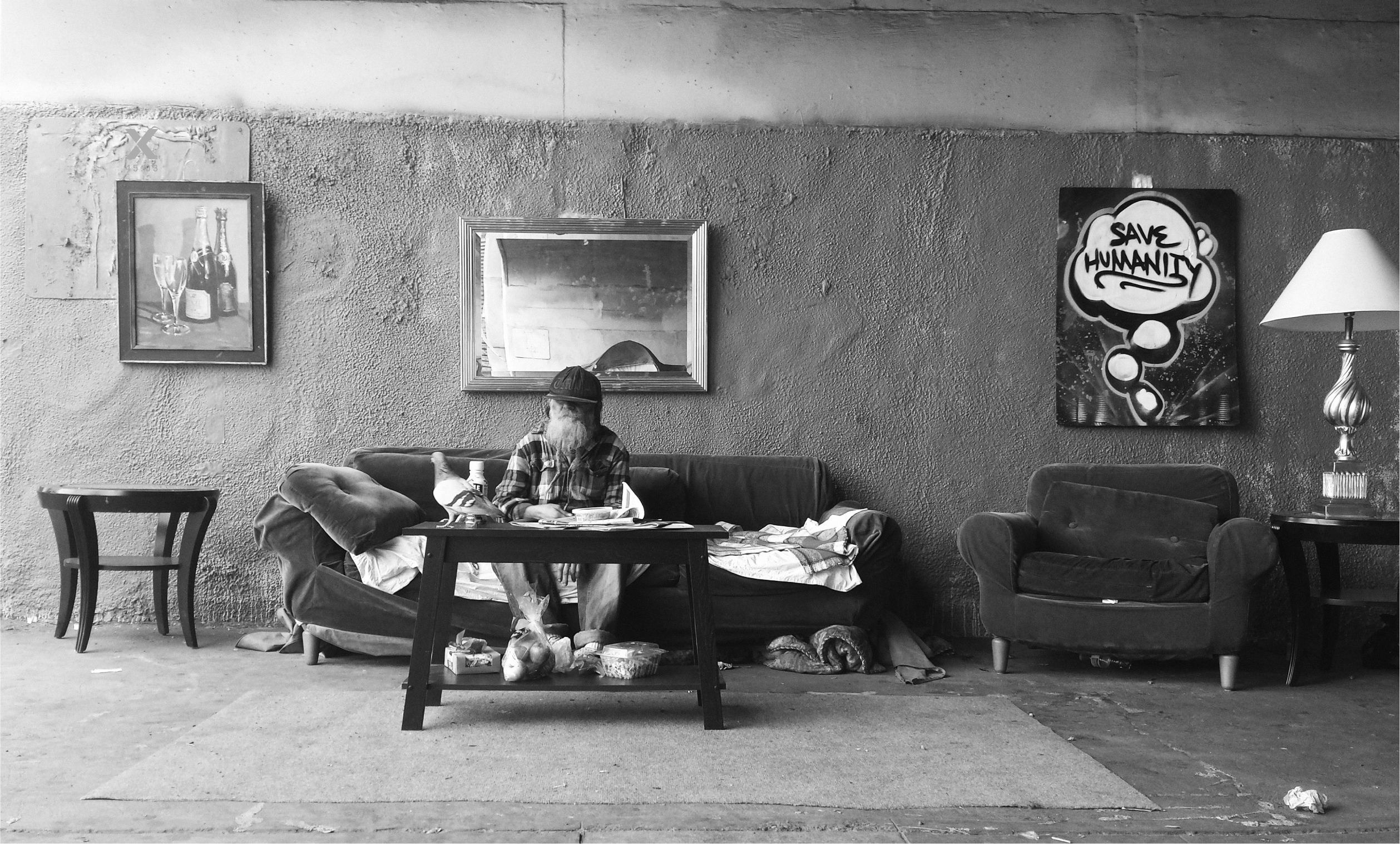
Birdman, one of Skid Robot’s most celebrated subjects, had lived under a freeway for more than 20 years
CREDIT: Skid Robot
Los Angeles graffiti artist
Writing as Currer Bell, Brontë hoped she would be taken more seriously if readers didn’t know she was a woman. JK Rowling attempted to remain incognito as a crime novelist by publishing under the name of Robert Galbraith. Historically, fear of persecution has also led to artists and writers choosing to wear a mask.
So in a data-driven, Instagram-rich world, how hard is it to preserve anonymity as an artist and how far does that anonymity force us to look more closely at the message in the art, rather than at the artists themselves?
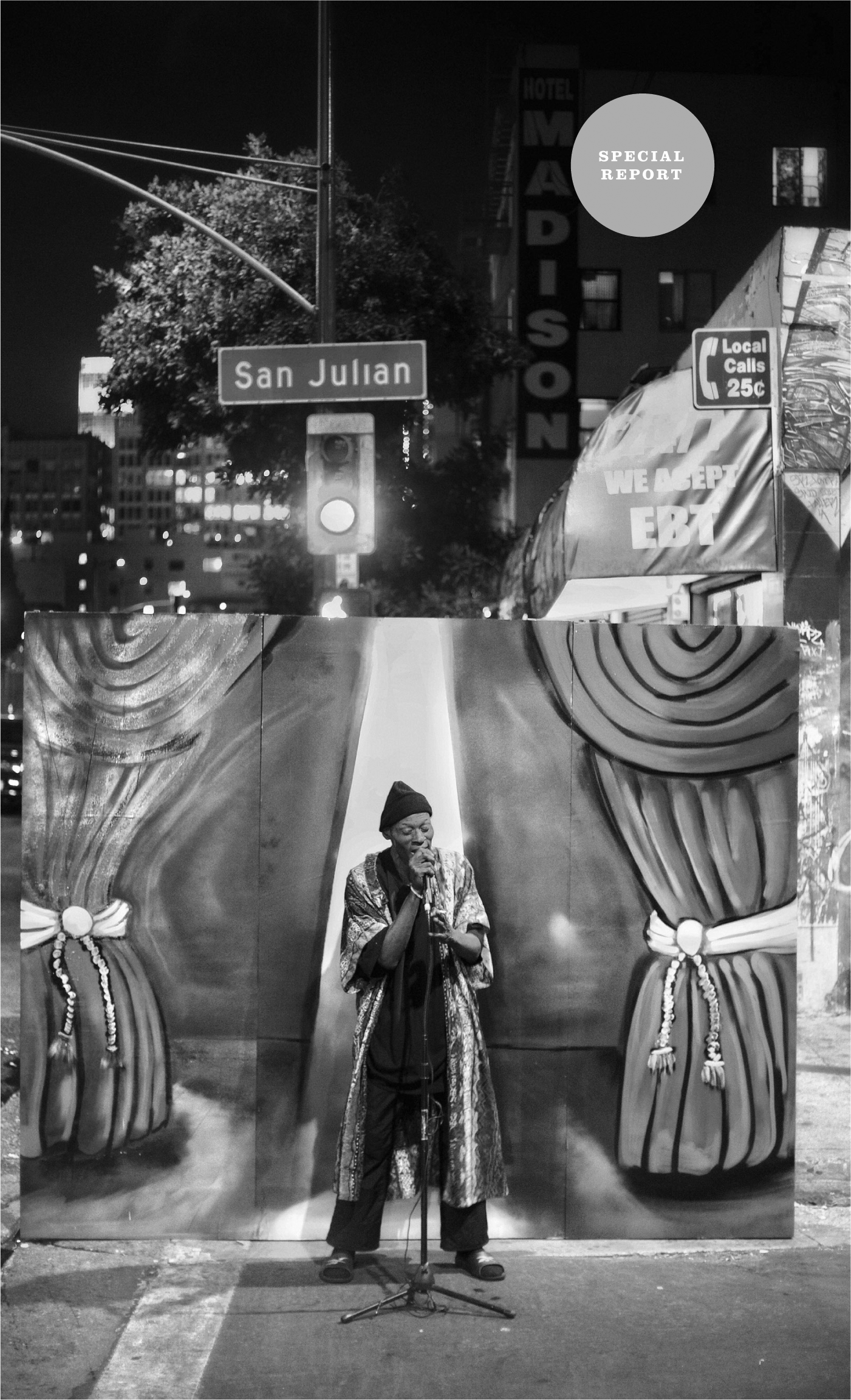
On any given night in Los Angeles, a young man with a spray can is attempting to highlight the problem of homelessness in the city. Skid Robot paints tiki huts and palm trees, living rooms, bedrooms, thrones and leafy forests behind living subjects in an attempt to give humanity to the estimated 8,000 dejected and forgotten men and women who live on the city streets, concentrated in a 54 block area of downtown known as Skid Row. They are part of the county’s record 47,000 homeless.
Skid Robot, whose name is a mash-up of the area he’s trying to draw attention to and the toy company Kid Robot, has been working on the streets for two-and-a-half years in what he calls a Living Art Project.
Already a graffiti artist, he’d been looking for more purpose to his work. Out on a date night with his girlfriend, he found it when sitting at a red traffic light in downtown LA’s Skid Row area.
“The conversation we were having was about the lack of quality in street art in LA – that it was more like marketing, done to post on social media – rather than artistic. I felt it devalued art. So I was yearning for a new way to express myself,” said Robot.
“My girlfriend drew my notice to a homeless person sleeping on the floor and said I should draw a dream bubble over her head so I grabbed my spray can and jumped out and drew a bubble with a bag of money inside it and that was the seed of the project.”
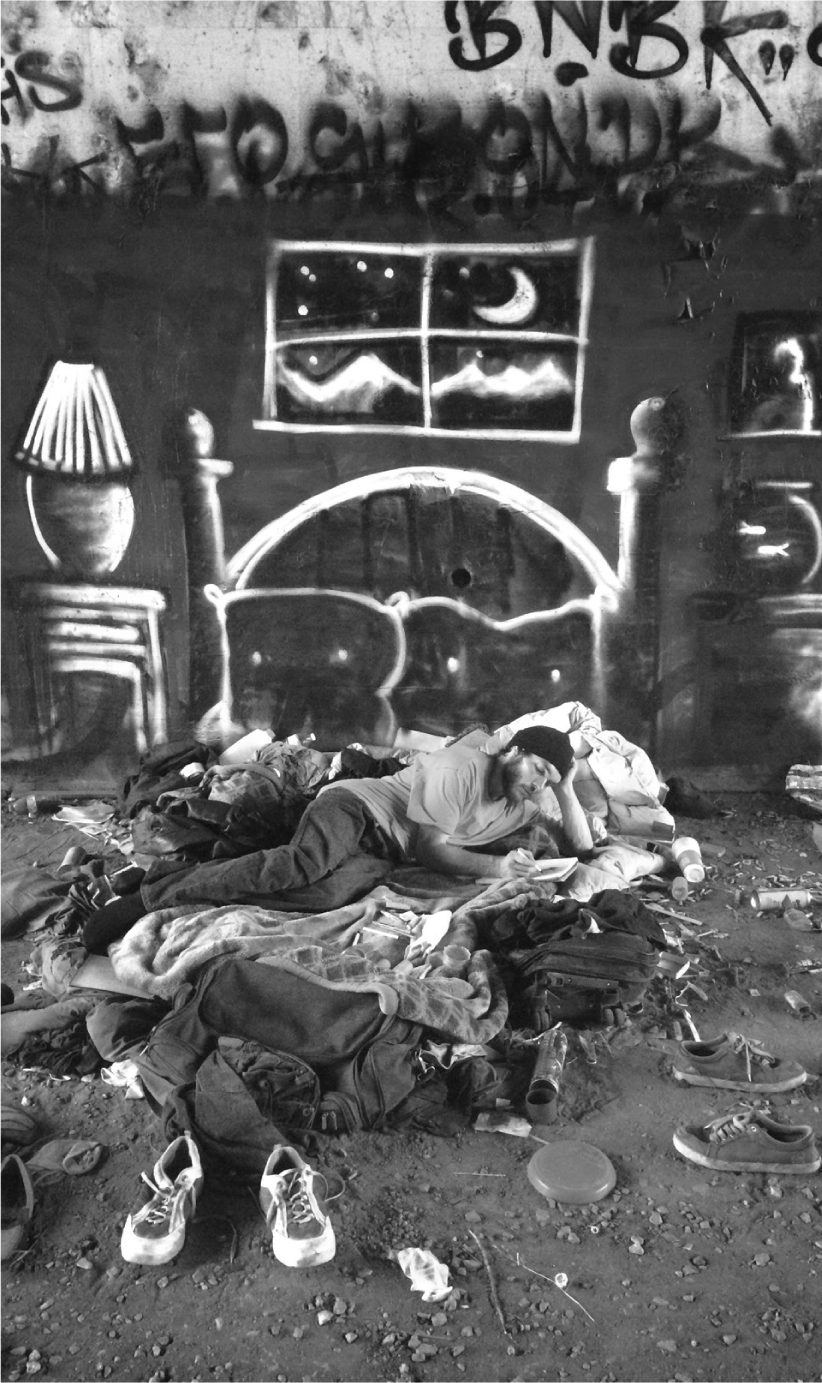
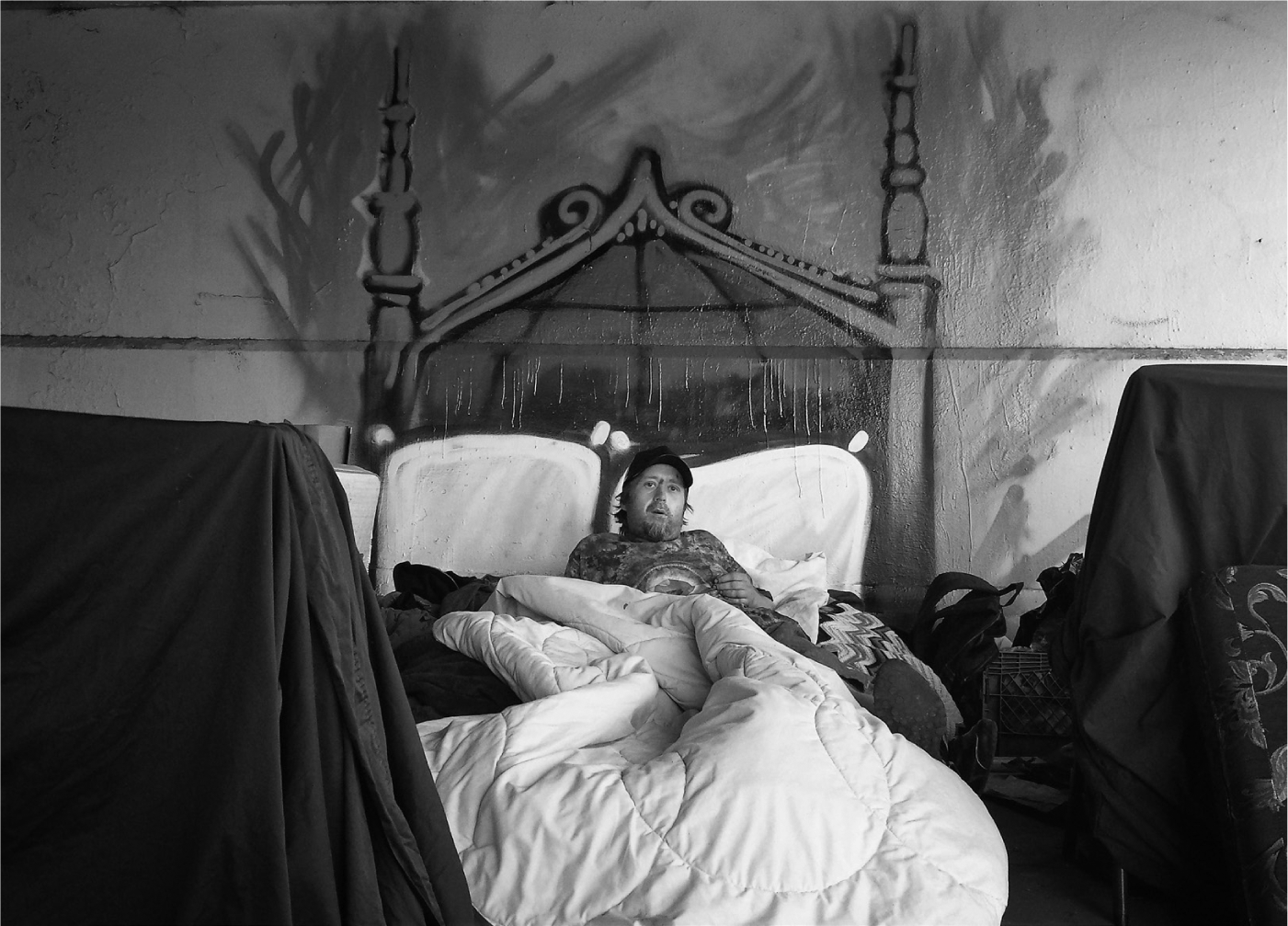
The work quickly progressed to intricate paintings with a lot more gravitas, often with added furniture to create full installations, with his subjects posing in new roles as homeowners sitting on sofas, reclining on beds, or in tents surrounded by trees in a forest. Robot transported those living on the streets, albeit fleetingly, away from the grimy reality of a gloomy underpass or street corner.
“I saw a man in a wheelchair one day. We’re all kings and queens, so I painted him on a throne in a very active part of Skid Row. It made him feel good as people passed by and noticed him. It gave him a sense of his worth,” said Robot. “The artwork takes them to a different reality. We make friends and find positivity through art.”
“One of the elements is obviously that graffiti is illegal but also it’s because what Skid Robot is doing is more important than what I’m doing,” he said.
“We live in a vain and shallow society and maybe if some people find out I’m a particular race, say, and they have a bigotry of any kind, that may dilute the message and the art is the message. It’s not about who I am or what I look like.”
Some of Robot’s off-the-beaten-track works are still visible around the LA streets, but most get swiftly removed by the city. The ephemeral nature of such anonymous art is not a problem for him though. “In a sense, it’s only living art while the subject is still with the artwork – once they get up and move away, it changes anyway,” he said.
Skid Robot’s installation Under a Bridge Downtown. J.W., pictured in the photograph, is also an artist
CREDIT: Skid Robot
The art, though ephemeral, can have a lasting effect. One of Robot’s most celebrated subjects was Birdman, who’d lived under the freeway for more than 20 years.
A selection of Skid Robot’s works from his Living Art Project, taken on the streets of Los Angeles
CREDIT: Skid Robot
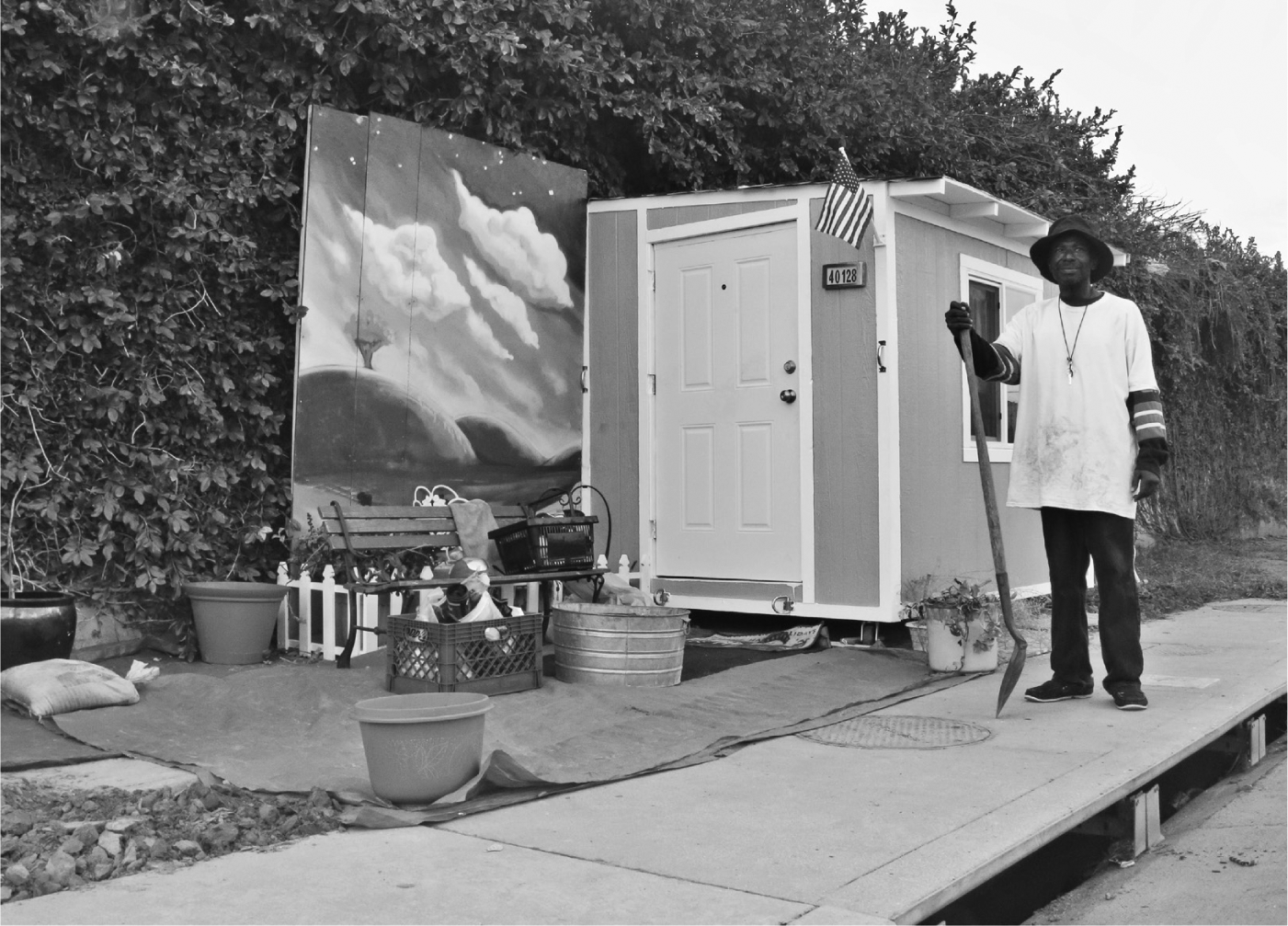
A selection of Skid Robot’s works from his Living Art Project, taken on the streets of Los Angeles
CREDIT: Skid Robot
“The living room installation I made him, gave him the gift of feeling he had a home – he hadn’t shaved or cut his hair in 15 or 20 years. Within a week he had cut his hair. He found a non-profit that helped him into an apartment. It all came about through art and the friendship that we created together,” said Robot.
The biggest threat to Robot’s anonymity? “Arrest, clearly, because graffiti is illegal.”
So far, he’s been lucky, though he’s had a few close calls. He was painting down by the LA river one night and some cops showed up. Robot backed away, tossed his paint and played drunk but was caught literally red-handed – with paint on them. He thought the game was up as he was loaded into the back of the police car, then realised the cops were looking at the work – a tiki hut and palm trees – and laughing. It wasn’t a gang tag, just a pretty picture. They let him go.
But if his luck runs out, he’s prepared for it. “I’m not afraid of arrest if it’s worth it to bring even more attention to the project,” said Robot.
So why does no one give him or other anonymous artists away?
“I think no one wants to go down in history as ‘the rat’, to be labelled as that,” he laughed. “I’m careful – I can’t be sure of everyone so there’s always that risk, but if people do find out who I am, it won’t change what I’m doing. There’s a kind of cops-and-robbers excitement around what I’m doing and graffiti is illegal, but some of it enhances our environment so there are people who enjoy that and wouldn’t want to give me away. We are creating an impact. If we are telling stories this way we can start to change things and I think a lot of people value that,” he said.
“Thousands of commuters drove through that underpass every day and saw Birdman and the fake room and they started to look for it and it created a memory. Eventually we put a tiny house there and I bought fake grass and a lawn chair. Then the city took the tiny house and so I tagged [Los Angeles mayor] Eric Garcetti’s name with the message: ‘You can take a man’s home but not his spirit’.
“The mayor responded on my Instagram! To know he acknowledged it and felt he had to respond revved it up. We got his attention.
“I started this project from the heart and I was passionate about it artistically. This [Skid Row] was such a chaotic place that I was compelled to do something about those who are ignored and marginalised,” he said.
“It started with people and dream bubbles and continues to evolve. My aim is to provide shipping container homes painted by artists, a Bauhaus-type mentality combining art, design and technology. It’s not a permanent solution but will surely do in a crisis like this.
“A big part of the anonymity angle is that I’m trying to say to people to treat other people as you want to be treated, save humanity. It isn’t just homelessness that’s the issue. We might lose a lot of our freedom because of the way political leaders are acting. Our apathy to this is the same as the apathy that might goose-step us into war again one day in the not too distant future,” said Robot.
Despite what he sees as lack of real action by the city of LA to tackle the homeless issue overall, he’s optimistic. “A hundred per cent. We can have a flourishing reality through the Living Art project. There are plenty of angles to work and plenty of people with heart including artists, musicians, architects. It’s like a ship or a rocket. I hope people will jump on and we’ll create that new frontier through the human spirit,” he said.
“The mask of anonymity is important because it’s the living art that takes precedence, not me, but if I have to come out from behind the mask at some point because it would further the solution, that’s what would have to happen. It isn’t like I’m a Banksy who thinks: ‘I’m anonymous because I’m cool’. It’s because I am the people and I have to connect with the people to get the message out and create change.”
A selection of Skid Robot’s works from his Living Art Project, taken on the streets of Los Angeles
CREDIT: Skid Robot
Find out more about Skid Robot’s Living Art Project at skid-robot.com