




Abstract

The growing popularity of Chinese art has been both a blessing and a curse. As major art exhibitions open across the world,
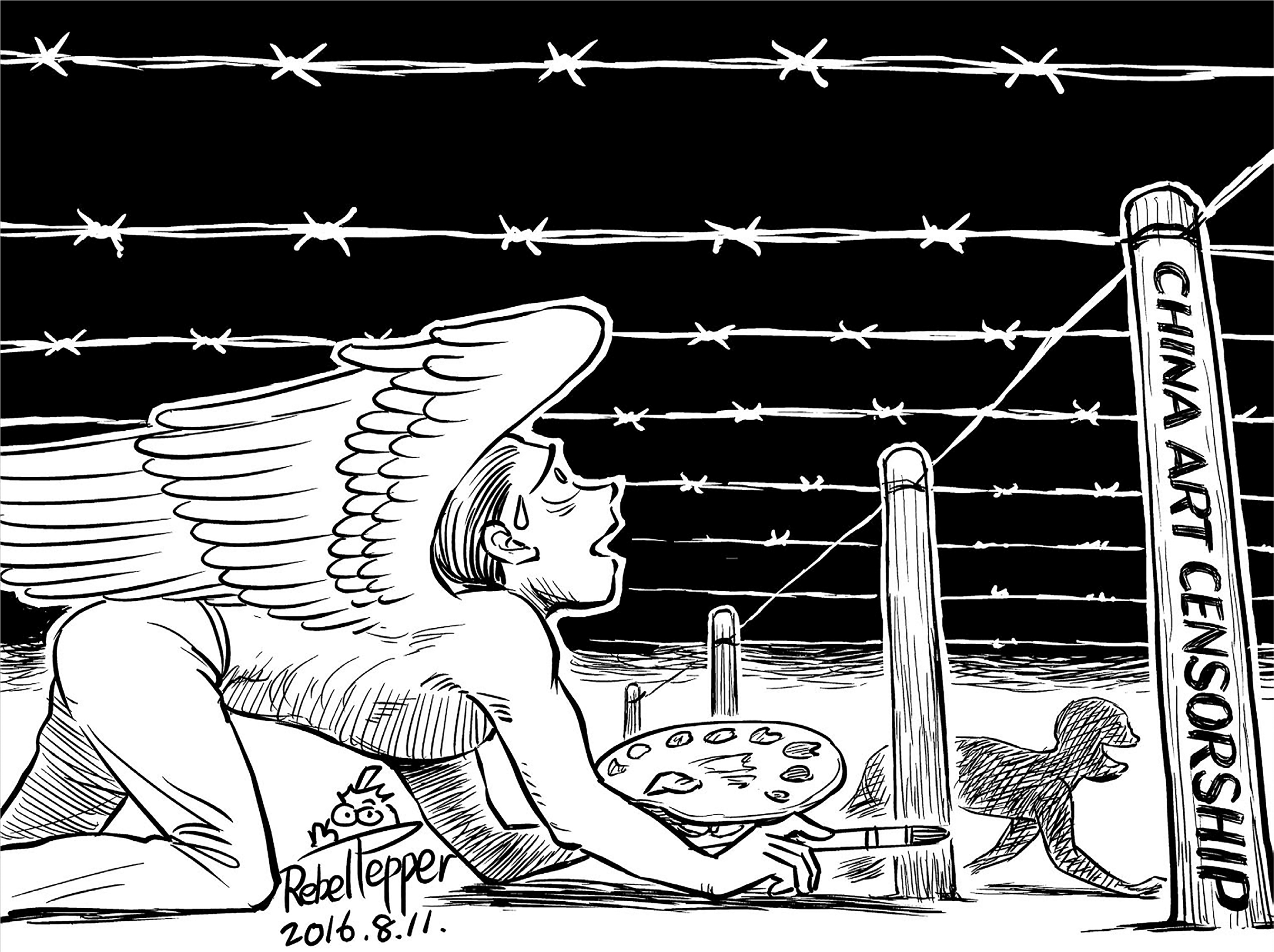
ILLUSTRATION: Red Pepper
For outspoken artists, the higher profile of Chinese art can work in their favour. The international outcry at the artist Ai Weiwei’s arrest is testament to this. His reputation brought world attention to his imprisonment, and he was freed.
Equally though, increased popularity can mean restrictions on artists. While art has never been completely removed from the political in China, its niche status meant that it was lower down on the list of industries about which the censors cared. TV, radio and cinema, all media with mass appeal, were more closely scrutinised. Now as galleries across the country attract significant footfall and the position of the artists within Chinese society is elevated, the authorities are paying closer attention to what artists are doing.
For an exhibition to take place in China today, curators must get approval from the government. A curator at one of the biggest galleries in Beijing, who requested anonymity, explained to Index how galleries must submit censorship lists, titles and descriptions of all the works they proposes to exhibit in public.
“[President] Xi is very authoritarian. Until recently the art market was not that affected by this because it was very small with little influence. That is starting to change. The government is overseeing public museums more carefully today than they did in the past as a result of more popularity,” the curator said.
How the government is responding to artists who seek to provoke is less clear. Last year Ai Weiwei was suddenly given his passport back and able to travel. It was a surprising shift after his imprisonment and attempts by the Chinese authorities to disrupt his work and intimidate those who promoted him after he was freed.
Other artists have found themselves under relentless attack. Recent years have seen arrests, alongside calls on artists to promote socialism in their work – a sentiment that led to China’s censors, in the form of the State Administration of Press, Publication, Radio, Film and TV suggesting artists should be sent to live in rural areas so they could “form a correct view of art”. It all sounded reminiscent of the cultural revolution.
Some have suggested the return of Ai’s passport was a subtle way of asking the provocative artist to leave China altogether.
Joyce Yu-Jean Lee, an artist who has worked in Beijing, thinks differently.“What is happening right now is intentionally erratic,” she told Index. “With Xi it’s very aggressive and the patterns are less obvious, so everyone is on their guard constantly,” she added to explain why sometimes the authorities are very harsh and other times they appear more lenient.
Speaking to people across China’s art community, from artists through to curators, this erratic pattern is palpable. Zhang Dali, one of the most high profile artists from modern China, describes censorship as becoming “less and less” today. But a spokesperson for the well-known LWH Gallery in Shanghai, which has a reputation for collaborating with Tibetan artists, said working with Tibetans had become tougher of late.
Coupled with a changing political climate is a changing economy and this is also playing a role in censorship.
Money being invested in art has led to the rise of self-censorship as artists “sell out” to commercial interests. The artist Zhang highlights an important shift since his early career in the late 1980s and early 1990s. “At the time we were very interested in philosophy and in politics. There was no consumerism. Now young people are more interested in how to change their own life. They are not so interested in common or public problems. Life is very expensive.”
Contemporary Chinese art made its debut in a very different context when the country was a lot less wealthy and money-orientated. In many ways it was born out of a struggle for free speech. Most people attribute its arrival to 1979. On 27 September of that year, three years after the death of Mao Zedong and the end of the cultural revolution, a group of young artists displayed their work outside the National Art Gallery in Beijing. These works were bold, influenced largely by Western modernism, an artistic style that had been forbidden during the Mao years when artwork was subservient to political dogma.
Within two days, the week-long exhibition was shut down. The artists and their supporters responded by holding a demonstration. One of the leading artists, Wang Keping, a sculptor, brandished a placard with five characters on it: Want art freedom.
It was a defining moment – the first time in China that artists had challenged Communist Party censorship, rather than kowtowing to it. The group of artists were dubbed the “Stars Group”, as they were thought to be like stars in the night sky, struggling to be seen and heard.
The artists’ efforts paid off. The government allowed them to exhibit their work in some of the most important art institutions in China. The 1980s were seen as an important period of freedom, experimentation and growth for Chinese art.
That said, openness was only tolerated up to a point. In February 1989, for example, a Beijing show China/Avant-Garde, which displayed highlights of China’s art movement of the 1980s, was closed down on the same day it opened.
Shortly after came the violent crushing of the student-led demonstrations on Tiananmen Square. In the aftermath several avant-garde artists adopted cynical realism in their work, seen to exemplify the disillusionment with Chinese society. But others, fearful for their lives, muted their opinions or fled the country altogether. This chilling effect, combined with an increasingly affluent population, changed the game.
And yet today it is not just Ai Weiwei who refuses to play by the rules. Ren Hang is another example. Ren is one of China’s most provocative artists and co-curated a show with Ai in 2013. Like Ai, he is no stranger to the authorities. They have threatened to arrest him and, as he told Index, plenty of his work has never been shown publically. His website is constantly banned. Still, he continues his work and says that he would never self-censor.
Unlike Ai, Ren’s work is not political. His signature photographs blend nature with nudity. This work falls under another category banned in China: pornography. Since the ascent of the Chinese Communist Party in 1949, pornography or obscene content has been forbidden under Chinese law. In fact, the most common censorship of art is within the moral sphere. For most of Mao’s era, displays of nudity were forbidden. Even today, nudity and sexuality are sensitive topics.
However, there are subtle ways to circumvent censorship.
“You can present a different version of the exhibition to the one that will be on display. That’s a common practise,” explained the anonymous curator, who believes that a lot of the censors are not educated enough in art to understand the nuances and messages of the work. The curator also reveals that there are secret rooms in many of the top galleries, used when art is considered too political.
“If we sense something is very political, we put it in a private space,” the curator told Index, citing examples of several major artists whose work has been shown privately. It’s a concession to be sure, but at least it is something.
All of this goes a long way in explaining why, despite today’s opaque censorship and the pressures of commercialism, experimental and irreverent Chinese art exists, as do bold, brave artists. Of course not all good art needs to be political or sexual. For those artists who choose that path though, there are ways to exhibit both at home and abroad.
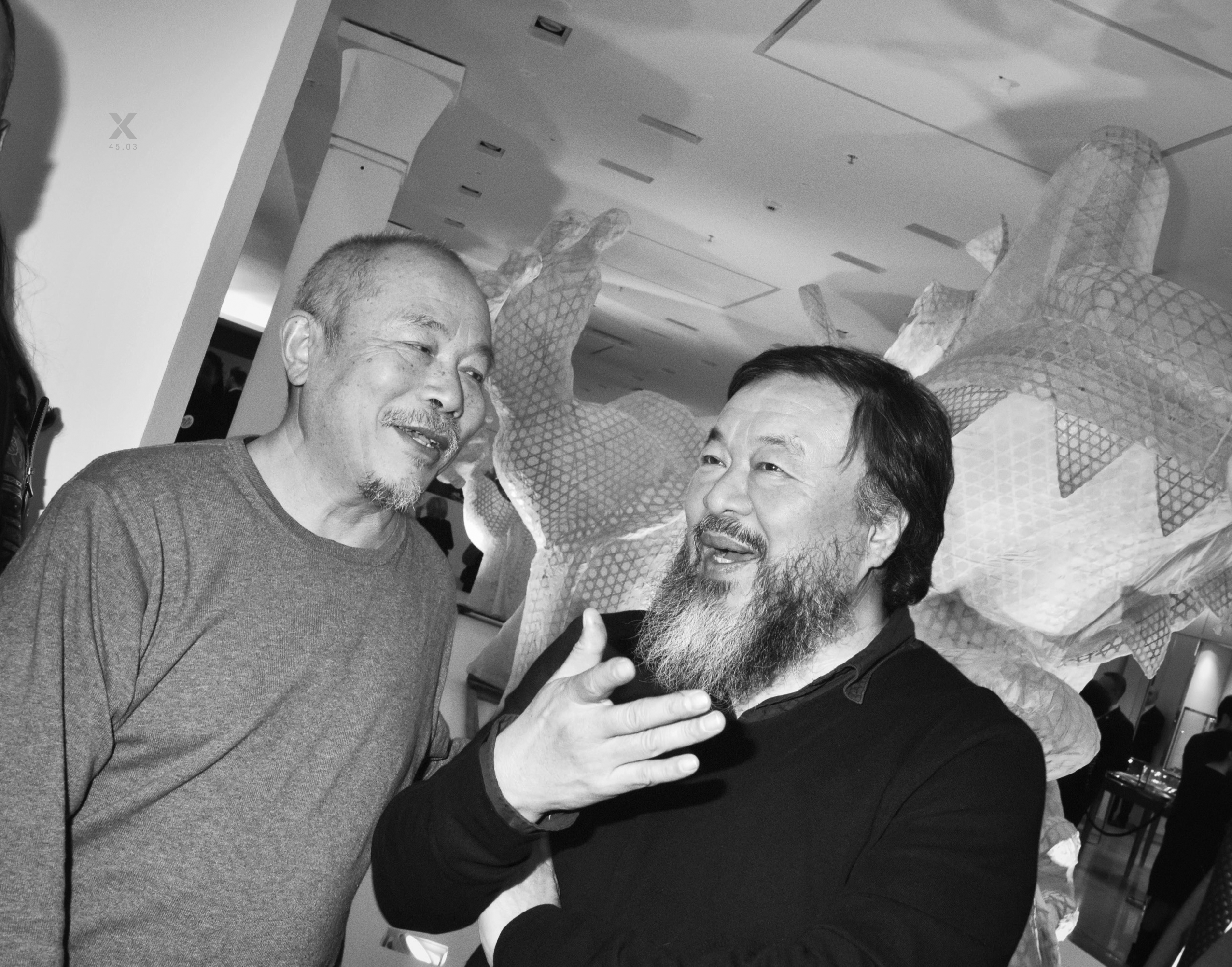
Sculptor Wang Keping and Ai Weiwei in Paris in January 2016
CREDIT: Foc Kan / Getty
Beyond borders
Censorship of Chinese art is no longer confined to works on show in China
Artist Joyce Yu-Jean Lee’s exhibition was never going to be embraced by the Chinese government. The idea was to create a pop-up internet café in Chinatown, New York. It would look like a regular cafe, except all the computers’ internet connections would run through a Chinese server. After browsing online for some time punters would likely come across the commonplace page on the Chinese internet − 404 error.
Lee, who had worked with artists in China in the past, was interested in how censorship affected creative output for ordinary people and for artists. She wanted to raise awareness of this and hence her art project FIREWALL Internet Café was born.
It was timed to open during Chinese New Year 2016 and to close on the first anniversary of the arrest of five prominent Chinese feminists, in early March. One week ahead of its official opening, a panel discussion was scheduled to act as a soft opening. The discussion, Networked Feminism in China, included several high-profile Chinese figures, including Lu Pin, a feminist who lives in the USA. Another participant was a Chinese lawyer still based in China.
As sensitive as these topics might be in China, Lee never thought she would have a problem discussing them in New York. But the night before the panel discussion, the lawyer was contacted by her boss back in China. Officials had heard about the talk and wanted her name to be removed from it.
“She was basically banned from being part of my project,” Lee told Index.
“Her participation was auxiliary and the project was in New York, so I was very surprised,” she added.
Nevertheless, Lee took her name out of the project, which involved deleting all social media.
“It was very strange doing a project on censorship and to be censoring – it was the antithesis of what our aims were. But we take security very seriously,” she said.
All of those involved assumed this was the end. It was not. The threats started to escalate and it became clear that there would be serious ramifications. Lee did not want to divulge more information out of fear it could compromise the participant further.
The event took place with different speakers. As for the cafe, it still opened, just with everyone on guard.
“I was told there might be plain clothes government officials in the audience. We were very cautious after that, not speaking as openly as we would have liked,” said Lee, who even eschewed an invitation to speak on Voice of America, an opportunity she would have ordinarily leapt at.
A few months on, Lee is still wondering why her exhibition and its events were in the firing line. She has a few theories – that the government was watching and scrutinising feminists more in the lead-up to the anniversary; that lawyers are currently under attack in China and it was part of a tactic to keep them at bay; or that it was to do with her connections with freedom of expression activists.
“So perhaps a partnership with them was problematic,” she said.
There are no certainties, except that the Chinese government is paying far more attention to its reputation abroad than ever before, and exercising a lot more muscle to control it.
JS