




Abstract

From a means of protest to a lifeline for prisoners, letters have been a hugely powerful tool for writers and activists throughout history.
Soviet activists Pavel Litvinov and Larisa Bogoraz, made the first move when they wrote to The Times in 1968 asking the international community to condemn the sham trial of a group of dissidents. A group of incensed intellectuals – assembled by poet Stephen Spender and his wife Natasha, and including WH Auden, Henry Moore and “Mrs George Orwell” – sent a telegram of solidarity to response. But – and here’s the kicker – Litvinov wrote back and asked if they’d be prepared to act on their words and form an international committee with “some sort of publishing house”. To cut a long story (and four intervening years) short, Index on Censorship was born.
Index’s history is full of powerful, inspirational letters. Many have made it on to the pages of the magazine, from the 1990s prison letters of Nigerian environmental activist Ken Saro Wiwa to Kurt Vonnegut’s 1973 letter to the chairman of a North Dakota school board after they burnt his novel, Slaughterhouse Five, because it was “unpatriotic” and used “obscene language”.
What is it about a letter that is so powerful, and, in the age of quick-fire email, is this a craft we are losing? Will future historians have trouble researching our correspondence since we moved it almost entirely online?
Author Shaun Usher referred to letters as “priceless time capsules” in the preface to his best-selling 2013 book Letters of Note. In 2009, Usher started a website to collate historical correspondence. Evidently, the public had a similar appetite for this sort of nostalgia. The site spawned two books and sell-out Letters Live events, where notable correspondence is read aloud by equally notable speakers, such as actors Ian McKellen and Gillian Anderson, and musicians Thom Yorke and Jarvis Cocker.
Email doesn’t compare, according to Usher. “If I’m reading an email I’ve always got my eye on something else,” he told The Guardian. And it is that ability to capture attention that makes letters such a vital tool for campaigners.
The Bishopsgate Institute, a charity-funded library in central London, has a large part of its collection devoted to the history of protest and campaigning. It also houses all of Index on Censorship’s archives, including many files of correspondence. On a recent visit, I called up a 1975 letter from Iranian writer Reza Baraheni. It arrived in a magnolia-coloured folder, bound by cotton tie and containing a collection of Baraheni’s prison poems. Intriguingly, he had also sent his CV, despite being eminently qualified to write for Index. Reading through his words felt like eavesdropping on history.
CREDIT: Muriel Lester Archive at Bishopsgate Institute
“Letters are wonderful as they often reveal more about the person sending them than the person receiving them: the handwriting, what is attached to them,” Stefan Dickers, library and archives manager at Bishopsgate Institute, told Index. “They are incredibly personal. Much more thought goes into them than an email. Writing them was an actual process.”
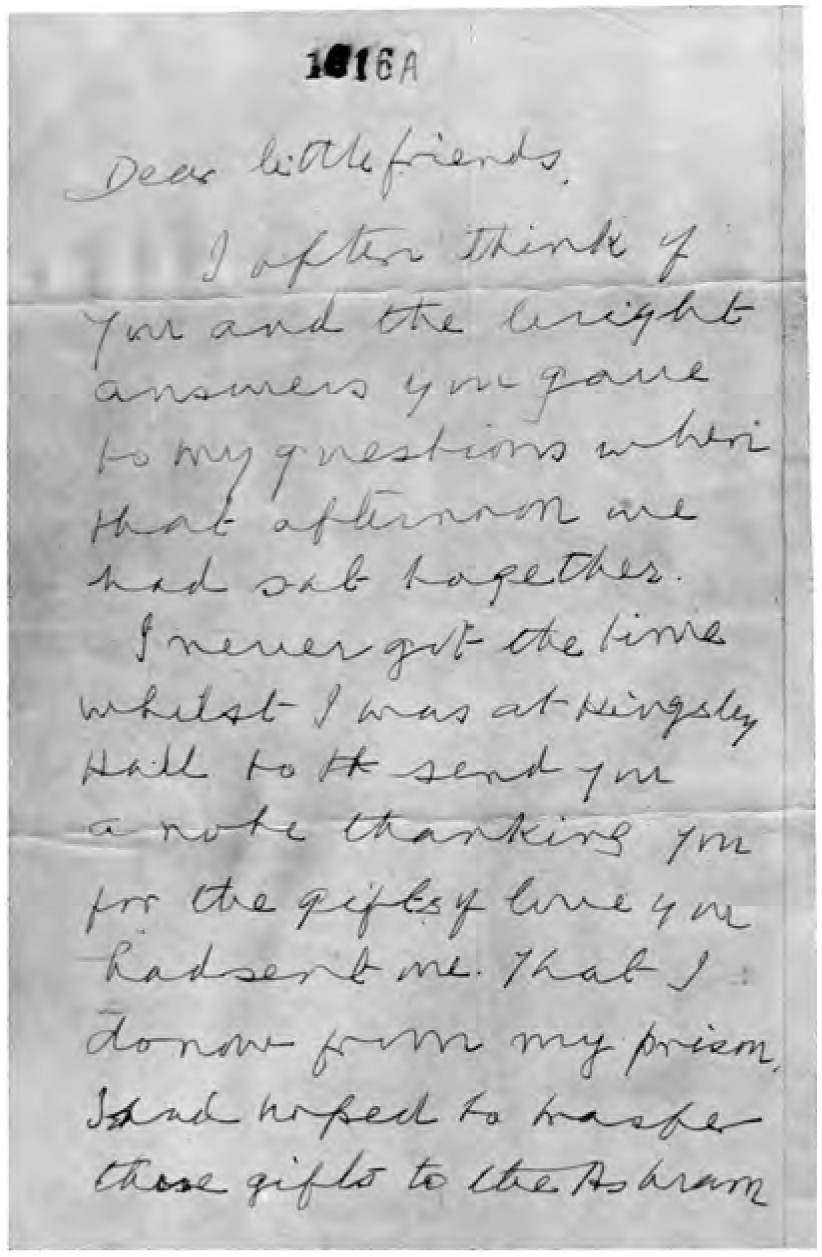
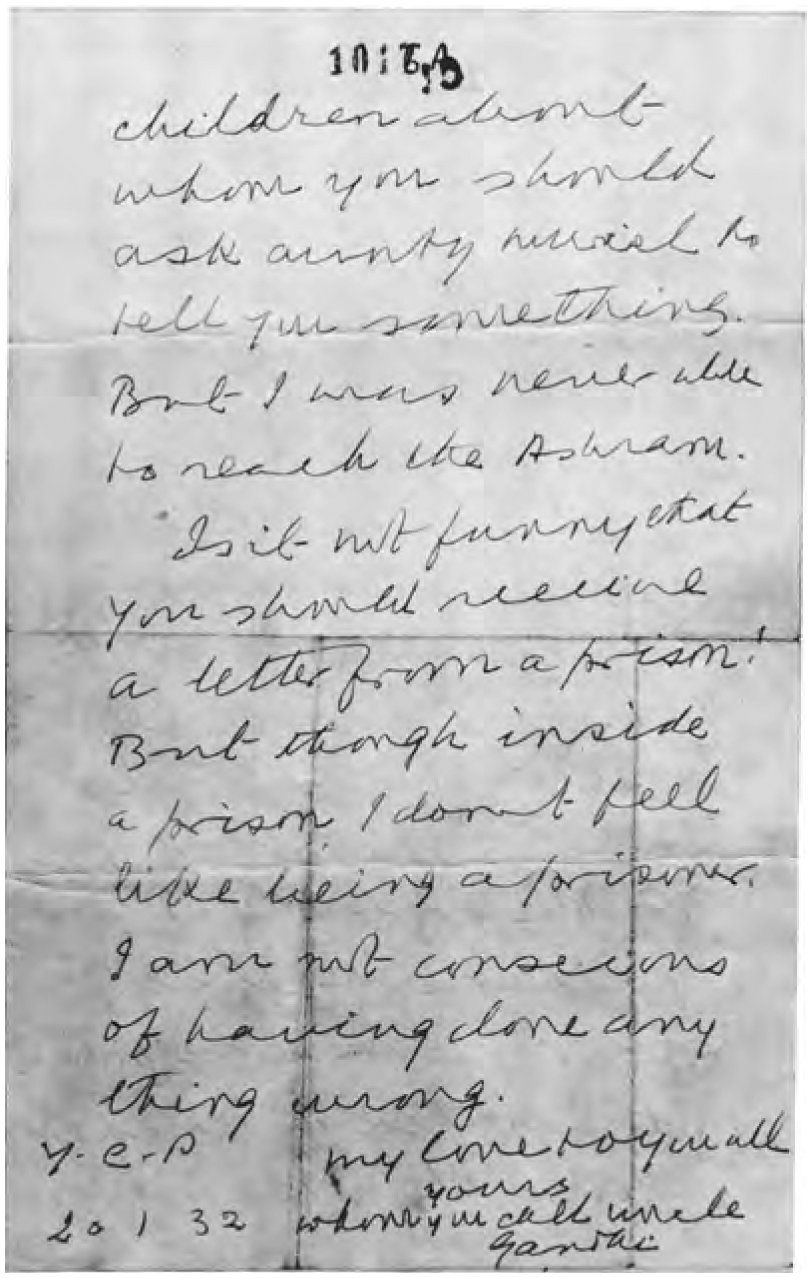
One of the most prized letters in the Bishopsgate Institute Special Collections is a 1932 note sent by Mahatma Gandhi from an Indian prison to a group of children he met on a trip to London just weeks before, when he shunned luxury hotels and stayed in a community centre called Kingsley Hall in the city’s deprived East End. It was a thank-you letter, written in pencil on a scrap of paper, which was presumably all he had.
Can an email ever be as poignant? Will we ever treasure them in the same way? Dickers admitted this is a testing time for archivists, who are still working out how best to keep and catalogue reams of new history, which might now come in the form of a USB stick.
“One of the biggest worries for archivists is how can we make an email last as long as a letter. We have all sorts of things to consider, including changing hardware, incompatible software, how to make sure they are not tampered with, and changes don’t sneak in. How can we guarantee an email’s integrity? Following the Iraq War, it was emails that people were analysing. And, in the future, it’s emails that will tell us what really went on during critical points in history. They will also be invaluable to historians trying to fathom out how we all lived day-to-day.”
In 2010, Emory University in Atlanta acquired the full digital archives of writer Salman Rushdie, including one desktop computer and three laptops (one ruined by a spilled Diet Coke). Rushdie started using a computer only when the Ayatollah Khomeini’s 1989 fatwa drove him underground, so there is the added dimension of seeing how he used it to communicate when cut off from the ability to travel freely.
Rushdie was apparently very open in letting his files be explored and then shared. (Most of the archives are available to the public at Emory’s Manuscript, Archives, and Rare Book Library.) Other famous and powerful figures may be less laidback. Popstar Beyoncé has apparently hired a digital archivist to manage her lifetime’s output. Will political figures soon do the same?
Correspondence can be complex to archive from a social and legal standpoint, according to Susan Thomas, digital archivist at the University of Oxford’s Bodleian Library, which has worked on projects to archive the emails of UK politicians. Copyright, defamation and privacy restrictions have to be taken into account. “Archivists have to balance the rights and interests of people who appear in the archive with those of the researchers who have an interest in the content. The law underpins how we manage information, and make judgments about what can be made available. It’s a part of our work that is invisible to many, but it’s vital,” she said.
One thing emails will show us is the conversational-style of correspondence, with both sides recorded equally. With hard-copy letters, it is rare that both senders meticulously keep all replies they receive.
Perhaps as troublesome and occasionally trivial as emails seem today, snooping through someone else’s in years to come could feel as nostalgic as letters are today. Until then everyone is welcome to explore the time capsules within Index’s own London archives. Just let us know what you find.
Index on Censorship’s archive is free to access at the Bishopsgate Institute (230 Bishopsgate, London, bishopsgate.org.uk)
A letter from Gandhi
Mahatma Gandhi wrote a letter to the children he met at Kingsley Hall, east London, during his stay in the UK in 1931. The letter was sent in early 1932 (see left), after he had returned to India and been imprisoned for civil disobedience. The letter is taken from the Muriel Lester Archive and is kept at London’s Bishopsgate Institute.
Dear little friends,
I often think of you and the bright answers you gave to my questions when that afternoon we had sat together.
I never got the time whilst I was at Kingsley Hall to send you a note thanking you for the gifts of love you had sent me. That I do now from my prison. I had hoped to transfer those gifts to the Ashram children about whom you should ask Aunty Muriel to tell you something. But I was never able to reach the Ashram.
Is it not funny that you should receive a letter from a prison! But though inside a prison, I don’t feel like being a prisoner. I am not conscious of having done any thing wrong.
My love to you all.
Yours, whom you call Uncle Gandhi
20 January 1932
The online version of this article was amended on August 16th 2016 in order to remove a factual error from the text. The original version stated that Mahatma Gandhi went onto become the Prime Minister of India. This has now been corrected.