




Abstract

Rebel Pepper is China’s most famous political cartoonist, but such fame has placed him in a dangerous spotlight. Now in self-imposed exile in Japan, he continues to wrangle with the Chinese Communist Party from afar.
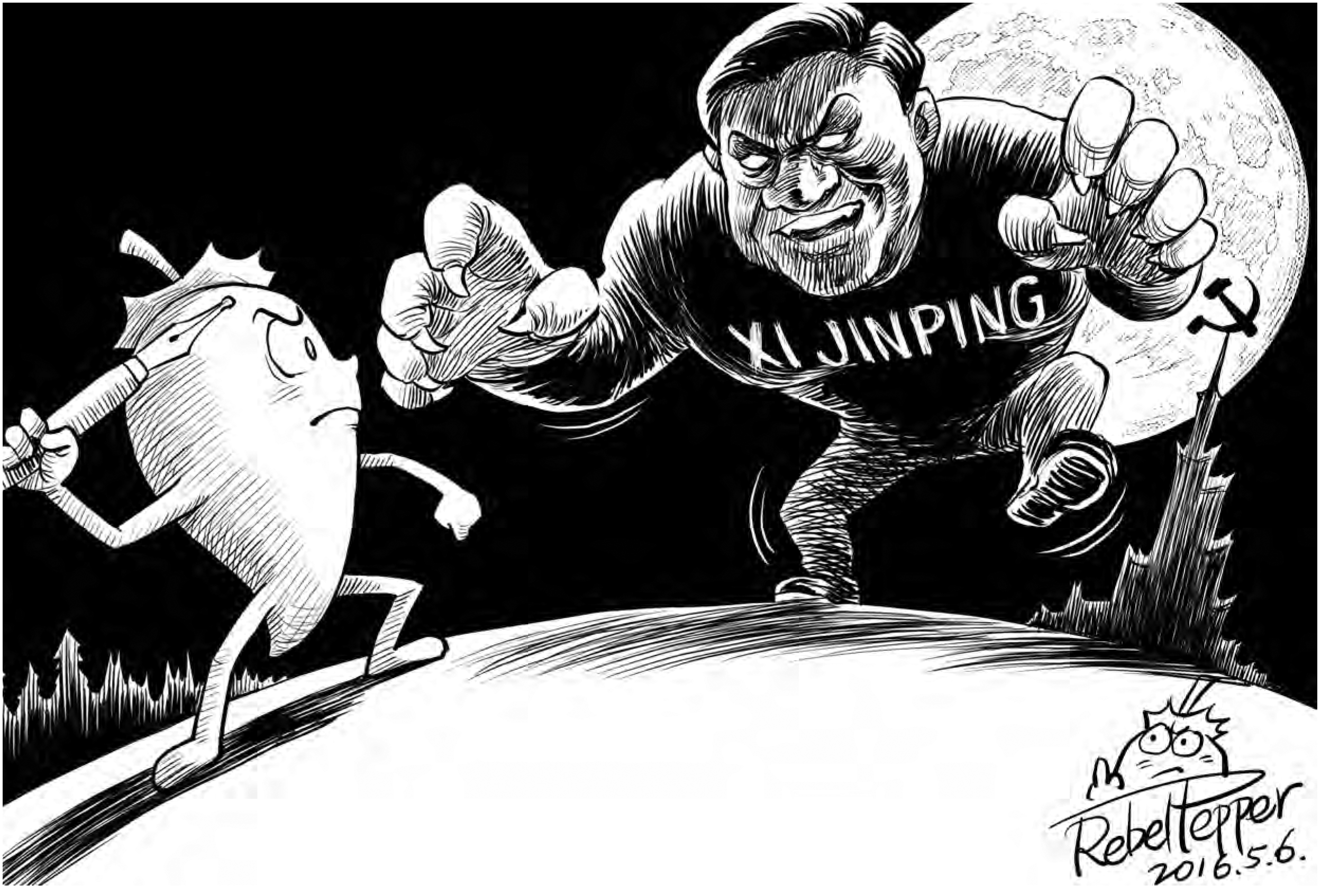
Rebel Pepper’s cartoon for Index on Censorship, depicting him taking on Chinese Prime Minister Xi Jinping
The Trump cartoon was a response to a 1990 Playboy interview with the billionaire businessman and presidential candidate, which resurfaced in February 2016. In the article, Trump was quoted as saying: “When the students poured into Tiananmen Square, the Chinese government almost blew it. Then they were vicious, they were horrible, but they put it down with strength. That shows you the power of strength. Our country is right now perceived as weak… as being spit on by the rest of the world.”
Wang, who was once a fan of Donald Trump’s show The Apprentice, told Index that he and his Chinese friends have become increasingly concerned about the US presidential hopeful’s campaign. When this interview raced through social media, Wang had what he needed. “I simply cannot accept his view on the events of 4 June 1989. He has always appreciated power, showing appreciation of the views of Vladimir Putin, while mocking Gorbachev as weak,” Wang told Index.
Trump is not the only one to be a target of Wang’s pen. Over the years he has taken on Syrian dictator Bashar Assad, Japan’s Prime Minister Shinzo Abe and North Korean leader Kim Jong-Un. It’s the Chinese government however that is his main target.
“People who live in totalitarian countries experience educational brainwashing and real fear of the government. They are not brave enough to stand out and express different opinions,” he said, adding that it was even more important therefore for the few who were brave enough to really put their thoughts out there.
Born in Tangshan city in Hebei, a northern province near Beijing, Wang started scribbling at the age of five. It was the 1980s and Wang observed political cartoons in the popular Beijing-based cartoon newspaper Satire and Humour. This was the golden age of cartoons in China. As the country opened up after decades of tough Mao leadership, new mediums emerged and gained traction, the cartoon being one.
Wang experimented with various types of cartoon early on in his career, all the while working in advertising. Then in 2009 he turned his hand to political cartooning and made that his career focus.
“I kept on reading, observing and reflecting on China’s political and social problems. Then in that year I suddenly felt a strong need to express my ideas. Comics is what I am good at, so I began to create political comics,” he said.
Already the tide was changing. Satire and Humour, which sold around 1.3 million copies in its 1980s heyday, had shrunk by over 90%, to around 80,000 copies. In mainstream media, pages devoted to cartoons were similarly slimming down. Still, nothing could stop Wang. He chose the pen name biantai lajiao, which translates as “perverse pepper” in Mandarin but changed it to Rebel Pepper in English on the advice of a Taiwanese friend, who said it sounded better and, of course, more fitting. The pepper is literally just that – the household veg anthropomorphised through large, expressive eyes. Wang’s pepper often appears in the cartoons, casting judgement from the sidelines.
From 2009 Wang’s pepper starting chronicling all the big stories – China’s air pollution, local corruption and political figures. However, it was not always controversial and Wang admits to a degree of self-censorship while living in China.
“In order to avoid my account attracting too much attention and then being banned, I would deliberately draw some more entertaining topics too. If I did not self-censor I might go to jail; the best outcome would be to be blocked online.”
Even interspersed with lighter cartoons, Wang’s work began attracting a lot of attention – and with that his worst fears started to manifest themselves. His accounts on Sina Weibo (China’s Twitter), numbering around one million followers at one stage, started to be deleted (they have now been blocked almost 200 times to date). Each time a Weibo account is deleted, the user loses everything on it. They must register under a different user name if they want to get back online.
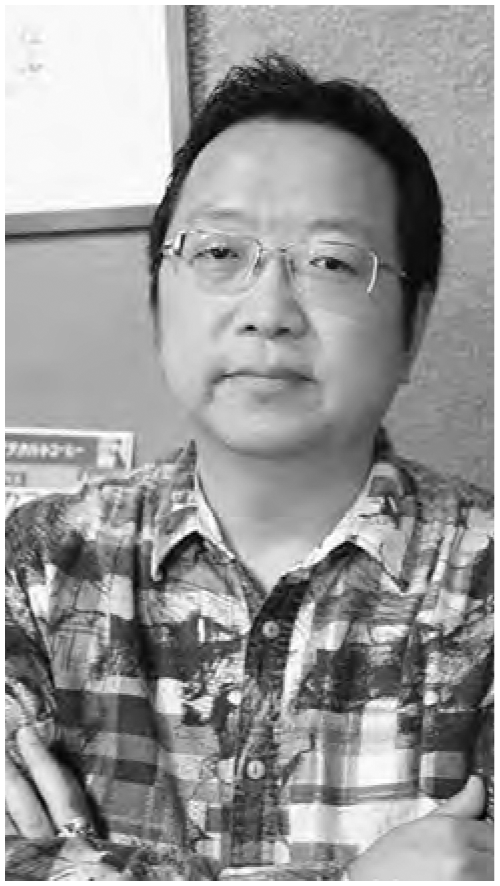
Chinese cartoonist Wang Liming, aka Rebel Pepper
Then in 2011 Wang got the dreaded knock on the door. He was questioned by state security officers in Hunan province, after drawing a cartoon which read: “One person, one vote, to change China.” Wang asked the police whether he was still allowed to draw cartoons and they responded positively, stressing that there was freedom of speech in China.
When Xi Jinping came to power a year later, the mood became frostier. Despite initial hopes that Xi would be a reformer, his time in power has seen a big crackdown on dissent. Scores of artists and activists have been arrested under Xi’s leadership.
The situation, while worrying, played into Wang’s hands. He has portrayed Xi in a variety of images; as a steamed dumpling, as a man topless in bed smoking with another man and as Winnie the Pooh, the latter being a reference to microbloggers comparing images of Xi and Barack Obama together to Winnie and Tigger.
On the subject of censorship, Wang drew a cartoon of a police officer playing with a machine that catches stuffed toys with a metal claw. The machine is labelled “500 catch”. The cartoon was a response to an announcement that people could receive jail time for any posts that were forwarded or retweeted more than 500 times, with the charge being that they were spreading rumours. The definition of rumours was purposefully vague.
Wang reflects on the years since Xi has been in power: “I felt a narrowing of freedom of speech. The change was very pronounced when you compare Xi Jinping to previous eras of Jiang Zemin and Hu Jintao.”
Wang fell foul of the aforementioned internet regulation shortly after it was introduced. It was October 2013 and he was in Beijing at the time. He forwarded a post about a stranded grandmother holding her grandson, who had starved to death in the typhoon-hit city of Yuyao. Wang was angry about the Yuyao government’s response – he believed it did not provide enough relief and was concealing the truth. He wanted to highlight this. For that he was accused of spreading a rumour and disturbing the peace. He spent 24 hours in jail.
Wang knew his work was putting him in danger, but he felt he could not stop. As he told Index: “I was deeply impressed by a story I heard from the ‘colour revolutions’ of eastern Europe. Someone stuck a portrait of a dictator on a metal bucket, put the bucket out on the street and anyone could kick it. Although the game sounds childish, playing it helped reduce people’s fears. Cartoons can have the same effect. They directly point out the truth, expose a dictator’s lies and make people laugh at it. In China, censorship online is very strict, protesters’ articles are always deleted, but cartoons are easier to spread and so can be very popular.”
The main tools of online censorship which pick up on certain words are harder to apply to images. Memes and cartoons have therefore played a growing role in challenging authority.
Perhaps spurred on by his increasing popularity, Wang became more subversive with each day. He knew his luck had run out on a trip to Japan. During the trip, his first outside China, he released a set of cartoons that were positive about Japan. These pictures were picked up on by a website linked to the People’s Daily, the communist party’s official newspaper, which denounced Wang as a pro-Japan traitor, one of the harshest accusations in a country known for its troubled relationship with Japan. The story quickly spread to other sites.
His microblogs were once again closed, as was his page on Baidu encyclopedia, which resembles a Chinese version of Wikipedia, and his online store on Chinese e-commerce platform Taobao. Next came a series of death threats.
Wang reckons the Japanese line was subterfuge. The real reason he was being targeted was his criticism of the government.
He decided it was best to stay in Japan and ride out the storm. Years later he is still there. He was tipped off that his name was on an official Chinese blacklist.
Life in Japan has not always been easy. With his Taobao store removed, Wang’s main source of income has been blocked. He also faces a precarious visa situation. And while Japan offers a degree of protection not granted in China, Wang does not feel completely safe.
“I’m still insecure,” he told Index. He worries that he will be followed. Nightmares haunt him, full of dreams of Chinese police hunting him in Japan. “This fear of the power of the totalitarian state is something normal people cannot understand,” he noted.
His world is an isolated one.
“In China most people, including my parents, cannot understand my choice and the way I live. After experiencing several political movements under the CCP, they fear politics. They think normal people shouldn’t touch these topics. They should just earn money and take care of themselves and their family. There are only a few people who can understand and support what I feel and do.”
In Japan the community of dissidents is even smaller. His wife is one though, and the two live together in Tokyo, where Wang currently works for a Japanese cartoon company. He also keeps in touch with a network of supporters. Encouragingly, commissions keep coming in. For the Tiananmen anniversary this year his drawings have been requested by a gallery in Hong Kong.
Some have expressed concern that the new market Wang finds himself in is driving him to be more critical than he might otherwise be of China. Instead Wang points out that in an environment where he does not have to self-censor, his work can be done better. “It’s an open space; I really enjoy the creative freedom.”
Will he return to China one day? Wang is not optimistic. “I have a lot of fans, but I know there are even more people who support the communist party.”
Whether this support is the result of being sold lies or simply being scared to show a different viewpoint is something Wang cannot answer. Either way, the result means Wang is less confident about China’s immediate future. “The only reason for the communist party’s validity is the development of the economy. Now economic crisis is occurring and will likely get worse,” Wang said, before adding: “Even if the party faces problems because of economic crisis, there are no other organisations in a position to be able to replace the party.”
That there are no other major organisations is true. President Xi has gone out of his way to minimise civil society in the country. But with the likes of Wang observing and critiquing – albeit from the side lines – there are still glimmers of hope.