



Abstract

Index’s Turkey editor
A 2010 edition of Turkish liberal paper Radikal, with a front-page story about Turkey’s foreign minister who was described as “exceptionally dangerous” in a US diplomatic cable leaked by Wikileaks
CREDIT: DPA Picture Alliance Archive / Alamy Stock Photo
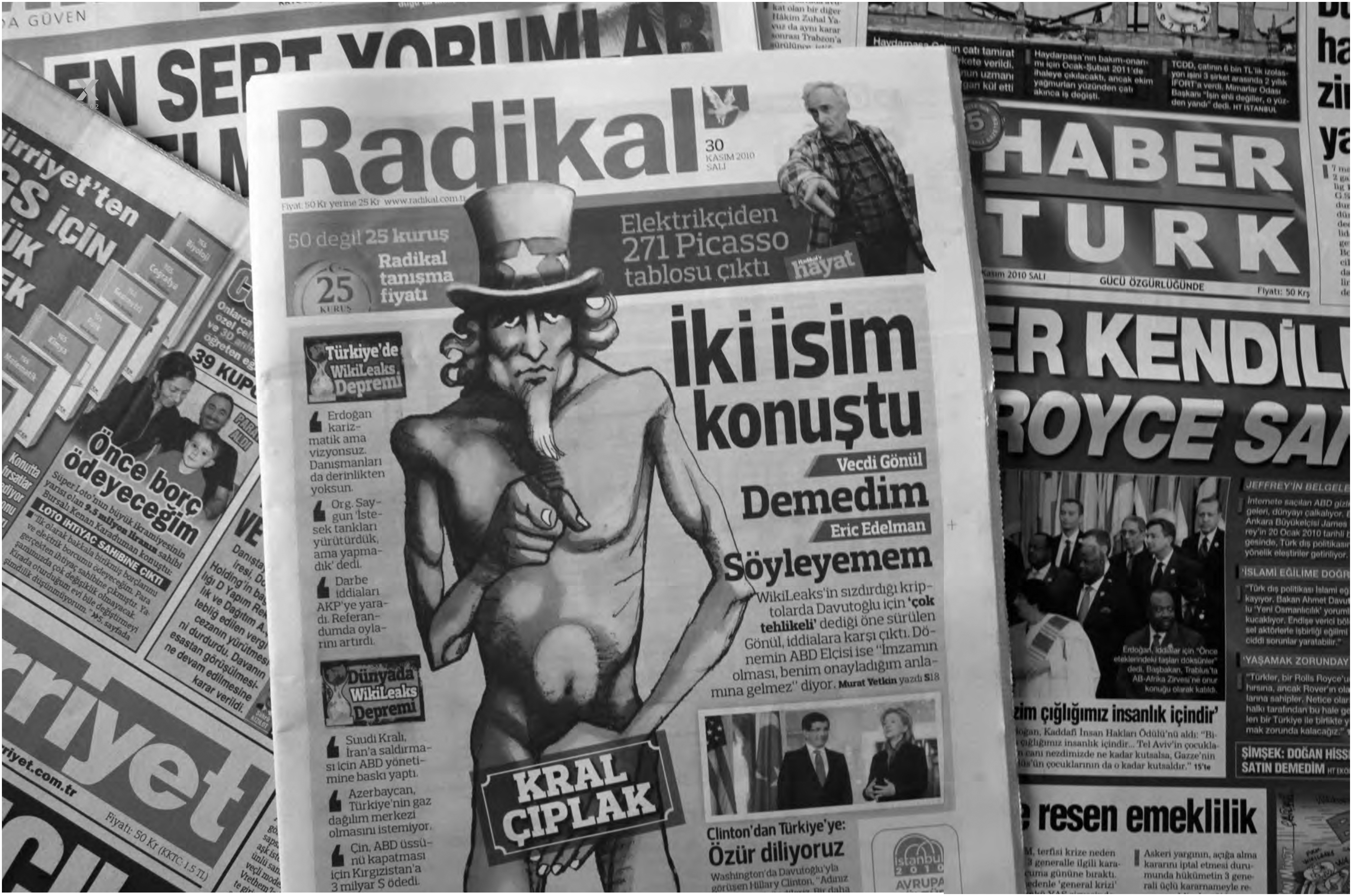
After two decades as a leader in its field, Radikal was shut down by its publishing house in March 2016, a few weeks before I met Güven. Its publisher, the Doğan group, said it was closed because of financial reasons but it is widely believed that political pressure was a prime factor. “Radikal’s closure can not only be defined in terms of infeasibility,” Ezgi Başaran, one of the paper’s last editors, told Index. “At some point, certain concessions had to be made and closing down the liberal left newspaper happened to be one of them. Even though freedom of expression was always limited in Turkey, Radikal had served as a platform where many taboo subjects could be talked about and had shown that investigative journalism can still make a difference.”
In today’s Turkey, mobs attacking newspaper buildings are a common sight. Journalism here has become risky business. I have heard stories from journalist friends working at anti- and pro-government papers, who have found themselves locked inside their offices as angry crowds threaten to destroy the buildings. Papers critical of the government, including Hürriyet, Cumhuriyet, Zaman and Özgür Gündem, have been victims of this new atmosphere of intimidation, as have reporters working for conservative papers, such as Akit and Sabah. A mob broke down the windows of Hürriyet in September 2015; another mob opened fired at the headquarters of Yeni Şafak in February 2016.
In recent years, these attacks have been provoked by news items which anger those who don’t share a paper’s politics. For instance, people were furious with Hurriyet and Cumhuriyet because they considered these newspapers’ coverage of national elections and Turkey’s involvement in the Syrian war to be specially designed to bring the government down and therefore traitorous.
Meanwhile hardline Turkish nationalists and radical members of the Kurdish movement despise the conservative rhetoric of publications on the other side of the divide and attack Akit, Sabah and Yeni Safaka because they consider these media outlets a threat to their existence.
As Turkey has become more polarised, different sections of society over the last 15 years have grown more intolerant. The new era has brought along the image of a society that is cut in two halves, as politicians have urged citizens and reporters to pick sides. This has had grave consequences for objective and investigative journalism.
Individual journalists have also been threatened. Ahmet Hakan, a popular columnist from Hürriyet, was punched in the face by two hired assailants in front of his apartment in the heart of Istanbul on 1 October 2015. The head of the pro-government Star media group closely escaped an assassination attempt in August 2015. An angry nationalist shot at Cumhuriyet’s Can Dündar outside a court on May 2016. The editor, having survived the gun attack, then walked into the courtroom, where he was sentenced to five years and 10 months in prison for publishing leaked documents concerning state secrets.
Güven smiled as we looked back on the text of her 1996 article for Radikal. It was about an unnamed, top-level Turkish general who told a crowd at a formal meeting in Ankara that the Turkish general staff was ready to stage a coup against the government of Islamist Prime Minister Necmettin Erbakan.
“This was my first piece about the Turkish general staff,” Güven said, recalling how her piece sent shockwaves through the upper echelons of Turkish political power. The article might not have pleased the general staff, but she was proved right when the Turkish army did indeed stage a coup on 28 February 1997, only four months after Güven’s article came out. The coup forced Erbakan out of power.
“During those days in the capital Ankara, journalism was a different business,” Güven said. When she worked as a reporter, Turkish investigative journalism carried risks but still promised an adventurous and exciting existence. Nowadays the risks are much higher.
Radikal had a gift for breaking big stories. One of its biggest scoops came when the paper revealed that the passengers in a serious 1996 car crash included an MP, a police chief and a former intelligence agent. The agent was known to have been used by the Turkish deep state to assassinate dissident youths and Interpol had issued a warrant for his arrest.
Radikal meticulously investigated the story, which laid bare a corrupt web of relationships between the police, mafia and politicians. The newspaper’s circulation rose at one point to 720,000, making it the best-selling paper in the country. Other papers did not dare cover what the crash had revealed.
As a result of Radikal’s investigation, the right-wing MP involved in the scandal was stripped of his immunity. There were daily protests demanding the prosecution of those involved. Unlike in the past five years, when we have been accustomed to the sight of street protests in places like Istanbul’s Gezi Park, the 1990s were a dark time for activism, with the regular assassinations of dissidents by deep state operatives.
Today, civil society and NGOs are much better organised and the spirit of social rebellion is very much alive, but interestingly, the media which is supposed to represent that spirit of dissent is having the most difficult time of its history. At the height of Radikal’s journalistic triumphs, it was riskier to march on the streets, today it is riskier to be a reporter.
But Radikal’s investigations into human rights abuses and police crimes did have consequences. In 1996, the second-highest ranking officer of the Turkish army told a group of journalists that there were “four traitors working in Radikal”. One Radikal columnist, the novelist Perihan Mağden best known for her harsh and innovative critiques of leading public figures, found herself in court on libel charges, after around a dozen politicians, artists and security chiefs came after her. Radikal paid thousands of Turkish liras for court settlements: 8,000 liras in 2008 and 20,000 liras in 2009. Later, in March 2011, Istanbul police raided the newspaper’s offices of Radikal and confiscated the computer of news editor Ertuğrul Mavioğlu.
Such events increased Radikal’s prestige rather than undermined it. Thanks to its high editorial standards and financial strength, the paper turned into the place to work for the best and the brightest prospective journalists during the noughties. Sadly today, that version of investigative reporting – top of its class, complying with international journalistic standards – is now seen as a threat to society. Instead, the risk-free job of making up stories in editorial rooms has become common practice.
In 2007 came a turning point in Turkey’s growing thirst for investigative journalism: it became open to political exploitation. Taraf, a new liberal paper, was founded in November that year. The paper made a name for itself by publishing minutes of the secret meetings of military personnel at the general staff headquarters in Ankara. Publishing diaries and correspondence of top generals became common journalistic practice both within Taraf and more widely in other opposition papers, especially during 2010, when Taraf reporters said they had received a bag full of secret documents sent to them by a mysterious source. This resulted in the jailing of hundreds of people, including journalists and intellectuals who insisted the leaked documents were fabrications.
The public faced a dilemma: could this kind of investigative journalism be ethical when it meant locking up of numerous people who said the evidence was fabricated? Many inconsistencies, later proved in court, cast doubt on the documents’ authenticity. In a sense, investigative journalism became a victim of its own success. The path opened up by diligent reporters was then used by those rich and powerful enough to fabricate evidence and present it as investigative journalism.
“There has been a continuous erosion of standards in Turkish newspapers and journalism since 2010,” Cem Erciyes, the last editor-in-chief of Radikal, told Index. “In the past, when a news article appeared in a paper, it would be properly sourced. Since newspapers have turned into tools for propaganda, most of the headline stories today are openly manufactured in editorial rooms. The kind of arguments you would hear at coffee breaks and consider conspiracy theories are now presented to readers as concrete facts.
“In the past, investigative journalists were able to change things through the power of the truths they were unveiling,” Erciyes said. “Today in Turkey, do journalists and newspapers have that kind of power?”
Begüm Güven quit journalism a decade ago. Nowadays she is working as a public relations professional. Cem Erciyes became the managing editor of a publishing house a few weeks before I interviewed him. As remnants of Turkey’s golden age of investigative journalism, they spend their time recalling those distant days to friends and colleagues, trying to figure out the exact point when things started going terribly wrong for Turkish journalism.