




Abstract

“It’s a tactic we see not only in Egypt. The chaos in countries like Syria, Libya, Yemen and Iraq is held up like a scarecrow to others, to persuade people to accept limits on press freedoms,” Hamoud Almahmoud, of the Amman-based Arab Reporters for Investigative Journalism network, told Index. “Journalists across the region face terrible situations because freedom is labelled with this chaos.”
The aftermath of the Arab Spring has not been good for all the region’s media, according to Almahmoud. “Unfortunately many regimes felt that they had survived it, and just returned to repressive tactics under different justifications such as counter-terrorism and national security,” he told Index.
Today the number of journalists being imprisoned is at an all-time high in Egypt, which is surpassed on the list of worst offenders only by China, according to the Committee to Protect Journalists. The intimidation reached a peak in May when an Egyptian judge recommended that three journalists face a death sentence if guilty of supplying information to the Qatari broadcaster Al-Jazeera. “Egypt’s rulers have made no secret of their hostility to independent journalism. But for a court to sentence journalists to death would represent a new low,” said CPJ’s Middle East programme coordinator, Sherif Mansour, after the hearings.
The royal regimes in Jordan and Morocco learnt their lesson early, according to political analyst Marc Lynch, dissecting How The Media Trashed The Transitions in the US academic Journal of Democracy last year. Both countries, he wrote, used “direct and indirect media controls … to tout the virtues of limited constitutional change while demonising protesters and rousing fears of bloody unrest”. In Libya and Yemen a free broadcast media aligned with factions to spread “polarisation, fear, and insecurity”, he wrote. In Jordan and Morocco, protests were relatively short lived, whereas Libya and Yemen remain in turmoil today.
A mural depicting youth activist Gaber Salah, also known as Gika, who was killed during the Egyptian uprising at Mohamed Mahmoud Street near Tahrir Square in Cairo, 18 November 2013
CREDIT: Reuters/Amr Abdallah Dalsh
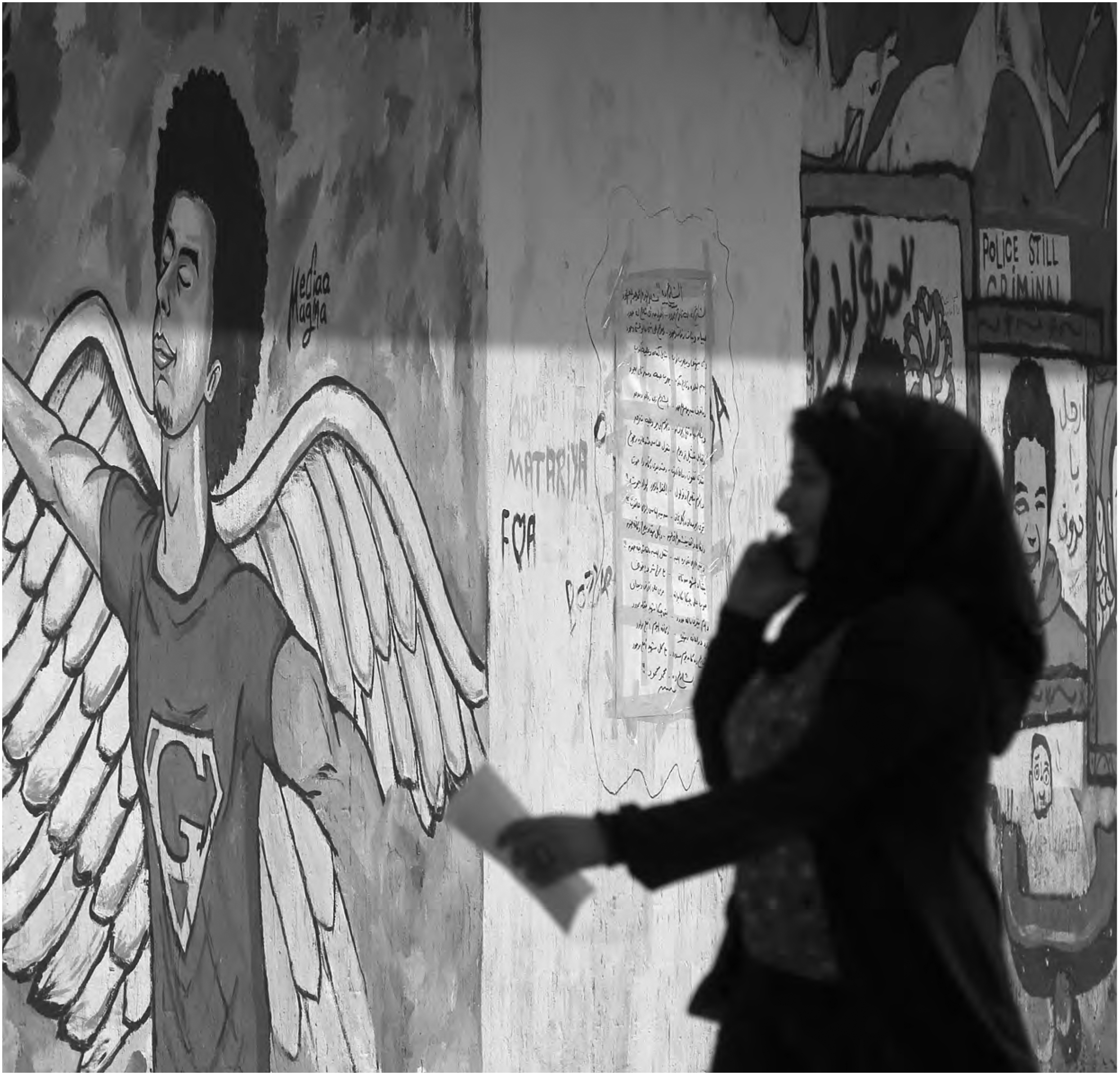
In the heady days of 2011 most independent Egyptian media rallied behind the protests, said Lynch. “The sight of top generals being grilled on live television seemed like an early sign that a classic liberal-democratic public sphere was coming into being.” Yet, he said, it did not last. “The momentary unity of the post-revolutionary media quickly degenerated into a polarised, sensationalistic, and toxic environment that fostered the worst political trends.”
Some television news commentators became cheerleaders for their own censorship. BBC Monitoring quoted Rotana Egypt TV presenter Tamir Amin calling for the army to be given a free rein in October 2014. “I am telling el-Sisi: To hell with democracy and to hell with human rights when it comes to the national security of the great Egypt.” A joint statement by chief editors of Egypt’s state and private daily newspapers rejected “attempts to doubt state institutions or insult the army or police or judiciary in a way that would reflect negatively on these institutions’ performance”.
Belgian-Egyptian journalist Khaled Diab said that the current war against Arab media freedoms hides a paradox. “Never have Arabs enjoyed freer access to information and never have the region’s journalists and citizens mounted such a constant, consistent and comprehensive assault on the state’s media dominance,” he wrote in an article for Al-Jazeera in May. He cited independent online news sites, such as Inkyfada in Tunisia and Mada Masr in Egypt. The internet’s ease of access makes their publishing work easier, even as the job itself gets harder.
However, television news, with its mass reach and enormous infrastructure costs, has found itself more open to political manipulation – the “protection racket” politics, so memorably described by Georgetown University academic Daniel Brumberg in his own review of the disappointments of the Arab Spring’s aftermath, for Journal of Democracy in 2013.
Normally, Arab TV defends its side and condemns everyone else. This is the Lebanese model. Hezbollah-supported Al Manar, the Shi’a Amal Movement-backed NBC TV and the broadly independent New TV oppose the government there, while Mustaqbal (Future) TV, founded by the late Sunni premier Rafiq Hariri, and the Lebanese Broadcasting Corporation (LBC), founded as a voice of Lebanese Christians, are broadly pro-government.
Since the Arab Spring, producers who upset this kind of finely balanced applecart are swiftly dealt with. The Alarab satellite news channel was taken off air by the Bahraini government within 24 hours of its premiere in February 2015, despite the fact that the owner, billionaire Saudi royal Prince al Waleed bin Talal, had powerful contacts with the state. The station’s first day “crime” was to interview a prominent Bahraini protest leader.
Yet in Tunisia, Egypt and other Arab Spring countries, the broadcast media’s response to coverage of public protest remains a kind of bellwether. The odds on a violent state reaction is tested by the coverage the state allows, or fails to block. It’s the balance between “risky” free speech and “responsible” compliance – whether journalists lead into live reports or just read official statements, offersafe, anodyne comment or ask hard, probing questions.
Speaking to Index, veteran Middle East correspondent James Dorsey said recent leaks to the TV media in Egypt suggest there is a split brewing between the paramilitary security forces and the military which may force the media to take sides. He said the media either takes its cue from the military, or makes a calculated judgement of how far it can go as the situation evolves.
It will be a difficult and dangerous call. This summer’s Egyptian anniversary has something for every side to mark with protests: for or against Morsi, for or against el-Sisi, or just pro-freedom, peace and stability. Everyone becomes a potential threat to the state the moment they step out on the street. And the authorities are not choosy about which tag – terrorist, traitor, criminal or journalist – they attach to their targets.