




Abstract

Kenyan journalist
Juma was escorted back to his house, where he found 14 people from the CID ransacking the place, in front of his wife and children. “They were looking for electronics, for laptops,” Juma told Index. Juma is a veteran investigative journalist known for his reports on the war against al-Shabaab, the Somalia-based Islamist militant group.
He was arrested for posting updates on his social media accounts of an al-Shabaab attack on the Kenyan Defence Forces in El Adde in Somalia. On 18 January, he revealed that 103 KDF soldiers had been killed there, three days before, after they were attacked by the militants. Juma had covered this ongoing conflict for years, and said he had a credible source within KDF confirming his story.
But his reports contradicted official KDF statements. A few days prior, Joseph Nkaissery, the cabinet secretary for the interior and a retired general, had publicly warned that anyone who circulated information about the KDF soldiers killed in the El Adde attacks would be arrested for being sympathetic to al-Shabaab.
Under President Uhuru Kenyatta, son of Kenya’s first president, the state has been using laws to incriminate and silence journalists. Henry Maina, east and Horn of Africa director for free speech NGO Article 19, said, “Many laws were on the statute books but were rarely used to incriminate journalists.” Section 29 of the Information and Communication Act criminalises the “improper use of a licensed communications system”, meaning the publishing of information online that is deemed unlawful by authorities.
On 19 January, blogger Eddy Reuben Ilah was arrested and charged under this law for sharing, in a WhatsApp group, images of dead KDF soldiers killed in El Adde. Juma faced a similar charge, for the “misuse of a telecommunication gadget”; he had shared a Facebook post by the brother of a dead Kenyan-Somali KDF soldier in El Adde. The charge was that he had shared this post to his followers without the permission of the KDF. Juma feels that such tactics are a “classic way of silencing journalists”.
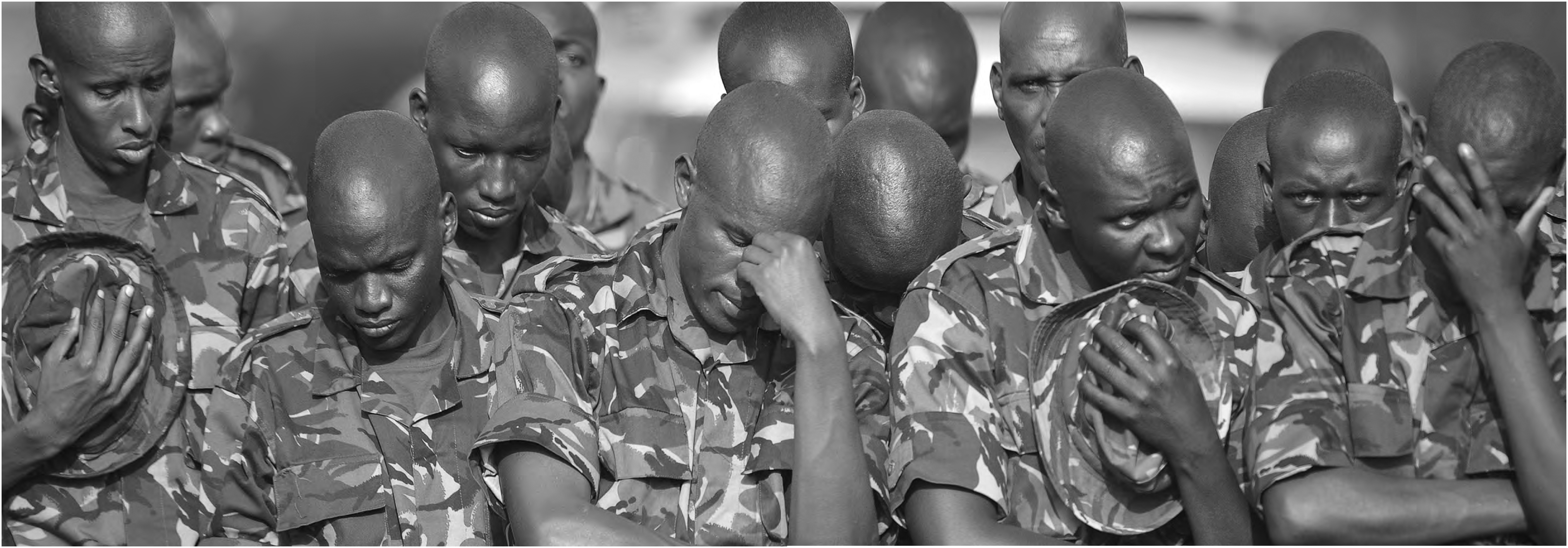
Kenya Defence Forces soldiers bow their heads during a prayer at a memorial for KDF soldiers killed in an attack by Somali based Islamist group al-Shabaab in southwest Somalia’s El Adde region in January 2016. A journalist’s reporting of the lost lives led to his arrest
CREDIT: Tony Karumba/AFP/Getty images
For Kenyan journalists, new media has become a key instrument in their reporting arsenal. Juma, for instance, has 19,000 Facebook followers, and uses social media to bypass the traditional media and connect directly with his audiences. During the El Adde attacks he said “the public was anxious to know what was going on”, yet mainstream media channels were not covering the incident. “Social media gave me an opportunity to give information to the families and the public,” he told Index.
The Kenyan government has denied that it is seeking to intimidate or silence journalists. Interior secretary Nkaissery told current affairs website African Arguments that the government respects independent media and freedom of expression, though added that this “freedom must be enjoyed in a responsible manner”.
Kenya had a reputation for being one of the freer media environments in east Africa, but this perception is changing. This year, Kenyatta’s government has severely cracked down on press freedoms.
Following several major terror attacks by al-Shabaab, Kenya’s effort to combat the security threat has, according to Human Rights Watch, been “marred by ongoing patterns of serious human rights violations by Kenyan security forces, including extrajudicial killings, arbitrary detentions and torture”. The Kenyan National Commission on Human Rights says it has recorded 81 “enforced disappearances” since 2013.
Maina says that Article 19 has seen a sharp rise in the risks and attacks on journalists in Kenya. From January to September 2015, Article 19 recorded 65 cases of individual journalists and social media users attacked in 42 different incidents, which include acts of physical violence, and also threats by phone and text, summons by police, and legal restrictions. Of these incidents, 22 cases related to journalists covering corruption, 12 to protests, and eight to terrorism and crime stories. Maina adds that only three of the 42 cases have been investigated and the perpetrators taken to court. That’s a 7% rate, which he said, is “an unacceptably high level of impunity regarding attacks on journalists”.
Maina acknowledged international criticism of the law was already improving things and that the Kenyan High Court had recently decided that Section 29 of its information and communication act was unconstitutional. “A number of bloggers and social media communicators who were facing charges under the impugned section have had those charges dropped and where there was no other evidence to enable the prosecution to charge them with other offences they have been acquitted.
“Given our legal system, all similar cases will be dropped when they are next scheduled for hearing. No new cases of bloggers and journalists charged under section 29 of KICA have been recorded,” he said.
From his home, Juma was taken to Muthaiga police station, where he was grilled about his reporting. He said, “They had my phone, they wanted to know my contacts in Somalia.” He was held for two days, before an officer came into his cell and announced: “There’s been a change of plans.” Shortly afterwards, he was released without charge.
Juma returned home, but, fearing further repercussions, later went into hiding with his family. “This is the first call I am making, we’ve gone underground,” he told Index. Juma is used to receiving threats for his reporting, but what has changed in recent years, he says, is how much more serious these threats have become.
