




Abstract

Iraqi journalists are under attack from all sides. Now a series of safety programmes offers training for battlefield reporting, and to combat everyday threats and danger on city streets. Trainer and journalist
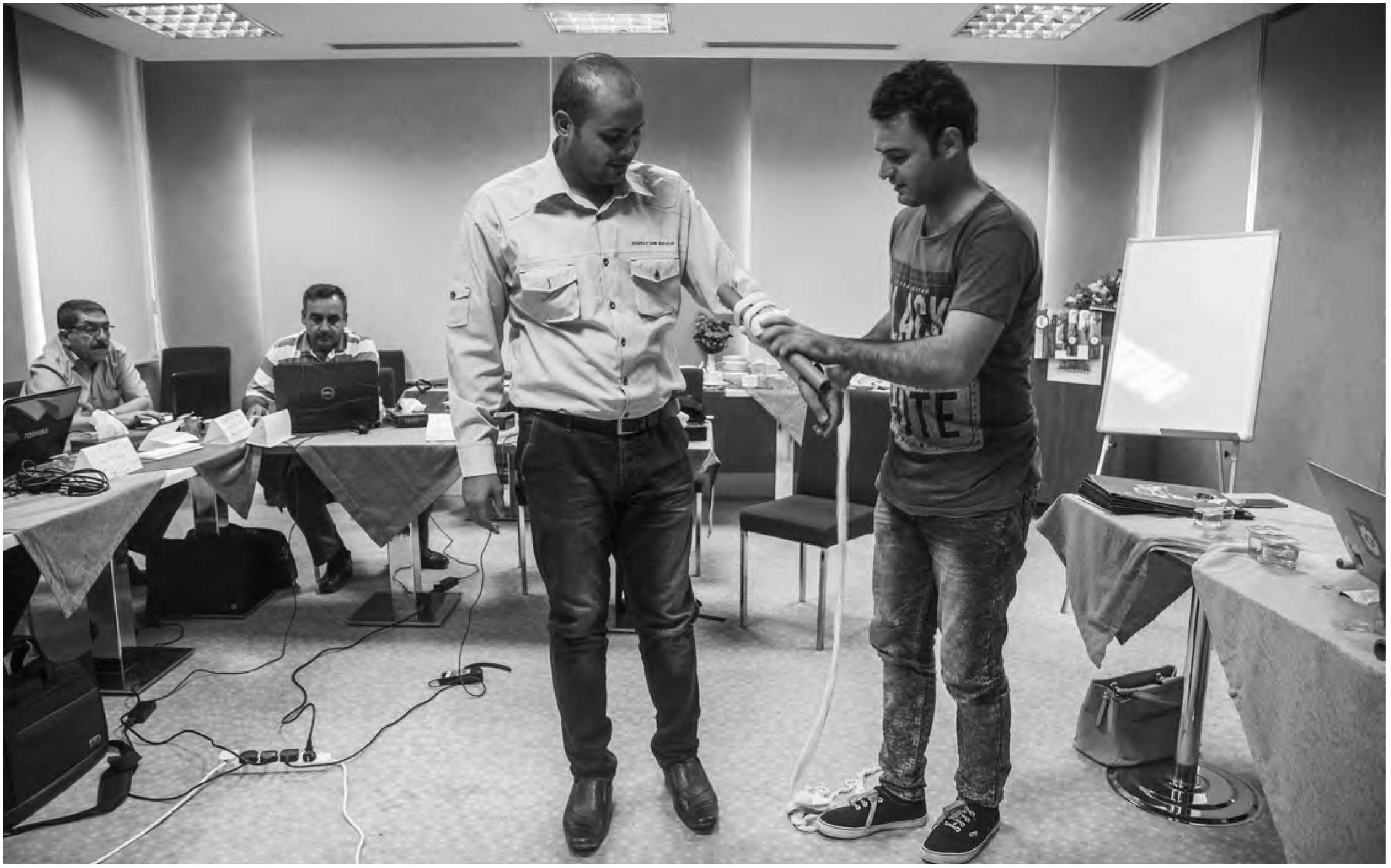
Al-Hassnawi was on a five-day training course, run by the Independent Media Center Kurdistan and one of a dozen courses run for Iraqi journalists in Erbil, Basra and Karbala. Skills covered included; learning how to scan the environment for danger, identifying weapon types by the sound of ballistics, using body armour, using the dark web for security, and basic hacking.
He also learnt how to administer first aid on the battlefield. “Now I know how to apply CPR and to stop bleeding in case IS launch a grenade at me and I am injured,” he said. As a battle-ready journalist, his training could save his life. During protests or after a suicide bomb it’s also really important for reporters to act safely, selecting the best angle to take pictures, but also avoiding arrest, teargas or a possible second explosion. “Once I was in the area of a blast [and] I was afraid to run immediately to the car that had just exploded. That instinct was a good one because a second blast happened but no one explained to me before how to position myself properly at the scene of the attack,” said al-Hassnawi.
He was one of 75 Iraqi journalists (15 per group) on the course last October. In Karbala, the 13 men and two women who attended the course expressed a specific need for the training to also cover psychological disorders. And so the course looked at how to minimise stress, post-traumatic stress disorder and vicarious trauma. At the end of the sessions the journalists called for a stronger commitment by international organisations to offer training in Iraq or countries including Lebanon, Turkey and Jordan.
Journalists attend a workshop on conflict reporting in Sulaymaniyah, Iraq
CREDIT: Bnar Sardar
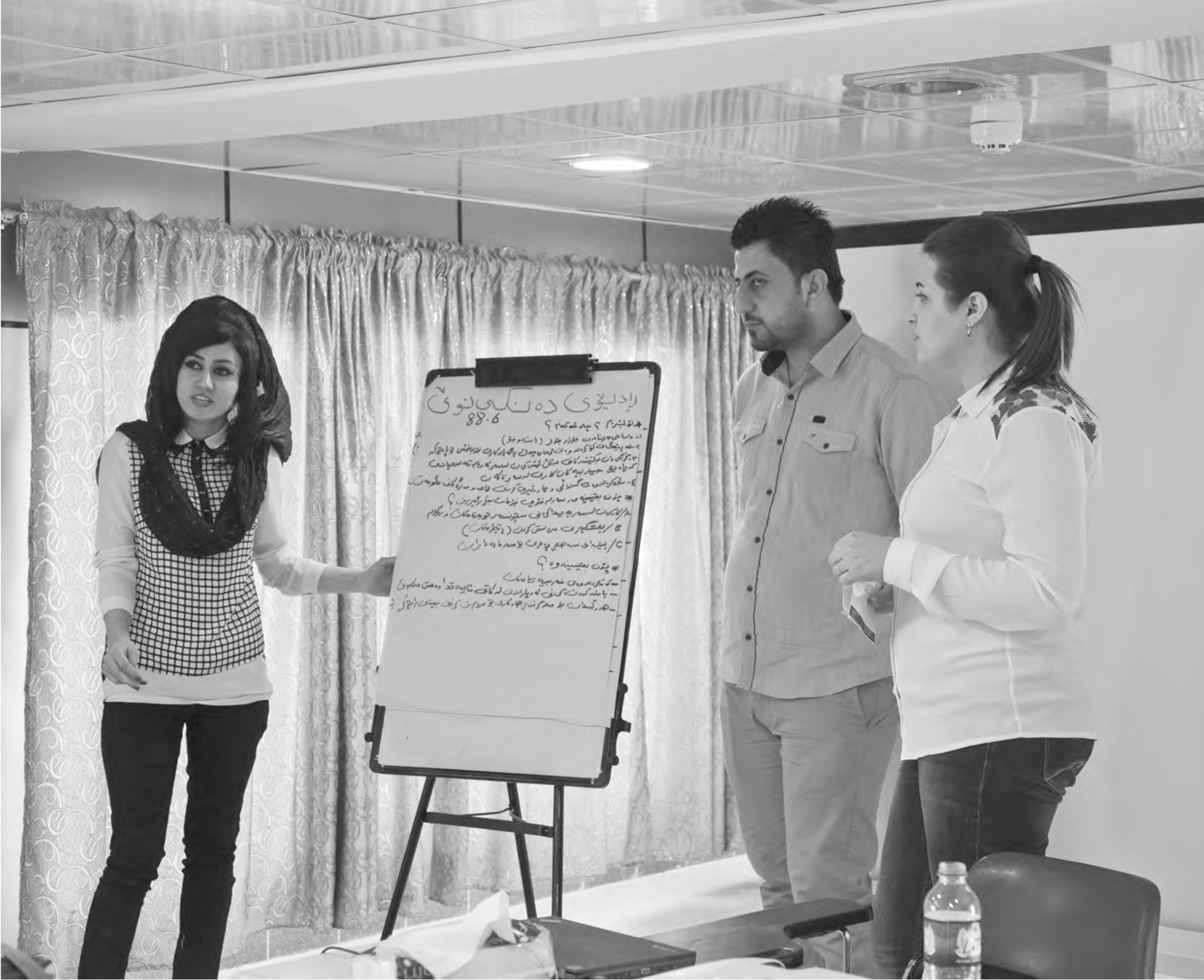
Safety training is even more vital now, as a new home front with IS has seen unprepared local journalists become embedded with the Iraqi army or with the peshmerga in Iraqi Kurdistan. Many of the journalists interviewed said their experiences of embedding have involved being taken to the front line by the Iraqi army without knowing exactly where they are and for how long. They also had never had any safety training, didn’t understanding the appropriate use of electronic devices in the battlefield, and had never signed any agreement with the army. Most claim to have had only a fairly lightweight bulletproof vest and, sometimes, a helmet issued to them. Few know how to save the life of a comrade in battle. Among journalists there is also an almost total ignorance of data encryption (see Stephen Grey on page 58), as well as some concern about using them, for fear of being accused of terrorism by the army, the police or militias.
The Women for Peace Organization, which is part of a larger group of local NGOs including the Iraqi women journalists’ forum, requested two training courses in Baghdad, one for human-rights journalists and activists under the age of 30; the second for female journalists. Many of those who attended the sessions have now requested more intensive training.
Iraqi journalists practise first aid during a safety workshop
CREDIT: Bnar Sardar
Hala Almansour, a 40-year-old journalist from Basra, was among the attendees. She was shy about telling her story at first but at the end of the course said: “I was a witness to murders and deaths in Basra at the time of the war. I asked for psychological help and it was successful. Now I’m trying to help other women in the same condition. The problem is that Iraq is entering into another bad time and I’m tired of all the corruption in society and threats against civilians and journalists. I want to know how to defend myself.”
Almansour, like most of the journalists at the workshop, is employed in the local media. The more experienced, older members of the group had worked as fixers for international media during the US occupation, or served as translators for the US troops or for the British Army in the first Gulf war. Many were later threatened with being labelled “collaborators”. Most of the time, the threats come from militias.
Tariq Alturfi, 40, was another workshop attendee. An experienced journalist with Alamda Press in Karbala, he is married to a colleague and has a young son. He was on the front line against IS only once: “I’ve been covering breaking news from Iraq and from the area of Karbala for 20 years. I attended this workshop because every day we have to deal with militias. IS is not the main problem for us.” Alturfi is committed to non-partisan reporting in Iraq. “Journalists must stand up for Iraqi people, not for thieves and criminals who sit in the parliament,” he said. Alturfi said he kidnapped by local militias in 2010, because he “wrote an article about a local politician, underlining his irresponsibility in not securing the area of Karbala”. Alturfi was abducted by a group of locals, detained for one night in a secret place, hanged on the roof and tortured. Then he was released, on the promise of “better behaviour”. He is still smiling but traumatised underneath.
There are very few freelance journalists in Iraq. It is hard to make a living as a freelancer without working for pan-Arab or international networks such as Al Jazeera or Al Arabia, Vice or the BBC. Foreign journalists who work in Iraq are also at risk of threats, and sometimes detention, by police or the Iraqi army. Nadir Dendoune, a French-Australian journalist was arrested and detained for three weeks in 2013 for taking photographs in a restricted area of Baghdad. Reporting on topics such as corruption, pollution by depleted uranium, threats against local journalists or activists, is also strongly discouraged by the government.
Freelance Iraqi journalists are experiencing a situation which is far worse than that of European and North American freelancers, according to the Committee to Protect Journalists. As the Rory Peck Trust, which supports freelance journalists, said that locally based journalists were facing by far the largest number of threats and the vast majority of murders, imprisonments and abductions. The organisation is calling on governments, combatants and groups worldwide to respect the neutrality of journalists and immediately end the cycle of impunity.
International organisations surely have a duty to provide safety training to Iraqi journalists and activists in danger zones. The key to encouraging press freedom in one of the most corrupt states in the Middle East, according to Transparency International, is supporting activists and journalists who want to be independent from political parties or sectarian interests.
Iraqi civil society has organised itself into small associations, such as women’s groups, trade unions, groups of cyber-activists, who all want to have an active role in the way the country works. They all need protection.
Sometimes as a security trainer, I come across Iraqi journalists who believe they don’t need training. A typical answer is: “We do not need it. We are Iraqis.” This quote shows the level of resilience of those who remain in Iraq.
But good local journalism is vital if the Iraqi people are to know what is happening in their country, and to do that journalists need to continue to protect themselves so they can do their jobs.