




Abstract
For a long time, Dutch journalist Fréderike Geerdink was the only foreigner based in Diyarbakır, the largest city in Turkey’s predominantly Kurdish south-east. In early January 2015 she was briefly detained. Among other things, the police asked her if she had met the Kurdistan Workers’ Party (PKK) leader, Cemil Bayik. She said she had, as the interview she had published showed.
Later on she was prosecuted and cleared, but the state appealed. Last September she was thrown out of the country and put on a plane to Amsterdam. She has since appealed the decision but does not yet know what the outcome is because her lawyer is in jail, also on terrorism charges.
“By throwing me out of the country, they killed two birds with one stone,” Geerdink explained to Index, speaking from Iraqi Kurdistan via Skype. “I was the only foreign journalist based in Turkish Kurdistan and now fewer journalists go there to report. The real victims are the Kurds because their stories are not told and it’s very urgent that they are because people are being killed there on a large scale. Kurdish journalists are being thrown into jail, also on terrorist charges, either accused of belonging to a terrorist organisation, acting on behalf of that organisation, or belonging to its leadership. This means the stories don’t get out.”
Geerdink said she was lucky to have the luxury of having another country to go to, which is not the case for Turkish journalists who are prosecuted. Having been a freelance journalist for 15 years, she depends on her writing to make a living, so over the last months, she has had to adapt, having lost the ability to report from the ground. Not wanting to become a Turkey and Kurdistan expert based in Amsterdam, she is currently spending time in Iraqi Kurdistan.
Geerdink is not the only journalist to be accused of being a terrorist. Reports filed to the Mapping Media Freedom project – which involves Index on Censorship and partners monitoring violations to press freedom across the European region – show repeated use of the the word “terrorism”. Of 32 incidents which took place in Turkey during the first quarter of 2016, 10 are directly related to terror charges or terror suspicions. They include seven arrests or detentions of journalists by the anti-terror police. The authorities also issued two media bans following terrorist attacks. Five other journalists’ arrests were not explained. Two foreign journalists’ accreditations were denied without explanation.
Sevgi Akarçeşme, former editor-in-chief of Today’s Zaman (the English-language edition of daily Zaman), had her newspaper taken over by the government in March 2016. She explains that in the past anti-terrorist legislation had been used against Turkish journalists and activists, but now the scope had widened further. “Zaman, which used to be Turkey’s largest media group, was accused of terrorist propaganda for a while,” she said. “In December 2014 the newspaper offices were raided. On 4 March 2016 we received a court order saying Zaman and Today’s Zaman had been [creating] terrorist propaganda and alleged them of being connected to the PKK, based on the testimony of a secret witness. They created a fake terrorist organisation, Fetö, and accused us of being linked to them.”
“The dismantling of Zaman tore my life up. I’m now an exile in Brussels, not knowing what to do,” Akarçeşme said. She left Turkey after the Zaman take over, not wanting to take the chance of being prosecuted by a judicial system she does not trust anymore. “But even if I had stayed, where was I supposed to work? Thousands of journalists have been dismissed. There is almost no independent media left,” she said.
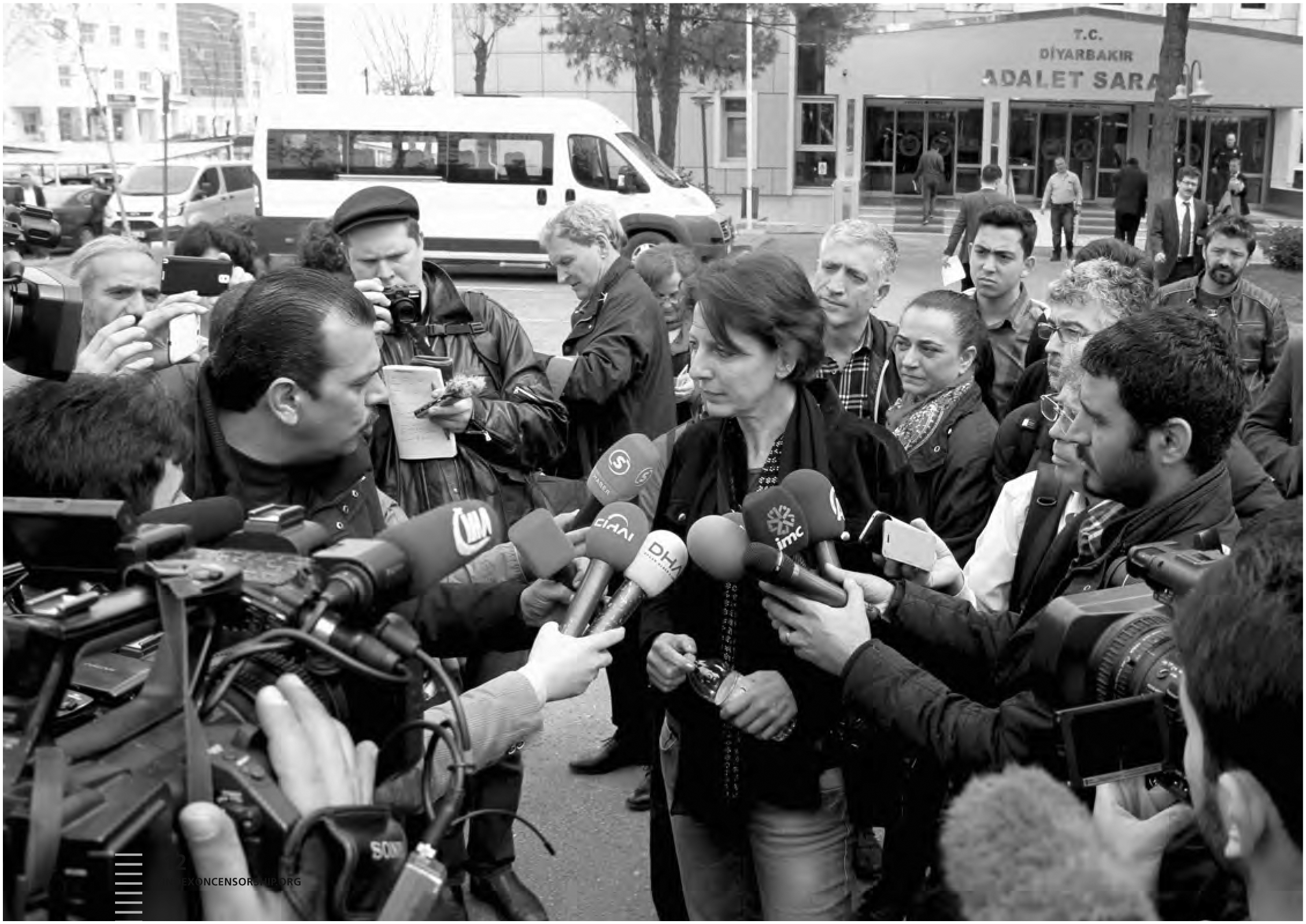
Dutch journalist Frederike Geerdink speaks to the media after her trial in Diyarbakir, Turkey, in April 2015
CREDIT: EPA
Anti-terror legislation seems to be the perfect tool for a state seeking to crack down on opposition. “It’s so elusive. You can [see] anything as terrorist propaganda. There needn’t be any evidence of violence, any praise of violence. Plus, if you blame someone for having a connection with the PKK the public buys that argument easily, especially in a country that is suffering from terrorism, as Turkey is,” Akarçeşme said.
Early in May, Brussels complained that the Turkish legislation allowed for an “overly broad application of the term terrorism”, underlining that the frequent arrests and prosecutions of journalists and academics on terrorism-related charges have a detrimental effect on freedom of expression which has led to increasing self-censorship. On 6 May, Turkish President Recep Erdogan rejected Brussels’ demands for an overhaul of anti-terror laws.
The government crackdown has had a tangible effect on the quality and the variety of the information published by media outlets. “When I read stories on what’s happening in Turkish Kurdistan I often wonder if it’s PKK propaganda or state propaganda. I try to rely on international media because they have no direct stake in the conflict,” Akarçeşme said.
“On some days you’ll have eight newspapers with the same headlines, all praising the government, it’s Orwellian,” said journalist Andrew Finkel, who has been based in Turkey for 20 years. He added: “The greatest test for the Turkish press happened in 2013, after media reports and social media users revealed the point-blank truth that the government was guilty of the most obscene corruption. The government still won the elections, by locking down the media, and controlling TV.”
But there’s another word one can use to browse through reports published on the MMF map: “extremism”. Anti-extremism legislation is used to intimidate journalists in post-Soviet countries, particularly in Russia. On the map, of the 35 incidents flagged with “extremism”, 11 took place in Russia, and seven in Crimea, others include Belguim, Italy, Hungary, France and Spain. Five reports connecting the media to “extremism” took place during the first half of 2016. They include website closures and journalists being put on a list of extremists.
In Russia, most cases using anti-extremism legislations against journalists happen via Roskomnadzor, the national media regulator.
Media lawyer Galina Arapova, who is based in the southern Russian city of Voronezh, explained: “Roskomnadzor has the power to issue warnings to a media outlet. If you receive two in 12 months, they can close you down. It’s almost unrealistic to challenge these warnings in court. We tried and the courts clearly take the side of the regulator. The number of these warnings is growing, particularly against online media.”
In 2014, an extremist warning prompted the dismissal of Galina Timchenko, the editor of Lenta.ru, which was then Russia’s most popular news website. This was a turning point. The trend has accelerated since, and, as Index’s interactive map indicates, several Crimean media outlets have recently been blocked.
“These warnings are very effective because they are extremely serious. Most cases connected to extremism are politically motivated. Criticising the annexation of Crimea or criticising government policy is considered extremism. Publications will have to be really careful for a year, that is to say, abstain from being critical,” Arapova explained.
On 13 May, Russia’s parliament, the Duma, approved the first draft of a set of laws targeting terrorism which would introduce new crimes into Russia’s criminal code, expand punishment for existing crimes, reinforce state surveillance on the internet, and lower the age at which Russians can be prosecuted for such crimes (from 16 to 14).
“In two weeks, we could wake up in a completely different reality,” activist Lev Ponoraryov wrote on his blog on the website of radio station Echo of Moscow (Ekho Moskvy). “In this reality, if you press ‘like’ under a picture that Centre E [Russia’s centre for combating extremism] doesn’t approve of, you could be sent to jail immediately.”
The MMF project shows that Turkey and Russia have become the main offenders in the region for use of anti-terrorist and anti-extremist legislation to target journalists and free speech, but they are not the only countries abusing anti-terror legislation.
Zoom into the map and you will see that in October 2015 the British police used the anti-terrorism act to seize the laptop of a BBC journalist who had been reporting on British-born jihadis, and that on 12 January 2016 the headquarters of a TV station were raided in Rome, following the airing of a programme asking whether security forces were equipped to foil terrorist attacks.
The 9/11 terrorist attacks fuelled the expansion of anti-terrorism and national security laws worldwide, starting with the USA. Cases where the authorities abuse the definition of extremism and conflate journalists and the subjects on which they report also happen close to us. In the spirit of the law, anti-terror legislation is supposed to apply to extraordinary cases – terrorist cases – but it is routinely abused.
In the UK, the I’m a Photographer Not a Terrorist group successfully challenged, through the European Court of Human Rights, section 44 of the Terrorism Act, which was being used to stop-and-search photographers in London – and to prevent them from photographing anything from a fish-and-chip shop to a tourist site. In 2015, the interception of communications commissioner (the prime minister’s snooping watchdog) found 19 police forces had made more than 600 applications to uncover journalists’ sources in the previous three years. In France, the November 2015 attacks were followed by the declaration of state of emergency which has seen extraordinary anti-terror legislation extended, and being used against activists.
In 2014, six British journalists and members of the National Union of Journalists took the police to court after realising information on them was being stored on “domestic extremism” databases. Speaking about the case, which is still ongoing, journalist Jules Mattsson, one of the complainants, told Index: “In the UK, when it comes to the police, it’s sometimes hard to know where incompetence ends and malice begins.”
This observation, funnily enough, applies not only to the Kafkaesque trials currently taking place in Turkey, but also to the prosecutions decided by over-zealous Russian police officers and members of security forces seeking to impress their hierarchy by the number of cases they process.
Repression that uses anti-terror legislation creates confusion and apathy – and the pervading sense that if a journalist is investigated on terror charges, placed on an extremist list, put under surveillance by special forces, then there must be something wrong with him or her. Speaking of Kurdish journalists imprisoned on terror charges, newly exiled Akarçeşme acknowledged that many Turks felt suspicion, or indifference, towards them. She said: “As long as they say they are journalists, we should take their word, and show solidarity.”