




Abstract
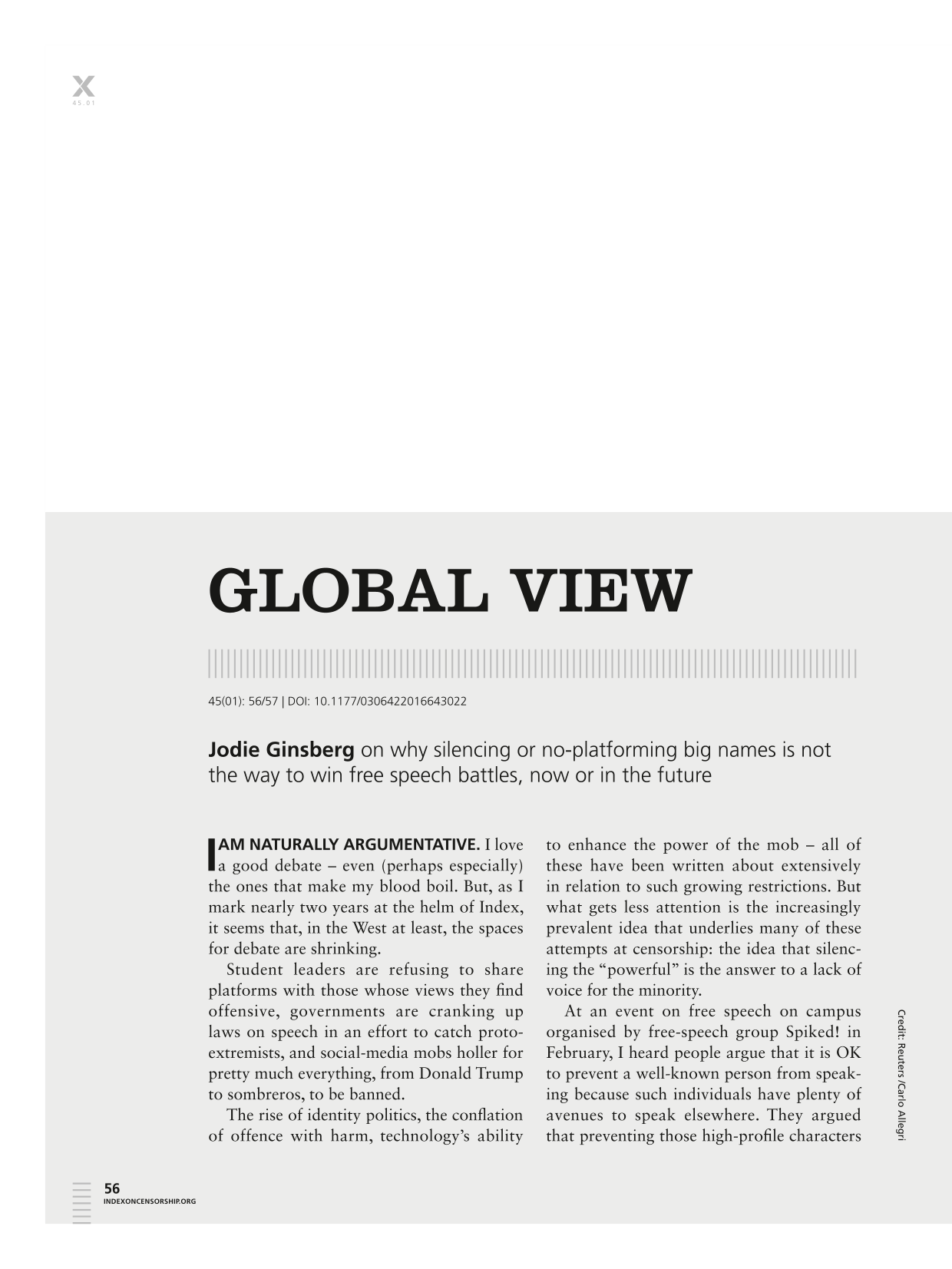
A petition was launched in late 2015 to stop US presidential candidate Donald Trump from entering the UK after he said Muslims should be prevented from entering the USA. UK parliamentarians discussed the petition after it gained more than 500,000 signatures; Trump’s views were widely condemned but most members agreed that banning him was not the answer
Credit: Reuters /Carlo Allegri
Student leaders are refusing to share platforms with those whose views they find offensive, governments are cranking up laws on speech in an effort to catch proto-extremists, and social-media mobs holler for pretty much everything, from Donald Trump to sombreros, to be banned.
The rise of identity politics, the conflation of offence with harm, technology’s ability to enhance the power of the mob – all of these have been written about extensively in relation to such growing restrictions. But what gets less attention is the increasingly prevalent idea that underlies many of these attempts at censorship: the idea that silencing the “powerful” is the answer to a lack of voice for the minority.
At an event on free speech on campus organised by free-speech group Spiked! in February, I heard people argue that it is OK to prevent a well-known person from speaking because such individuals have plenty of avenues to speak elsewhere. They argued that preventing those high-profile characters from talking simply starts to equal the balance between those who have platforms to speak and those who do not.
This does seem to be a growing position and one we should fight back against. Some of those arguing for the no-platforming of feminist author Germaine Greer at Cardiff University felt Greer already had too many opportunities to speak.
It’s an alluring argument. But it is false. And it is false because it confuses failure of access with failures of speech. These two things have to be approached separately.
We also need to be clear that a lack of access to places on panels or at events for some groups in society means this market of ideas does not always work as effectively as it should.
All too often, in the debates about no-platforming speakers at universities, in the demands for writers to be prosecuted, in the attempts to get plays or figures banned, do we see people calling for censorship of the speech they don’t like.
Censorship is never the answer for opinions you disagree with. Because as soon as you to start to undermine the idea that all speech is valid, then you lose the battle for your own voice to be heard.
In 2014, there was a furore over the cancellation of a show at the Barbican in London called Exhibit B. The work, by white South African artist Brett Bailey, used black actors to recreate the “human zoos” of the 19th century, which saw kidnapped Africans paraded as entertainment. Some 23,000 people signed a petition urging the Barbican to drop the show, which the venue eventually did following concerns about its ability to safely police protests outside.
Ahead of the cancellation, Index’s associate arts producer Julia Farrington wrote an article looking at the role of institutions in managing controversial art and a lack of diversity in arts management in the UK. Farrington wrote of “institutionalised mono-cultural bias” that was also a form of censorship.
Some of those who read the article after Exhibit B was cancelled interpreted this argument as one that in some way excused the cancellation of the piece. The decision to pull Exhibit B was censorship – pure and simple – but Farrington had a point. A lack of platform for diverse voices is a form of silencing.
And we should stop pretending that encouraging a diversity of viewpoints is somehow nanny-state tokenism. If you genuinely believe in free expression, then you should also believe in the importance of hearing other views, not just your own.
But the lack of platform for some must never be answered by removing the platform of others.
There is another way. This year’s Index on Censorship Freedom of Expression Awards shows how the world needs a range of people speaking out ondifferent issues. From theatre producers working in a French refugee camp, to a female Syrian journalist who trains other women to tell their stories about the ongoing war, these extraordinary people work, day in day out, to give a voice to those who otherwise have limited access to platforms for speech. The megaphone, which is the motif for this year’s awards, is an apt symbol for them all.
