




Abstract

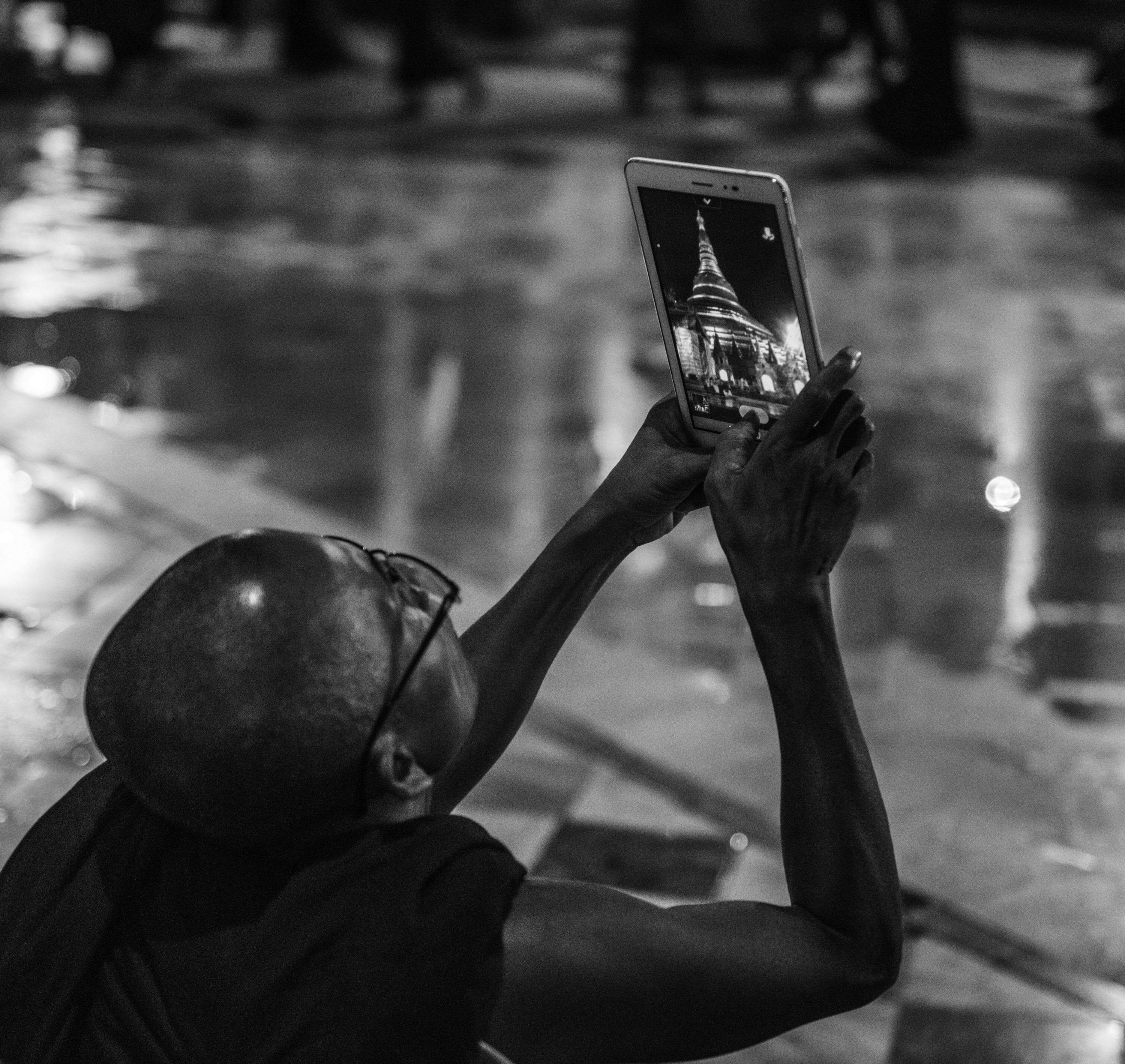
Burma is changing as new technologies come in. Here, a monk takes a photo of Shwedagon Pagoda in Yangon
Credit: Alamy / Tommy E Trenchard
“
No group was more astounded at Burma’s transition than its writers. The military government had maintained one of the world’s most repressive censorship regimes for five decades, so its announcement that the country was going to be steered towards democracy met with widespread disbelief. Yet in 2012, in a series of radical moves, the law that had formed the backbone of all censorship restrictions was repealed, large numbers of political prisoners were released and a by-election enabled democracy icon Aung San Suu Kyi to first stand for election and then lead her party to victory. The face of a country that had looked like it was stuck in a time warp started to change too. Young people in Yangon walking around wearing traditional longyis, clutched smart phones. Developers began building new office blocks next to crumbling colonial mansions.
But the path of transition soon became rocky. It didn’t take long until the government passed a law making it a criminal offence to publish anything without a licence and then began imprisoning journalists who asked tricky questions. It denied persecution of Muslims, but then passed a law targeted at Muslims to restrict inter-faith marriage. It published a bill to enable independent companies to run television stations, but then deposed an influential politician for being too liberal and shut down a radio station run by his relative. It launched a new state scholarship programme to enable a select few students to study abroad, yet floods and dengue fever were killing off children in rural villages.
Transition was supposed to conclude with the landmark national election in November. Yet the government refused to amend the constitutional requirement that 25% of the parliament should be reserved for the military, undermining the whole notion of democracy. They also refused to change the clause barring Aung San Suu Kyi from becoming president, although, as her National League for Democracy achieved its landslide victory, she announced this would not stop her from running the country. So it seems that, while the transition continues to progress, it still has a way to go. And in the meantime the censors are still twiddling their pens.
Still, literary culture remained ostensibly free from interference. Some writers, distrustful of the authorities and fearing a regression to old ways, continued self-censoring. But others, particularly the younger generation, were determined to make the most of their new-found freedoms to write about subjects they never used to be allowed to touch.
In reflecting on what Burma’s transition means and what is at stake, the beauty of fiction is its ability to delve behind the fraught media and political narratives. The two stories that follow do just that, by exploring the effects of the country’s repressive censorship regime on the narrators’ personal relationships. They reflect a mood too – a characteristic Burmese blend of bitter cynicism and a burning desire for change.
Books For Dogs
by Myay Hmone Lwin
1.
He was looking out of the window on to his calm, residential street, sipping a cup of coffee, when he heard shouting. A shaggy pack of dogs tore past his house, knocking over a banana stall and narrowly missing a small child. Behind them followed two men, yelling and cursing. The dogs kept on running, as if on a mission. Each one was clutching a book in its jaws. The men gave up, dropped back, and looked at each other, angry at first, then perplexed.
2.
Soon such sights became common, and he was unable to remain a bystander.
The first time the dogs managed to break into his flat they grabbed some books from a pile by his shoe stand. He was in, but as his boyfriend had called to say he couldn’t come over, he was busy pleasuring himself. So they made off with three paperbacks.
But the dogs became bolder. Even if he locked his windows they would jump through them, and take off with any books they could reach. Once, when he and his boyfriend were asleep, they took Win Oo’s Beauty’s Hate. His boyfriend chased after them, but the dogs were too fast.
Soon, aside from four or five books that he salvaged and kept in his fridge, the dogs had run off with his entire collection.
The last straw was when they barged in and snatched Murakami’s Kafka on the Shore from his hands as he was reading it, in broad daylight.
Enraged, he went to the municipal office to petition for eradication of these dogs. A huge crowd had already lined up outside the office. He queued a while, then went home, frustrated.
3.
His publisher delivered him the next instalment of strange goings on. “As you might expect, we’re having to respond to the dog situation.”
“You mean, lock up more books?” he asked.
His publisher was not potbellied and greasy-faced like other publishers, but was a well-built and good-looking young man, whose defined cheekbones were a key reason why he did not switch.
“That’s proving futile. I’m talking about a more proactive response. Writing in the way the dogs like.”
“What the …?” He felt sure the publisher must be joking. Never, in his life, had he heard of dogs reading, still less demanding certain types of books.
“Orders are skyrocketing,” the publisher continued, straight-faced. “We can’t print enough.”
“Really?”
“You should know that all my regular writers have now switched to writing dogs’ literature. I’m letting you know so that you, too, have a chance to change.”
“What, write books for dogs?”
His publisher’s eyes glinted. “You know your last book about the guy who became a ghost after falling off a rickshaw?”
“Corpse Carrying Rickshaw.”
“Well, its sales have decreased by 50% in a week.”
He clenched his teeth. He knew full well that, in this market, if orders drop by that much, it is a danger signal to publishers, who always try to keep track of what readers want. He’d already seen trends for comedy, romance and horror. Whatever the audience was in the mood for, writers had to satisfy. But he had not anticipated dog fiction. He had no idea what the genre even required.
“Can you show me some samples?”
“Sure.” Five books came out of the publisher’s bag, all covered with pictures of lolling canine tongues and paw prints.
“Even the covers are rabid!”
“Maybe to you, but they’re selling. Look, just read these and write me something along those lines but with your own twist of originality. I’ll call you in two weeks to collect.”
Two weeks was tight. He considered refusing.
“I’ll give you an advance now. Two million kyats. OK?”
There was an offer he couldn’t refuse.
4.
Soon the only books to be found on bookshop shelves were dog fiction books. Bestsellers all had titles like A Call from the Hill of Bones, Only Bone Bearers Allowed, and No Bone More Sweet.
Despite now writing them himself, he still found dog stories revolting to read. He couldn’t bear to finish one. Word on the street was that most other human readers didn’t like them either, but they were too scared to protest. He wished he could go back to writing what he wanted.
But he had to eat, didn’t he? Plus, his boyfriend was only attracted to him because he was a famous writer. So he would have to reconcile himself to writing dog stories until further notice. He started thinking about his next title. Beef on a leash?
It was nearly three o’clock. His boyfriend was coming later. He decided he’d better start making him a beef stew from his new doggy delights cookbook.
The Newspapers
by Pandora
As a kid I found newspapers boring. Not only did they look monochrome, the content was monochrome. All the stories were about officials going around the country and opening new bridges, schools or pagodas. But I liked to read, so I read them.
I came to understand that we were a fast-developing country, the most beautiful in the world, rich in natural resources and full of happy people. We did have the odd natural disaster but any casualties were insignificant. Other countries constantly had wars, volcanic eruptions and earthquakes. Even in the wealthy United States, street shooting sprees were commonplace. We had no idea how our country’s military budget compared to others’, but we knew about all the soldiers being killed in Iraq and Afghanistan: this information was updated as a daily column to emphasise our relative peacefulness. So we didn’t envy foreign countries. If it so happened that we couldn’t afford to send children to school, or pay for medical expenses, we just put it down to bad Karma.
The only internal friction seemed to be caused by a few rebellious villains, who sometimes appeared in movies with long hair, unkempt moustaches and beards, set fire to villages and demanded money. I wondered why such rogues existed. Most of our citizens were highly civilised, to the extent that we understood it to be in our public interest that images of ladies showing thighs, calves or cleavage obviously could not be published.
But the more I read, and the older I got, the more I began to get a sense that the real world looked a bit different to the way it seemed in the newspapers. I noticed that Grandpa was prone to complain about the government. Eccentrically, he always listened to foreign news broadcasts through an old radio, even though our newspapers made clear that such news was spun by liars. But Father disapproved of Grandpa for listening to this kind of thing. They were always squabbling. Grandpa was usually boiling with dissatisfaction whereas Father was easily contented, just like my elder brother.
When my brother finished school, my parents encouraged him to apply for the Defence Services Academy since they could not afford university, and being a military officer was the most secure of jobs. Unlike me, my brother always obeyed my parents. Four years later, my parents proudly hung a framed photo of him in military uniform in the sitting room, and waved him off for overseas training. While he was abroad, the internet arrived in the country, and my parents started travelling into the nearest town regularly to chat with him online.
One day, Grandpa told us he’d heard that a big storm was about to strike in the delta, and would be worst by the coast. Father chided him for believing foreign news sources, and our newspapers made it seem as if it would only be a minor storm. But my parents needed to make a trip to a small village on the coast, so they asked my brother for this advice. He told them not to worry – there had been no instruction from his senior officials, and any important matters would be published in the newspapers.
So, that evening my parents set off on their trip even as the rain had started to fall. In the twilight, Grandpa and I saw a flock of seagulls flying toward the town. Early the next morning, we heard the wind roar and saw the sky turn red, and soon after a barrage of wind and rain rammed the village. Grandpa told me that our house was not strong enough. We stuffed a few important things in a bag, and rushed to safety in a monastery on a nearby hill. As we walked, the water level rose to our knees and trees started falling. It got dark, hard to find the way, and I was terrified that we would drown.
The monastery was already filling up with other refugees. The water was already close, so we knew our house must have been submerged. By that afternoon the cyclone had passed, but when we got back to our village we found all the roads, houses and trees destroyed. I could not even find where our house had been. We had to go back to the monastery, and I became really worried about my parents.
So many more survivors from other villages came to seek refuge in the monastery that there was no more space and they were turned away. At least half of our villagers turned out to be missing. People brought word that many villages nearer the sea had totally disappeared and around 100,000 people had been killed just in our township. As my fear for my parents grew, I became furious at how so many people had died just because they hadn’t been given the proper information about the cyclone. I took all the money I had saved and went to town to call my brother online.
My brother was astonished when I told him what was happening in the delta. “Are you sure?” he asked. But when I told him that I still couldn’t get in touch with our parents on the coast, where whole villages were still underwater, he laughed. “Whole villages! Come on. Don’t believe everything you read on the internet. Opportunist people exaggerate information like that to defame the government.” I dropped the call in despair.
It was windy when I left the internet cafe, and rubbish was blowing along the battered street. Something flew up and stuck on my face. It was a torn page of a newspaper. I crushed it in my hands.
Profile: Myay Hmone Lwin
Myay Hmone Lwin’s provocative and semi-jocular reflection on Burma’s censorship regime is typical of this young writer and publisher, who founded his own publishing house 11 years ago, aged just 17.
Before the transition began, Lwin went so far as to offer the censorship board the bait of his rebellious first novel, Engraved, which narrates the Saffron Revolution from the perspective of a teenager who winds up in a police cell after the crackdown, and gradually becomes politicised, none of which prevents him from spending nights out in illicit clubs, chasing girls and getting boozed up. He even has the gall to contradict and insult his father. All this subject matter was inflammatory by the censors’ standards.
Lwin managed to avoid being imprisoned, perhaps because he’d become acquainted with some of the censors in his capacity as a publisher. Still, his novel manuscript was sufficient to cause a group of officials to turn up on his doorstep for a long interrogation and for his publishing house to be shut down.
He bided his time and when transition began he got his licence reinstated and started publishing again, focusing not only on his own fiction but on other banned or controversial books.
Books for Dogs represents some of the defining characteristics of his writing, including provocative references to masturbation and a gay relationship, both of which remain taboo in Burmese fiction. However, unlike the realism of much of his work, this story is allegorical: a popular literary device under censorship, since it allowed writers to slip political critiques past the censors. The story alludes to the craze for horror fiction in Burma around 2009. The censorship board was fine with that: clearly, horror fiction was just escapist. It couldn’t possibly reflect reality for the contented people of Burma.
Profile: Pandora
An angry, sardonic transition story, The Newspapers by Pandora illustrates the extremes of Burma’s news media censorship, which rendered all newspapers mouthpieces for government propaganda. While it can be difficult to connect the concept of censorship with tangible harm, this story achieves that by illuminating its role in the horrific events around Cyclone Nargis, which resulted in the deaths of approximately 138,000 people in the Irrawaddy Delta in 2008.
The story is also partly autobiographical. Pandora grew up in a small town in the delta, where her parents ran a bookshop. Her younger sister had the experience of telling a friend stationed in Russia that his parents’ house had been submerged by Cyclone Nargis, a fact which he flatly refused to believe despite having access to the internet. Pandora went to university in Yangon to study English literature, but became frustrated with the restrictive teaching. The last straw was having her course cut short because of student protests against the regime. Landing a rare scholarship to do a master’s degree in Singapore, she promptly migrated there and later got a job as a civil servant.
Creatively dissatisfied, she decided to publish some of her Burmese-language poetry on a blog and used Pandora as a pen name. People liked it and she gained confidence. Liberated by the anonymity of the blog, she began to experiment beyond the traditional poetic forms that prevailed in Burma, and to use postmodern techniques to disguise critiques of the regime in complex and ambiguous language and imagery. When the transition began, she decided to return home to start a family and to develop a writing career beyond the blog.
Books for Dogs was translated by
The Newspapers was translated by
