




Abstract
Should racist words and stereotypes be edited out of old films, television programmes and books? No, says
Critics rounded on the Swedish broadcaster SVT, accusing it of imposing adult PC values on a beloved fictional figure. But this situation is not unique to Sweden. The people who run television programming throughout western Europe are acting in the same way. The programme could be seen as simply part of work reflecting attitudes of a particular period. I fear there is a danger we lose the contextual understanding of the work and an understanding of the period by editing it in this way.
Mark Twain’s classic novel Adventures of Huckleberry Finn has been at the centre of a similar debate in the United States, but the book was always intended to be controversial. Critics rounded on it when it was first published in 1885. The Committee of the Concord Public Library in Massachusetts, publicly declared the book “couched in the language of a rough, ignorant dialect” and that “all through its pages there is a systematic use of bad grammar and an employment of inelegant expressions”.
The enterprising publisher saw this as a “rattling tip-top puff” and used the library ban and subsequent publicity to promote the book. It went on to sell several million copies in its first year and has never been out of print since. More recently, Huckleberry Finn has caused controversy for different reasons. In January 2011 NewSouth Books, a publisher in Montgomery, Alabama, announced it was going bring out a version that omitted the racial epithets “nigger” and “injun”, which appear hundreds of times in the original book, and replace them with “slave” and “Indian Joe”– a gesture that was applauded and derided in equal measure.
There is a growing modern-day presumption that by airbrushing out racist monikers of the past we are, in some way, making improvements to the way equalities will be shaped in the here and now. This view has created a new industry geared to suppress, edit and, in some extreme cases, revise certain books and films that are discordant with modern life. An atmosphere is being created where there are whole historical spaces that have become taboo, no-go areas for broadcasting and film.
Today we may laugh at the idea of the Victorians covering up the legs of tables lest some uncontrollable passions be unleashed upon society, but it seems similar sentiments are being used to restrict artistic practice today. The argument that re-editing the past protects minority groups is becoming more and more acceptable to some.
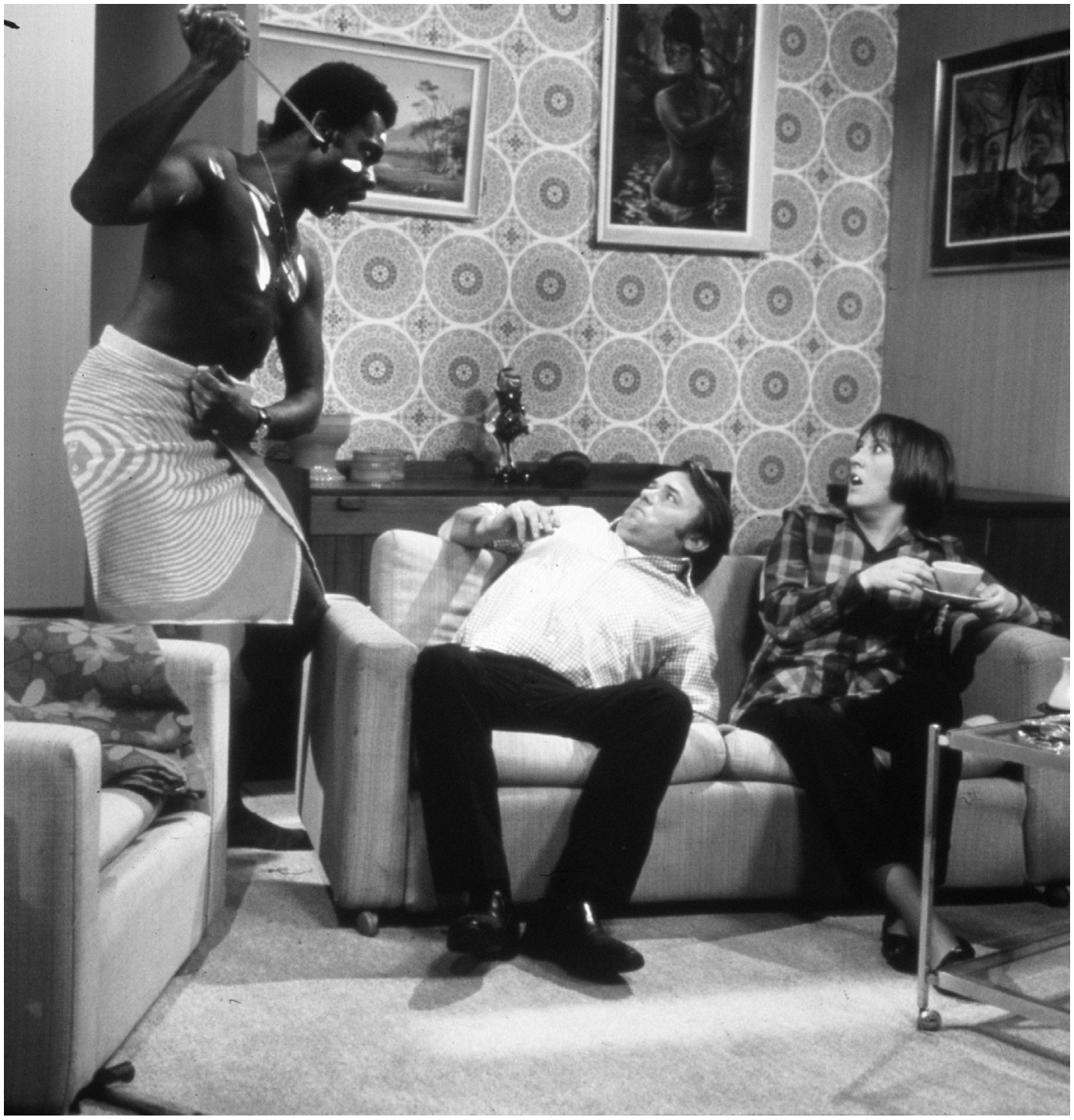
A still from 1970s British sitcom Love Thy Neighbour
Credit: FremantleMedia Ltd/REX Shutterstock
Historically, censorship and bans connected to race were not about protecting the sensitivities of minorities, but keeping them in their place. In 1908, Jack Johnson became the first black Heavyweight Champion of the World, beating the white reigning champion, the Canadian Tommy Burns. His victory caused uproar: it had been unthinkable before that a black man would fight a white man for the title, let alone win. The writer Jack London made a call for a white champion to step forward “and remove the golden smile from Jack Johnson’s face”, coining the phrase “great white hope”. Undefeated, popular, white boxer, James J. Jeffries stepped forward in 1910. Despite the hype, Johnson comprehensively beat Jeffries in 15 one-sided rounds, challenging one of the great taboos of Western culture: white invincibility. Johnson’s victory provoked riots across 25 states, with around 20 people killed.
The racist establishment in the US, and throughout the colonial territories, understood what was at stake: the film of the fight received more public attention than any other film before. Its relevance was not lost on the media of the day. Prior to the fight, The New York Times wrote: “If the black man wins, thousands and thousands of his ignorant brothers will misinterpret his victory as justifying claims to much more than mere physical equality with their white neighbours.” The controversy motivated the US Congress to ban distribution of all prize-fight films across state lines in 1912, paving the way for a national framework for censoring films.
What’s important here is that the activities of black people and the control of the image of black people as unequal in society was central to the development of censorship in film, not sex and violence.
This idea was not unique to the USA. It also shaped film content in Europe, and the relationship to its colonies, where primitive stereotypes of black people on screen predominated in the inter-war years and beyond, with films such as Tarzan (1920), King Kong (1933) and Zulu (1964).
If the past was about censors using film to reflect and maintain inequalities, today’s restrictions are put forward as progressive tools of equality which work by singling out parts of our culture that are out of step with modern life.
In the UK this summer, British Olympic athlete Linford Christie sat down with comedian Brian Conley on the BBC 1 television programme TV That Made Me and astounded Conley by stating his favourite show was the 1970s comedy Love Thy Neighbour. This was a programme bursting with bigoted and brutal caricatures of race and the working classes. The show is set up around a white racist, Eddie Booth, played by the late Jack Smethurst, and an angry Caribbean neighbour, played by Rudolph Walker. The show is described on the British Film Institute website, Screenonline, as “the epitome of racist sitcom”. In October 2010 in Camden, north London, I went to an event to celebrate Walker’s 40 years of acting. He bemoaned the simplistic criticisms of people who attacked the programme today and pointed to the huge black audience it drew at the time, who understood that the original intention was to ridicule racist views using humour. It was the same point Christie made. He said: “We wouldn’t be allowed to show it now. It’s not PC. [But] in those days people didn’t care, people just watched things for what it was. We enjoyed it.”
So have we in the UK become more sensitive and easier to offend? Or could it simply be argued that Love Thy Neighbour and many others old British situation comedies, which relied on racial and other stereotypes, were bad television? I’m thinking of 1960s and 1970s programmes which have almost been forgotten: Mind Your Language, a sitcom set in a multi-cultural English language class where the humour relied on exploiting every single international stereotype; Mixed Blessings, a comedy about the trials and tribulations of interracial marriage; or even short-lived sitcom Curry and Chips, in which Spike Milligan blacked up to play an Asian factory worker. But the quality of writing is not the saving grace in this debate. Till Death Do Us Part – a precursor to Love Thy Neighbour, airing from 1965 to 1975 – was a well-written sitcom that satirised contemporary attitudes to race. The central character, Alf Garnet, a reconstituted working-class right-wing bigot, was supposed to be satirical but he is probably held in greater contempt by today’s liberal intelligentsia than any other from the era.
Should we not accept that films and TV programmes created in the past will include some stereotypical images of minorities? We know history is littered with conflicting notions of racist artefacts encased in entertainment, so while artistic and entertainment products, taken at face value, might be beautiful and uplifting, experience teaches us that the intention behind them is not always so.
Take Leni Riefenstahl’s 1935 Nazi film Triumph of the Will. We know that it’s unbelievably well-made and effective. But we also know where it was a pro-fascist propaganda film. It makes us feel uncomfortable and angry but we still watch and discuss it. Should we not be open to seeing and talking about racist TV programming in the same way? It’s not about making excuses or leaving our critical faculties behind, it is about understanding why something was made, how it was made and how audiences responded to it. This is surely better than attempting to re-edit the past and is it not better also to be able to see how our society’s thinking has developed over time?
Racist culture will have produced racist works of art and, by the same token, racist entertainment and literature. I agree with those who argue the problem is not the film or the TV programme, but our reaction to it today. Learning to live with and understand this conundrum is part of modern life.