




Abstract
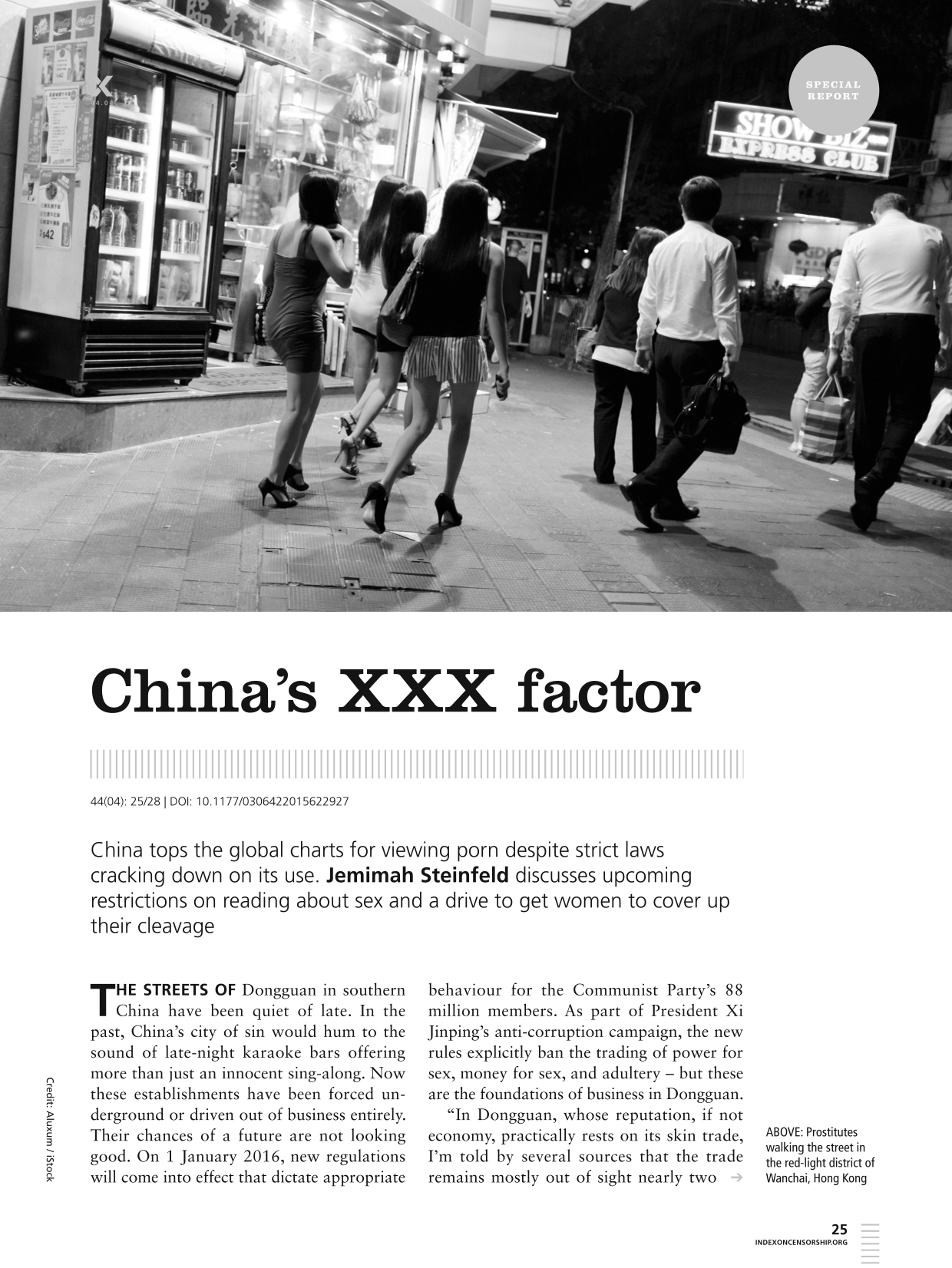
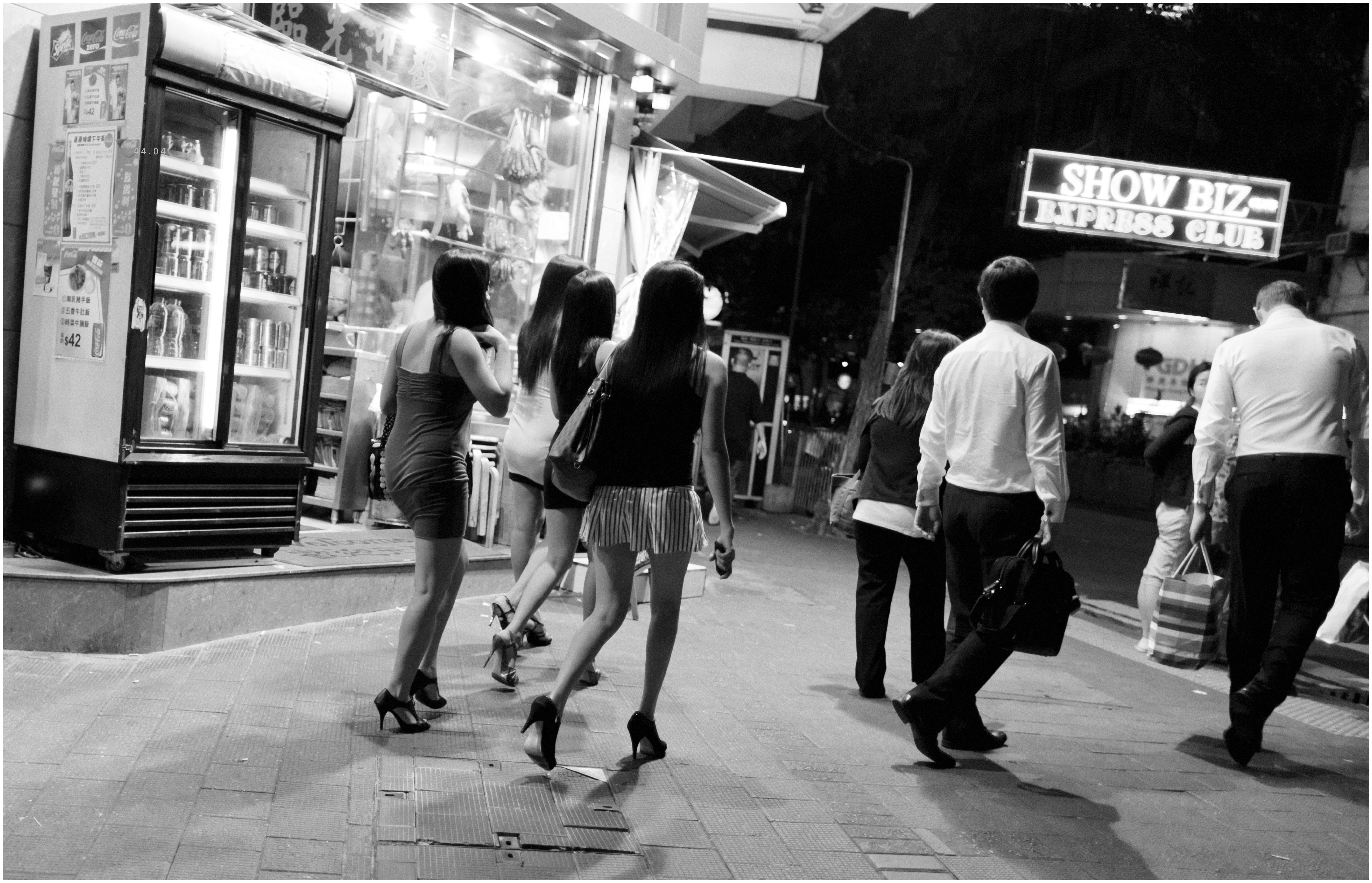
Prostitutes walking the street in the red-light district of Wanchai, Hong Kong
Credit: Aluxum / iStock
China tops the global charts for viewing porn despite strict laws cracking down on its use.
“In Dongguan, whose reputation, if not economy, practically rests on its skin trade, I’m told by several sources that the trade remains mostly out of sight nearly two years after a television report [led to]a sweeping crackdown,” said Robert Foyle Hunwick, a writer who has visited the city many times to research his forthcoming book The Pleasure Garden: China’s Hidden World of Sex, Drugs and the Super-Rich.
Dongguan is not the only city suffering from this campaign against smut – it has been lights out for many brothels across China. Nor is this crackdown limited to China’s Communist party members, as the January 2016 regulations imply. Instead, it forms part of a broader crackdown on China’s sex industry that has been underway since Xi Jinping came to power in 2012.
Enemy number one is internet pornography. In the most recent statistics, from 2014, China accounts for up to 28% of the world’s porn consumption, taking the global lead. It’s a statistic that does not sit well with Xi. Shortly into his term in power, he launched his first anti-pornography crusade, calling for a “benign internet environment”. An attempt was made to clear China’s internet of anything verging on pornography. A similar initiative was launched this summer, following the release of a video featuring a couple having sex in a Uniqlo store. It was the usual drill: sites were blocked or removed and anyone caught facilitating the production or distribution of pornography was arrested.
Other forms of media have not been spared. Film, television and literature are all closely monitored and scrutinised at present. A handful of writers of slash fiction, erotic prose for same-sex relationships, were arrested back in 2014 – just one of many examples.
But what exactly constitutes pornography? The definition is very broad, as was evident at the start of this year when a big budget Chinese TV show ordered its leading ladies to cover up their cleavage.
This nebulous definition serves the party well. Being able to easily change the goalposts of what is and what is not acceptable is a crafty way of widening censorship. Author Murong Xuecun believes his 2002 book on love and life in the Chinese city of Chengdu would have been banned straight away if published today. It’s one way to silence a writer known for his scathing criticism of the Chinese government.
Other victims of the crackdown are those who stand up for sexual freedom or any sexual identity alternative to the norm. For instance, in 2014, when nine gay activists were arrested ahead of the anniversary of the Tiananmen Square protests, with authorities making the link explicit.
This is something that Katrien Jacobs, author of People’s Pornography: Sex and Surveillance on the Chinese Internet, said is having a particularly ill effect on young people in China – who cannot form their identities freely in lieu of sexual content. She told Index on Censorship: “People were saying [in 2009-10], ‘yes, we do have pornography’. It is illegal, but available and liberating. It’s definitely changing for the worse now.
“Young people who maybe five years ago would have come out as being in a sexual minority now might be quiet about it. There’s no culture around it. Because you get censored it’s deeper underground.”
Jacobs also cites the arrest this year of the Feminist Five: five women who were calling for greater protection for women against sexual harassment on public transport, as an example of how far government attitudes have shifted and what that means for society more generally.
“When [the Feminist Five] were censored, an entire network of activists, including queer activists, were censored too. If you cannot fight for female rights, what can you fight for? There’s no chance that you can have the kind of discussion about the merits of pornography in this context,” Jacobs said. And there are other merits to “pornography” for some in China. Sex education at school is patchy. While some schools in major cities offer courses that rival Western counterparts, the norm is more towards little or no sex education. Outlets that offer honest conversations about sex could mitigate the effects of this haphazard approach, which include a surge in sexually transmitted infections and high numbers of unwanted pregnancies.
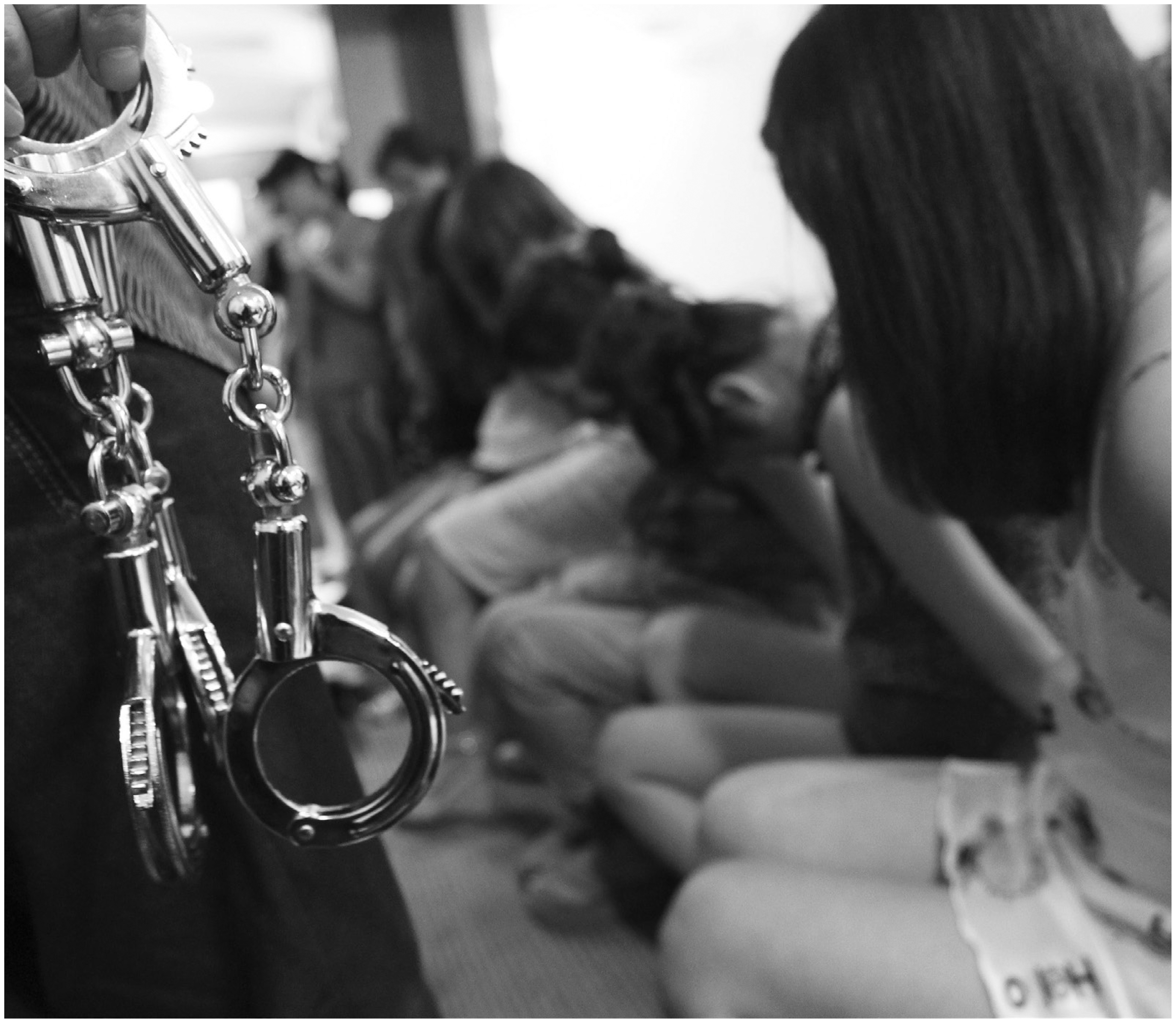
A police officer arrests suspected sex workers as police crack down on prostitution in Wenzhou, China
Credit: Reuters
Of course, Xi cannot be blamed entirely for what is currently going on. He has inherited a party that has never been comfortable about sex. Pornography has been banned in China since 1949, when the communists first came to power. During the Cultural Revolution, the height of puritanism, owning an erotic novel was enough to get you seriously in trouble. Sex was erased from public discourse.
This hysteria started to calm after the death of Mao Zedong and when people began exploring new sexual identities in a more open way. But even under Deng Xiaoping, the instigator of China’s period of opening up, a level of discomfort about sex persisted. At its extreme, Deng passed a law in 1990 bringing in the death penalty for traffickers of prostitutes and pornography.
Still, Xi’s campaign is taking the Chinese government’s war on sex work to new heights.
“The crackdown on sexual commerce seems to have been longer and more sustained than under previous administrations,” said Foyle Hunwick. Jacobs agreed.
Xi might be fighting a losing battle. Even with his large army of censors, the crackdown remains incomplete: a quick search on Chinese search engine Baidu for adult content generates results very similar to Google’s. Some large porn websites were blocked at the time of accessing; others were readily available. The censorship is so patchy that Zhang Lijia, an author currently working on a novel about Chinese prostitutes, was not aware the authorities were censoring conversations around sex.
“Go to any Chinese website and tell me what you see,” she said, unfazed by the latest crackdown.
Meanwhile, people have been finding creative ways to express sexual identity that won’t be censored. Jacobs highlighted that authors of slash fiction are now adapting to the new environment. Where it was once about sexuality, plots are now more about romance. When they do want to describe sex, writers might get around restrictions by using coded words and symbols.
“It’s not a very good time to have this as a hobby,” said Jacobs. “But if you are willing to compromise – you can get away with it.”
Case Study
Xi Jinping: A model of morality
Shortly after Xi Jinping became the leader of the Chinese Communist Party in 2012, an article was released by Xinhua, the official press organisation of China. Billed as biography, the article was as sycophantic as it gets. Xi was referred to as a filial son whose parents were original Communist party members.
“The Xi family has a tradition of being strict with children and living a simple life,” it said and quickly added that Xi has kept up this tradition.
The article skipped over the part where Xi was married and then divorced. Instead it went straight to his second marriage to Peng Liyuan. “Xi and Peng fell in love at first sight in 1986 and got married the same year,” it reads.
Xi was “different from anybody else and also an average person”. The most racy comment was that he likes to drink a bit at parties. Otherwise, he enjoys home cooked meals and sport.
In many ways this article launched the cult of Xi. Today he is affectionately referred to as Xi Dada or Big Daddy Xi by many in China. There are love songs about him, biographies of him, stickers and cartoons. There are even action figures.
“We love and respect President Xi,” commented Song Zhigang, the composer of a hugely popular love song about Xi and his wife called Big Daddy Xi loves Mama Peng.
“His life story has been appropriated,” said Kerry Brown, author of several biographies on China’s leaders, including one on Xi Jinping set to be published next April. Brown explains how this construction of a cult of personality is a departure from the past. Chinese leaders have usually avoided a strong personal narrative since Mao.
The image that Xi has carefully crafted is one of a skilled statesman and wholesome family man. It’s from this perspective that a lot of current policy emanates, including ideas around what constitutes public morality and pornographic content.
“Xi has a strong idea of what traditional Chinese culture is,” says Brown. “One idea is that unhealthy content [porn] is absolutely not acceptable.”
Of course it’s a well-known fact in China that Communist Party members are as guilty – if not more – of partaking in China’s more illicit industries. In 2013 one provincial official was revealed to have kept 47 mistresses, and it’s not hard to come across other stories of this kind. But Xi wants to rid the party of this image and he’s willing to go to extreme measures to do so (see main article).
“The party is saying, ‘We are not this morally corrupt party – we’re clean and we therefore don’t support this market of flesh,” Brown said. When asked about Xi, Robert Foyle Hunwick, an author of an upcoming book on sex and the mega rich in China, added further insight into the man and the myth.
“Xi often claims he was ‘made’ in Yanan during the Cultural Revolution, and these formative rural years, at the height of Maoist puritanism, seem likely to explain his robustly conservative views, which presumably apply to sex, and certainly toward materialism and other forms of ‘vulgarity’,” he said.
Foyle Hunwick does not believe Xi’s views are completely different from former leaders, but highlights that “his presence has magnified the discourse against all forms of liberalism, including sexual, to the point of hysteria”.