



Abstract

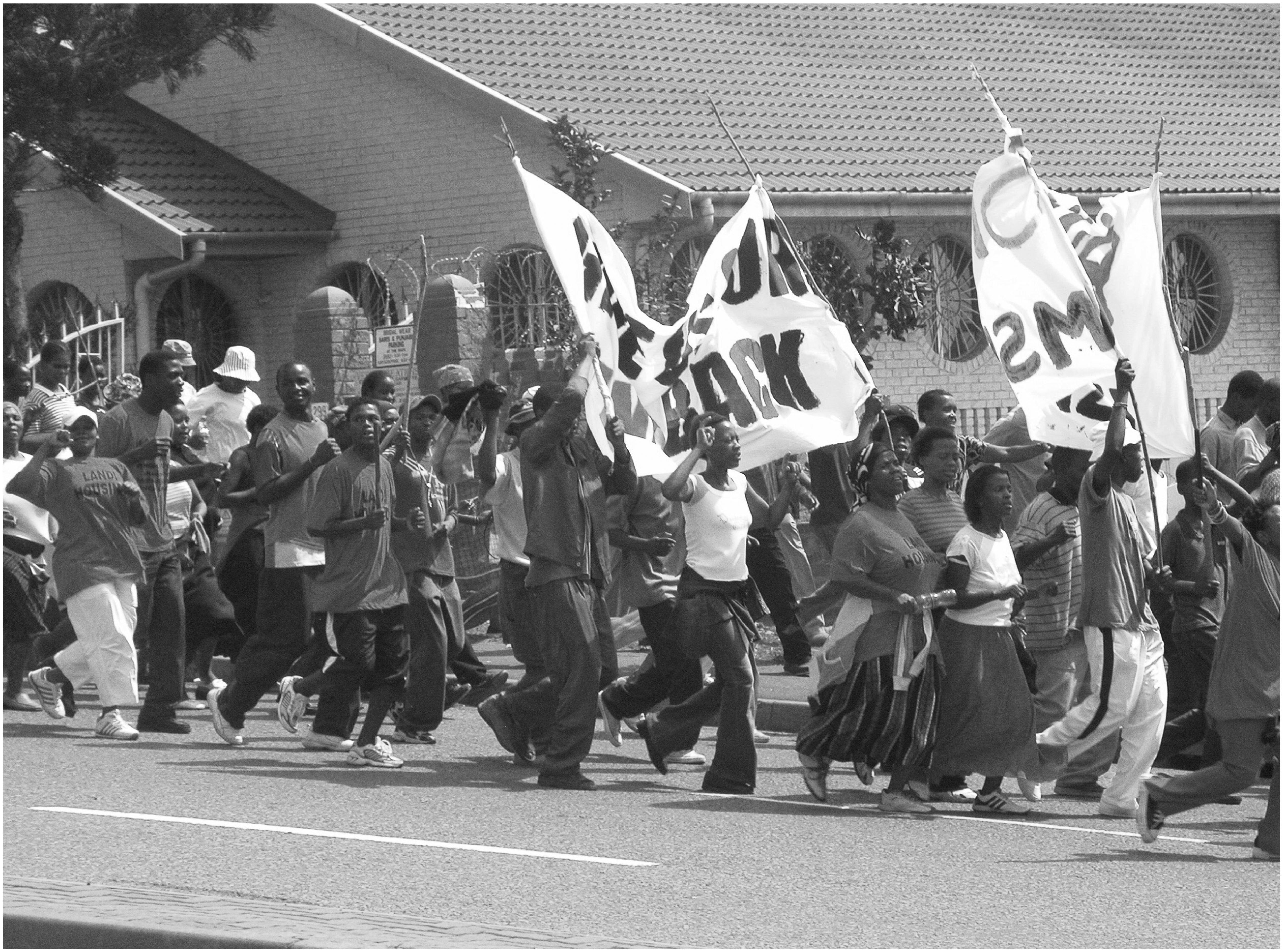
Members of South African housing rights group Abahlali baseMjondolo at a protest in Durban. Several of their members have been assassinated and the organisers believe the unknown perpetrators wanted to shutdown the call for proper housing
Credit: Inkani~commonswiki/ Creative Commons
After assassinations and break-ins, what lies ahead for South Africa’s campaigners? Amid fears of restrictive new legislation,
The attitudes of the governing African National Congress towards the civil society sector have changed several times in the two decades since apartheid ended. Currently, says Section27’s executive director Mark Heywood, “there is no uniform view in government” about whether organisations are friend or foe. Section27 is a public interest law centre that litigates around social justice issues like access to housing, education and sanitation. It incorporates one of the country’s most famous NGOs, the Aids Law Project, which in the early 2000s went to court to force the government to provide treatment preventing the transmission of HIV from pregnant mothers to their unborn children.
It won, the victory coming at the height of then-President Thabo Mbeki’s era of Aids denialism. Heywood was an integral part of that campaign, which was run in the courts by the Aids Law Project and on the streets by the Treatment Action Campaign. He told Index on Censorship that there was “more trust in government among ordinary South Africans” at that time and the organisations’ work was seen by some ANC members and supporters as being tantamount to treason.
The judgment was a turning point for many people’s attitudes to civil society organisations and NGOs, and today South Africa boasts what many worldwide consider a model approach to HIV treatment programmes. On the flipside, the government is viewed with increasing dissatisfaction and mistrust as it seeks to provide healthcare, housing, sanitation, education, a stable supply of electricity and job opportunities to its citizens while battling economic uncertainty.
Heywood said that while there were those in government who “would like to work more openly and constructively with us”; there are others who resent “the echo that we’re creating”. Civil society organisations, including Section27 and the anti-censorship campaign group Right2Know, ask difficult questions, putting a spotlight on government failings and, in Section27’s case, using the country’s powerful constitution and its well-regarded courts to hold the government to account on its social responsibilities.
“The securocrats in government view us as an enemy,” Heywood said. There’s a view that, since President Jacob Zuma took office in 2009, the securocrats have become increasingly powerful and have captured a number of crucial state organisations – including the State Security Agency, the priority crimes division of the police service, and the tax collection agency.
Those in power who want to sideline civil society accuse it of being funded by nefarious Western interests that want to return South Africa to white rule. Recently, the Southern African Litigation Centre was criticised by the government for its role in trying to obtain an arrest warrant for Sudanese leader Omar al-Bashir while he was in the country for an African Union summit. The centre was accused of behaving in an anti-African fashion by taking on one of the continent’s own leaders.
Heywood said attempts by those in power to stigmatise the sector have been largely unsuccessful:“We’ve not encountered any hostility in the communities where we work and help. The people who buy that type of nonsense are not ordinary people.”
“The stigma strategy doesn’t work as well as it used to, so [their methods of countering us] become more insidious,” he explained. For instance, several NGOs have reported break-ins at their offices during which only computer hard drives are taken and valuables are left untouched. These kinds of incidents, Heywood said, are supposed to intimidate workers – a way of saying “we can get you”.
There have also been less subtle incidents. In a report entitled Big Brother Exposed, Right2Know shared stories from community and civil society activists who say they have been followed by state security agents and had their phone conversations recorded. The government has denied these allegations.
Most worryingly, some activists have died because of their work. The Durban-based housing rights group Abahlali basMjondolo said several of its members have been assassinated by those wanting to shut down the fight for proper housing. Heywood said smaller organisations with less sophisticated structures and fewer support networks were far more vulnerable to this kind of violence than their counterparts at bigger, more established organisations.
Why would anyone resort to murder to shut down a protester or social movement? Because, in many cases, these organisations are getting too close to revealing an individual or group’s involvement in corruption, Heywood said. In the case of an organisation like Abahlali baseMjondolo, which tries to lift communities out of shacks and into formal housing, they may be interfering with someone’s access to a lucrative government tender. Bullets guarantee silence.
There’s plenty for civil society in South Africa to celebrate. Heywood said the sector had the ability to litigate, access to a strong and vibrant media (still one of the most free in Africa) and, of course, the cornerstone of modern South Africa, its constitution. “Civil society is getting stronger again, and organisations are learning from and becoming more engaged with each other,” said Heywood.
With local government elections scheduled for next year, it remains to be seen whether the situation will worsen for these organisations or if government attitudes will change for the better, fostering the dissent and transparency every country needs.
© Natasha Joseph