



Abstract

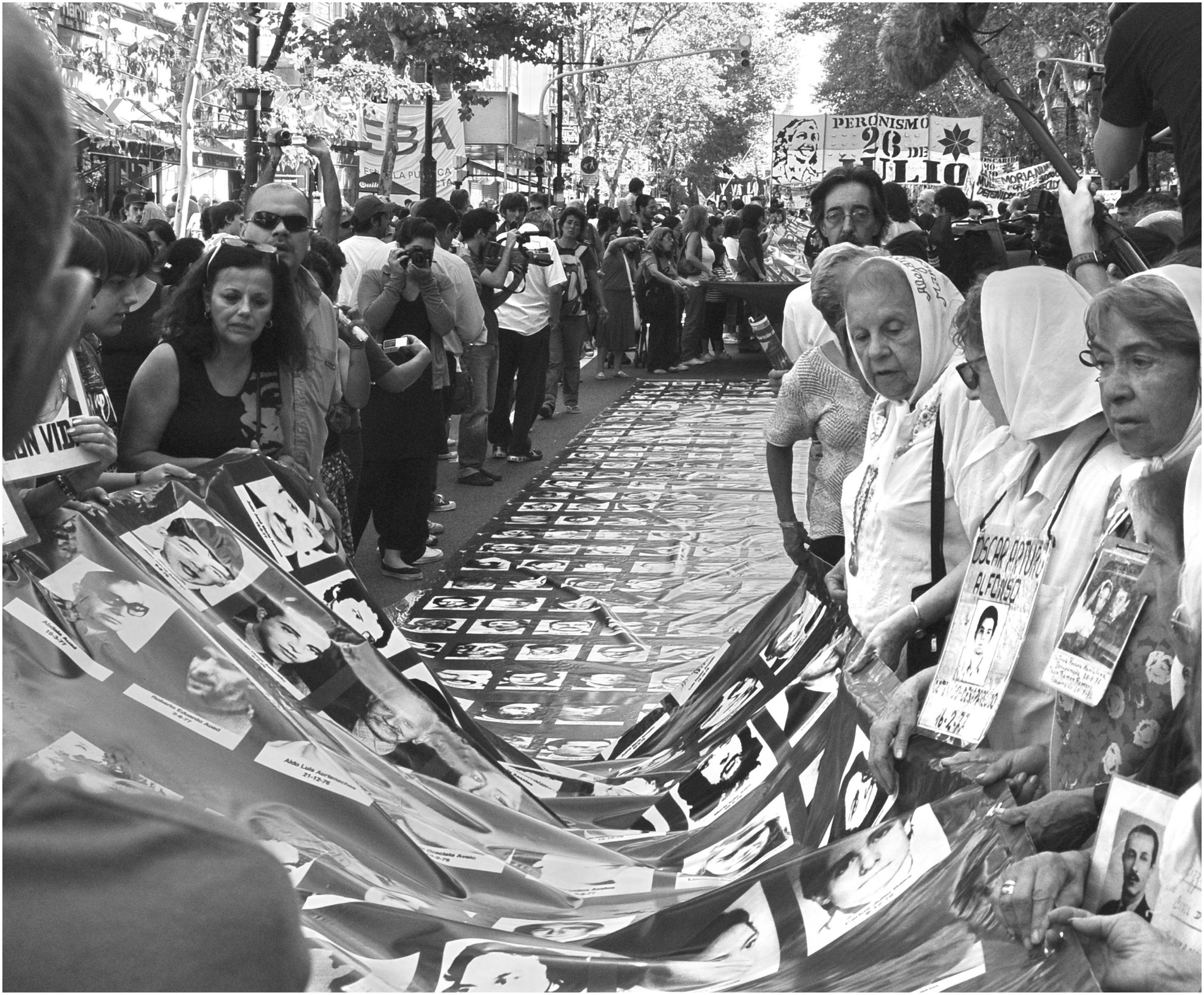
Relatives of the people “disappeared” during the Argentinean dictatorship carry images of their loved ones through central Buenos Aires in 2008
Credit: DigitalVues / Alamy
Argentina’s press freedom has come a long way since its junta sought to silence criticism by killing journalists. But is it free of censorship?
Nearly four decades ago the military regime (1976-83) of General Jorge Rafael Videla went from threatening and terrorising journalists, as a means of controlling information, to murdering them. More than 100 journalists were killed during the seven-year rule of the armed forces, but that figure was hardly reported in the establishment press. The absence of that record often turned on the argument that the dead were “not real” journalists; that they were not newsroom hacks, but militants of different political organisations. The public lived in a state of denial, so the crimes were ignored: those killed “must have done something”.
Freedom of expression has moved on a bit. They don’t kill journalists any more. Harassment is more common. For journalists of a certain age who worked through the 1970s, there has never been so much freedom to criticise a government as now. One magazine (Noticias) even printed an artist’s impression of a woman, with a close resemblance to the president, in full orgasm. In return, the aides of President Cristina Fernández de Kirchner have used contrived “show trials”, held on a stage in front of Government House, to “try” well-known media personalities accused of siding with the military during the dictatorship. The government also publicly insulted opposition scribes and commentators. In April 2008, the president lashed out at Clarín’s political cartoonist, Hermenegildo Sabat, for a drawing that showed Fernández with her lips closed with an X. She accused him of a “mafia-style warning”.
The election of Raúl Alfonsín as president in 1983 marked the end of military rule and the beginning of a new democratic age. Film production flourished; Luis Puenzo won an Oscar for his 1985 film, The Official Story, which told of babies borne by captives who were murdered. Radio became more daring and, while government-run television had limitations, newspapers could claim never to have supported the military. Fear had not vanished, but it was good to see the alternative press trying to find test their limits.
The 1990s saw a free-for-all. Carlos Saúl Menem became president in 1989 and was re-elected in 1995. He sold state television to friendly media owners and bought goodwill with generous arrangements, just as he made profitable associations with editors, columnists, trade unionists, police and members of the judiciary. In the mid-90s the rot set in, with rampant corruption and gross abuse of power. This included destruction of evidence of illegal arms sales to Ecuador and Croatia between 1991 and 1995: a munitions factory in Córdoba province was blown up, leaving seven dead, 300 injured and a town devastated. Reputable columnists in the press were seen as more reliable than the courts and people resorted to them, to mediate in conflicts and court cases.
The lobbies hit back. In the summer of 1997, a 35-year-old photographer, José Luis Cabezas, was murdered, allegedly at the instigation of a business tycoon, Alfredo Yabrán, who had forbidden the press to photograph him and who was close to the Menem administration. Nine men were charged and sentenced for the murder; Yabrán committed suicide in 1998. It was the high-point of confrontation between the press and government.
In 1999, Menem left office with the country in crisis. Argentina faced financial disaster in December 2001. There were riots and looting. Menem’s successor, Fernando de la Rúa, resigned and Argentina had five presidents in a week. In January 2002, a former Menem associate, Eduardo Duhalde, was elected by the national assembly to complete the presidential term to 2005. But Duhalde called elections and handed over government to Néstor Kirchner in 2003.
Kirchner promised change. He even won praise from freedom-of-expression NGO Article 19 for sending Congress a bill freeing access to information. It has never been passed.
Nearly 40 years on from military dictatorship, Argentina’s line in the limitations on freedom of expression has changed. It’s hard to say when to yell “censor” and when it would be a false alarm. Cristina Fernández de Kirchner succeeded her husband in 2007. Néstor died suddenly in 2010. She continued the policy he had set: do not censor, gain full control of the media.
The three main newspapers in Buenos Aires – Clarín, La Nación and Perfil – are critical of the government. Allegations of repression range from failure to provide state advertising to frequent insults by officials. Argentina’s Newspaper Publishers Association (ADEPA) clocked up nine serious protests over attacks on journalists and publications between 12 September 2014 and 8 April 2015 (and four more protests more recently). The Association for Civil Rights (ADC) has been active in questioning the constitutionality of government intentions (such as a plan to restrict some internet contents).
But is this censorship? The protests and demands are published widely, which is evidence of freedom of expression. What has replaced censorship is the massive control of the media by the government through favoured supporters becoming its owners. The government encouraged business allies and supporters to buy into existing companies, facilitating the purchases with generous credits and assuring proprietors abundant and well-paid government advertising.
Some government opponents describe the new media law, a reform needed for more than half a century, as a weapon for censorship. But the law of audiovisual communications services, passed in October 2009, has been bogged down in court actions which question its validity and effects. It includes six clauses, tamely voted for by Fernández’s majority in Congress, aimed almost specifically at facilitating the takeover or break-up of the Clarín Group – one of Latin America’s largest media companies. The Kirchners saw Clarín as their real political “enemy” and sought to destroy it. The clauses in question have reached the Supreme Court, which has rejected them in part. The six-year-old battle continues.
Fernández’s regime, which constitutionally comes to an end on 10 December this year, has used its allies to gain influence at more than 100 newspapers, television channels and radio stations up and down the country. The most recent purchase was made by a construction tycoon and controller of gambling venues, Cristobal López, who bought the financial paper Ambito Financiero, including purchase of the 139-year-old, English-language daily Buenos Aires Herald. And by acquiring media influence, Fernández has also put pressure on the courts, on business, on just about everything. Now she has to go, her ambition only partly reached.
So Argentina has gone from murder to bureaucratic mayhem, with only some of the media and the courts able to keep a check on government. The country lives without full freedom of expression, but the means of pressure have changed. Fernandéz has to step down in December, but she is clinging to the influence she has built up in government with a view to a comeback – and a new catalogue of excesses against Argentina’s critical media.
©Andrew Graham-Yooll