




Abstract

Harber was sipping a cappuccino in a café at the University of the Witwatersrand, Johannesburg, surrounded by students of all races. Some tapped away furiously at their laptop keyboards; others were reading assignments or debating with classmates. On the face of it, this is the new South Africa brought to life. So no, Harber, the university’s Caxton professor of journalism and media studies, doesn’t think the dark days of apartheid have returned for the media. But, he added, this is the worst it’s been for the media since apartheid ended.
In April, South Africa’s Sunday Times published a chilling series of photographs on its front page. The pictures, shot by internationally acclaimed photojournalist James Oatway in Johannesburg’s Alexandra township, documented the murder – in broad daylight – of a Mozambican man named Emmanuel Sithole. The crime followed weeks of xenophobic violence that saw foreign-owned shops looted and thousands of immigrants from the rest of Africa displaced.
President Jacob Zuma reacted swiftly to the grim images – but perhaps not quite how people might have expected him to. At a public meeting in Durban to address xenophobia, Zuma complained that the photographs made South Africa “look bad”. He also scolded the country’s “unpatriotic” media for publishing them. Zuma has invoked this rhetoric of patriotism before; the apartheid government used to do the same.
Harber suggested that “unpatriotic” is being used by Zuma’s governing African National Congress as a byword for critical reporting and that this points to a fundamental tension between how South Africa’s journalists view their jobs and how the ANC believes journalists should operate. It also has faint echoes of the way patriotism was used during the apartheid era.
“I don’t think there’s anyone who would argue that the media shouldn’t be part of South Africa’s transformational agenda. But the question is how this is best achieved,” Harber explained. “Journalists think that they drive transformation best when they play the role of a watchdog and produce critical reporting. The government seems to want developmental journalism and soft criticism.” He said the state issued lots of press releases that trumpet “the good news” about service provision. “There’s no reverse communication, where the government listens to what people are telling them and responds accordingly.”
The president’s reaction to Oatway’s photographs is symptomatic of a far deeper government antagonism towards journalists, said Harber, and this is manifesting itself in several ways. He suggested that the ANC’s approach to dealing with the media has gone through three phases since the party was unbanned in 1990 and came to power four years later. At first, it pursued a liberal policy to open up broadcasting, transform the South African Broadcasting Corporation into an independent public broadcaster, build community media, and criticise the private media, but essentially leave them alone. Push the private media, to transform, they were saying, but do not interfere with them.
But then the honeymoon ended. Journalists started asking tougher questions and exposing cracks in the façade of the governing party. Harber said there’s no doubt the media was “quite hostile” during this phase, which ran into the last decade. The ANC replied by taking “a heavy-handed route” and mooting legislation like the hugely controversial Protection of State Information Bill. It also pushed for the creation of a Media Appeals Tribunal designed to do away with a self-regulated press ombudsman system. This legislative muscle-flexing, Harber argued, failed largely because it was “crude and pursued in a rough, ham-handed way”.
And now the third phase has arrived and the government is playing a new game. Harber says the ANC – which has complained in the past that advertisers are influencing media organisations’ decisions – has realised it holds tremendous power in this space. In the 2012/13 financial year, the government’s communication arm spent R219.4 million ($18.25 million) on radio, television and print advertising. R181.7 million ($15.10 million) of this was paid to mainstream media organisations. Last year it emerged that the government was planning to axe its advertising with three of the country’s most prominent newspapers. Among them was the Mail & Guardian, which Harber co-edited from the mid-1980s when it was still The Weekly Mail and which is considered a bastion of investigative journalism. In 2009 the Mail & Guardian broke the story that President Zuma was using public funds to refurbish his private residence in Nkandla.
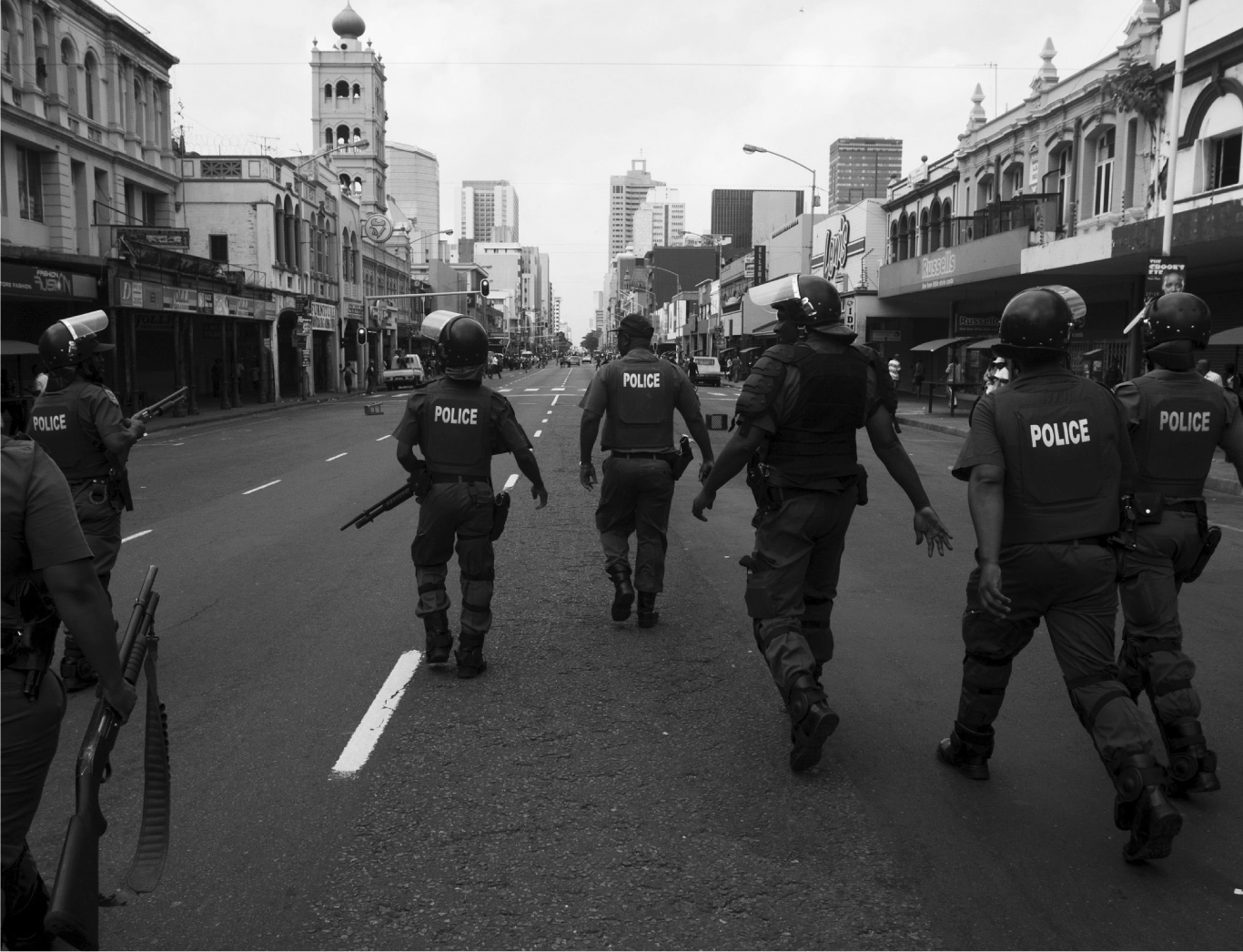
Police clear the streets in an attempt to quell rioting and looting caused from anti-foreigner violence in Durban, April 2015
Credit: Rogan Ward/Reuters
Newspaper ownership has taken centre stage in South Africa’s public debate. The country’s largest media group, Independent Newspapers, was bought in mid-2013 by Sekunjalo Independent Media Consortium – and owner Dr Iqbal Survé is regarded by some as an ally of the ANC. Since then the group has been plagued by a series of high-profile sackings and resignations. This, along with staff cutbacks at other media houses like Media24 and the Times Media Group, has added to the pressure mounting on journalists. All this leaves reporters, said Harber, “fighting for spaces for critical journalism”.
Zuma scolded the media for publishing photographs that made South Africa “look bad”
© Natasha Joseph