




Abstract

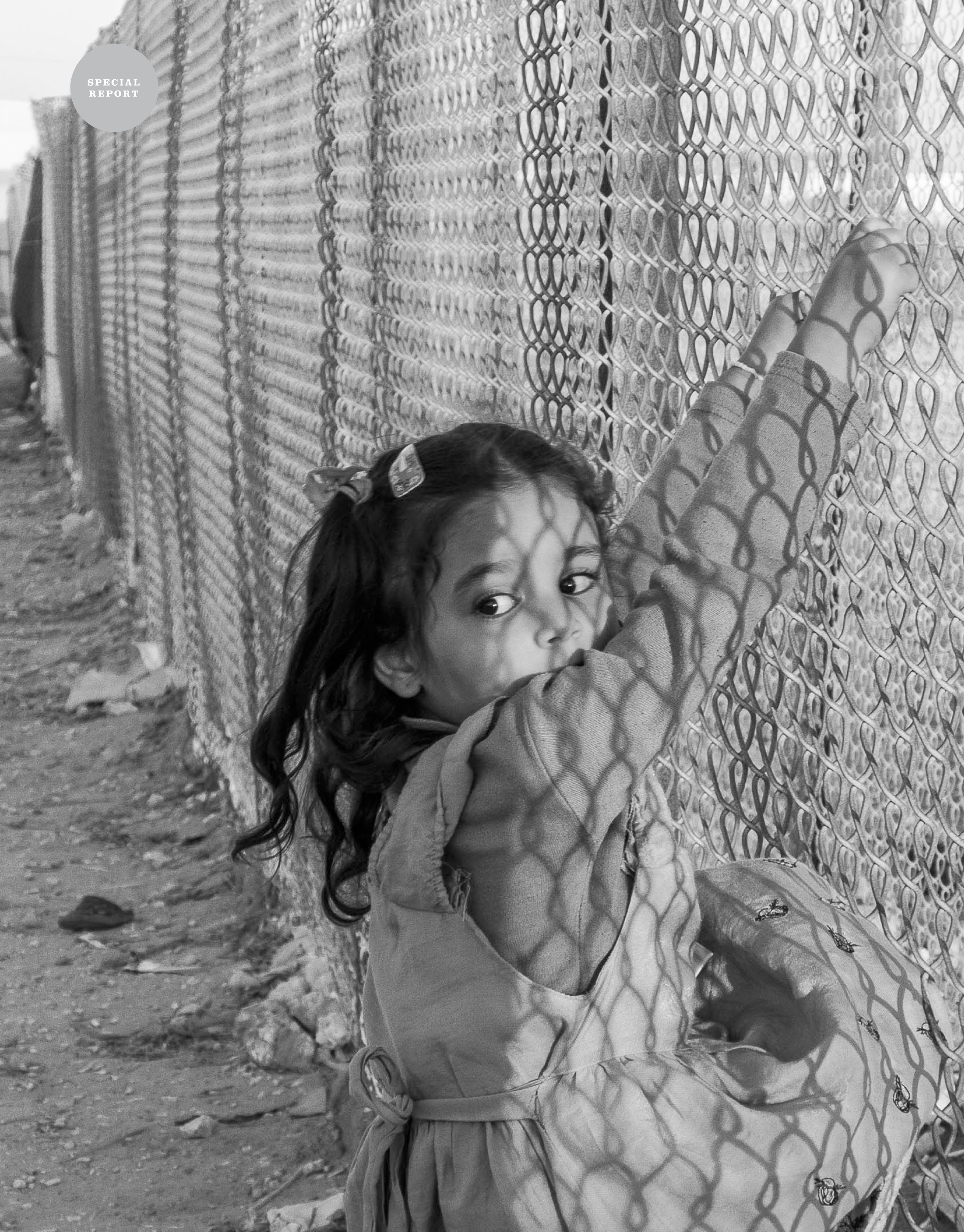
A student from Do You See What I See project, Raghda, describes her photograph: “She doesn’t know how, and will not have a chance, to live her childhood. It was taken away from her by the war and destruction of Syria. A child’s vision in Zaatari camp is different from the vision of other children in the world. The child in camp looks toward the distant horizon, searching for a route out of this situation and looking to carry on with her life – life like other children enjoy, with play, joy, friendship”
Credit: Raghda/ Do You See What I See
Arts producers
Georgina Paget, who co-produces the project with Charlotte Eagar, discusses what the project hopes to achieve: “In simple terms, the radio project aims to reach as many Syrian refugees and members of their Jordinian community as possible with dramatised presentation of topical and relevant issues about their daily lives. It aims to help all elements of the community to have a greater and deeper understanding of the situations of others living side by side with them and highlight the benefits of understanding co-operation.”
The team’s ambition is to gain a long-term commission for the series on either radio or television. To bolster the series’ credentials they have assembled a group of established screen actors to join with refugees, co-creators and producers. The series is partly funded by the United Nations High Commissioner for Refugees, and the title We Are All Refugees has echoes of philosopher Hannah Arendt’s 1943 book, We Refugees. Some 70 years later, the radio soap explores themes that now have every day and ordinary resonance, such as forced or arranged marriages for young Syrian refugee girls, domestic violence, unemployment and water shortages. It also looks at the predicament of young Syrians not allowed to work legally in Jordan and the tensions between two communities living side by side.
More than 50 million people are displaced globally, according to the UNHCR. Yet many of the images in the media are emptied of the nuanced details and the day-to-day challenges of refugee camp life.
That’s why there are increasing attempts by refugee agencies and other organisations to tell refugees’ stories and make their experiences come alive.
As the British writer, AA Gill, who won an award for his articles from refugee camps, puts it: “The hot news story is the conflict itself; this intransigent, complex headache of unwanted, awkward, lumpen people doesn’t have the dynamic interest of global politics or the screen-grab of smoke and bodies and Kalashnikovs.”
In the Zaatari refugee camp in Jordan, for instance, a United Nations’ project is working with US-based photojournalist Brendan Bannon, to equip young refugees with cameras, so they can take photos and write about their personal histories and memories. Their work has been published online and in newspapers. “We promised to give the kids a voice through photography,” said Bannon. “I have heard from so many people who have seen the kids work in The New York Times and online. I am sure that the pictures are challenging preconceptions about refugee life. I hope that the work can be more widely seen in places where refugees are living today.”
Alaa, 14, fled with her family from Dara’a in Syria. She now takes photos of family, friends, neighbours in Zaatari. As the family and community chronicler, she re-imagines and documents what has been lost, discovering a voice through photography: “Although I’m shy,” says Alaa. “I had no problem showing my work and talking about it in class. We all learned to look after each other.” If she could photograph anything, it would be her house in Syria and the beautiful countryside surrounding it. “I can still remember the trees and the smell of the soil.
I am sure the pictures are changing preconceptions about refugee life. I hope that the work can be more widely seen
Lost boy found
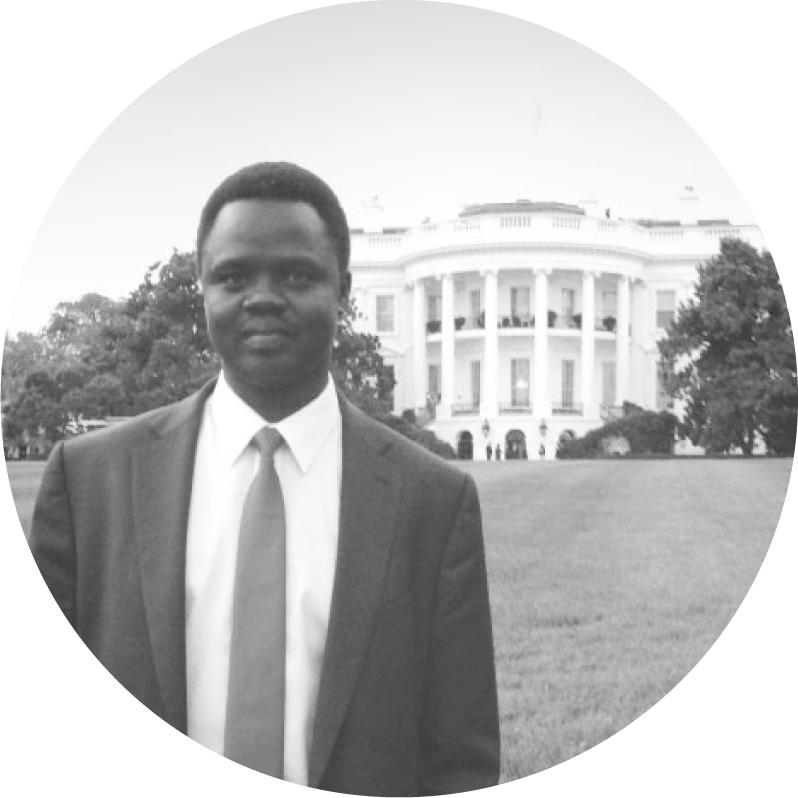
I had to flee from my home before I was 10 years old due to Sudan’s civil war and violence in my village. Growing up in a refugee camp, I would listen to the life stories of others and share my own. Later, after resettling in the United States, I was blessed to be able to share my story with the world through the novel What is the What, which was a fictionalised account of my life by writer Dave Eggers.
When I arrived in the USA, I wanted people to know more about the war in Sudan. I wanted people to know what my people had endured. I first met Dave while he was visiting some of the “lost boys” of the Lost Boys Foundation [which helped the thousands of young refugees who had fled Sudan]. We became fast friends as he interviewed me and that started a three-year writing process. At first, I hoped to write my story myself, but realised quickly that I was not prepared to take on this task.
We were unsure of whether the biography would be in first or third person, if it would be fiction or non-fiction. Dave settled on a fictionalised biography in my voice. After the novel was a wide success in 2006, I travelled to communities around the world to speak. I continue to speak on the importance of education, gender equality, and giving youth opportunities to lead. I have been blessed with the platform to share my life story, much by circumstance.
Credit: The Valentino Achak Deng Foundation
I hoped that by reading the novel more people would come to understand South Sudan, Sudan and Dafur. The proceeds from the book have gone to found the VAD Foundation, which created Marial Bai Secondary School in South Sudan. We now have over 400 students, and we help them move on to universities, start small businesses, meet with regional leaders, and advocate for themselves.
In recent months, I have taken a position as state minister for education in Northern Bahr el Ghazal, one of the states in South Sudan. I was tasked with the challenge of improving the primary education system and overseeing hundreds of schools working to engage our youngest citizens. It has always been my mission to give students a voice and the skills to share, clearly and passionately. The children suffer the most in times of conflict and as we rebuild a nation destroyed by decades of war, I believe they hold the future. x
On the UNHCR’s Tracks website you can see refugees telling their own stories from camps or en route to sanctuary. There are experiments in immersive storytelling and the authors use photography, video and sound.
Some stories are written by journalists commissioned by the UNHCR, such as those within the Family Ties section, charting the journeys of Syrian Kurds who find refuge with their extended families in Turkey. Istanbul-based multimedia journalist Lauren Bohn tells the story of Ibrahim: “When 41-year-old Ibrahim, one of the most cherished bread makers in the Turkish city of Suruc, heard the news that Isis was surrounding his Uncle Veysi’s village near Kobane, also known as Ayn Al Arab, he rushed to grab his mobile phone.
‘I told them to get out of there right away… to come here,’ he says, in the small grey courtyard of his apartment, tucked away behind his bakery just a few miles from the Syrian border. ‘It’s just as much their home as it is ours.’
So Veysi, his wife and children packed up as much as they could – some clothes, a few books and family jewellery – and fled to the border. Ibrahim, still wearing his baker’s smock, was there to greet them. ‘The Kurdish life in Syria, and everywhere, has always been hard,’ says Veysi. ‘But this is something we never imagined.’”
Dadaab – near the Somalian border in Kenya – is one of largest refugee camps in the world and “home” to approximately half a million people
Stories on the Tracks website come from all over the world: from the Zaatari camp in Jordan, from Northern Iraq and the Democratic Republic of the Congo. Some are told from European makeshift camps like the ones in Pozzallo, Sicily, or Calais, France. And soon Tracks will be inviting user-generated content so the website can help create a conversation with the wider world and refugees via social media.
Another media project, Dadaab Stories, which has a lively website, is dedicated to telling stories from the enormous Dadaab refugee camp in Kenya, near the border with Somalia. Describing itself as a “collaborative community project”, Dadaab Stories is an initiative run by FilmAid, which has been working in the camp screening, teaching and making films since 2006. It is funded by the Tribeca Film Institute New Media Fund and the Ford Foundation.
Playing with perceptions
In a shabby Amman apartment, 23-year-old Raneem has been practicing her stage make-up again. One of the 600,000 Syrian refugees living in Jordan, her clothes now come from bargain racks and charity bins, but she’s still never knowingly underdressed.
For Raneem, getting her husband’s permission was the hardest thing about joining the Syrian Trojan Women project. “He was worried about men seeing me, about me talking with men. But I kept going to the rehearsals because it was women I wanted to share stories with. There are things women experience in war – what it is to be a mother in war – that only they understand. I think he was jealous: he didn’t come to the performance, not because he disapproved, but because he was jealous of what I had found.”
Women’s space or not, when Trojan Women was first performed in 415BC, it shocked, precisely because it told the truth – to men. Euripides’ play was performed to an Athenian audience, shortly after the Athenian army had enslaved the entire female population of the island of Melos. “Euripides puts women’s voices on stage – whoever is silently watching, those who have suffered get to confront them,” says Reem, a performer and translator with the project. “Men die in wars, but women get left behind, and have to feed children and endure the chaos.” Fatima, an older woman from the siege city of Homs, tells me “in school, I had heard of the Fall of Troy: but only of the men fighting, Achilles and Hector”. The only woman she knew featured was Helen, the whore. “I couldn’t identify with her,” says Fatima. “But in Euripides’ play, there are so many other women. I am Hecuba: in her own house, her palace, she knew who she was. When her house was destroyed, her identity, her dignity, was gone too.”
Nobody wants to be Helen in the play. Sex, especially sex in war, isn’t talked about. But whispers of rape haunt the rehearsal room: no one talks of personal experience, but everyone admits to knowing a friend’s sister or cousin who has been assaulted by President Assad’s enforcers. In the play when the Trojan princess Cassandra is taken into slavery, she laments her humiliation as Achilles’ concubine. “When we recite Cassandra’s lines,” says one woman, “it’s like a storm has lifted from the room.”
© Kate Maltby
Dadaab is one of the largest refugee camps in the world and “home” to approximately half a million people. The sheer scale of Dadaab is reflected in the different generations living in the camp. As the FilmAid website puts it: “By definition, a refugee camp is temporary, but life does not stop here. Love, marriage, children, work, art – life goes on. After two decades, there are more than 8,000 Dadaab grandchildren, children of children who were born in the camp.”
Unlike Tracks, which casts its storytelling net globally and across refugee camps in different countries, settlements and diaspora locations, Dadaab Stories is firmly anchored in everyday camp life. While it includes perspectives from diaspora communities, the main focus is on communications within the camp through personal videos, journalism, photography, poetry, and music. Powered by the social media platform, Tumblr, this is community media at its liveliest.
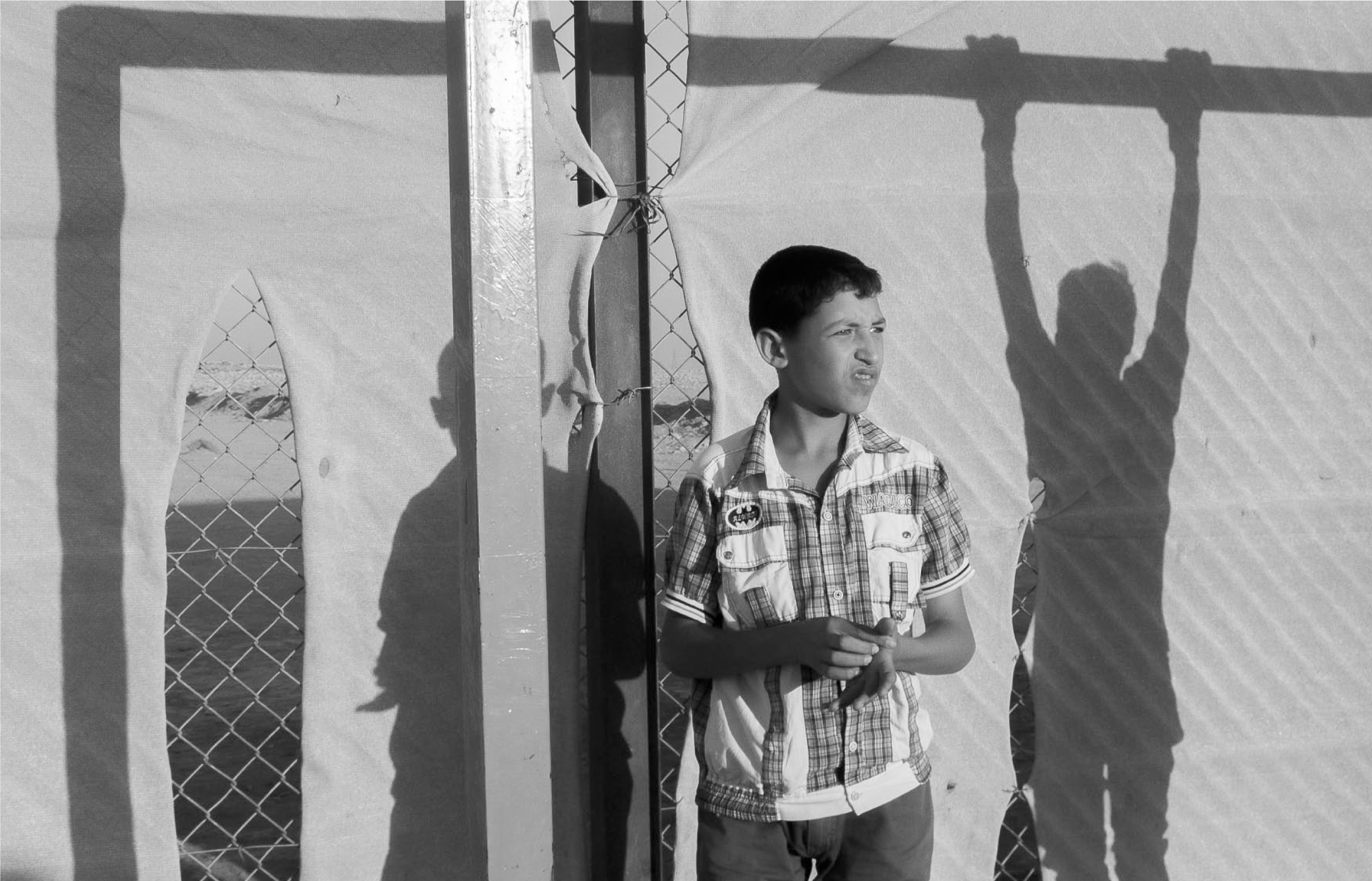
A young photographer from the Do You See What I See project, Mohamed Soleman, describes his picture: “Here I am thinking about how to leave the goal and defend it too so the ball does not go in”
Credit: Mohamed Soleman/Do You See What I See
One of the camp’s media services led by refugees and forming part of Dadaab Stories is The Refugee News, a community-run newspaper and the only local print media outlet for the population of 500,000. It is edited by a dedicated group of volunteer journalists that come from the refugee communities within the camp, with training and facilities provided by FilmAid.
By definition, a refugee camp is temporary here, but life does not stop – love, marriage, children, work, art
The Refugee News also includes a radio station called Gargaar (Somali for assistance), supported by the international non-profit, Internews, whose mission is to strengthen local media worldwide, enabling local people to circulate and hear much-needed news and information. The refugee journalists working on Radio Gargaar are all trained by Internews, with some working as professional journalists before coming to live in Dadaab.
The Syrian Trojan Women project (see box, page 20, Playing with Perceptions) for refugee women in Amman, Jordan, also co-produced by Charlotte Eagar and Georgina Paget, is using the classic Euripides anti-war tragedy to interweave drama therapy workshops, participatory storytelling and public performance, in addition to promoting understanding between refugees and host communities in Jordan. The drama workshops help refugee women who are suffering from mental anxiety, post-traumatic stress disorder, and depression. When possible, the women are paid to participate.
The drama workshops help refugee women suffering from mental anxiety, post-traumatic stress, and depression
This relatively modest project began in 2013 with small scale workshops in Amman and has since spawned several spin-offs incluing a documentary film, titled Queens of Syria, chronicling the project’s participatory methodology, and a Trojan Women tour to the US and Switzerland. Queens of Syria was shot and directed by filmmaker, Yasmin Fedaa. Fedaa engaged closely with the cast of refugee women by spending time with them in their homes and integrating the women’s personal stories into the film. The aim is to screen Queens of Syria in refugee camps, at international film festivals and on television.
It is clear that we are witnessing the many ways in which photography and film; the visual arts, theatre, mixed-media storytelling and online journalism are transforming the idea that refugees are voiceless victims.
Speak the speech, I pray you
Warwick University research fellow
What might Shakespeare’s plays offer people forced from their homes in Syria and into a refugee camp in Jordan? Given that the pressing priorities are water, food, clothes and safety, “nothing” might be the honest answer. But that word, so central to Shakespeare’s great tragedy King Lear, resonates hugely when spoken by children whose lives have been devastated by war.
In March 2014, a cast of 100 Syrian children, dressed in makeshift costumes and paper crowns, performed the play under the hot Jordanian sun. They took their places although there was no stage, just sand underfoot. Behind them, hand-painted sheets strung up on the barbed wire surrounding Zaatari, the vast camp where they live, read: “The inhabitants of Zaatari welcome the guests”.
More than 60,000 children live in Zaatari, over half the total population of the camp. Shakespeare in Zaatari was a project run by Nawar Bulbul, a Syrian actor who is well known across the Arab world. Spanning a few months and, including art, theatre and writing, his project unlocked the creativity of children more used to real tragedy than playing “let’s pretend”. For many of them, it provided an alternative to the overcrowded camp schools, which parents feel are unsafe for girls and take boys away from earning enough to help their families survive.
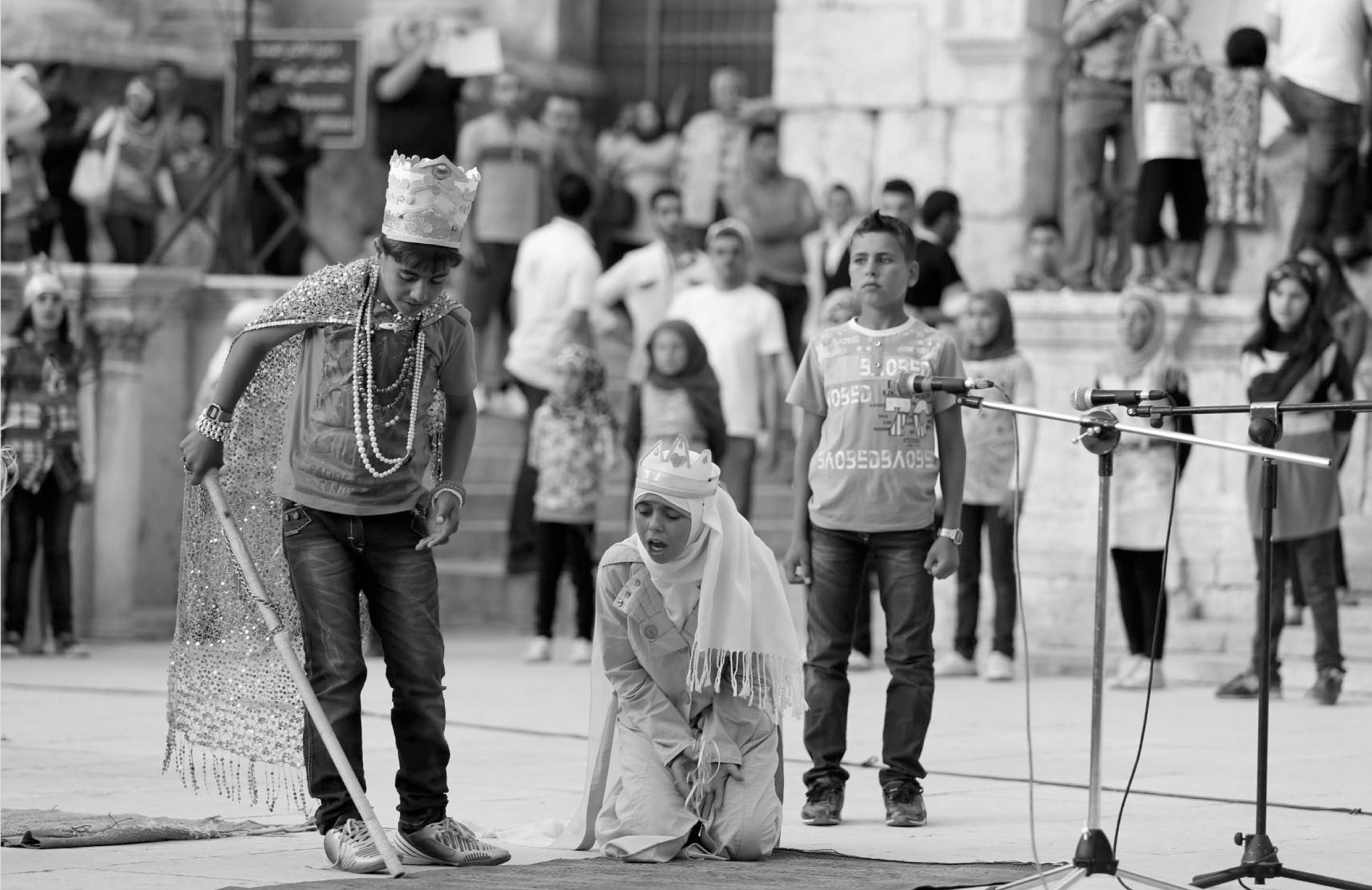
Syrian children, who are living at the Zaatari refugee camp in Jordan, perform an interpretation of Shakespearean plays Hamlet and King Lear, during the Shakespeare in Zaatari event at the Roman amphitheatre in Amman, May 2014
Credit: Muhammad Hamed/Reuters
It is striking that Bulbul chose King Lear, and it is set in a world that has taken too little care of their needs. One of the play’s most moving scenes reveals that even if a person loses all their wealth, their home and even their family, compassion for those even less fortunate remains.
Bulbul said: “The show is to bring back laughter, joy and humanity” – and not just for the children and their parents. But why Shakespeare? The name attracted global media attention. The New York Times described the scene: an audience of a few hundred people sitting on the desert ground; younger children on parents’ shoulders to get a view of their siblings, watching parents beaming with pride. The performance of Shakespeare by children in this vulnerable situation served to highlight not only what they have lost, but what they could gain and offer if they had the chance.
Following the camp production, the children were invited to perform to a public audience in Jordan’s Roman amphitheatre. The tagline on the poster read: “A message from the children of Zaatari to the people of the world.” Such productions performed in such situations also encode a question, which the children themselves posed. “To be, or not to be?” they chanted as they left the stage. Nearly a year later, their lives remain hanging in the balance and they are still waiting for an answer from the world.
© Preti Taneja
As Ugandan artist Lucy Namayanja, now living in London, said: “Art can help people to come to terms with their past, to develop new perspectives and ways of dealing with their suffering. It certainly saved me when I was in a dark place and later on helped me expand my horizons and mind, which for years was locked in the prison of my circumstances and surroundings.”
Footnotes
