




Abstract
Italian investigative journalist
Lampedusa, a tiny Italian island between Africa and Europe, made worldwide headlines in October 2013 when a boat sunk off its coast, killing over 360 passengers, mostly Eritreans attempting to flee the military dictatorship and forced conscription.
Ten years since Gatti took that trip, immigrants continue to make the same journey. Naval boats now patrol the waters, attempting to avert another tragedy – but not without criticism, from those saying this is not sufficient protection to others saying it encourages more to take the trip.
As Bilal, Gatti was aware of the rights he should be given. After four years spent travelling migrant routes from Africa, he simultaneously fitted in and pushed boundaries to test support mechanisms, often finding them inhumanely lacking. Although he was able to understand Italian authorities as they interrogated him, he pretended he didn’t. The book, part of which is published below, has been translated into French, German, Norwegian and Swedish, but, as yet, is not available in English. This abridged extract recounts Gatti/Bilal’s treatment after being picked up from the sea and transferred to Lampedusa.
“He’s hypothermic,” says the doctor to a nurse, in Italian, after checking Bilal’s hands and feet. “Get a bottle of saline solution and put it in some hot water. When it’s warm, we’ll inject it. He can’t have been in the sea for long. But the water temperature’s dropped to 19 degrees.”
Lampedusa has been an international crossroad for years. Yet no one has taught these aid workers to speak English. Or even French. Let alone Arabic. A nurse gestures that Bilal should strip off his sodden clothes. Off come the black trousers. The cotton T-shirt. The blue sweatshirt. The heavy fleece that had glistened with plankton.
“Everything. No, no!” shouts the nurse. “Not boxers.”
Bilal lies back on the bed. They insert a needle for the drip, attach the electrodes for an electrocardiogram. A different nurse with a sweet face comes closer. She looks at him. “Have you pain?” she asks, in a whisper, in English.
“Pain?”
“Yes, have you pain?” she repeats, ending the question with a smile.
“No pain. No pain.”
Instead Bilal wants to know if the carabinieri [Italian military police] have been informed, if he will be put in the large cage. He asks a few questions. But the nurse doesn’t know how to say anything else in English.
“Heart rate normal,” states the doctor, removing the electrodes. The nurses measure his blood pressure. Normal. The nurse with the sweet face comes back with a glass of hot milk. […]
Another nurse finishes writing the medical report. “What did the carabinieri say? Are they coming?” she asks her colleagues.
“Adesso tu vai con i carabinieri [Now, off you go with the carabinieri],” says another nurse, addressing Bilal.
Bilal listens. The other nurse realises he hasn’t understood. “You, carabinieri, police,” she translates into English.
“Police, no police,” Bilal pleads and looks at the young nurse.
“Eh, tesoro mio, che ci devo fare? [Sorry, love, there’s not much I can do, is there?] We have to hand you over to the carabinieri.” Bilal is at the end of the line. Even she doesn’t make the effort to speak English any more.
The carabinieri arrive. The women leave. Bilal is asked to take off his boxers too. “They’re wet,” says a male nurse. “Put on these dry clothes.”
He’s handed a blue outfit, the type worn in an operating theatre. But it must have been washed in boiling water. The trousers have shrunk and they barely cover his groin. The top is so tight that Bilal finds it impossible to lift his arms. The male nurse struggles to smother a laugh. “Sorry, mate,” he says, “but we don’t have anything else.”
Bilal smiles to thank him.
The carabinieri walk quickly. Too quickly for their stiff trousers. They lock Bilal into their black car. The headlamps rake across the deserted town. They stop in a dead-end road beside the airport. On the right, at the end, is a green gate topped with a bundle of barbed wire. One officer opens it. He’s dressed in riot gear, complete with heavy-duty boots and a pistol in its holster.
The noble sentiments of humanity end here, on this side of the gate. That common sentiment that binds us together as individuals, individuals who are free to think. That sentiment that draws no distinction between men and women. That forgets who they are. Friends or enemies. Fellow countrymen or foreigners. Citizens or illegal migrants. Here ends that magnificent sentiment that prompted an unknown inhabitant of Lampedusa to lend me his shirt last night and warm my shivering body with his own. The same sentiment that filled the emergency nurse with smiles. Beyond this gate, state conventions come into play. Their governments’ lies. The betrayal of their parliaments. Thanks to this green gate we are no longer individuals. We are what we are.
By law, the people held inside are free citizens. So free that they’re not allowed out again
Bilal walks awkwardly between the carabinieri.
“A&E have sent us this one,” say the two military police to their colleague in riot gear. By law, the Italian constitution, the European Convention on Human Rights, the Universal Declaration of Human Rights, the people held inside here are free citizens. So free that they’re not allowed out again. Bilal is accompanied, head hanging, to a small courtyard where other carabinieri are waiting with a young man dressed in the yellow uniform of the private firm that runs the centre. The youngster offers Bilal a glass of water and four packs of croissants. Then he pulls a cotton T-shirt and a tracksuit out of a bag. It’s a white tracksuit with four blue stripes on the sides. “Put this on. You’ll be warmer,” he says.
Choosing the language of interregation is top of the list of “migrants’ rights”, typed up and pinned up in the corridor
“What’s your name? Where are you from?” asks one of the carabinieri in Italian.
“I don’t understand,” whispers Bilal.
The question comes again, this time in broken English. “What is ze contry you are from?”
“Kurdistan.”
“Kurdistan? But this guy’s whiter than me! How can he be Kurdish?” replies the carabiniere in Sicilian.
Another heavily tanned carabiniere jokes, in rhyme: “Io sì che sono nivuro e potrei essere curdo.” (Look at me, I’m so black I could be a Kurd.)
Bilal keeps his eyes down, looking at his worn slippers, and listens to the men’s banter in Italian.
“A Kurd who speaks English. Well, what d’you know? You don’t think he could be an American journalist from CNN who’s found his way in here?”
“Yes, or even an Italian journalist?”
“You must be joking. Italians don’t do that sort of thing,” answers the first voice.
Danger over.
“Bilal, you must tell ze verity!” shouts a carabiniere. “You must tell ze verity! Ze verity, understand? If not, bam bam.” He mimes slapping.
Verity? In English that means truth. Was it a mistake or a trap? […]
The African girls spend the time plaiting their hair. One of them, no more than 20, has nails that are half-varnished. The upper part is embellished with a pearly glaze. The part below is unadorned. Perhaps her journey started where the varnish ends. Outside, in the small courtyard, hang the wet shoes, trousers and tops of the last ones to arrive. Yesterday evening 161 migrants landed. Then another 37. And then Bilal. There’s even a Quran drying in the sun.
“Bilal” yells a voice. “You,” gestures a policeman, beckoning with his hand as if to say “Follow me”.
The identification office is a large room with four desks. Bilal goes to sit at the back, on the right. Facing him are two plain-clothes policemen, a computer and a youngster with a Berber face. The interpreter.
“Do you speak Arabic?” he asks, in Arabic.
“Yes,” replies Bilal, also in Arabic.
“Where are you from?”
“I come from Kurdistan,” says Bilal in Arabic, before switching to English. “I’d like to continue in English. Arabic is not my language. The Arabs have occupied my country.”
Choosing the language of interrogation is top of the list of “migrants’ rights”, typed out on the prefecure’s headed paper and pinned up in the corridor. A young woman joins the interrogation. She wears a US-military khaki top. All the men call her “Dottoressa” [meaning she has a university degree]. She wants to know everything. Bilal tells her he wants to go to Germany. He tells her he was locked in a container in Turkey, loaded on to a cargo ship and then boarded a motor launch a few miles from the Italian coast. Then the launch broke up. It sank. The transom couldn’t support the weight of the engine. Bilal saved himself by swimming. They want to know about the Arabic text on his lifejacket.
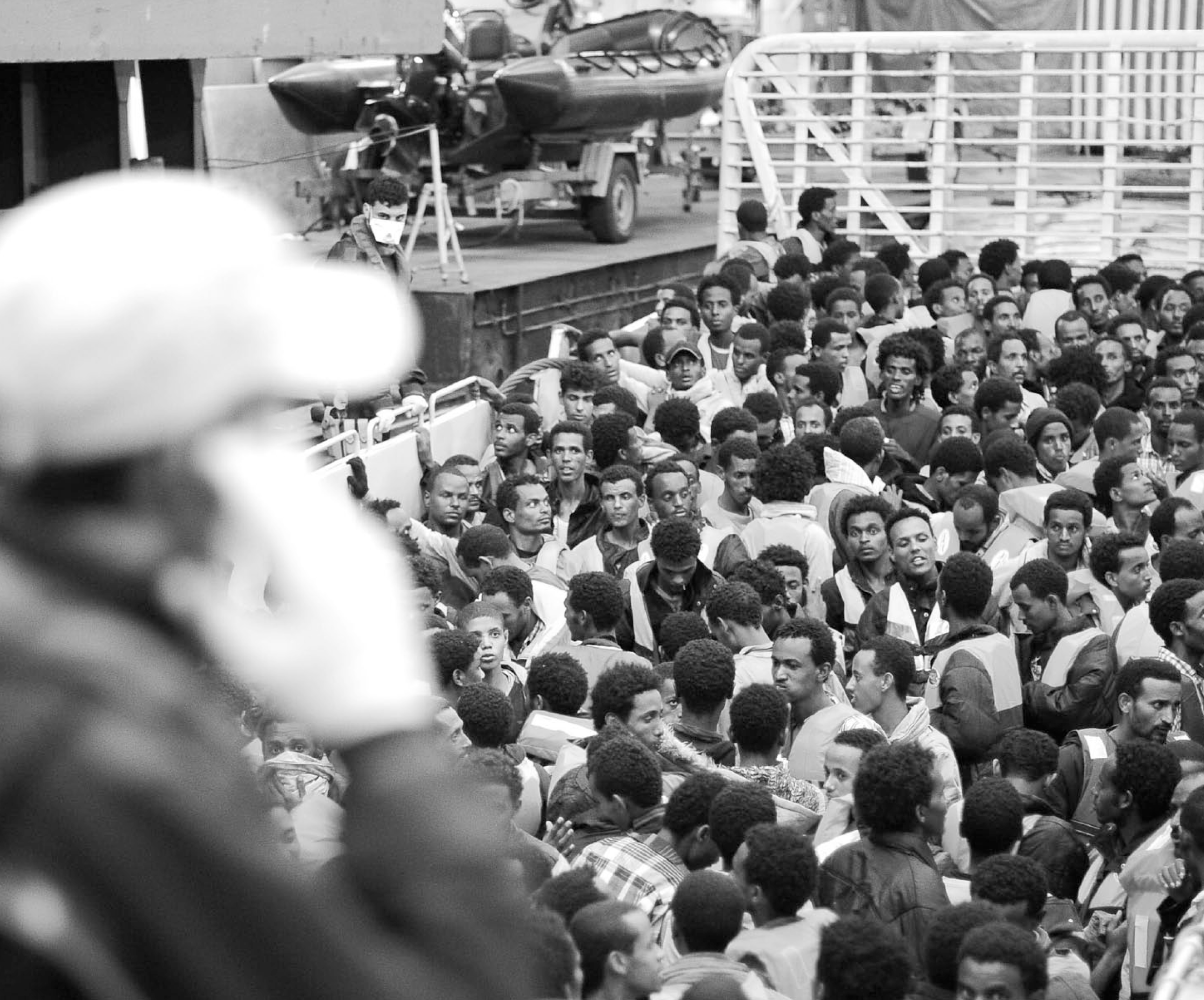
Migrants picked up by Italy’s Navy after being rescued in the Mediterranean Sea between the Italian and Libyan coasts, in 2014
Credit: Giorgio Perottino/ Reuters
“It says: Happiness 3. Perhaps it’s the name of the ship,” explains the Berber interpreter.
“Do you know what’s written on it?” asks the Dottoressa in English.
Bilal answers in Arabic, looking at the interpreter. “Yes, as-Soror talata.” And then looking at the Dottoressa: “Happiness. We all came to Europe in search of happiness.”
“Good. Now we’ll start the interrogation again,” she announces.
Bilal has to repeat the story of his journey three times. They try to make him contradict himself. One plain-clothes agent asks him a trick question: “If you’re a Kurd, do you speak Urdu?”
“No,” Bilal stalls him. “Urdu is the language of Pakistan.”
They ask him what he thinks of Erdoğan’s government in Turkey. “No good,” he replies.
They want to know what he ate on the ship. How much he paid. What was the name of the city where he was shut inside the container.
“Two weeks in a container, but how did he take a shit?” the policeman writing on the computer shouts out in Italian. The Dottoressa translates. And Bilal repeats the story he’s heard countless real migrants tell.
“I peed through a hole in the metal. For the other thing, they’d take me out every two days, after it was dark. They took me to the toilet. But I never saw the ship’s name. They kept my head down all the time.”
They lose their rag: “Stronzate! Bullshit!” screams the Dottoressa. “You’re telling a pack of lies. You don’t come from Turkey.”
Bilal feels lost. Perhaps they’ve guessed something. The feeling lasts just long enough for the Dottoressa to draw breath: “You’ve come from Libya. The Arabic on the lifejacket is the proof,” she says with conviction. “Now we’ll pack you off back to Gaddafi.”
Another plain-clothes policeman, the largest of the lot, walks over to her. “Dottoressa,” he says, continuing in Italian. “Will you leave him with us for a moment so we can take him to the torture room?”
Perhaps it is only a ruse to see if Bilal speaks Italian. To frighten him […]
She decides the destination of thousands who are expelled. She establishes the origin of Arab migrants by their accent
After the interrogation, they take your fingerprints. Fingers and palm are pressed against the red glass of a scanner. You’re automatically put on record. Outside, 21 teenagers wait their turn. They must be aged between 15 and 20. Seen like this they look like a high-school class on a school trip. But Bilal can’t sit down with them. Another policeman calls him. He gives him a ticket with a registration number on it: 001. “Don’t lose it,” he says and hands him to the carabinieri. The military police walk up to a large green gate, swathed on all sides by hanks of barbed wire. A carabiniere opens the padlock and frees the chain. Immediately afterwards the gate swings shut again.
***
Immediately after sunset the police try again. The sun has already dropped, leaving a trail of spectacular colours. The agent with ice-cold eyes appears. He’s with a colleague, the one who usually writes on the computer. The two of them ask the carabinieri to open the gate into the cage.
“Bilaaaal,” they shout.
When Bilal arrives the policeman talks only in Italian. “Come on, we’re going to interrogate you again.”
It’s Saturday. The day is almost over and the two of them are still at work. Bilal has to behave like a goalie at the end of the match. Hang on to the ball and kick any shots that might raise suspicions as far away as possible. In English, Bilal replies that he doesn’t understand. The policeman calls the interpreter. A girl with a Moroccan accent. One he hasn’t seen before. She’s petite, attractive. She decides the destination of thousands who are expelled. She establishes the origin of Arab migrants by their accent.
“Do you speak English?” the policeman asks her.
“No, very little. Only Italian and Arabic,” she replies.
“But this one wants to speak English,” says the policeman.
“Of course, because he’s Romanian. He’s just taking the piss. He’s not an Iraqi,” answers the other man angrily.
“Go on, try and see if he really comes from Iraq then, like he claims,” grumbles the policeman.
“Good evening, do you speak Arabic?” she asks Bilal in Arabic.
“Yes” is the easy answer, also in Arabic.
“What’s your name and where are you from?”
It’s the fourth or fifth time today that Bilal has heard the same question and he replies in broad terms. Still in Arabic. She asks him something else. But Bilal doesn’t understand. At this point he’ll have to test the promptness of the interpreter’s reactions. All he has to do is make a vague remark and see what happens.
“Insh’allah.” God willing, he says.
Another question he can’t make out. “Insh’allah,” repeats Bilal. And he spreads his arms like a preacher.
Another question. This time Bilal guesses the gist. He repeats in Arabic that he’s from Kurdistan. That he boarded a safina kebira, a large ship. And now he’s on Lampedusa.
Another incomprehensible question.
“Thank God, yes,” he ventures. Then he says in English that because Arabic is the language of the occupation of Kurdistan, he refuses to speak Arabic and if no one on Lampedusa can speak Kurdish, then he can speak English. Bilal doesn’t speak Kurdish. But neither does the interpreter.
In her rudimentary English she insists that the police want to continue in the office, not here in front of the gate. And given that Bilal can speak Arabic, the interrogation can continue in Arabic.
Replying in English, Bilal tells the girl she has beautiful eyes. It’s a gamble to see if she too is bluffing. In the end neither of them knows where the conversation is going.
“I’m sorry, but I don’t understand you,” she apologises. “I can’t interrogate you in English.”
“Bukara,” Bilal tells her after half an hour’s wild goose chase through the mysteries of language.
“Bukara? Tomorrow? He wants to be questioned domani, in English,” she explains to the policeman. They glance at their watches, shrug their shoulders.
“Ok, let’s do it tomorrow morning with the other interpreter,” says the policeman with pale eyes. “But have you found out whether he’s Kurdish or Romanian at least?”
“He’s not Romanian,” answers the girl candidly. “He speaks very good Arabic.”
The carabinieri lock the chain on the gate once again. Full marks in the practical. But is it really possible to speak a language well if you barely know 20 words? Bilal grips the bars like a monkey in the zoo as he watches the interpreter walk away. How many migrants has she sent to Libya without understanding where they came from? […]
How many migrants has she sent to Libya without understanding where they came from?
The lavatories in the large cage on Lampedusa are an unforgettable experience. The prefabricated building is divided into two sections. In one, there are eight showers with blocked drains. Forty basins. And eight squat toilets, the hole-in-the-ground variety, of which three are brimming with a gooey substance. The other section has five toilets, two of which have no flush. Five showers. Eight basins. Salt water comes out of the taps. It’s not pleasant if your skin is sunburnt, bruised and cut by the journey or riddled with scabies. The cubicles have no doors. There’s no electricity. No privacy. You do everything in front of everyone. A few try to shield themselves with a towel. There’s not even any toilet paper: you have to use your hands. It’s better to go at night because during the day the sewage rises over the top of your slippers and your feet sink into it. […]
Bilal needs to make a phone call. He tries the old system of opening the line with a piece of wire. But the new cardphones are protected. It doesn’t work. He has an idea: the emergency number 118 is free. He tries and someone answers.
“I need help. I’m shut in the immigration centre on Lampedusa and they don’t let us use the phone,” he says in French. “I must let my family know. Please, if I give you an Italian number, will you ring and say that Bilal is alive. It’ll cost you less than a euro.”
Hundreds of fathers and sons here have the same urgent necessity. At Bilal’s request, so as not to block the line, the first operator passes his call to another office.
“Do you need a doctor at the centre on Lampedusa?” asks a female medic in English.
“No, not a doctor. My family need to know that I’m alive. I’m asking you as a personal favour. Ring my family. They’re in Italy. It’ll cost you …”
“I’m sorry. It’s not something we’re required to do,” says the woman and hangs up.
Bilal tries again, dialling a few freephone numbers at random. At 800-400-400 someone answers from Madre Segreta [Secret Mother], an advice bureau in the hinterland of Milan. It’s a public organisation run by volunteers. They’re bound to be more approachable.
“Madre Segreta, good morning,” answers a girl’s voice.
“Do you speak English, please?”
“Yes, I do.”
Bilal tries everything. She keeps insisting that he should contact the police for this sort of thing. Bilal repeats that he’s inside the cage on Lampedusa. That the police will pass the buck on to the company that runs the centre. And the company will turn the matter over to its director who’s never here. He explains that the state buys phonecards – at least one when you first arrive. So even as a young volunteer, and an Italian citizen, the girl’s paying for them too. But on Lampedusa the phonecards are not handed out.
“My wife’s expecting a baby. If you ring this Italian number, she’ll know I’m alive.” Bilal almost says too much in front of the others who are listening. “Do it for my wife, please. I’m asking you a favour as one person to another. One day it might be you who needs to ask the same thing. Do you or don’t you work for an organisation called Secret Mother?”
“But you’re an illegal immigrant,” she answers. After half an hour of trying, the girl even makes up a law: “I can’t do it. The anti-terrorism law means it would be illegal for me to make the call.”
“But there’s no such law.”
She too hangs up.
This is the worst humiliation. More painful than the beatings in the desert. More burning than the arrogance of the military police. A brutal experiment. The most chilling revelation. I hadn’t asked her to give me a bed in her own home. Or even a lift in her car. Simply to make a phone call. The time it takes to say three words to a pregnant woman: Bilal is alive. How can a humane gesture be so terrifying? I feel the urge to knock down the gate. To unroll the skeins of barbed wire with my bare hands. To tear the uniforms off these mercenaries who have no power except for their own arrogance. Yet even they’re not to blame. They’re just kids, the same as all over the world. But what have the world’s illegal immigrants done to deserve this? […]