Abstract

Twelve months ago
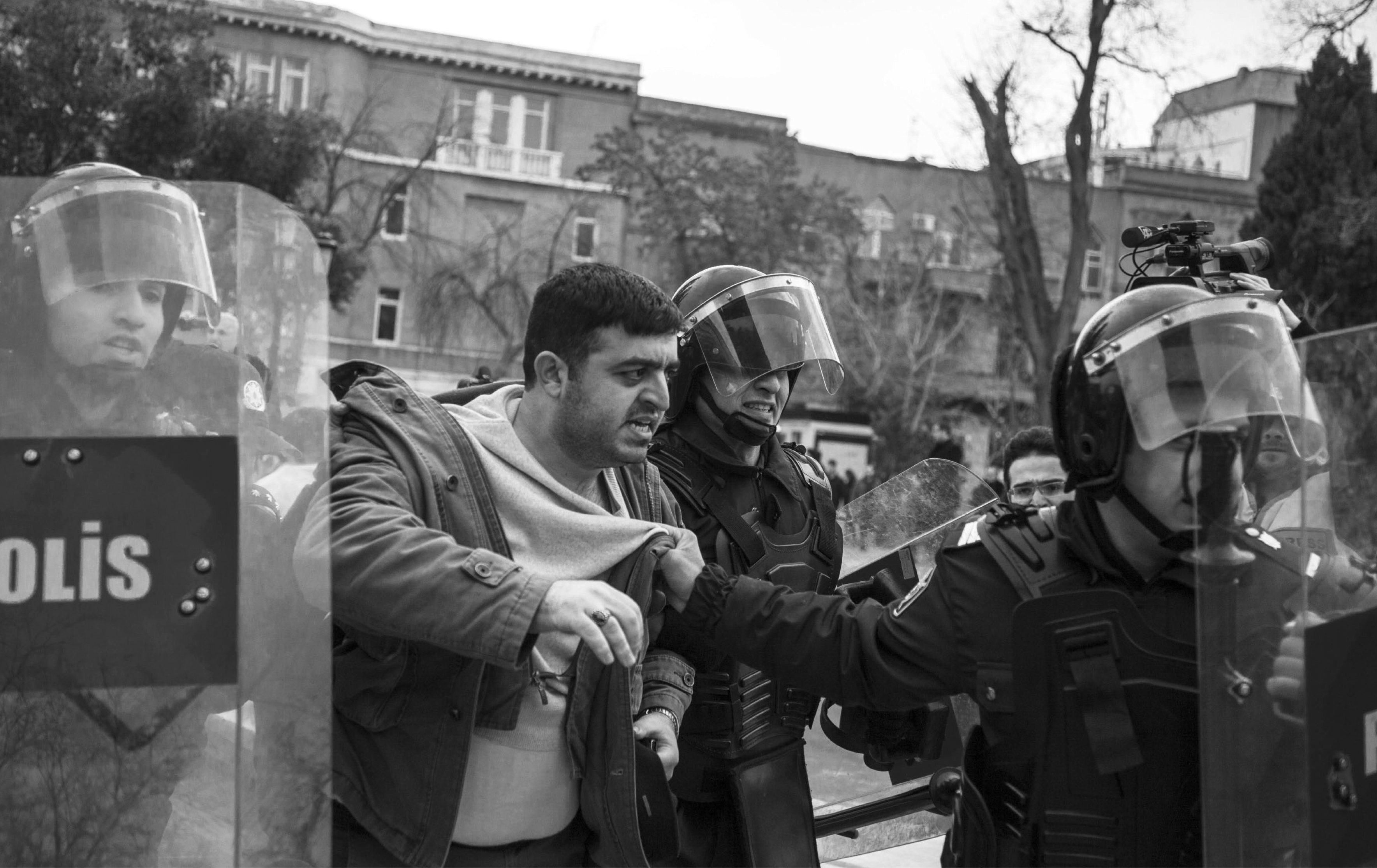
One of the photojournalists featured in the article 12 months ago, Jahangir Yusif, took the pictures for this year’s update. Above, police and activists clash during the run-up to the presidential election
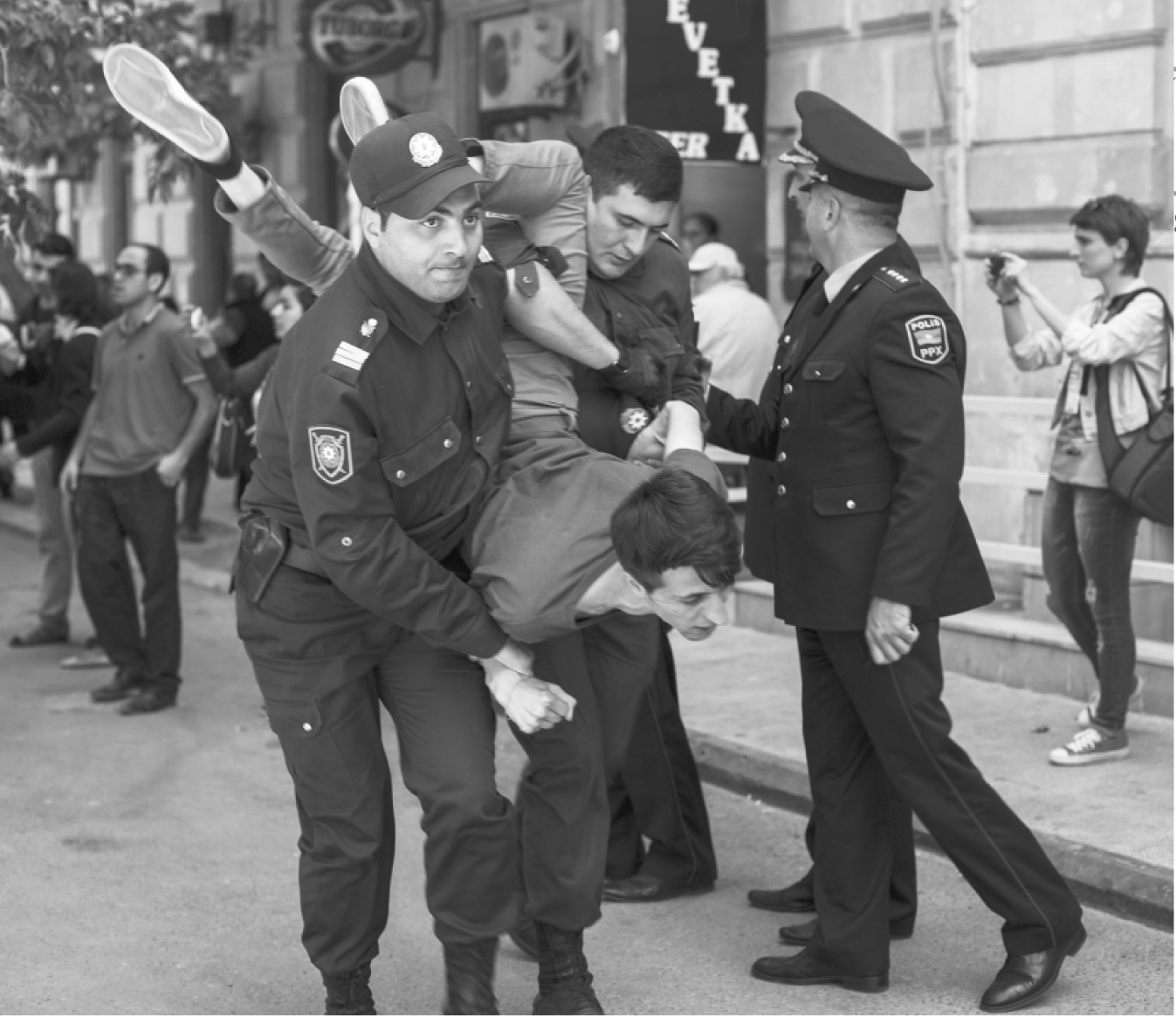
That piece was typical of the work of the Art for Democracy campaign, which used all forms of artistic expression to promote democracy and human rights in Azerbaijan. Now, a year later, the human rights situation in Azerbaijan has worsened immeasurably. Rasul Jafarov was arrested and remains in detention, facing a serious jail sentence on fabricated and politically motivated charges, alongside a number of other prominent human rights defenders. Art for Democracy’s activities have been effectively suspended, as well as the operations of nearly all of the remaining human rights NGOs in the country.
The authorities work aggressively to silence the country’s few remaining voices
Indeed, the past year has seen the most unprecedented of all human rights crackdowns to date in Azerbaijan, as the authorities work aggressively to silence the country’s few remaining voices. As a result, there are currently more than 90 reported political prisoners in Azerbaijan, including some of the country’s leading human rights defenders, lawyers, journalists, and bloggers.
Rasul Jafarov’s case bears all the hallmarks of the pressure exerted on human rights defenders in Azerbaijan. He had been on the authorities’ radar for years, with his earlier work for the Institute for Reporters’ Freedom and Safety and, since December 2010, in his role as the founder and Chairman of the Human Rights Club. Perhaps most notably, Jafarov co-ordinated the Sing for Democracy campaign, which used the May 2012 Eurovision Song Contest, held in the capital Baku, as a platform to expose on-going human rights violations in the country and promote democratic change. He was the driving force behind the creation of the Art for Democracy campaign.
Alongside Art for Democracy’s activities, Jafarov worked to expose the situation of political prisoners. On the eve of the October 2013 presidential election, the Human Rights Club released a list Jafarov had compiled of political prisoners, revealing a shocking 144 cases. The election itself was marred by widespread electoral fraud and saw incumbent President Ilham Aliyev re-elected for a third term in office.
In 2014, Jafarov continued working on the list and co-ordinating efforts among NGOs to achieve consensus and develop a joint version of the list, which would prove crucial to international advocacy efforts. Along with some of the other human rights defenders who have since been targeted, Jafarov repeatedly raised the issue at the Council of Europe, and advocated the appointment of a new special rapporteur to take up the work of a previous rapporteur whose efforts were defeated by lobbying from the Azerbaijani government. Jafarov also announced plans to launch a new campaign, Sports for Rights, ahead of the first European Games, which are due to be held in Baku in June 2015.
After having his bank account frozen and being prevented from travelling outside of the country, Jafarov was arrested
As a result of these activities, Jafarov faced a number of pressures from the authorities, but he persevered. He was aware of the risks, but also remained hopeful that the situation in his country would improve. He was dedicated to his work defending the rights of others and attempting to hold his government to account. Indeed he remains passionately committed to these aims even now, in detention.
After having his bank account frozen and being prevented from travelling outside of the country, Jafarov was arrested on 2 August and charged with illegal entrepreneurship, abuse of office, and tax evasion. The fabricated and politically motivated charges were similar to those used against other prominent human rights defenders. Some of the charges were linked to the fact that the Human Rights Club remained unregistered, despite the fact that Jafarov had been attempting to register the NGO with the state for more than three years, an issue pending consideration by the European Court of Human Rights. Jafarov remains held at the Kurdekhani detention centre, awaiting trial.
Campaigners outside the Baku court where members of N!DA were being sentenced
Jafarov is only one of many prominent human rights defenders to have been targeted in Azerbaijan in recent months. On 26 May, the chairman of the Election Monitoring and Democracy Studies Centre Anar Mammadli, was sentenced to five and a half years in jail, and his colleague Bashir Suleymanli to three and a half years on charges including illegal entrepreneurship, abuse of office, and tax evasion. Elnur Mammadov of the Volunteers International Cooperation Public Union was also sentenced to three and a half years in prison with two years on probation.
On 30 July, the head of the Institute for Peace and Democracy, Leyla Yunus, was arrested on politically motivated charges of treason, fraud, forgery, tax evasion, and abuse of office. Her husband, an activist in his own right, Arif Yunus, was arrested on 5 August on charges of treason and fraud. On 8 August, the head of the Legal Education Society Intigam Aliyev was arrested on similar politically motivated charges: illegal entrepreneurship, abuse of office, and tax evasion. There are now a total of nine human rights defenders behind bars in Azerbaijan. In addition, the whereabouts of the director of the Institute for Reporters’ Freedom and Safety Emin Huseynov have been unknown since 8 August, the day his organisation’s office was searched and sealed shut by police.
Parallel to these arrests, the authorities have stepped up other forms of pressure against both local and foreign NGOs, making it nearly impossible for organisations working on issues related to human rights and democracy to continue operating in the country. This has resulted in the closure or suspension of activities of many of the remaining human rights NGOs in the country. Parliament continues to tighten legislation related to the operations and financing of NGOs, cutting off vital sources of funding for independent groups and making it difficult to carry out even routine activities.
At the same time, other violations continue, such as pressure against the few remaining opposition and independent media outlets in the country. Prominent investigative journalist Khadija Ismayilova continues to face serious pressure and possible arrest, as government officials and their supporters employ new tactics in their relentless attempts to silence her. Journalists Seymur Khaziyev and Khalid Garayev, both presenters of the Azerbaijan Hour programme, were arrested on 29 August and 29 October respectively, bringing the current total of journalists and bloggers behind bars to 14. The Azadliq newspaper, the country’s main opposition daily newspaper, teeters on the brink of closure, facing serious financial hardship because of excessive fines from civil defamation lawsuits and a number of other pressures from the authorities.
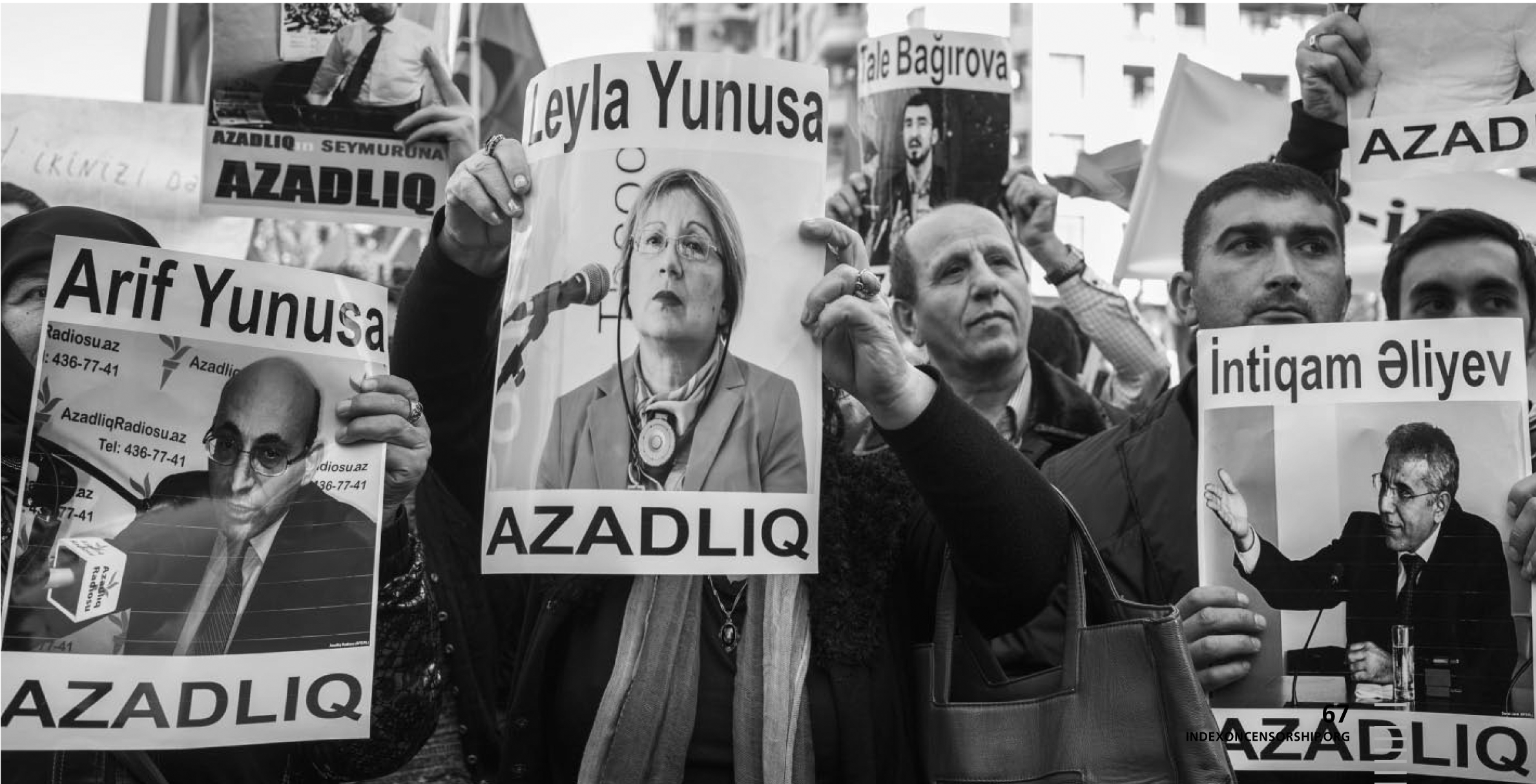
Protesters campaign for the release of imprisoned activists
In an ironic twist of fate, in the midst of this unprecedented crackdown, Azerbaijan in May 2014 assumed the chairmanship of Council of Europe, a body whose very purpose is to safeguard human rights and democratic values. Sadly, during Azerbaijan’s chairmanship, the Council of Europe, and, the broader international community, has done little to hold the government to account for its human rights obligations.
Now, with Jafarov and so many of his colleagues behind bars and the organisations they represent effectively paralysed, concrete international support is needed more than ever. Azerbaijan’s few remaining independent voices are under siege and will not be able to hold out much longer.
The political is personal
Azerbaijan’s crackdown on dissenting voices is causing fear, frustration and family rifts. Azerbaijani journalist
For the first time in many years, I am having difficulty in writing. It is taking me more time and effort. It is hard to recap everything that happened in the past year and I admit, there are things and moments, I would rather not remember. It certainly has been a challenging year. I cannot seem to remember moments of true joy, with few exceptions. Most of 2014 is covered with a thick cloud of frustration, sadness and void.
I remember meeting friends was something you did at school, parties and various gatherings. But this past year, I have made friends with people standing in front of the court rooms, waiting for news on their loved ones, with advocates and rights defenders and, most recently, with children of those unjustly thrown behind bars.
Wishes of “get better soon” were replaced with “I hope they are released soon”. It seems I have wished a lot more of these this past year. And not just to friends but strangers, with whom our paths have crossed because of injustice, blindness and corruption. Texting a family member became a stressful ordeal – the uncertainty of whether that person still loves you despite the work you do, whether that person still has not disowned you.
A particular memory on this topic comes to mind. It was just few months back, in May, just after eight activists from N!DA [a young Azerbaijani civil movement] were sentenced, I received a phone call. On the other end of the line was my brother, busting his vocal chords. For a few days now he was calling, distressed, telling me he had been questioned about my work by the relevant authorities in Azerbaijan.
“You and your work,” he shouted, “will cost me my job!” I was worried. The last thing I wanted was to cost my brother anything, let alone his job. I tried my best to calm him down. He refused. “You ought to go public and tell everyone that you are stepping down from whatever it is you are doing,” he said. “Enough is enough!” I took a deep breath and said I would do it. I was broken down to tiny little pieces. It was his job on the line. On the other hand, it was my work too. After all, everything I have done so far, be it in writing, statements, conference talks – all of it has been for the sake of pushing for a change back home. I couldn’t give up just like that.
The next thing I remember was telling my brother to disown me. He didn’t do it, although I am sure he did give it a long thought or two. At the end he decided not to. A decision he regrets often. And this is what Azerbaijani government does to its people. It imprisons people’s perceptions of a family; it scares people and creates an environment where even your family could turn on you. But silence and fear isn’t a way forward.
This is how the past year felt mostly.
From January to the end of October 2014, a total of 13 people were arrested because of their pro-democracy work. While the charges vary from drug possession, hooliganism and espionage to name a few, these people are all known for their critical writing, outspokenness and their overall perception of the deteriorating situation in the country. Among these are rights defenders, journalists and social media activists. In the same period, a total of 15 people, including youth activists, were sentenced. Several journalists and civil society activists fled the country. One person remains in hiding. One journalist was brutally beaten and is currently facing with a possibility of blindness.
Despite the international attention, the calls and demands of immediate release, the possibility of anything changing in Azerbaijan is as dim as ever. There are fewer voices to speak to and more people behind bars.
It is hard to write about future of a country where most of its independent minds are being silenced.
To me, my home was always about our colourful carpets, our rich culture, the laughter of our jokes and the spirit of our people. I am afraid our carpets are fading, our culture is dying, and there is little place for laughter. Azerbaijani government has slowly broken the spirit of its own people. They are nothing more but grey matters, shuffling hopelessly, aimlessly in what is no doubt, a frightening end.
© Arzu Geybullayeva
During 2014
A list of 13 people arrested in Azerbaijan between January and October 2014, on various charges, but allegedly because of their pro-democracy work.
Arrested:
Khalid Garayev, anchor of internet TV show Azerbaijan Hour
Seymur Hazi, anchor of Azerbaijan Hour, hooliganism charges
Murad Adilov, member of opposition, charged with drug possession
Rauf Mirgadirov, charged with espionage
Khagani Mammad, hooliganism charges
Leyla Yunus, charged with economic crimes and treason
Arif Yunus, charged with economic crimes and treason
Intigam Aliyev, accused of tax evasion
Rasul Jafarov, charges of tax evasion, operating an illegal enterprise and abuse of official power
Hasan Huseynli, hooliganism charges (recently pardoned)
Orkhan Ayyubzade, resisting police
Faraj Karimov, drug possession charges
Ilham Muradov, drug possession charges
Sentenced:
Parviz Hashimli
Ilgar Mammadov
Tofig Yagublu
Yadigar Sadigov
Anar Mammadli
7 members of NIDA
Abdul Adilov
Omar Mammadov
Ilgar Nasibov, beaten
Emin Huysenov, hiding
This is a list of names reported to Index and may not be fully comprehensive.
A year ago:
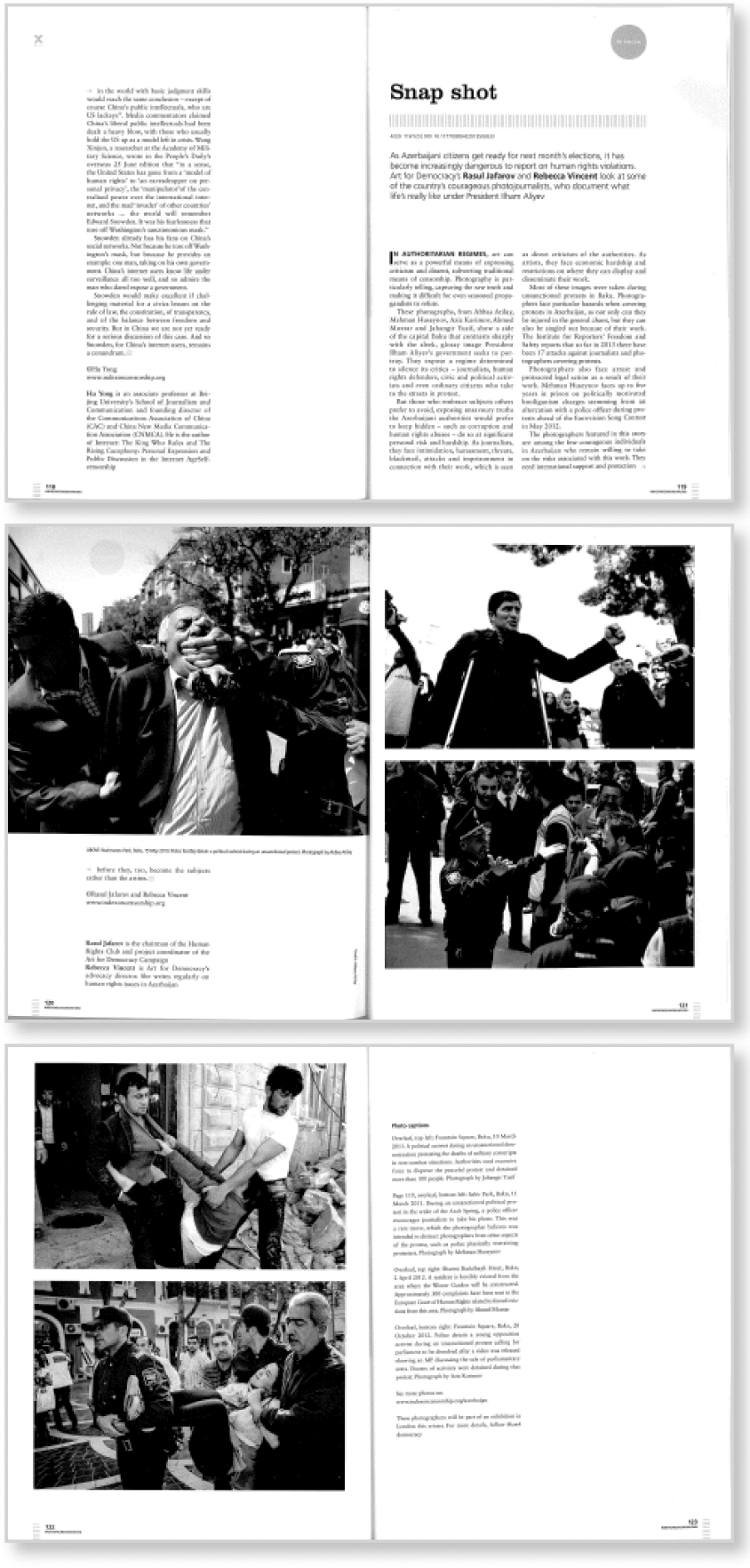
In Index 42, 03, Rasul Jafarov and Rebecca Vincent wrote on the increasing dangers facing human rights protesters and photographers in Azerbaijan. The selected images showed various unsanctioned political protests, and the chaotic attempts by authorities to shut them down. Photographing these clashes is a high-risk pursuit, with photojournalists then facing the problem of finding somewhere to publish or display their work. The brave few that persevere capture a very different side of the country to the glossy image the government likes to present.