




Abstract

“
Yanishev was fined 9,610,500 soms ($3,200) in June 2014 by Uzbek authorities, for researching and writing a story about residents of a demolished Tashkent housing estate receiving inadequate compensation, according to news website Uznews.net. Yanishev was charged with operating as a journalist without a licence and producing or storing materials that pose a threat to public safety. The judge handed down the maximum penalty.
During the past few years, dozens of artists, poets and musicians have faced oppression for their art or political views. Aside from Yanishev, two more artists have become symbolic of the struggle of Uzbek artists – those of celebrated photographer Umida Akhmedova and conceptual artist Vyacheslav Akhunov. All three were interviewed for this article.
Yanishev spoke of his worries about the future of Uzbek arts, particularly literature, and the restrictions on independent publishing, which, he feels, suffer more than performance and theatre.
“Theatres, including those performing in Russian, work quite successfully, and they manage to sell out their performances. But in literature we have problems: there is almost no possibility for writers to get published, and they are hardly able to get any readership even if they can. Most people nowadays read from a computer screen or e-books,” said Yanishev.
Photographer and filmmaker Umida Akhmedova was charged with an “insult of Uzbek people” and “creation of a negative image of Uzbekistan” after the broadcast of her documentary The Burden of Virginity. She was also charged with defamation and damaging the country’s image in her photo exhibit Women and Men: from Dusk till Dawn, which showed images of rural life in the country. She could have faced up to two to three years in a labour camp. She was found guilty in 2010, but the judge waived the penalty “in honour of the 18th anniversary of Uzbek independence”. Akhmedova said she would appeal. According to Akhmedova, whose work has been published in The New York Times and the Wall Street Journal among others, she just filmed the traditions of her nation, taking an ethnographic approach. The photographer donated the series to Radio Free Europe, where they can be viewed: rferl.org/photogallery/3213.html.
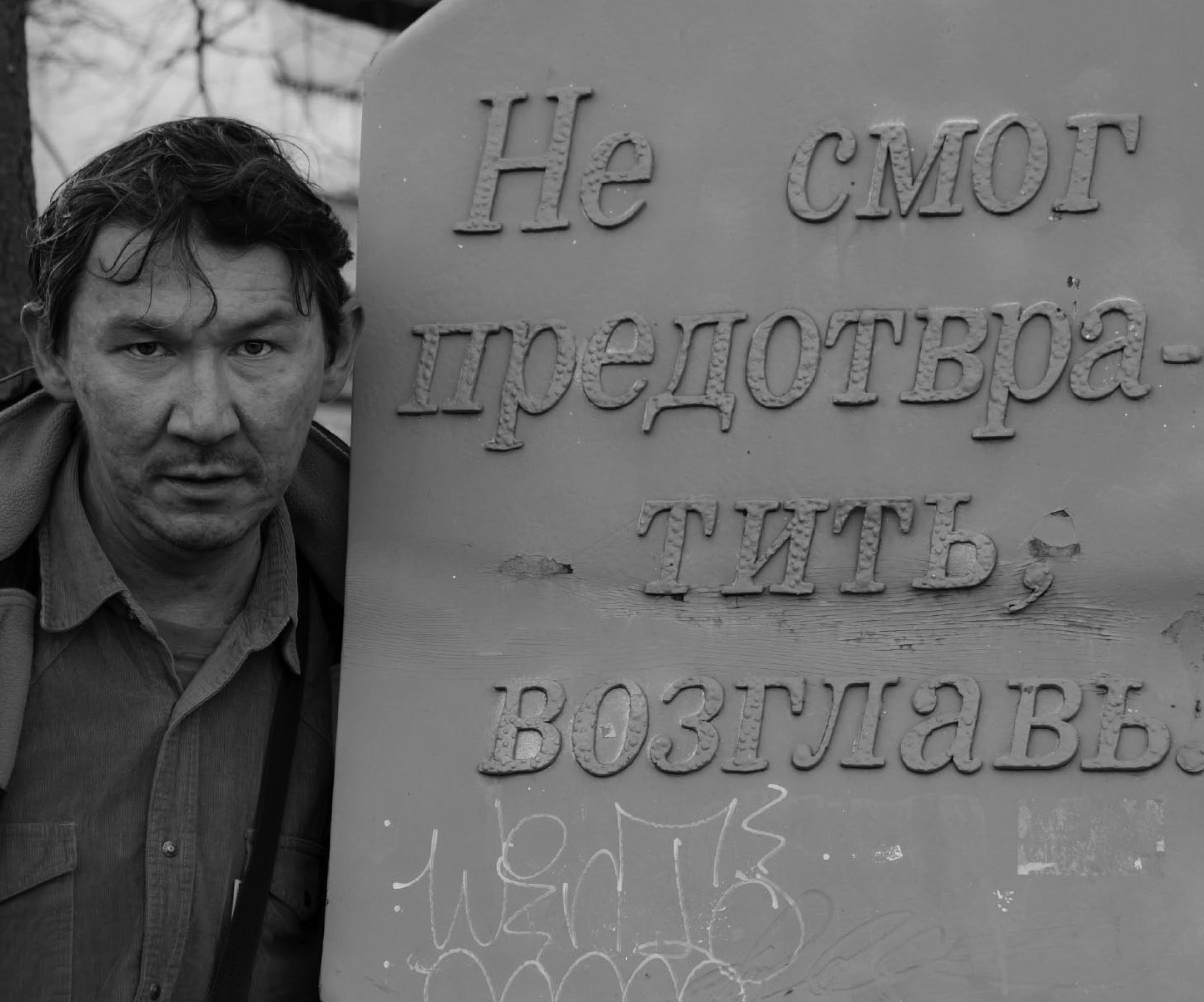
Writer Sid Yanishev next to words that translate as meaning “if you can not prevent something, then take charge yourself”
Akhmedova told Index she felt there are more restrictions on arts now than during the Soviet era. She said: “It seems like culture and cultural programmes have been totally forgotten during the independence era. During Soviet times there were arts, in one way or another, although they served the communist ideology. But there was the Khrushchev thaw in 1960s, and there was a powerful rise of arts in the Soviet Union, including Uzbekistan.
“During the Soviet times, the cultural elite of the republics interacted between each other, shared experiences, thus there was some development. Nowadays I don’t see any perspectives for the part of young people; there is no base, no knowledge. If a young artist is worthy, he or she prefers to develop their talent abroad.”
Conceptual artist Vyacheslav Akhunov, whose work includes performance and video art, has been fighting for his right to free movement for three years. In 2011 he was refused an exit sticker that would give him the right to leave Uzbekistan. At the same time he was banned from working in the country, and his name is even excluded from official list of artists of Uzbekistan, despite his numerous international awards. Akhunov says repressions against him are connected to his dissident views and to his sharp socially motivated art.
He said: “In our case the strategy of searching for a way out of the deadlock situation is defined by impossibility of going forward into the future. To get art back as a genuine cultural system, we need to have a completely new composition of public relations, a new society.”
All the artists interviewed for this piece were worried about the future, and the pressure being placed on them and others to leave the country in order to be able to show or publish their work.
Yanishev said: “The biggest problem with artistic expression is that you can’t earn a living in Uzbekistan, even professional actors have to survive with a poor salary. To make ends meet they have to dedicate themselves to popular culture or even perform at weddings.”
Akhmedova would agree. “It is difficult for an artist to express oneself in Uzbekistan. An artist can survive if they have a powerful patron, and if they just ‘go with the flow’. There are almost no programmes for support of arts, except a few provided by the Goethe Institut or Swiss Agency for Development and Cooperation. And there are no new ideas. Biennales of modern art in recent years were of very low quality, as their foreign participants say. One can see imitation of activity and the absence of professional art curators. There is simply no environment for an artist here.”
Akhmedova added: “I don’t see any perspectives, and I don’t believe the government will be replaced. We don’t have anyone courageous enough to challenge the system.”
Speaking of the legal cases taken against her, and of the pressure that placed on her, she said: “Events related to a criminal case against me definitely affected my civic position. I used to see the world in a more colourful way before. I feel like I have grown up since. There is more irony in my projects now, sometimes even sarcasm. And I feel I am ‘the fifth column’ now. I have always felt myself to be a national artist.”
But she and others have not given up. Yanishev said: “Probably I will take up a topic of my persecution for one of my future books. I am not a revolutionary in my writing, I write in quite a traditional manner.”
According to Akhmedova: “Art cannot be non-political. The question is what form an artist does this in. I don’t know much about terms of the official propaganda, but whatever they say, they have no right to impose and dictate to everybody. I will never accept it. Total control is deadly not only for any art, but also for any development.”
It is difficult for an artist to express oneself in Uzbekistan. An artist can survive if they have a powerful patron, and if they just “go with the flow”
Both Yanishev and Akhmedova do not want to leave Uzbekistan to be able to work. “I would not like to leave my homeland. I feel lonely, sad and nostalgic while abroad. But if they put pressure on me … It is better to suffer being free than to die behind bars in my home country,” said Yanishev.
Akhmedova also felt strongly about staying in her homeland: “I want to work here and now. I want to stay at home. And I do hope the things will not come to extremes, and I won’t have to leave. It is a pity though that I cannot exhibit here, as everything is under such tight control”.
Arts and culture have always reflected the pressures within society. The attitude towards culture is an indicator of the development of a society. The word of these three artists proves that it is impossible to restrict art to the borders of any state or nation. But the consequences of the isolation of artists from the rest of the world, that can be fatal both for art, and for society.