



Abstract

Fantasy writer Neil Gaiman speaks to political cartoonist
After we’d chatted for a while about the latest doctor, Peter Capaldi, and the show as a political allegory for post-war Britain, Gaiman observed that in our brutal yet over-sensitive world there’s something else about the series: “When I was being interviewed in America about Coraline the movie [Gaiman’s 2003 children’s horror novel] they would say: ‘You’ve made something scary for children.’ As if I’d done something terrible that nobody else had done before. And all I could try and explain to them was the joy of watching Doctor Who from behind the sofa, the joy of climbing into your dad’s or your mum’s lap and being scared and being safe at the same time.”
We had, eventually, to move on from Doctor Who and its comforting and redemptive power to scare small children witless. Instead, I asked Gaiman if he’d caught up with recent news reports about the response to Hilary Mantel’s short story The Assassination of Margaret Thatcher, including the demand by former UK Prime Minister Margaret Thatcher’s former adman Tim Bell that Mantel be investigated by the police under terrorism laws.
“As long as people are getting upset, then a medium is not dead. And as long as Tim Bell can call for the arrest of Hilary Mantel for writing a short story, then the short story is not dead,” he said.
But while I agreed that it was heartening that Bell had shown himself to be so indestructibly stupid, he’d actually called out loud for a writer to be investigated by the police because of something they’d made up in their head, which hadn’t happened and which wasn’t real. I suggested to Gaiman there was an ever present danger here, and quoted his own words: “A nice easy place for freedom of speech to be eroded is comics because comics are a natural target whenever an election comes up.”
We’re both of an age where we can remember the authorities impounding the works of the American underground comic artist Robert Crumb to stop them coming into Britain in the late 1970s. Gaiman said: “The last Robert Crumb thing that I remember was about 1987 or 1988 and it was particularly notable because customs were impounding Crumb and it was stuff being imported to tie-in with a BBC2 Arena special on Robert Crumb.”
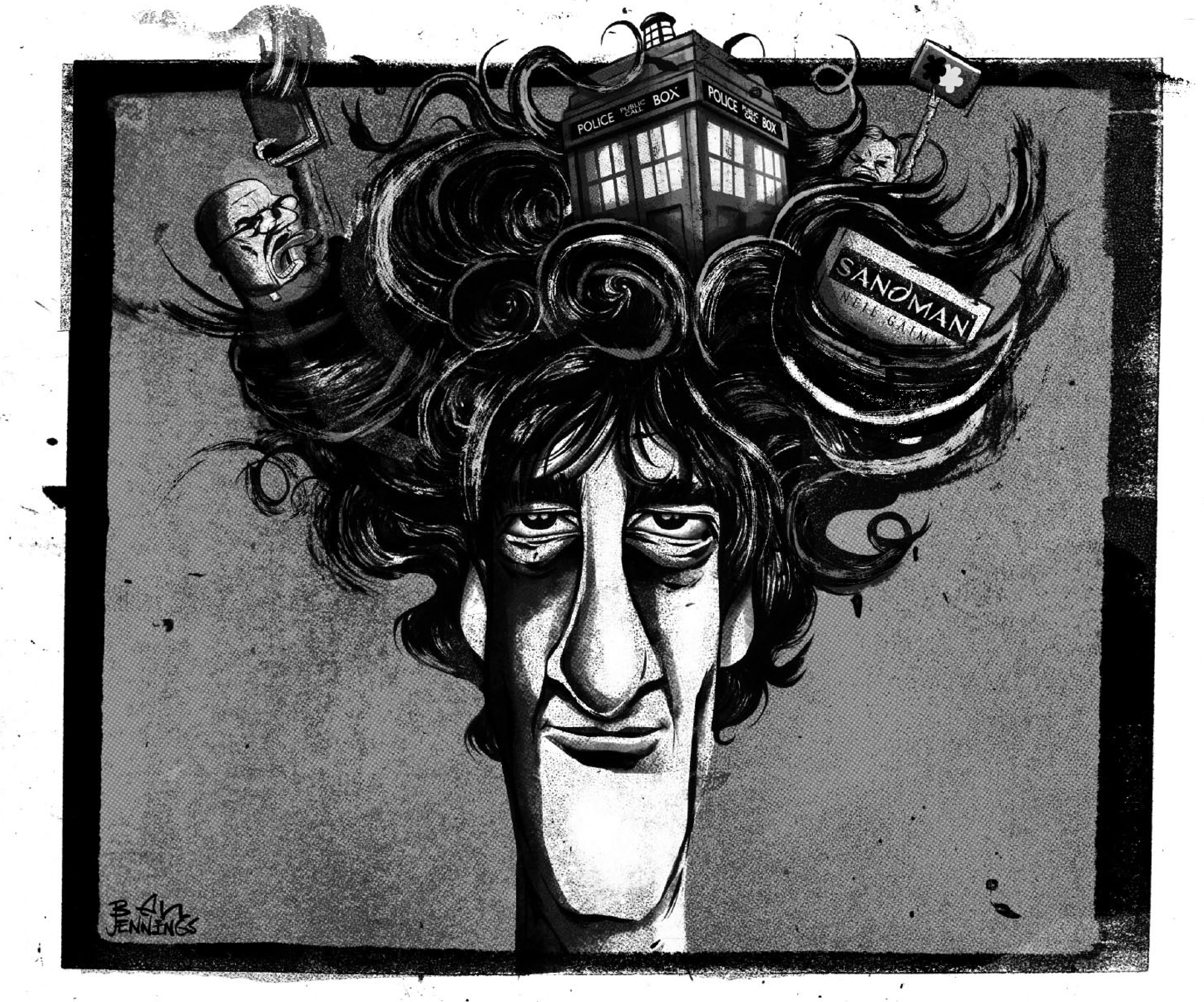
Inside the mind of Neil Gaiman
Credit: Ben Jennings
It was a nice irony, but as a practitioner myself (I’ve written and drawn comic book adaptations of Eliot’s The Waste Land, Sterne’s Tristram Shandy and Swift’s Gulliver’s Travels), I’m conscious of deeper ironies, particularly in genres like comics and cartoons. I suggested to Gaiman that when there are BBC Arena specials about Robert Crumb, that’s the moment the medium starts dying. Didn’t he feel that he should being doing something sufficiently vile and Crumbian to get his own books burnt in the high streets of the United States and, for that matter, Britain too? He recognised the dilemma at the heart of my question. He said: “On the one hand, I love that comics get power from being a gutter medium. But on the other hand, I spent 12 years on the board of the Comic Book Legal Defense Fund, having to oversee legal cases where the whole point was proving that comics were literature and art, and were worthy of a first amendment defence and not just trash.”
People would say, ‘You’ve made something scary for children’. I’d try to explain to them the joy of watching Doctor Who from behind the sofa
He then referred to a notorious case when the state of California surreptitiously tried to reclassify the art of the Furry Freak Brothers artist Paul Mavrides as sign painting which, unlike art or literature, is subject in California to sales tax. The message the state was sending was clear: comics are so trashy you should pay tax on them.
I think that comics, because of the capacity of offence that an image can give, will always have one foot in the gutter
“It was their way of trying to tax the [“Peanuts” creator] Charles Schulz’s of the world. And suddenly here’s the Comic Book Legal Defense Fund having to get out and muster our experts to say: ‘No, this is art, this is absolutely art.’ [In 1997 a California State Board of Equalization ruling found in Malrides’ favour.] So you’ve always got those tensions, but I think that comics, because of the capacity of offence that an image can give, will always have one foot in the gutter. You know it may be walking wobbly because it’s got one foot on the pavement, but it really will be walking wobbly because it has one foot in the gutter.”
Gaiman writes stuff, others draw. I wondered how this worked, and how well, so I asked him if he’d ever been offended himself by something someone had produced to illustrate his words.
He said one of his very first comics was for Knockabout’s Outrageous Tales From The Old Testament, a 1987 portmanteau comic book published by Knockabout Books illustrating biblical stories and produced in ironic response to the latest calls from MPs and religious groups for comic books to be banned. “I was fascinated by the Book of Judges, mostly because it was these monstrous immoral stories where God keeps telling people to commit genocide and they’re never quite doing it the way he told them.
“I did one story about a man whose wife whores around and he sends her away but then has second thoughts, gets her from her dad’s, and on the road to Bethlehem they stop in a little village. A nice stranger takes the guy in and that night a whole bunch of people come out in the street and say: ‘That bloke who came to stay with you tonight, we want to have sex with him.’ And the host says: ‘Good people, you are being evil, what an awful thing you are saying. You cannot rape this nice man, but I’ll tell you what, he’s got a concubine and I have a virgin daughter who’s known no man, you can have them.’
“So he threw them out and, according to the Bible, they used them and abused them till dawn and left them dead on the doorstep. The guy puts his wife on the back of his donkey, takes her home, cuts her up into 12 pieces, and sends one to each of the 12 tribes in Israel to let them know what a terrible thing has happened.
“I had Steve Gibson, who is a fantastic artist, drawing this. When he got to the rape page, I had said this is not a sexy rape: it’s awful and monstrous. Steve drew a gang rape so monstrous and terrible that Knockabout and I agreed it should not see print. We had Mark Matthews draw a replacement page.”
Even so, he added, the book was not without controversy: a Swedish publisher of Outrageous Tales From The Old Testament was still arrested and threatened with prison for having published images breaking Swedish laws against depictions of violence towards women.
He thinks they saved the publisher from going to jail by playing up the biblical dimension. “I was saying: ‘Look, if you’re going to go after this, what about that incredibly disturbing image of a guy nailed to a piece of wood hanging there in his death robes? We may want to start removing those because it’s pretty harrowing and it seems to be some kind of image of torture crime.’” Nonetheless, remembering Gibson’s rape artwork, he reflects: “I think that was the only time I’ve looked at something and said: ‘That’s too disturbing.’”
That was nearly 30 years ago, when Gaiman’s work was defined by a punkish mission to offend. These days he’s rich, very influential and very, very successful. So does he think he’s now part of the mainstream or has he sold out?
“You know 30 years ago, I was sushi, in a world in which if you wanted to have sushi in any little town or any big city you had to go and find the one place that sells it and it might be full, but that was the one place because it definitely wasn’t mainstream. And now every little town seems to have sushi and any big city has a lot of places that sell it.”
But, maybe in 30 years of post-modernism we have just seen what we used to call the mainstream hit the floodplain and engulf the whole of the culture?
“The key word for the last 20 years, for me, is confluence, and I love the fact that you’ve said it’s become a floodplain because that is a confluence, it’s all of the rivers, all of the mainstream and the outlying tributaries, have come together.”
Yet, however apparently respectable both Gaiman and the genres he works in may have become, the old threats remain. Book banning is still a problem in the US. When John Green’s 2012 novel The Fault In Our Stars was taken out of a Los Angeles school system, there was, said Gaiman, “a note saying it could not even be donated, if it was donated it had to be given back or burned”.
I was saying: ‘Look, if you’re going to go after this, what about that incredibly disturbing image of a guy nailed to a piece of wood?’
“This is probably the bestselling book of the last three years. And now a huge movie. I think popularity and mainstream success does not mean that the people who want to save you from the stuff that could contaminate your brain will not save you, they are out there and they are determined to save you from anything, and popularity for them genuinely means nothing.”
And, of course, even if Gaiman’s not moved an inch while the culture’s washed over him, the fault lines of taking offence never rest.
“I was pondering the fact that in 1987, one of the Sandman graphic novels was getting banned and attacked because it featured the first transsexual character in a mainstream comic, who was transsexual and sympathetic and smart and charming and fucked up like all of the characters in Sandman were and I was getting attacked from conservative elements, from people who thought there should be no transsexuals in comics. The American Family Association put me on their banned list because of that and the Concerned Mothers of America actually boycotted DC Comics and as far as I know, never lifted their boycott because of me writing my transsexual character. And now I get attacked by young transsexuals, young trans activists, going: ‘Look at this character, you kill this character and bad things happen to this character which proves you are transphobic and why could you do this?’”
He recalled some of the comments. One person said: “Gaiman’s transphobia makes Sandman unreadable for me and this is offensive and this is awful.” Gaiman remembered thinking: “And I’m going, you know a part of me just goes: ‘I wish you could have been there in 1988 when I was writing it and looked at the world that you’re in now.’”
That was good point to end on, though during the previous hour and a half our conversation had ranged across everything, from how cereal crops had domesticated human beings, to the empowering nature of fiction. Gaiman also said something that I thought not only described the power of his chosen genre of fantasy fiction, but also pointed to a more universal truth: “Where there is a monster there is a miracle.” Of course this observation applies equally to the unending struggles of the world of politics as to Gaiman’s realm of the imagination.
Neil Gaiman biography
Neil Gaiman is the creator and writer of the award-winning Sandman comic series. He is also the bestselling author of Coraline and Stardust, both of which are now major films. Gaiman co-wrote the script for Beowulf, starring Anthony Hopkins and Angelina Jolie. Sandman was the first comic ever to receive a literary award, the 1991 World Fantasy Award for Best Short Story. His latest book, The Sleeper and the Spindle, was released in October 2014.
