




Abstract
As Thailand’s King Bhumibol Adulyadej - the world’s longest reigning monarch - celebrates his 87th birthday, any comment about his country, its future or the royal family can result in a lengthy jail term.
Such is the air of hysteria in modern Thailand – a country under martial law and gripped by anxiety as the current monarch nears the end of his reign – that any discussion of the royal family is taboo. The generals who seized power in a military coup last May have vowed to crack down on anti-monarchists, heightening the climate of fear in the so-called “land of smiles”.
As Index went to press, millions of people across Thailand were preparing to celebrate the 87th birthday of King Bhumibol Adulyadej on 5 December. He is the world’s longest reigning monarch, crowned in 1946, and revered by many as a semi-divine ruler.
But Bhumibol is now frail and ailing, leading to acute end-of-reign anxiety among his subjects. The political turmoil that has racked Thailand for the past decade is closely linked to the battle over the forthcoming royal succession – yet honest discussion of these issues is impossible without risking a lengthy jail sentence.
Lèse-majesté, or defaming the monarchy, has been prohibited by Thai law since 1908, when the country was ruled by an absolute monarch. Article 112 of the criminal code specifies that “whoever defames, insults or threatens the king, queen, the heir-apparent or the regent, shall be punished with imprisonment of three to 15 years”.
Pavin Chachavalpongpun of Kyoto University’s Centre for South-East Asian Studies is an outspoken democracy activist who was stripped of his Thai passport following the coup and is currently applying for asylum in Japan. “The anxiety over the new reign has driven some royalists to use the draconian law to punish those thinking differently about the monarchy,” he told Index. “Sadly, there has been no attempt on the part of the Thai elite to address this problem seriously.”
Trials are held in secret, with offenders deemed a threat to national security, and information is often difficult to come by. However, the number of cases has escalated dramatically since 2005, coinciding with Thailand’s political turmoil and following a speech by the king in which he indicated that he could be criticised.
US historian David Streckfuss, author of Truth on Trial in Thailand: Defamation, Treason and Lèse-majesté, published in 2011, said 1,237 cases were sent to trial from 2005 to 2013 – an average of 137 charges per year – and 455 judgments were handed down in the same period.
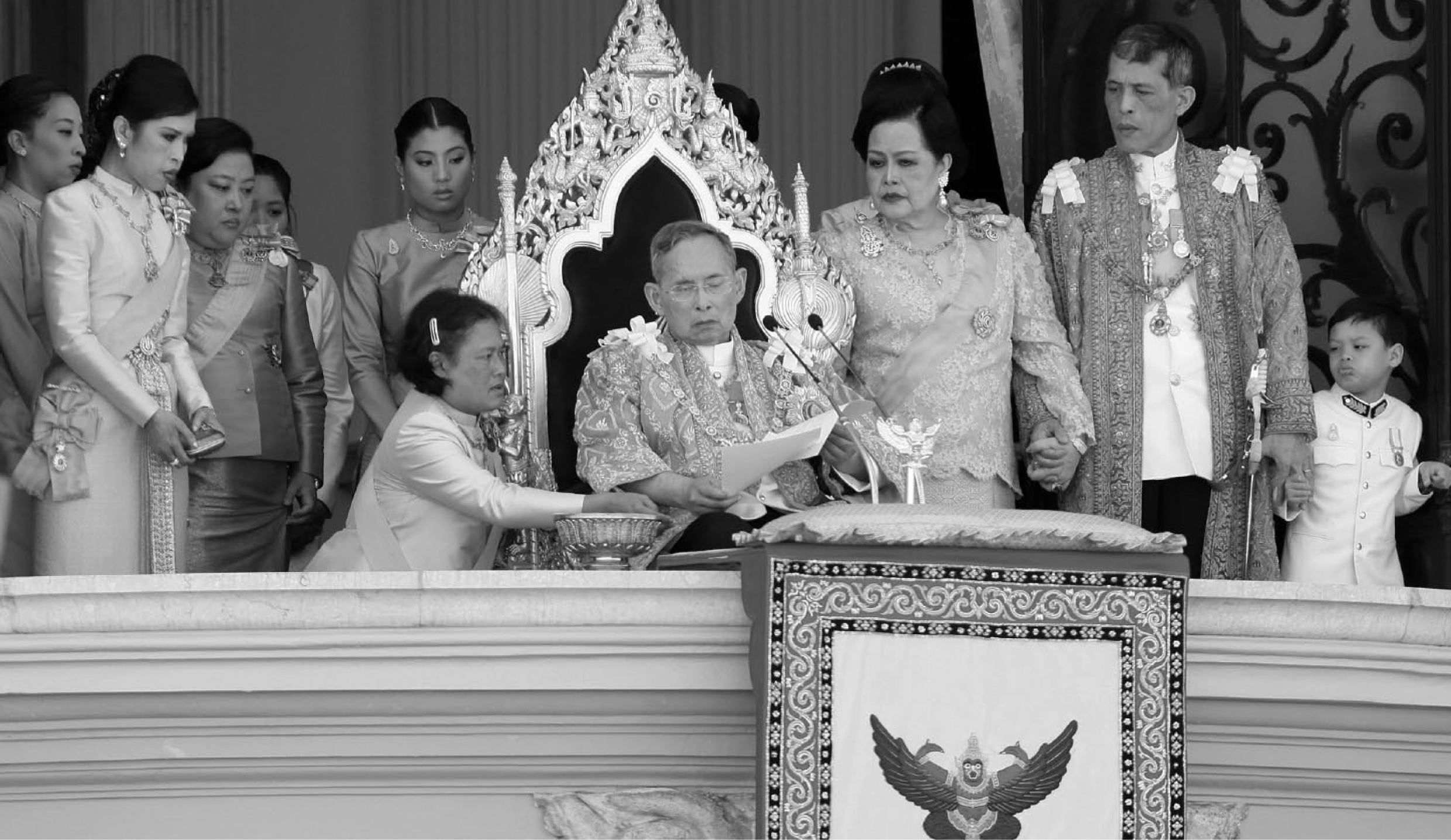
With Thailand’s King Bhumibol (pictured centre with other members of the royal family) elderly and frail, a battle over his succession includes the ruling generals seeking extradition of critics of the monarchy, and court cases against those who criticise the state
Credit: Reuters
“There is hard information on only a handful of cases,” he said. “It has been assumed by observers that most lèse-majesté cases are not even officially ‘cases’ yet, as officials in the police or prosecution departments decide how to proceed further.”
The promotion of the monarchy as a central component of national identity began under military governments in the 1950s, aided by the US Central Intelligence Agency, which saw Thailand as a useful ally in the fight against communism in south-east Asia. Officials, military men, businessmen and others have long sought to win prestige by associating themselves with the palace, engaging in what some scholars have called “flattery inflation”.
Since the 22 May coup, the ruling junta has cracked down on debate and dissent, including perceived threats to the monarchy, with an iron fist. In recent years, tens of thousands of websites have been blocked, according to human rights groups. The junta has announced that it is actively monitoring social media for signs of lèse-majesté.
Any citizen can file a lèse-majesté complaint – although no member of the royal family ever has – and the police are obliged to investigate. The law has often been misused for political purposes, according to Human Rights Watch (HRW), which says it has a “devastating impact on freedom of expression in Thailand”. HRW says that the “police, public prosecutors, courts, and other state authorities appear to be afraid to reject any allegations of lèse-majesté out of concern they might be accused of disloyalty to the monarchy”.
A taxi driver was sentenced to 30 months in jail after a passenger recorded their conversation about social inequality on his mobile phone
Last year, a man was jailed on an unprecedented charge of attempted lèse-majesté, and the supreme court ruled that the term “king” also applied to previous monarchs.
In August, two activists were charged for staging a performance of a play, The Wolf Bride, which the junta deemed “insulting to the monarchy”. The same month, a taxi driver was sentenced to 30 months in jail after a passenger recorded their conversation about social inequality on his mobile phone. The junta also banned a computer game, Tropico 5, because it allows players to name a country and its king or leader as they please. This was deemed offensive to the monarchy and might affect the country’s dignity, the head of the Cultural Promotion Department said.
Trials are held in secret, with offenders deemed a threat to national security, and information is often difficult to come by
The ruling generals also announced in June that they would seek the extradition of critics of the Thai monarchy who are based abroad, such as the London hairdresser Chatwadee “Rose” Amornphat, who now has British citizenship. Her own parents had earlier filed a lèse-majesté complaint against her.
Yet some citizens believe that not enough is being done to protect the monarchy’s reputation. A doctor and hospital director, Reinthong Nannah, earlier this year formed the Rubbish Collection Organisation – a vigilante group aimed at hunting down people it believes have insulted the king.
Reinthong, whose group claims more than 200,000 followers, has referred to lèse-majesté offenders as “garbage” and says they must be “eliminated”. He reportedly refers to himself as Van Helsing, after Bram Stoker’s fictional vampire hunter in Dracula.
Through most of Thailand’s recent history there were only a few lèse-majesté convictions per year, and the law was enforced arbitrarily rather than focusing on obvious targets. This was a deliberate strategy designed to “inculcate fear and obedience by making an example of the unlucky few and destroying their lives”, writes British journalist Andrew MacGregor Marshall in his book A Kingdom in Crisis: Thailand’s Struggle for Democracy in the Twenty-First Century, which was published in October and is banned in Thailand.
Among these unlucky few was a student sentenced to six years in jail in 1983 after writing to the king, whom she revered, asking him to abdicate and enter politics. Another was a grandfather known to supporters as “Uncle SMS”, who died in jail in 2012, after he was found guilty of sending four text messages insulting the queen to a government official. He had denied the charges, saying he did not even know how to send a text message, but was sentenced to 20 years.
Foreigners are not exempt. In 2009, an Australian, Harry Nicolaides, was jailed for six months over a passage in his self-published novel – which sold just seven copies – dealing with the romantic entanglements of a fictional crown prince. A Thai-born American, Joe Gordon, was also jailed after reportedly posting passages he had translated from a banned English-language biography of Bhumibol, The King Never Smiles, on his blog.
In July, a leaked document apparently showed that the junta considers a British comedian, John Oliver, a threat to the monarchy after he mocked the crown prince on his US television show Last Week Tonight.
Thailand’s political scene has been bitterly divided for the past decade between supporters and opponents of the former prime minister, Thaksin Shinawatra, who was deposed in a 2006 coup and is seen as close to the king’s presumed heir, Crown Prince Vajiralongkorn. Both sides have used the lèse-majesté law to try to discredit their opponents, although the pro-Thaksin “red shirts” – a broadly progressive movement that draws its strength from rural areas – have been targeted more often.
Last year, Somyot Prueksakasemsuk, editor of a red-shirt magazine, was sentenced to 11 years in jail for insulting the monarchy.
“The courts seem to have adopted the role of chief protector of the monarchy at the expense of free expression rights,” a Human Rights Watch spokesman said at the time. “The court’s ruling appears to be more about Somyot’s strong support for amending the lèse-majesté law than about any harm incurred by the monarchy.”
The harsh sentencing, and the presence of online spies and police informers, has had a chilling effect on the media in Thailand. Journalists – including this one – routinely practice self-censorship and reports of lèse-majesté cases are kept deliberately vague to avoid repeating the offending words.
“Thailand’s use of the lèse-majesté law has become unique in the world and its elaboration and justifications have become an art,” said Streckfuss. “The law’s defenders claim that Thailand’s love and reverence for its king is incomparable. Its critics say the law has become the foremost threat to freedom of expression.”