




Abstract
Attacks on journalists in the Balkans are being highlighted by Index on Censorship’s European map of media freedom.
Index on Censorship and Osservatorio Balcani e Caucaso (OBC) launched an online platform in May to report and map media freedom violations in the European Union and across candidate countries until January 2015. Eight regional correspondents have been dedicated to monitoring what is happening across Europe, and the public has also been encouraged to submit reports. So far, over 250 cases have been reported. Almost half of the violations have been reported from the Balkans.
Of course, it is unwise to jump to conclusions based on crowdsourced data. Nonetheless, the numerous reports of censorship, verbal harassment and physical violence paint a worrying picture (see map on the next page). And, as reported on p91 of this magazine, the Organisation for Security and Cooperation in Europe (OSCE) representative on freedom of the media, Dunja Mijatović, is also worried about threats in the region.
The latest Reporters Without Borders Press Freedom Index reports that Serbia ranks 54 out of 180 (where one – Finland – is the gold standard). Bosnia and Croatia are not far behind, at 65 and 66 respectively. Kosovo is 80th and Albania 85th, with Montenegro and Macedonia trailing at 114th and 123rd. Slovenia, in 34th position, is in line with many of the current EU countries and its score raises the region’s average. But the rankings are concerning for Croatia, which is already an EU member and for the other countries – including Serbia, Bosnia and the smaller Balkan states – that aspire to join.
Concerns about the state of media freedom have to be seen within the context of the region’s poor economy. There is also corruption and lack of accountability within the political systems, and significant power is granted to wealthy tycoons. Serbian journalist Ana Jovovic* told Index: “Because the economy in Serbia is very bad, it is easy to control the media. There is no resistance either from journalists or editors. They are only looking for a way to survive.”
In Macedonia, the country’s latest European Commission progress report also expresses concern about the lack of transparency over the allocation of government advertising, highlighting claims that they are “directed only towards pro-government media”. There are also worries about the influence of big business on journalism. For instance, Bosnia’s biggest construction magnate Fahrudin Radoncic, also owns the country’s most widely read daily newspaper, Dnevni Avaz, and has served as a minister of security between 2012 and 2014. The number of powerful business owners who have side interests in media companies constitutes a major obstacle to media pluralism and independence.
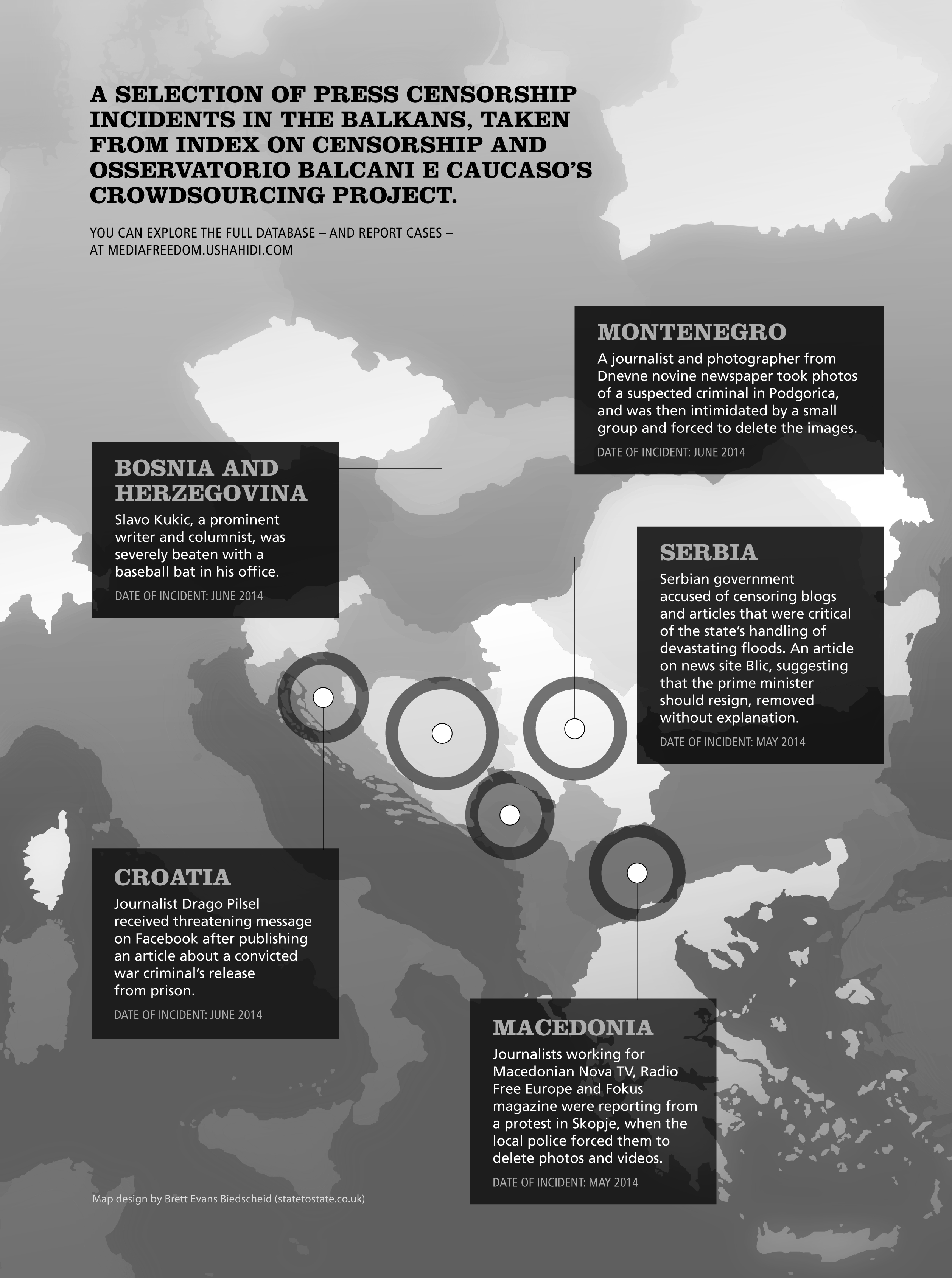
Though there are ongoing threats and violence against critical journalists in the region, most incidents have not been properly investigated and the response from the authorities has been minimal. This environment of impunity has contributed to creating a climate of fear and self-censorship. Zeljko Ivanovic, co-founder and co-owner of Vijesti news site, where journalists have been physically attacked, wrote in a blog for Index last October: “Not only have none of these criminal acts been properly investigated, but the authorities and their institutions have done everything in their power to render the investigations meaningless and to ensure that real culprits are not touched.”
Ilcho Cvetanoski, Index’s regional correspondent in the Balkans for the crowd-sourcing project, added: “Keeping in mind the number of unresolved assaults from previous years, being a professional journalist in this region is not an easy job. This atmosphere of impunity is probably the biggest threat to media freedom.”
Press freedom in the region has long been complicated. Under communism, despite the relatively liberal and free Yugoslav model, there were still restrictions on what journalists could report. Propaganda and hate speech disseminated through the media also played some part in the violence that enveloped parts of the region in the 1990s. Award-winning Bosnian journalist Kemal Kurspahic wrote an acclaimed book called Prime Time Crime: Balkan Media in War and Peace in which he accuses certain media in Serbia, Croatia and later Bosnia of “perpetrating lies about genocidal threats, awakening forgotten fears and hatreds, and preparing once peaceful neighbours to suspect, hate, confront, and finally, kill each other in the last decade of the 20th century”.
Being a journalist in this region is not an easy job. The atmosphere of impunity is the biggest threat to media freedom
Jovovic believes that in order for the situation to improve, the government must withdraw from the media. But, she says, international players also have a role, especially at EU level: “In my opinion, European politicians should insist more often on media freedoms and on the government’s withdrawal from media ownership.”
Index’s online platform, with the crowd-sourced map, is a project mainly funded by the European Commission. It will serve not only to monitor incidents but also as an advocacy tool to help raise awareness of media freedom in the region and give European officials more leverage to tackle the issue.
* Name changed to protect the individual