




Abstract

Chinese author Xiaolu Guo has long experience of censorship – and not just in her native land. She talks to
Guo was born in 1973 and raised in a fishing village in south China. At 18 she moved to Beijing to study at the Beijing Film Academy and later began writing screenplays, fiction and criticism. Her first documentary, The Concrete Revolution, followed construction workers in the run-up to the 2008 Beijing Olympics. She now lives in Hackney, London.
“In China writers face political censorship. In the West artists are superficially more free, but then there is commercial censorship,” says Guo. The dynamic between overt censorship and its more subtle manifestations forms the backbone of her latest novel, I Am China.
I Am China follows a punk musician in Beijing, Kublai Jian, and his poet lover Mu, who are separated by political disruptions, including China’s Jasmine Revolution of 2011. Their story is pieced together by Iona Fitzpatrick, a Scottish woman in London, who translates a series of their letters and diaries for publication. Through Iona the narrative develops into a fragmented account of their lives and of the relationship between art and politics. We learn that Jian, who participated in the Tiananmen Square protests as a teenager, has since channelled his criticism of the Chinese government through music. It was at one of his concerts that he met Mu and fell in love. It was also at one of his concerts that he was arrested and later exiled – to become as much of an outcast in Europe as he was in China.
Guo sees elements of herself in all of the characters. Mu’s father suffers from cancer, as Guo’s own father did. Iona lives close to where Guo is now based in London and, like Guo, writes and communicates across languages and cultures. But it is Jian with whom she identifies first and foremost. “The energy of Jian – his anger, his character, he doesn’t surrender – that is very much like my character,” she says. Both she and Jian are “anarchists”.
Jian’s struggle for freedom of movement and expression is the most explicit engagement with censorship in the book. But it is not the only censorship mentioned. In one of the most powerful sections, Mu is attacked by a crowd of Chinese students at Harvard University when she recites Allen Ginsberg’s 1956 poem America, originally published in his collection Howl, substituting “China” for “America”. Just a few verses in she’s pulled off the stage and slapped in the face.
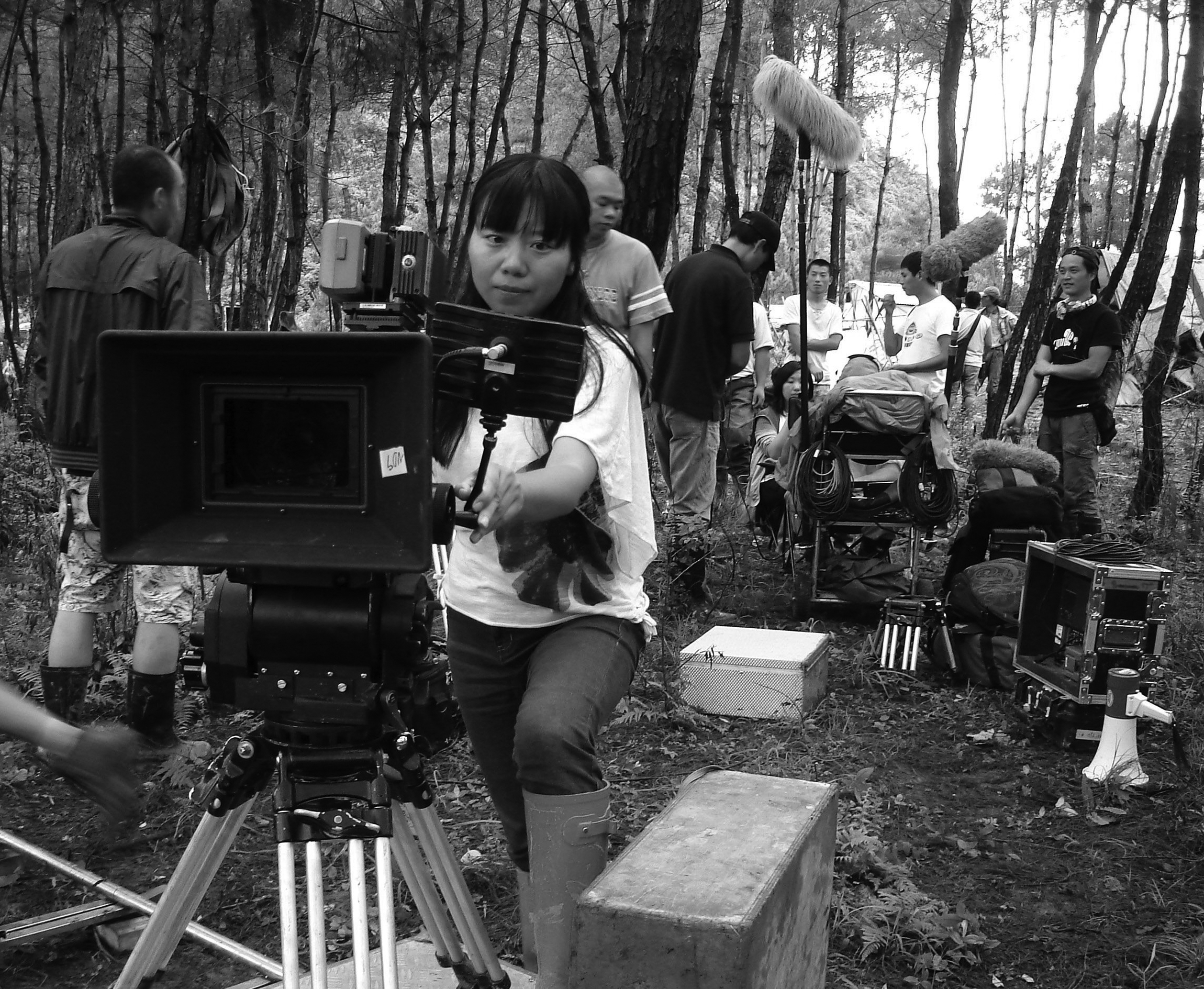
ABOVE: Chinese novelist and director Xiaolu Guo on the set of her 2011 film UFO In Her Eyes
Credit: REX/Match Factory/Everett
“They grabbed my arms exactly like the Red Guards had done to protesters during the Cultural Revolution. The only difference was that these little Red Guards were educated at Harvard, not in the rice fields of home,” writes Mu, comparing Jian’s earlier silencing in China to the silencing of her on this stage thousands of miles away.
In China writers face political censorship. In the West there is commercial censorship
The lines quickly blur further. Western commercial censorship and Chinese political censorship become one. Iona’s London publisher halts production of the book after Chinese pressure not to print. And even Iona struggles with the limitations of language. “How much liberty does a translator have?” she asks, while grappling with the letters.
Uniting different countries under the banner of censorship was important, says Guo: “I didn’t just want to write only about China because China is part of the global evolution.”
At the same time, in outlining what writers cannot talk about, Guo also highlights what they can do. Jian’s overt activism is juxtaposed by Mu’s softer approach. Through being less confrontational, the young poet can – and does – express more. As the pair clash over the role of art (for Jian “all art is political expression”; for Mu it’s much more personal), the novel challenges Western assumptions about Chinese free speech.
Ironically it is Mu’s character who is almost censored out. Iona is told by her publisher that Mu represents no more than a “lens” through which to present Jian’s tale, because he is the one who fits the Western romantic notion of persecuted dissident, which is more likely to sell books.
This highlights Guo’s other point. She says that “the state artist market needs to be more discussed” instead of overlooked as we focus almost exclusively on the bigger names, such as Ai Weiwei. Guo has written in defence of Chinese state writers, a label given to those who are considered to work without challenging the rules of the government. Then there are non-state artists who won’t work within the rules and will therefore take bigger risks (and have become more notorious in the West). However, as Guo points out, the lines blur – because both non-state artists might have started off following the rules, and state artists might very subtly challenge the system. She specifically mentions Mo Yan, whose winning of the Nobel Prize for Literature in 2012 invited a lot of criticism about why someone working within the confines of the Chinese state could be valued. But Guo points out that the lines between those considered “state artists” and those who aren’t are often blurred, as both may challenge the system in different ways.
“But surely every artist is born from within a state, trained by the state, and has a complex discourse with the state, even an artistic reliance on it, until the day the state choses to designate that artist an ideological enemy,” she writes on her blog.
In some ways this reappraisal of the mechanisms of censorship is liberating, and Guo’s own art has evolved into a pastiche of the styles of Jian and Mu. As she adds on the topic: “Don’t always look at China in terms of GDP and political talk. If you look at the literature, music and art scene in China you will see that it is rich, interesting, incredible. Once you enter there you have a softer landing towards Chinese culture.”
