




Abstract

With an election in Burma next year,
In July, four reporters and the chief executive of the now-closed news weekly Unity Journal were sentenced to 10 years in prison with hard labour for reporting on the alleged manufacture of chemical weapons in a military facility in central Burma. The two dozen journalists who later staged a silent protest against the convictions, all dressed in Don’t Kill Press T-shirts, with tape across their lips, have now been charged with unlawful assembly.
These shocking prison sentences, condemned by citizens’ groups and press watchdogs alike, are the culmination of months of clamping down on the press. Since the beginning of this year, not only journalists but editors and publishers of privately owned newspapers, such as The Irrawaddy, have been called in for government questioning about their balance sheets. They have been made to justify even the names of their publications. A reporter from the Democratic Voice of Burma was sentenced to a year in prison following an interview with an education official, who later brought charges of “trespassing” and “disturbing a civil servant while on duty”.
Interference of this sort still seems mild in comparison to the repression of previous decades, when military authority took on the trappings of a police state. It was early in that era of totalitarian rule that my father, Ed Law-Yone, founder and publisher of The Nation, then the leading English-language daily newspaper, was imprisoned for five years – two in solitary confinement. In the absence of due process, there was no charge, no trial, no visiting rights for the prisoner’s family, just indefinite incarceration for unspecified crimes.
For my father and his newspaper contemporaries, General Ne Win’s military coup in 1962 marked the end of what seems in retrospect a golden age of press freedom, when despite chaos, corruption, treachery, larceny, inefficiency and a host of other evils besetting the government, the independent press was still allowed to flourish. In the period of parliamentary democracy between independence in 1948 and the coup, close to a hundred newspapers were published in Burmese and English, and in a variety of other languages: Chinese, Hindi, Gujarati, Urdu, Tamil and Telugu.
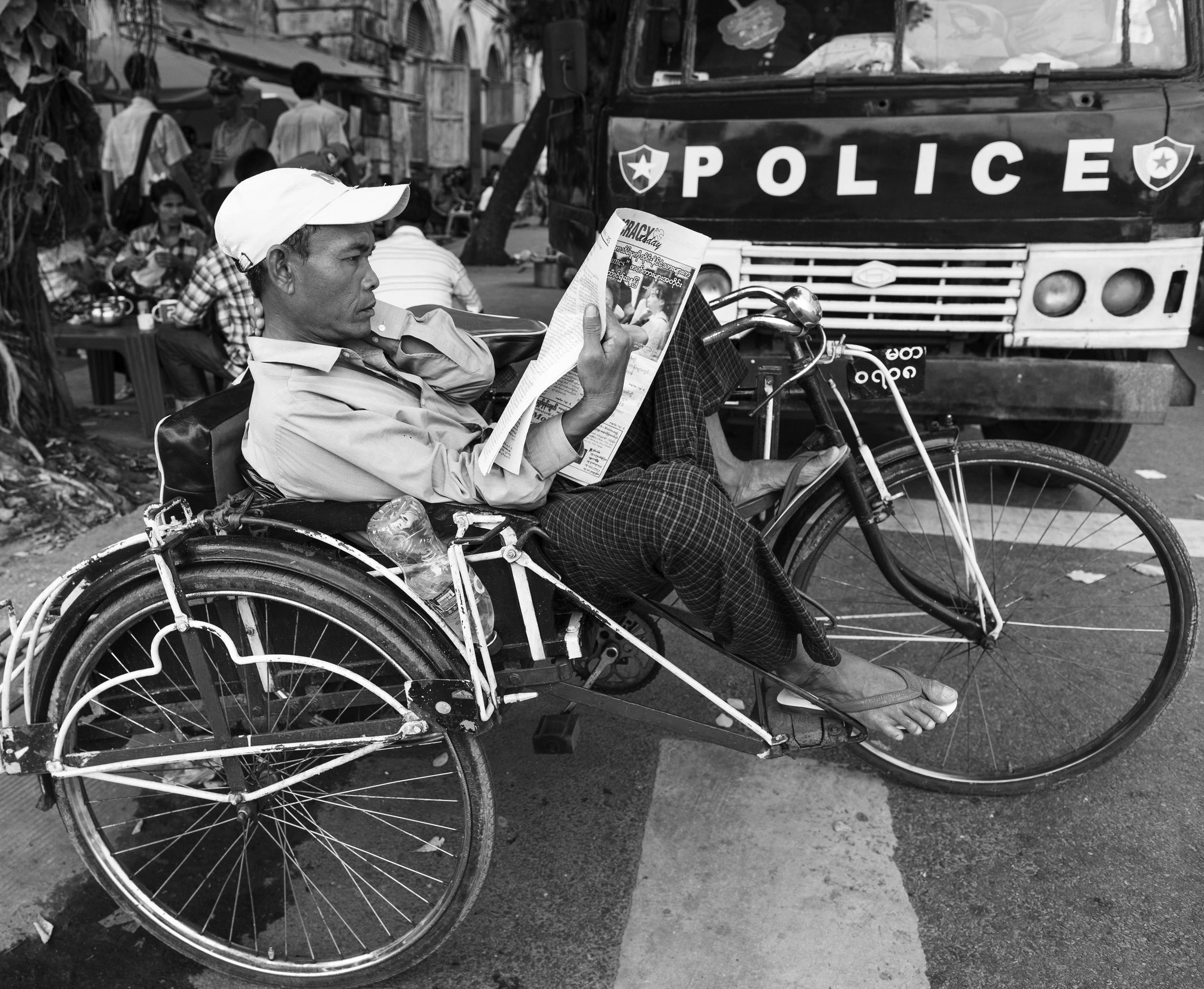
ABOVE: A man reads a newspaper in front of a police van in Rangoon, Burma
Credit: Zuma Press Inc / Alamy
It did not mean that there were no attempts at censorship. In 1957, in the heyday of his newspaper’s influence, my father was charged with criminal libel for accusing senior ministers in the U Nu government of corruption.
In July, journalists were sentenced for 10 years with hard labour for reporting on the alleged manufacture of chemical weapons
In a celebrated case, which he further dramatised by defending himself in court and then devoting large sections of his newspaper to the proceedings, my father established himself as a flamboyant champion of the free press. And although he lost his case, his jail sentence of one month was struck down on appeal, his fine reduced to a nominal sum, with a warning to “keep the peace and be of good behaviour” – allowing him to concede a Pyrrhic victory to his legal opponents.
Six years later though, when General Ne Win’s henchmen came to arrest him, there was no law to invoke, no higher authority to appeal to, no cadre of newspapermen who could come to his aid because most of them were in jail. It was the beginning of decades of repression, of which extreme censorship was a significant feature.
Since President Thein Sein took office in 2011 exiled journalists have returned, hundreds of political prisoners have been released and new press laws drafted. In a society long deprived of steady access to reliable news, the sudden proliferation of independent daily newspapers in Burma, forbidden for some 50 years, has been greeted with jubilation and the “newspaper renaissance” welcomed as another step forward on the promised path to reform.
Yet there continue to be steady curbs on press freedom, curbs justified in the name of peace, security, religion and race, as anti-Muslim violence continues to erupt throughout the country.
Take the common Burmese fear and hatred of the Rohingya, the mostly Muslim people of Arakan in the west. The violence against them has led to the displacement of 100,000. The death toll has been uncertain; aid workers have been evicted from the area by local and central authorities and the besieged Rohingya incarcerated in concentration camps. Death threats have been issued to any witnesses suspected of pro-Muslim sympathies, including reporters.
Mob hysteria has been fuelled by fascist elements led by the Buddhist monk U Wirathu, founder of the extremist 969 movement. Violence has also been stoked by pro-government vigilantes. Meanwhile President Thein Sein blames the conflicts on the “misuse of new-found media freedoms”. He has conflated inflammatory propaganda spread by social media with the reports of responsible journalists. Similar attempts to undermine the free press will no doubt continue in the run-up to the 2015 general election.
According to The Irrawaddy newspaper, Phoe Thaukkyar, vice-chairman of the interim Mynamar Press Council, has warned that the government is actively shrinking the space for independent media after a two-year period of relative freedom.
Opposition leader Aung San Suu Kyi has campaigned without success for a constitutional amendment that would allow her to run for president.
President Thein Sein blames extremist conflicts on the “misuse of new-found media freedoms”
Under the existing constitution, she is ineligible to run because of a clause that prohibits anyone with a foreign spouse or child. Her party, the National League for Democracy, has announced that it will contest the 2015 elections regardless.
In their coverage of the intensely scrutinised contest, Burmese journalists will be facing formidable, hydra-headed forms of censorship. We can only hope that in the event, with the world’s eyes on Burma, the government will be a little less ready to hit the kill switch.
