




Abstract

The new Indian government has signalled that it wants schoolbooks edited in line with Hindu religious beliefs, reports
The Rashtriya Swayamsevak Sangh, an organisation that represents the cultural and social agenda of the ruling BJP and its affiliate organisations, such as the Shiksha Bachao Andolan Samiti (Save Education Struggle Committee), headed by the indomitable Deena Nath Batra, have been fighting for years to remove any references in curriculums that they perceive as “hurting” Hindu sentiments, or portraying Hindus in bad light. Batra has been in the media spotlight for targeting a number of highly rated academic works, including Wendy Doniger’s books The Hindus: An Alternative History and On Hinduism. She also attacked Sekhar Bandopadhayay’s From Plassey to Partition: A History of Modern India.
The controversy over textbooks in India is similar to the attempts in Texas in the US to change school curriculums to reflect conservative values. Republicans on school boards have systematically targeted science and history textbooks to reflect “family values” and support creationism, despite the objections of scientists.
In a move, reminiscent of the debates in Texas, the Gujarat government has issued a circular recommending six books written by Batra should be used for primary and secondary school students. Local newspapers have pointed out that Batra’s books speak of an undivided India (Akhand Bharat), a definition that includes neighbouring countries and fits into an expansionist Hindu nationalist view of the world. In these books, Batra advises against blowing out birthday candles, suggesting this is a Western cultural practice to be avoided. The Shiksha Bachao Andolan Samiti has also objected to academic material that it deems critical of Hinduism saying that it “hurts the sentiments of Hindus”.
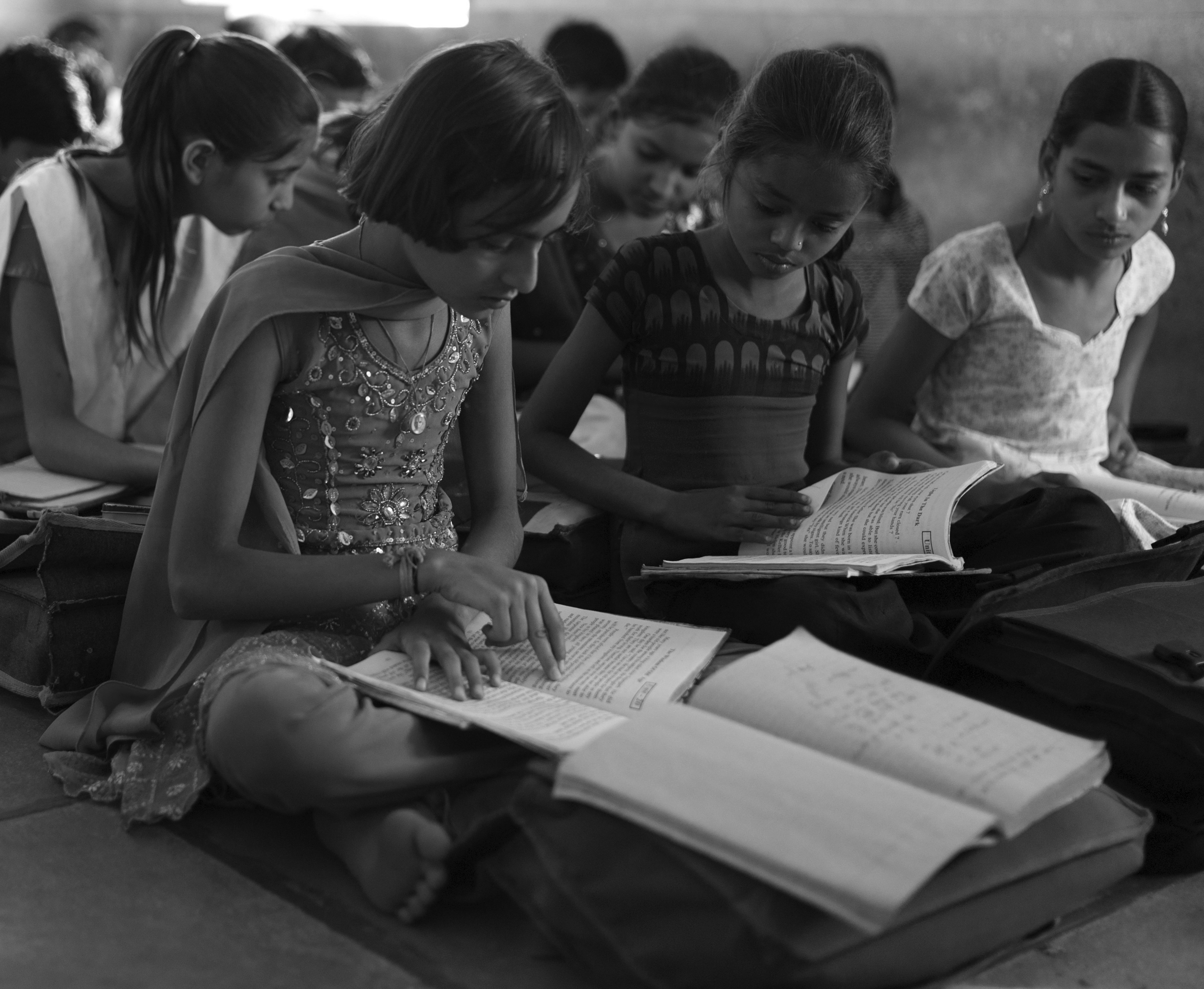
ABOVE: Children study textbooks at a school in rural Rajasthan, northern India
Credit: Rex / Tim Graham / Robert Harding
The battle over textbooks is not new: in the early 1990s, the then NDA government initiated a process of “saffronisation” of school curriculums, an attempt by Hindu right-wing thinkers to influence education curriculums. This trend was reversed over the last decade when the United Progressive Alliance was in power. But Irani’s recent statements may be the beginnings of a new battle. There is an overlap here between the demands of the Shiksha Bachao Andolan Samiti and the government’s own ideological leanings. Both believe that current curriculums need to develop education according to “Indian ideals and values”. The emphasis here is on moral conservatism and on India’s Hindu heritage. They want curriculums to have a historical slant towards revisionist interpretations that show Muslim rulers and Islamic tradition in a negative light, and Hindu rulers and traditions in a positive light, even if this means eliding the pernicious impact of caste or gender hierarchies.
The government announced that it would “Hinduise” the content of textbooks
Claims of “hurt religious sentiment” have emerged in recent years, often linked to the threat to public order. For instance, Wendy Doniger was accused of sexualising the portrayal of the Hindu religion. The other argument is that the content of school curriculums is too secular and ignores “indigenous” Indian, ie Hindu, streams of knowledge.
For those advocating a more liberal legal framework the deluge of legal claims around “hurt sentiments” has become a troublesome feature of the manner in which the Indian law has worked to limit speech. Examples of groups that have made these claims in the recent past include religious groups (Hindus, Muslims, Christians), caste groups (Lingayats, Dalits), occupation-based groups, which have strong caste associations (washer men, cobblers), and language groups (Oriya speakers). In a number of editorials in newspapers and magazines, India is now referred to as a “Republic of Hurt Sentiments”.
Successive Indian governments have responded to criticism of the law by citing the history of communal disturbances in the country, and conflict based on caste, religion, ethnicity and language, but the fact is they have chosen to regulate speech rather than provide protection to those speaking and expressing their views.
The courts in India have become an important battleground. For instance, in the Doniger case: after a two-year legal battle Doniger’s publishers, Penguin, came to an informal agreement with the petitioners, Shiksha Bachao Andolan Samiti. Penguin agreed to pulp recalled, unsold and withdrawn copies at its own cost, sparking international widespread outrage. Penguin, while defending their actions, has cited the Indian legal framework as one of the reasons for their action. The problem with the Indian legal framework, though, is not the law in itself.
The substantive law around “hurt sentiments” is situated mostly in three provisions of the Indian Penal Code; 153a (promoting enmity between different groups on grounds of religion, race, etc), 295a (deliberate and malicious acts intended to outrage religious feelings) and 298 (uttering words with deliberate intent to wound religious feelings).
Indian courts have held that the manner of discourse and nature and text of captions is significant. This can be illustrated by a case decided by the Supreme Court in 1980, concerning articles written by Babu Rao Patel. The court dealt with an allegation under section 153a related to two articles, A Tale of Two Communalisms and Lingering Disgrace of History in a magazine called Mother India. The petitioner was convicted under section 153a by the trial court, and the conviction was confirmed by the Sessions Court and the Delhi High Court. Babu Rao Patel claimed that A Tale of Two Communalisms was a political thesis and that Lingering Disgrace of History was based on historical truths against the naming of roads in Delhi after Mughal emperors. The court analysed both the articles. It said that the first article began as a political thesis but degenerated into hate speech. For instance, the author referred to Muslims generally as “a basically violent race” and alleged that communalism in India was an instrument of a minority with a racial tradition of rape, loot, violence and murder. The author proposed that the only solution to communalism was to declare India a Hindu State. The court said that this clearly amounted to hate speech, and was undisguised attempt to promote feelings of enmity and hatred between the Hindu and Muslim communities.
In a number of editorials, India is now referred to as a “Republic of Hurt Sentiments”
The court held that the second article dealt with much more than just the naming of Delhi’s road after Mughal emperors. Among the reasons that the authors argued that Delhi’s roads should be renamed were “the endless raids, rapes, loot, arson and slaughter” perpetuated by Muslims. In the article the author said, “To have a street named after this Mughal bastard in New Delhi, the capital of India, is not only a disgrace to the Hindus but a crying insult to the brave community of Sikhs.” The court held that it was wrong for the author to vilify Muslims, and to promote feelings of enmity, hatred and ill will between the Hindu and Muslim communities. The judgement said this could not be done under the guise of political thesis or historical truth.
Judges have recognised the freedom to express diverse viewpoints and freedom of creativity and art as long as the mode of delivery and the language used does not indicate a deliberate and malicious intention to hurt sentiments or outrage feelings.
Courts have also consistently held that academic material is highly protected unless the language used is crude or coarse. For example, the Bombay High Court decision, in 1982, where the Maharashtra state government forfeited copies of the Marathi weekly Shree for violating section 153a. The government argued that the article’s attempts to show that Arabian culture in pre-Islamic times were influenced by Indian culture would promote disharmony between Muslim and Hindu communities. The petitioners argued successfully that the author was a well-known research scholar and that the article was based on historical evidence, dealing with the religious, cultural and socio-historical background in west Asia before the advent of Islam.
At stake is not just the right to have access to information, but the way future generations view the world
The court held that while truthful and historical accounts are not completely exempt from the purview of 153a, scholarly articles stood on a different footing. The court said that it would be very difficult for it to hold that the narration of history could promote violence, enmity or hatred. The court said:
If such a contention is accepted, a day will come when that part of history which is unpalatable to a particular religion will have to be kept in cold storage on the pretext that the publication of such history would constitute an offence punishable under Section 153a of the IPC. We do not think that the scope of Section 153a can be enlarged to such an extent with a view to thwart history. For obvious reasons, history and historical events cannot be allowed to be looked as a secret on a specious plea that if the history is made known to a person who is interested to know the history, there is likelihood of someone else being hurt.
Ironically, the trend in India today has been for academic publishers to capitulate, instead of fighting their cases through the courts. The problem for publishers, and those at the receiving end of “hurt sentiment” claims, is that once courts agree to take on these cases, the time, money and effort that goes into fighting them within the legal system, is a form of punishment itself. An effective strategy for Batra and others has been to file these claims in small towns, where lower courts admit these matters. The accused is then summoned across the country, causing much inconvenience. This is possible because the cause of action can be the place of production, circulation or distribution of the offending material.
Initiatives to change the content of school textbooks, and to prevent the publication of academic material on the grounds of “hurt sentiment”, make this issue a serious threat to free expression. At stake is not just the right to have access to information, but the way future generations view the world. The courts have become an important site for this battle, and the arsenal of existing penal provisions are the weapons increasingly being brandished to enforce the writ of the religious right. This trend can only be stopped through a mobilisation of liberal voices, and by making sure that none of these changes happen without a fight.