




Abstract
Young journalists in Honduras are entering a profession where fear and corruption are the driving forces. Investigative reporter and human rights campaigner
Perhaps understandably, many young Honduran journalists don’t want to put themselves in danger. At current estimates by the National Commission of Human Rights, 40 journalists have been killed since the 2009 military coup, when the army ousted President Manuel Zelaya. Many young people are instead turning to celebrity journalism or gossip columns rather than seeking to engage with social issues or take on tough assignments.
When I was a student in mid-1980s and early 1990s, there was more optimism. I studied journalism and law together, and felt that you could do a lot of good in Honduras through journalism. Some of my contemporaries felt the same and also wanted to make a difference by covering the big issues. But after the coup, many of the most motivated and critical journalists were forced into hiding. The military shut down several TV stations, radio stations and newspapers. There was a climate of fear, fuelled by deaths and disappearances of those who disagreed with the military’s actions or demonstrated in favour of the ousted president. Later, when journalists returned to work, many chose to self-censor their work and keep a low profile. Some publications switched their whole editorial line.
Self-censorship has become a big problem in Honduras, and also a means for self-preservation. Many students have told me they wouldn’t touch certain issues because they fear the consequences. As a very vocal reporter on human rights issues, I have been threatened repeatedly, forced to move house and temporarily left the country. Recently, I have had suspicious characters following me, photographers taking pictures of members of my family and phone calls at home at night from someone threatening to beat me up if I “continue to mess around”. This happened just minutes after I posted a story on Facebook relating to the murder of a political activist.
I have also spoken to a lot of young journalists who feel that even if they wanted to make a difference, they’d have no outlets willing to publish them. When giving a talk on journalism, I remember once being approached by a student who said his self-esteem had been entirely worn down after a tutor told him he would have to bow to the will of media owners, instead of being able to challenge authority and write about he wanted. It was only when I explained how powerful media groups were not the only outlets and we could express ourselves by starting our own projects or working with existing online alternatives that he was encouraged. Soon afterwards, he told me he found renewed enthusiasm and was no longer considering quitting journalism.
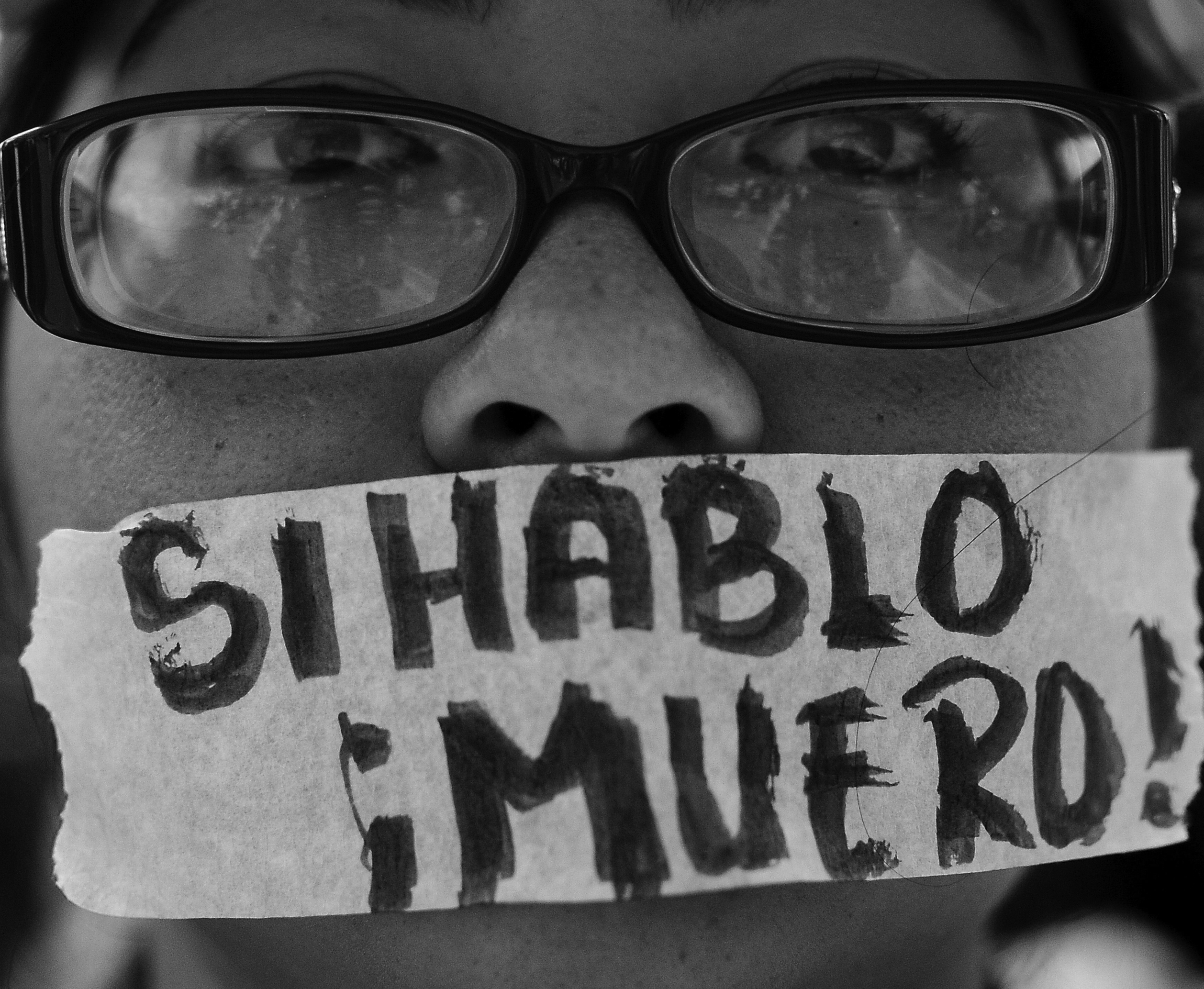
ABOVE: “I speak, I die” – a journalism student marching to demand an end to violence against the press, in Tegucigalpa, Honduras
Credit: EPA /Gustavo Amador
Many stories go unreported in Honduras. Journalists are seen off with threats or bought with bribes
If universities produce submissive journalists, it is certain beneficial to media owners. The biggest media companies have wealthy owners with multiple business interests – land ownership, the arms industry, fast food industry, medicine – many of which become off-limits for reporters. A young journalist might write a good, balanced story – maybe on the indigenous community affected by a hydroelectric plant – where they’d interview all sides. Yet the publication won’t publish it. I remember those days and how frustrating it was. When the first thing you do in the morning is see if your story has been published. Some never were.
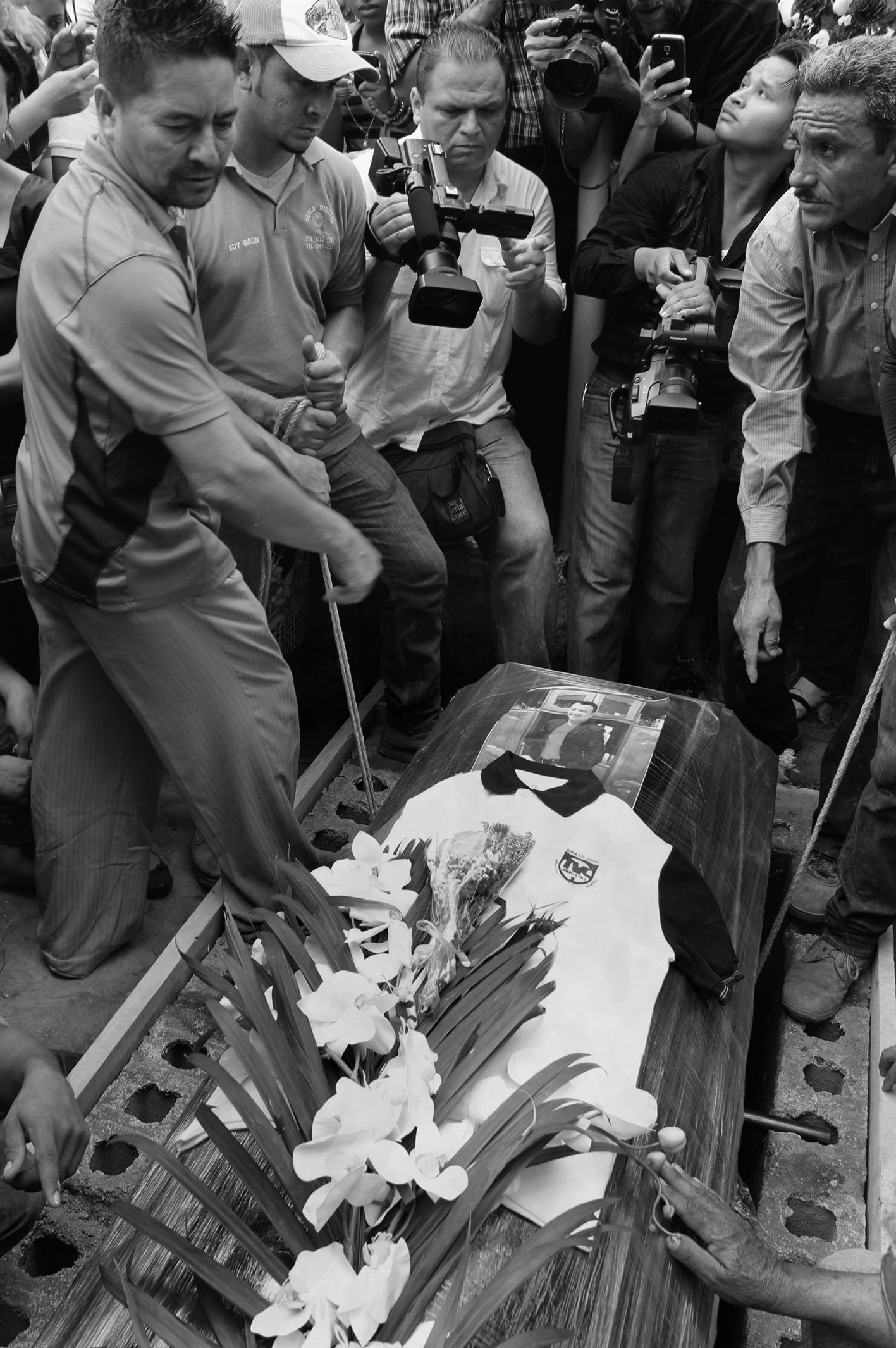
BELOW: Coffin of Honduran television journalist Herlyn Espinal, who was killed in July
Credit: Reuters
Many stories go unreported in Honduras; journalists are seen off with threats or bought with bribes. Young journalists might find they are offered payment from an official who uses public money to pay them for a flattering profile. With wages so low, it is so easy to succumb to corruption. Many publications also have to be careful of criticising the government as the media is heavily reliant on money from state advertising.
The foreign media offer few opportunities for budding locals. Some of the big international agencies are present in Honduras, including AFP and Reuters, but their vacancies are few and far between. And although some – such as Mexican news agency Notimex – can be quite challenging sometimes in its reporting, many correspondents, while not being officially censored by their companies, self-censor to stay out of trouble.
But some young journalists are experimenting with alternatives: using their own blogs, Facebook, Twitter. The student website Frusps.com brings together young people from different faculties, not just the journalism school. But there is no university-supported student newspaper to offer the students the chance to practise their skills and write freely, without media owners on their backs.
The National Autonomous University of Honduras has recently reformed its school of journalism, now the school of communication sciences. Students can now do a postgraduate in social media or radio technology. A move with the times, perhaps, but it does nothing to strengthen the development of investigative journalism.
Journalism students at this university attend ethics classes three times a week, but some students complain that the course is disconnected from the rest of their studies. There is a sense that the principles are presented as ideals, rather than practicalities that can be applied in the workplace. So, theoretically, they are taught to be balanced and honest in their reporting, while being reminded that the bottom line is that they need to be submissive to keep their jobs.
There are, of course, lecturers who are trying their best to motivate their students. One lecturer at the university, who requested to remain anonymous, says that more must be done to strengthen the social function of journalists: “Students today want to study journalism in order to appear on television or on radio, and are inclined to go for gossip and celebrity stuff, rather than journalism rooted in serious research.”
Investigative and news-orientated journalists in Honduras come under constant pressure. The elite wield the power, and much of the truth of what is going on in the country remains concealed. Haidy Carrasco, a 20-year-old journalism student, says: “Freedom of speech doesn’t exist if what you say affects the interests of powerful groups.” You’ll lose your job, or worse.
Freedom of expression and freedom to information are vital rights, connecting to and underpinning all other rights. In a country when there is little freedom of expression, there will inevitably be violence. The next generation is now taking the reins to direct the future of our nation’s journalism. They urgently need support.
Students are taught to be honest in their reporting, while being reminded that they need to be submissive to keep their jobs
Factfile: Honduras
(highest in world)
countries
(2013 estimate)
Sources: UN, Reporters Without Borders, Transparency International, CIA