




Abstract
“My collection probably still exists in some dark corner in a storage room in a military facility, where they bring those kinds of things,” Ataman told Index in the living room of his Istanbul apartment.
The apartment, which has a stunning view of the Bosphorus, has long been home to Turkey’s most controversial contemporary artist and has served as a hub for the leading curators and artists of Turkey’s burgeoning art scene. It was from here that Ataman watched thousands of protestors travelling to the quay in Karaköy in ferries, before they marched to Taksim, to join last year’s protests.
Ataman is a devoted socialist and activist. In the months preceding the 1980 military coup which led to the ruthless dictator Kenan Evren taking over, Ataman was physically tortured and sent to a military hospital where he “was retrained to become a Turkish nationalist”. He described how he was forced to recite the now defunct national oath during his imprisonment.
A few days before our interview, Evren was finally sentenced to life imprisonment following a trial in a criminal court, some 34 years after taking the reins of the country from democratically elected politicians. For Ataman the wounds of Evren’s coup, which changed his life forever, are still fresh. He sees a parallel between the atmosphere of 1980 and the outpouring of energy during last year’s demonstrations.
“On the one side there is this culture which says the state can do whatever it likes. On the other side, there are people who are so much oppressed that they just enjoy going to the streets to shout ‘Enough!’ I kind of understand that.”
In the post-coup days, public expressions of dissent like organising public meetings or publishing publications critical of the official ideology, were strictly prohibited. In order to save him, Ataman’s family bribed state officials to let him leave the country. “I didn’t really have a say in my future because I was the guilty one bringing all this unhappiness on my family,” he recounted. His parents told him to go as far as possible. So he went to the USA and graduated from the University of California, Los Angeles with a Master’s degree in fine arts in 1988.
While he was there he continued to be involved in campaigning. “I had been heavily involved in the gay rights movement. It was the times of the Aids crisis and I was part of an activist group called Act Up. I was able to join all their political meetings and was involved in extremely creative acts of discontent. I got into film-making and helped organise gay film festivals. Having done all of that, when I came back to Turkey, it was just normal for me to continue being the person I had become in the States.”
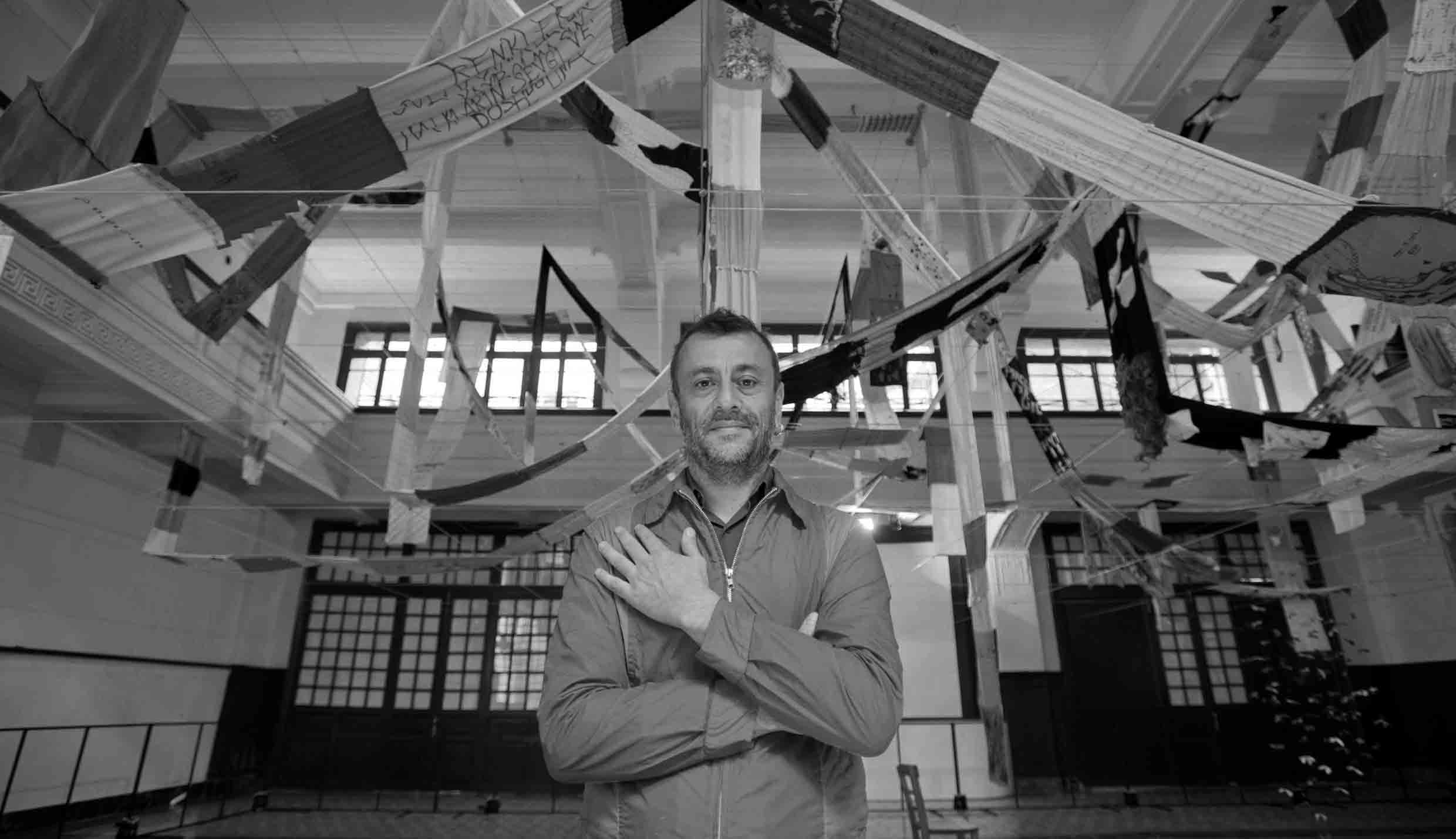
ABOVE: Turkish artist Kutluğ Ataman at his exhibit for the 18th Istanbul Theatre Festival
Credit: Muhsin Akgün
He returned to his homeland in 1994, at the age of 33. In the 20 years that followed, his films and installations have brought him fame as well as notoriety. Ataman’s first film, The Serpent’s Tale, was a gothic story, based in Istanbul. His 1999 film, Lola and Billy the Kid, about a 17-year-old Turk’s discovery of his homosexuality while living in Germany, won the Special Jury Prize at the Berlin International Film Festival (Berlinale). For his next project, Ataman adapted feminist Turkish author Perihan Mağden’s novel Two Girls, and cast Hülya Avşar, the leading Turkish film star, in an important role. In 2009 he directed The Journey to the Moon, a mockumentary about an imaginary journey to the moon from a Turkish mosque in 1950s Erzincan. Screened at the BFI 53rd London Film Festival, the film featured real interviews about its imaginary subject matter with Turkey’s leading intellectuals.
“I didn’t have any problem with authorities upon my arrival in Turkey,” Ataman said. “And yet people were always telling me: ‘Oh you are so courageous, you are so great.’ I never understood that. Yes, I had made the first openly gay film in Turkey, I was outspoken against seeing Atatürk statues everywhere, I was really critical of the state ideology… but I never really understood why people always called me courageous. I felt that freedom to express myself was already there.”
Ataman was physically tortured and sent to a military hospital where he “was retrained to become a Turkish nationalist”
Four years into his new Turkish existence, things took a different turn. In 1997, the military attempted to engineer social and political life through the so-called 28 February post-modern coup.
“I learned about what had gone on during the post-modern coup later and I was scared,” Ataman said. “At the time I was working on a video called Women Who Wear Wigs.”
In the film a cancer survivor, a Muslim activist, a transsexual and a revolutionary, who all wear wigs for different reasons, tell their personal stories of how they have been affected by state ideology. “Had I known what I know today about what had been going on in that period, perhaps I would be scared to film it.”
Ataman had made his entry into the art world in the year of the post-modern coup, with his documentary film about Semiha Berksoy, the famous Turkish opera diva. In Semiha B. Unplugged, the iconic singer talks to the camera continuously for eight hours. Following this film’s success, Ataman redefined himself as a video artist and participated in the 48th Venice Biennale with Women Who Wear Wigs.
During Gezi Park he argued that the protests had been hijacked by ultra-nationalists, and warned against a return to darker times
“I was in the beginning of my career. With all their manipulations the military could have easily destroyed it, had they chosen to,” he said. “Maybe today it would make news abroad but back then I had completely no shell, nothing to protect me. I had beginners’ luck. I always felt that there were pockets of freedom back then. There were other areas you knew not to be so free. One of those pockets of freedom for us was the Istanbul Biennal. I always made sure that I created my most controversial works during the Biennal. I thought that if they wanted to do something they were not going to do it in front of the Europeans and foreigners.”
In 2011 Ataman exhibited the health certificate he was issued by a Turkish Military Hospital about his “military status” and which showed his “unsuitability” for the army. It reads: “Self-care: good. Disposition: calm. Sociability: respectful. Speech: effeminate. Tone of voice: effeminate… Fails to show interest in women, shows interest in men.”
“When I made my first application to the ministry of culture to get backing for a film project, some people from the film industry said ‘Oh, he is a homosexual, he is not good for our country,’ blah blah,” said Ataman. “Professional people badmouthed me. They were horrible. They made sure that I didn’t get any backing from the ministry. Those kinds of things I learned from the press, with everyone else.”
During the noughties, Ataman argued that the expansion of the art scene and more funding for artists would result in more freedoms. “The market expanded but sometimes it hit no-go areas. For example, some Marmara University professors wanted to sue me because of my work in the Biennial. A lot of westerners automatically assume that this kind of censorship and oppression comes from Islamists. Personally, I never had that kind of censorship from them. But obviously, that doesn’t mean that this kind of censorship doesn’t exist. It’s just that I personally never had it.”
Ataman’s international prestige increased with new video installations, Mesopotamian Dramaturges and Küba, which were screened in prestigious galleries, including The Serpentine in London and the Museum of Contemporary Art in Sydney. In 2003 UK newspaper The Observer picked Ataman as the best and brightest artist of the year.
But 11 years after being named a young bright artist, Ataman seems bored with the machinations of the art world, and says he wants to go back to making films. Warning against a new system of censorship, one that is created by financiers and capitalists who control the art world with cunning new methods, Ataman said: “Their methods of control are more dangerous to me than the crude state control of my youth. What happened then was that the state came, took your work and burnt it. It was all factual: you could prove it, but in the new liberal system the censorship is done in a much more efficient way. They make it so that the channels of production are cut from the very source. They control you with financing. Market economy, basically.” In short, he has become a critic of the liberal market economy which he once believed would save the art world.
During last year’s Gezi protests, Ataman was invited to become a member of a conciliatory committee, where a group of artists, intellectuals and actors attempted to negotiate a peace between protestors and the government. On national TV he argued that the protests were hijacked by ultra-nationalists, and warned against a return to darker times. Ataman’s words created outrage among protestors, who accused him of selling out to the system.
“When you see people getting killed on the streets, I say: ‘get the fuck out of here’,” Ataman said. “I am not going to support you any more… People are getting killed, so go home, sit down. I get angry with both sides.” He complained about the polarising discourse of the last year, which he said “united the whites and blacks who ended up attacking the people in the centre”, the grey area where he sees himself, and where “people have the debate”. He went on: “The fascists of the left and the right, they want to destroy the real workers, which is the position I occupy.”Ataman’s stance, and his support of it through his Twitter account, resulted in a kind of excommunication from the art world, which was united in its support for the protests.
“I was already switching from the art world back to my film-making. So it was a welcome break from the self-replicating art world. Sometimes the universe works in very amazing ways. Just look at the state of the art world since Gezi, since I have been out. Nothing is happening. The bubble has collapsed. The last Biennial was [dubbed] the worst Biennial ever. How can you come up with a Biennial like this after Gezi? It was the biggest betrayal.”
Ataman has come full circle to his film-making. He was back this February at the Berlinale premiering his new film, Lamb, about village life in one of Turkey’s poorest communities. The film will also be shown at the 58th BFI London Film Festival, which runs from 8 to 19 October this month.
“I have done what can be done in Turkey,” Ataman said. “I had shows in the Istanbul Modern, Sabancı and Arter. There is nothing else to do here. Even if I become the toast of town it doesn’t matter because I have done everything. I don’t have any immediate plans for this country. I am just a tourist again.”
