




Abstract

The Ecuadorian government is accused of using a Spanish legal firm to employ copyright laws and get critical posts removed from Twitter, Facebook and YouTube.
The 34-year-old Ecuadorean translator signed up to the social network in 2011 to join an online campaign against the government’s plans to allow mining in an environmentally sensitive area. Little did she know that some of her sarcastic political tweets would eventually get her into trouble.
In early 2014, Spanish law firm Ares Rights contacted Twitter to demand it removed content from Amores’s account for infringing copyright laws. The firm appears to have been acting on behalf of Ecuador’s governing party.
As a result, the account, @diana_amores, was temporarily suspended. Amores was surprised, but also outraged: she appealed and her account was soon activated again. “I am not a hero, but I was not going to stay quiet,” she told Index on Censorship. “This was a clear abuse of the copyright law.”
Amores is one of many internet users who have been targeted by Ares Rights, which contacts websites insisting content is taken down under a US law, the Digital Millennium Copyright Act (DMCA). The firm has asked for documentaries, tweets and search results to be removed from the web, saying they are infringing copyright.
The DMCA, approved by the US Congress in 1998, was designed to modernise copyright law for the internet era. The act allows for takedown requests to be sent to websites publishing material that infringes copyright. Most sites receiving takedown requests react by automatically removing content to avoid any legal problems. If uploaders file a successful counter-notice, as Amores did, the material can be put back online.
In theory DMCA notices are a quick and hassle-free way to protect copyright – but in practice they can be misused.
“In the wrong hands, the DMCA can be used for temporary censorship,” says Adam Holland, a project coordinator at Harvard University’s Berkman Center for Internet and Society. Holland also works with the Chilling Effect database, an online archive started in 2001 to keep track of takedown notices. Chilling Effect researches how DMCA notices are being used to censor material.
Big companies such as Google, YouTube and Twitter receive huge numbers of notices every day. Twitter gets about 1,000 per month, Google close to seven million. Holland argues that the incentive to verify whether all those notices are legitimate is small. Firms such as Ares Rights have many clients who are willing to pay them to monitor internet activity and send notices.
In Ecuador, Ares Rights is alleged to have acted on behalf of the Alianza PAIS governing party, EcuadorTV (the state-run television station) and even President Rafael Correa.
ABOVE: Ecuador’s president, Rafael Correa, awaits a press conference. Correa has successfully pursued several libel lawsuits against the media
Credit: DPA Picture Alliance / Alamy
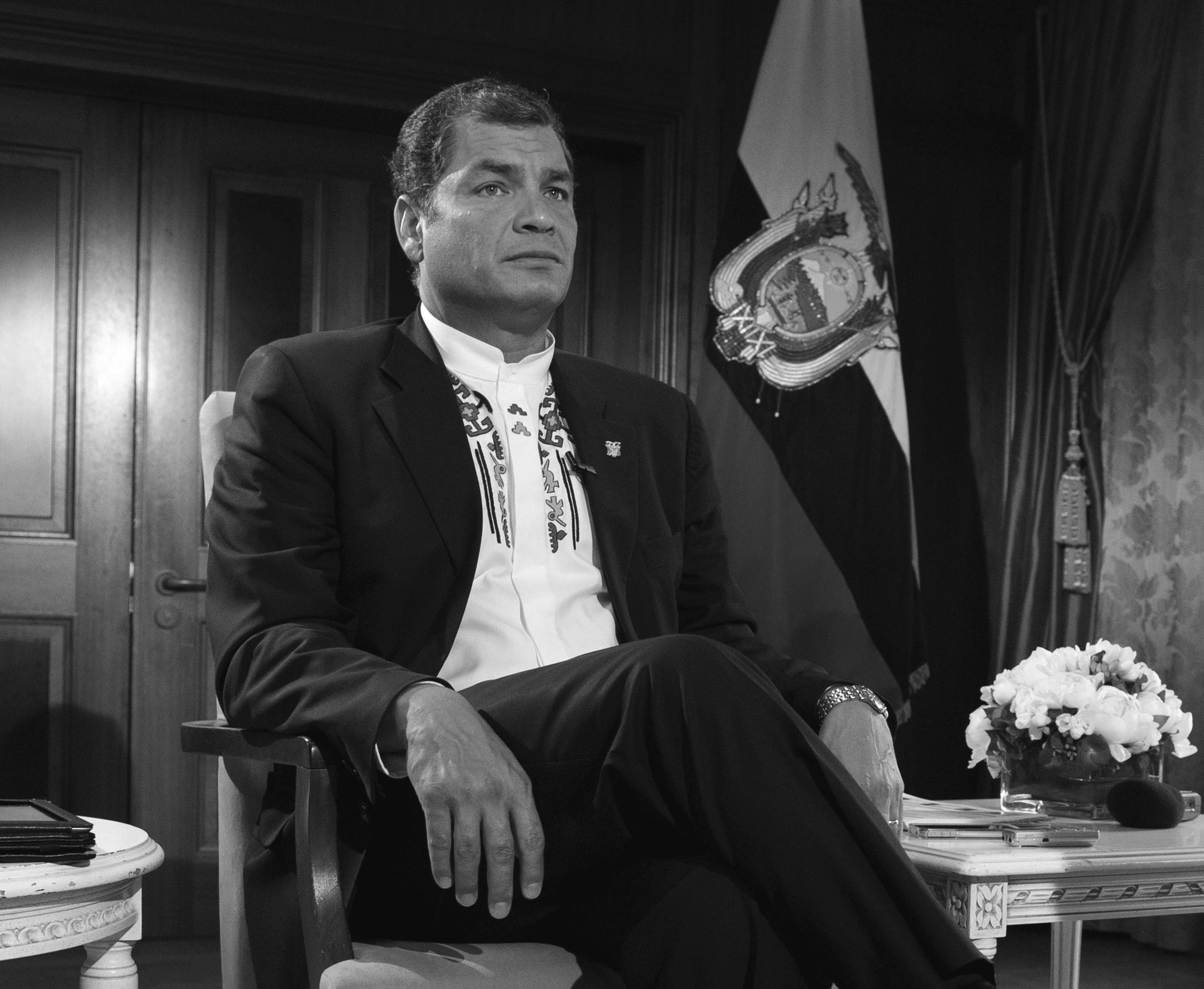
Since coming into power in 2007, Correa has attracted international criticism for his treatment of media. He has been accused of double standards – granting Wikileaks founder Julian Assange asylum in the Ecuadorean embassy in London but clamping down on freedom of speech at home.
Correa has successfully pursued several lawsuits against local private media for libel and regularly insults reporters, calling them bestias salvajes and sicarios de tinta (“wild beasts” and “ink hitmen”). He regularly insists, in his weekly Citizen Link television show, that he is fighting against powerful elites with strong economic interests, who have traditionally been represented by private media in Ecuador.
In 2013, the National Assembly approved a communications law, which created a state watchdog to regulate newspaper and television content. The government said this was a step toward more balanced media. “The law is there to create a good press, good information, true freedom of expression, to make sure that the corrupt press doesn’t make up something new every day – that is lying and manipulating,” explained Correa in one of his weekly addresses. Journalists said it was a blow to free speech. Two media outlets were sued for their coverage of a trip Correa made to Chile and a cartoonist was ordered to modify the text on his image. Other aspects of the law have been praised. For example, the law fairly distributes broadcast frequencies: 34% to state broadcasters, 33% to private media and 33% to community broadcasting, thus allowing for what many consider media pluralism.
Many Ecuadorian editors have said that self-censorship has become one of the main results of the new law. On World Press Freedom Day, 3 May, media outlets abstained from republishing an illustration created by the World Association of Newspapers and News Publishers criticising Correa for his stance against the media. Ecuadorean editors published only images created by the association related to China and Ethiopia.
According to Chilling Effect, Ares Rights has been active since 2010. Last year, the company sent a DMCA notice to get confidential documents removed from online library Scribd.com, the online library. The documents had been posted by a reporter from Buzzfeed.com, who had revealed that the Ecuadorean government had purchased equipment to carry out large-scale domestic surveillance. Although the ministry of the interior said the documents were fake, Ares Rights sent DMCA notices. Once the documents were taken off Scribd and uploaded on Dropbox, Ares Rights sent a new notification. Buzzfeed sent a counter-notice, and the files were put back online.
Ares Rights also successfully removed an anti-mining video by Ecuadorean filmmaker Pocho Álvarez, Acoso a Intag (Intimidation in Intag), which showed Correa’s insults – broadcast on national television – against the people of Intag, a town that fought against mining in its biodiverse area, as well as an anti-government short film called Cómo Miente el Presidente de la República (How the President of the Republic Lies). Another critical documentary, Rafael Correa: Retrato de un Padre de la Patria (Rafael Correa: Portrait of a Father of the Motherland), by Colombian filmmaker Santiago Villa, was also taken down from YouTube. Acoso a Intag and Rafael Correa: Retrato de un Padre de la Patria were later reinstated.
Claiming to be acting on behalf of Correa, Ares Rights sent a notice to Twitter regarding a posted picture where Correa is seen next to a woman during a party. The notice says the takedown is “extremely urgent”, because it concerns “distribution of images of the private sphere of our client”.
Twitter gets about 1,000 takedown requests per month from around the world; Google gets close to seven million
Ares Rights is based in Barcelona, but few details are available about its work. The company’s website links to Twitter and Facebook profiles with little activity and few followers. There is a Vimeo video posted on its main page. “Piracy control in real time,” says the video. “Transparent, clean, fast, safe, without lawsuits, simple strategy to monitor websites.”
During an investigative series for Ecuador’s El Universo newspaper, journalist Mónica Almeida tried to contact the company but found none of the company’s registered details led anywhere. Index on Censorship also tried to contact the company via social networks but received no reply. In its transparency report about the firm, Google states: “We believe it is an impostor or someone who is abusing the process. We report this action here to guarantee completeness and show one of the types of abuse of the DMCA process.” Google, which owns YouTube, told Index that it is working “to detect and reject invalid takedown requests”, adding that the work done by NGOs and the media is currently hugely beneficial for informing on the misuse of copyright claims.
Amores first received a DMCA notice in 2013 on her YouTube channel, where she had uploaded a copy of an anti-mining video by Ecuadorean filmmaker Pocho Álvarez. She paid little attention to these notices, as the video was available on several other sites.
In February 2014, as Ecuadoreans geared up for municipal elections, Amores posted a collage of pictures of local candidates with President Correa, who had previously said he was “happily not running for any post”. In her sarcastic tweet, Amores said: “Hmm… Who is this guy who appears in all these pictures?” In another post, Amores reproduced the electoral publicity of another local candidate.
She received takedown notices for both tweets. They were sent by Ares Rights on behalf of Movimiento Alianza PAIS, Ecuador’s government party. She appealed and her tweets were put back online. But Ares Rights sent a new notice a month later for using the image of another politician, Fernando Cordero, former president of the National Assembly and former head of the country’s pensions system. A fourth notice arrived in connection to her republishing an open letter by Correa.
After this fourth notice, her account was suspended. Amores created a new account, reported what had happened on the social network and appealed. It took 24 hours until her account was reactivated.
Twitter also took down another image she had posted poking fun at the president’s weekly Saturday address. The copyright claim was over the official government logo that was used with a video still from the Simpsons cartoon show. This time Ares Rights filed a complaint on behalf of EcuadorTV, the state TV channel that broadcasts the show. She never received a notice for this takedown, so the image remains blocked. Index asked Twitter to comment but received no reply.
After leaving his position as CEO for Ecuador’s state broadcaster in April 2014, Enrique Arosemena denied any relation with Ares Rights. “To be very clear, EcuadorTV has no relation with Ares Rights. It has signed no contract.” Mónica Almeida of El Universo tried to contact several government officials but received no answer. Index on Censorship also asked Ecuador’s national secretary of communications, Fernando Alvarado, for an interview. Alvarado is in charge of the government’s communications strategy, as well as all national broadcasters, and is one of the main advisers to the president. In an email, Alvarado’s press secretary, Mariana Bravo, said: “The national secretary of communications expresses his thanks for the request, but is not interested in the interview.”
“The situation is very critical,” says Cesar Ricaurte, director of the Ecuadorean NGO Fundamedios. Ricaurte says that since the law was approved, two printed publications have shut down, there have been more than 100 proceedings against media and more than 30 prosecutions, including one against a cartoonist. “Facing the closing down of spaces for expression within traditional media, social networks acquire a growing importance in Ecuador,” says Ricaurte.
Amores agrees. She was once a supporter of Correa: in 2006, she voted for him, thinking he might be able to bring about significant change. But now she believes it was a mistake. “Social networks have become the last bastion of true freedom of expression in Ecuador,” she says. “I have few followers and my account has little impact. How uneasy does the government feel about criticism if they go after people like me?”