




Abstract
Shortages of newsprint in Venezuela have forced newspapers to close, but online media are expanding fast to fill the gaps and bring the public the latest news.
Venezuela has had paper shortages for the past two years. In 2013, 10 newspapers closed. Many more have shrunk in size. But digital news is taking up the slack.
Many newspapers have had to reassess their plans. El Correo del Caroni went from 32 pages to eight pages. El Nacional reduced its news coverage, cut its culture, sports sections, magazines and literary supplement. Even the pro-government Diario Vea announced several times that it was doomed (although it was later saved).
The internet has become the place where information from all over the country flows most freely and spontaneously. In Venezuela – a country of 29 million inhabitants – the internet reaches only 54 per cent of the population, but there has been a big growth in digital entrepreneurs as people try to attract new users. New sites include Poderopedia.org, launched in June by a disgruntled print journalist to investigate the links between politicians, business people and military officials.
SIC, the country’s oldest magazine, run by a Jesuit political centre in Caracas, has decided to print at a loss this year as it works on a digitisation strategy. The magazine also has the challenge of trying to lure its subscribers (with an average age of 56) online. The key difference between Venezuela’s media landscape and the rest of the world is that when people talk about the end of print journalism elsewhere, it is normally a discussion about changing technology; in Venezuela, it’s different. The migration to digital platforms in Venezuela is a means of offsetting a crisis from a lack of physical paper.
It was Andiarios, a non-profit media organistaion from Colombia that saved El Impulso, by stepping in with an emergency paper delivery. “This allowed us to print for another month,” says Carlos Eduardo Carmona, the newspaper’s president. “We are still surviving day-by-day. Media managers feel like firefighters here, constantly controlling emergencies.”
Inflation in Venezuela was already crippling (60 per cent was the official rate in 2013). But between June 2013 and January 2014, the cost of printing in Venezuela increased by 460 per cent.
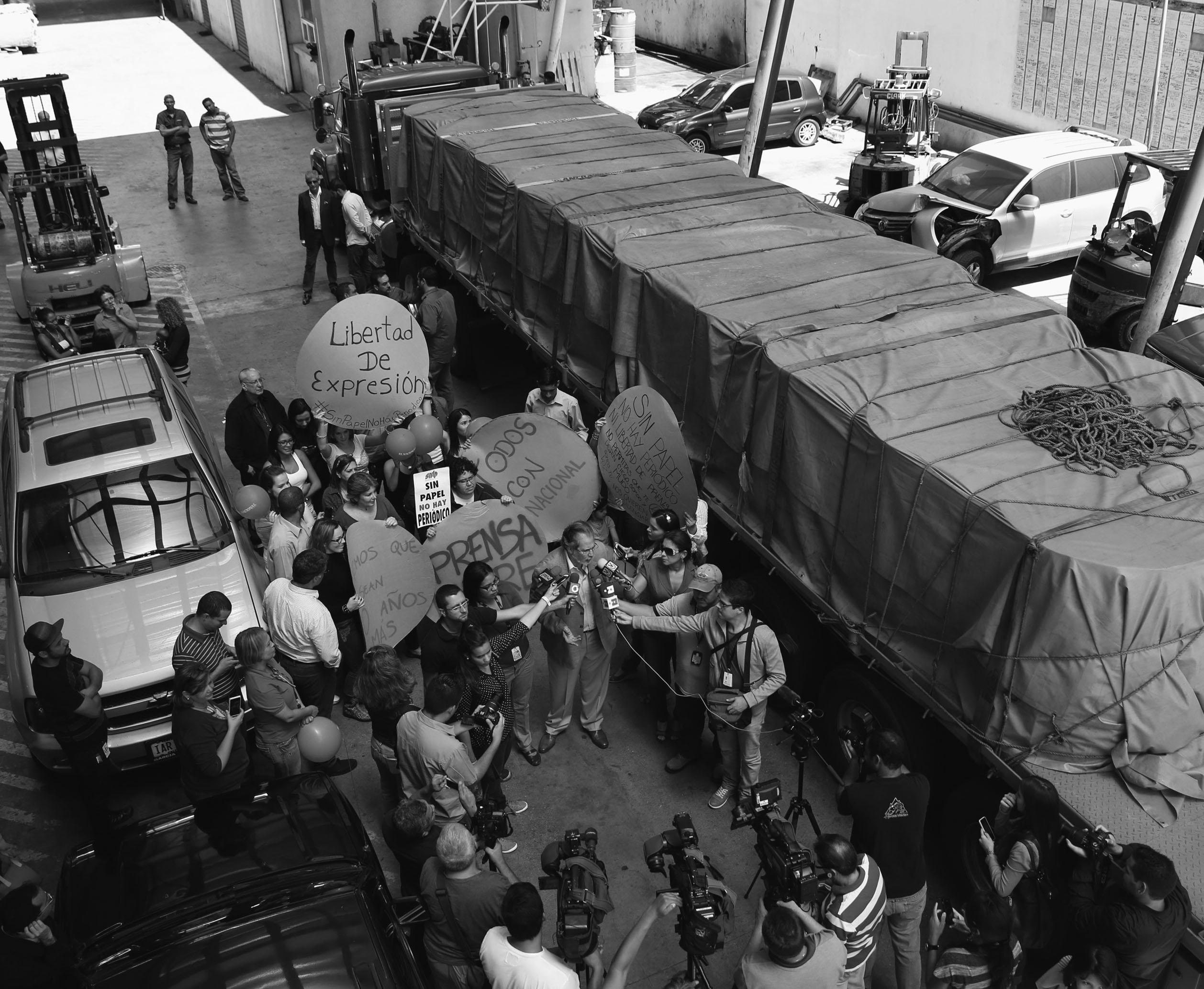
ABOVE: Miguel Henrique Otero, president of El Nacional, talks to the media in front of a truck loaded with paper supplies at the newspaper’s building in Caracas in April 2014. Demonstrators hold placards calling for the protection of a free press and free speech
Credit: Reuters/Carlos Garcia Rawlins
The paper shortage is just one of many peculiarities of Venezuela. The oil-dependent economy has built a state with a chronic weakness at its heart. Little is produced domestically; almost everything is imported – including medicines, basic foods and car parts. And these products can’t be bought freely on the international market. All purchases have to go through the state – which creates a highly complicated system that leads to shortages.
In 2013, 10 newspapers closed and many more have shrunk in size
A law on foreign exchange was passed by ex-president Hugo Chavez in 2003, meaning that only the government could administer the buying and selling of dollars. The government also has a list of priority goods for which it will grant dollars. But in August 2012, it decided to remove paper from the list, increasing the costs and the complications for anyone trying to import it.
The effect was not really felt until a year later, when it became apparent that paper supplies had dried up and a national toilet-paper shortage made international headlines. The damage to the newspaper industry, however, was long-lasting. The country’s big newspapers reduced their pagination over the following six months, getting rid of whole sections and inserts.
Though the crisis really started with the government’s 2012 decision, it was exacerbated by a succession of protests that began in February 2014. A series of youth demonstrations demanding the resignation of the government quickly escalated into violent clashes, in which 42 people died and more than 3,000 were arrested. In the weeks leading up to the protests, there were demonstrations by journalists and journalism students in Caracas, Barquisimeto and Ciudad Guayana, with an accompanying social media campaign. The Bloque de Prensa, an editors’ alliance, estimated that there was a debt of at least US$15 million owed to suppliers.
The government responded by centralising paper purchasing, one day before the main protest. As a result, there is now only one entity that’s authorised to buy paper from overseas – and all the newspapers and the country’s editorial industry relies on it for their supplies.
Carmona, from El Impulso, says the state’s paper supplier meets only half the paper’s needs. Unlike other papers, he hasn’t yet been pressured to change his oppositional editorial stance, but the size of the paper has shrunk, from 48 pages to 12 or 16. “We do not want to close, but neither do we want to be part of a Pyrrhic media with a limited presence. I no longer have space for reportage. We have cut out information, decreased the font size and line spacing. We have fewer photos. The news is telegraphic and worse quality. But at least we’re still running.”
Official statistics on dollar purchases from January to April 2014 reveal that US $7.41 million was approved for paper for the media. And 85 per cent of this amount ($ 6.3 million) was intended for Últimas Noticias, the newspaper with the biggest circulation in the country, which was bought in 2013 with capital linked to the national government. After the buyout, Últimas Noticias changed in its editorial stance to favour the government. Many of its main journalists have since either quit in protest or been fired.
Miguel Henrique Otero is editor-in-chief of El Nacional, currently the only oppositional newspaper in Caracas, after El Universal was sold in July. He says: “The government knows perfectly well what the newspapers’ needs are. They know they approved currency to buy paper, yet they don’t pay out for unknown reasons, which one assumes are political. All they need to do is buy a media network, one that bows down to them, so that the money starts to flow.”
Mariaengracia Chirinos, a communications researcher and a member of Venezuela’s Press and Society Institute, believes the shortage of paper affects the readers more than the companies: “Information now comes in half-measures. It has to resort to other spaces and self-publishing, which is sometimes a good thing, but when it is a response to restrictions, it can also affect the citizen’s ability to choose where they get their information from.”
We have cut out information. The news is telegraphic and worse quality
Polarisation have been strong in Venezuela since the coup d’etat of 2002, but the last election in 2013, after the death of divisive leader Hugo Chavez, further increased the frustration of opposition activists because they disputed the result (the margin of victory for Nicolás Maduro being just being 1.49 per cent). Fernando Giuliani, a social psychologist, says: “Polarisation is so strong that state media do not have any room for opposition issues, either in news or in opinion. We have broken bridges and now there is no more room for dialogue.”
How Venezuela’s economy works
A law controlling currency exchange was set up by then-president Hugo Chavez in 2003, meaning that only the government can administer the buying and selling of dollars because they come from the state-owned oil industry. It was intended to avoid capital flight and to control the prices of food staples. By maintaining dollars at a subsidised price, it is cheaper to import products than to produce them in the country.
Currently Venezuela has four exchange rates: the Tasa Cencoex at 6,30 bolívares to the dollar (for state imports only); the Tasa Sicad 1 at 10 bolívares to the dollar (in state-controlled sales for companies); the Tasa Sicad 2 at 50 bolívares to the dollar (in state-controlled sales for citizens); and the black market rate, from 65 to 80 bolívares to the dollar – an unofficial, illegal rate that is nevertheless common on the streets. The state has tried to centralise all the economic variables, but it hasn’t gone well.
What Venezuela needs most is the establishment of information channels that are both reliable and successful in increasing public loyalty. For the Venezuelan media, it’s more about quantity of readers than quality of content, because costs are too high. Today every digital user in the country is left navigating the complex media scene by themselves, working out how to process information and working their way through a hierarchy of networks. What we have is not enough to know about all that’s going on, but it is empowering citizens to make choices for themselves.