




Abstract

Russian radio station Echo of Moscow is one of the last bastions of a free media not toeing Putin’s line.
“There are attempts to influence us, hints that we should ‘put that on’ or ‘take that off’,” he says. “We may sack a journalist ourselves but if the suggestion comes from outside, never! I’ve heard Alexei Venediktov, the editor, say, ‘I’d sack that fellow but Vyacheslav Volodin [of the presidential administration] wants me to so I can’t.’ It’s a matter of principle.”
Buntman receives me in his book-lined office. On the door is a street sign reading “Old Trafford: Sir Matt Busby Way”, a nod to the Manchester United manager who was his childhood hero. “Can I break the law?” he asks, as he lights up his pipe in violation of Russia’s new anti-smoking rules.
I’m seeing Buntman rather than Venediktov because Echo has said its famous, crazy-haired editor-in-chief doesn’t meet the foreign press. Asked why, the mustachioed French-speaking Buntman says it’s nothing sinister, just a “division of labour”. Buntman, who started out as an announcer on Soviet radio, co-founded Echo together with its first editor Sergei Korzun in 1990.
These men are not dissidents, just journalists dedicated to professional principles of objectivity and balance. But in President Vladimir Putin’s Russia, where almost all the media spout state propaganda, that position looks like radical nonconformity, and it seems a wonder that Echo survives.
There are various theories as to how Echo gets away with it. Some say the radio and associated website, with a following of nearly one million in Moscow and three million in the regions, is tolerated because it allows the intelligentsia to let off steam, with little impact on the rest of the TV-watching country. Others say it allows the Kremlin to argue to the world that free speech is not dead in Russia. And one theory has it that Kremlin staff themselves depend on Echo to be properly informed because they can’t rely on their own propaganda.
Buntman has another explanation. “It’s no miracle and no wonder,” he says. “You’d be surprised but a lot actually depends on us. Many journalists just give in too soon; they give up at the first hurdle.”
Does he mean they engage in self-censorship? “No, they take up a political position; they do this themselves. It’s professional suicide, of course. You can’t present yourself as a journalist and then do propaganda. There is pressure but to get killed as a journalist, you’ve really got to earn that. Not everyone is granted the fate of a Politkovskaya.”
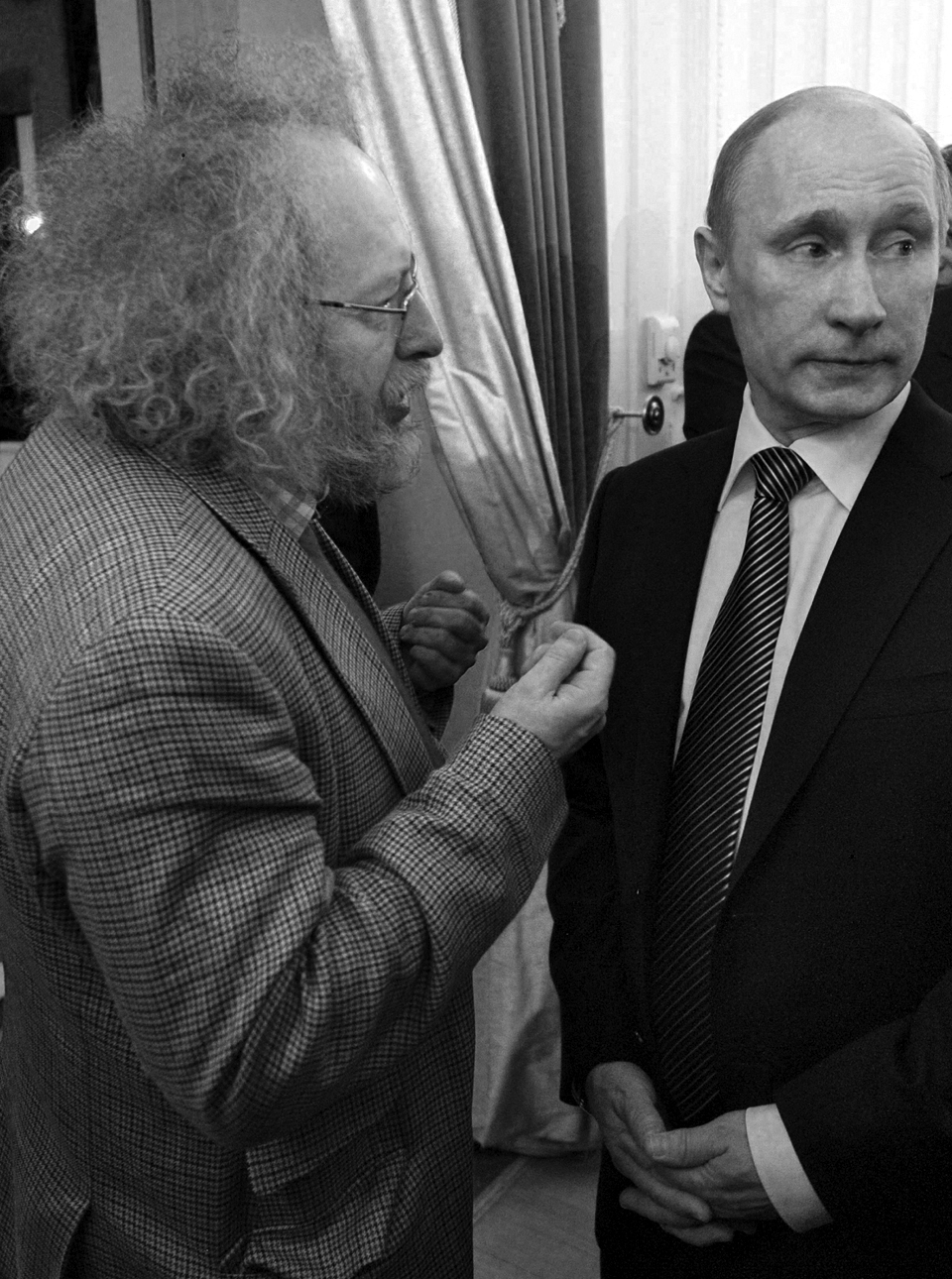
ABOVE: Editor-in-chief of Echo of Moscow, Alexei Venediktov, speaks with Putin during the 2012 Russian Print Media Awards ceremony
Credit: REX/Kommersant Photo Agency
The journalist Anna Politkovskaya was shot dead in the stairwell of the block of flats where she lived on 7 October 2006. She investigated killings and disappearances in Chechnya for the newspaper Novaya Gazeta, the most robust of the Russian print media. There is also the opposition-friendly internet TV channel Dozhd (Rain), which gave a platform to two feminists from Pussy Riot on their release from jail. But all the major TV channels, from which the majority of Russians get their news, promote the president’s policies and views.
One theory is that Kremlin staff depend on Echo for information because they can’t rely on their own propaganda
It was not always thus. The decade of Boris Yeltsin’s rule may have been difficult and turbulent, but the free media flourished and Russia produced some very fine journalism. In the 1990s, NTV stood out for its inquiring spirit, which makes it all the sadder that the channel now specialises in hatchet-job “documentaries” about Kremlin critics. Some former NTV journalists have found asylum at Echo, in which Gazprom Media holds a 66 per cent stake and journalists 34 per cent.
According to Buntman, a generation of Russian journalists has been virtually lost, so the station hires young reporters and trains them to the highest standards.
“A reporter never invents and never conceals,” he says. “In the 1990s, we drew up a charter of journalists’ ethics – you can’t be a journalist and a party member, you can’t have a conflict of interest, all that sort of thing. And everyone at Echo signs this charter when they sign a contract to work for us.”
Balance, balance and again balance is the Echo mantra. Buntman remembers that in 1991, the year of the hardline coup against Mikhail Gorbachev, the editors were upset because they couldn’t get a comment from the GKChP, the junta that briefly seized power, to balance all the views coming from the democratic side.” We invite everyone to speak on Echo,” he says. “We invite Sergei Markov [a pro-Kremlin political analyst]. We know he’ll talk rubbish. Let him talk rubbish; I won’t moderate him.”
During the crisis over Ukraine, Echo has ruffled feathers both in Moscow and Kiev by airing the full gamut of opinions and refusing to take sides. Its reporting of the tragic fire in Odessa on 2 May, when over 40 people, mainly pro-Russian activists, were burnt to death inside the city’s trade union building, stood out in contrast to the tendentious coverage of Russian and Ukrainian media. It appears both sides threw Molotov cocktails and how exactly the fire started is still to be established.
“We were suspicious that the fire was hardly over before one side was blaming ‘Russian provocateurs’ and the other was pointing the finger at Pravy Sektor (a Ukrainian nationalist group),” says Buntman. “ There was a fire; that was a fact. We dispatched three reporters to try to piece together, millimetre by millimetre, what happened. We still only have preliminary conclusions.”
Likewise, Buntman says, only international criminal experts will be able to apportion blame in the deaths of some 100 people, killed by snipers in Maidan (Independence Square), Kiev, in February.
And what about the 1999 apartment block bombings in Moscow? “Yes,” says Buntman, “questions, questions, questions. Journalists should have questions, not premature answers.”
Covering Ukraine, Echo is careful in its choice of language, says Buntman. “Do we call the pro-Russians ‘separatists’? Yes, because they want to break away. ‘Militias?’ Yes, because they are irregular armed forces. Those terms are not coloured either way. But for the word ‘terrorist’ to be used, there must be a real act of terror.”
While Echo spoke of the “interim government” that replaced ousted Ukranian president Viktor Yanukovych, most Russian media called it a “fascist junta”. Now that Petro Poroshenko has been elected president in Kiev and is talking to Putin, those media are having to row back on the junta label.
“I don’t envy the propagandists,” says Buntman. “They have to think up new lies every day. Our life is much easier.” I ask whether Venediktov – for it is the editor-in-chief who has the job of drinking whisky with Kremlin officials and even meeting Putin himself – has had any contact with the Kremlin leader over the Ukraine crisis.
“No,” says Buntman. “Lately we’ve had the feeling that we can’t talk to him. One official said to us that he had jumped from a high building and thought he was flying. The only reason he still thought he was flying was because the building was very high.”
But Venediktov has met Putin on numerous occasions in the past and the relationship is clear. “From the start,” says Buntman, “Alexei took the right position. Putin sees the world simply, in terms of friends, enemies and traitors. We can’t be traitors because we were never friends in the first place. Echo is an enemy.”
I don’t envy the propagandists. They have to think up new lies every day. Our life is easier
Putin himself said this? “Oh yes, quite clearly, 14 years ago, at the time NTV was destroyed.”
And if Putin has any suspicion that Echo is secretly financed by the CIA, all he has to do is look at the station’s rather shabby offices and low salaries, says Buntman, with a twinkle in his eye.