




Abstract

As Los Angeles prepares for the 30th anniversary of its Olympics, it is embracing a new attitude to art and graffiti.
It was only late last year when the ban was finally lifted, following two years spent drafting new regulations on murals, with discussions between the city, artists and cultural administrators. During the ceremonial sign-off inside City Hall, Isabel Rojas-Williams, executive director of the Mural Conservancy of Los Angeles, who organised many public meetings between the city and muralists, lifted the proclamation over her head in victory.
“Under the new policy, graffiti will be protected and share the same rights as traditional murals,” says Pilar Castillo, archivist for the Social Public Art and Resource Center (SPARC). “Unfortunately, it does nothing to help change the public perception of graffiti as mere vandalism. And the fact remains: graffiti is in its essence an art form that needs no permission to roam the streets.” SPARC was founded after initial murals from the Citywide Mural Programme – including depictions of residents’ clashing with the police – were censored in its first year.
Los Angeles was once known as the mural capital of the world. In the 1960s and early 1970s, large-scale street paintings flourished. Mexican artists David Siqueiros, José Clemente Orozco and Diego Rivera, made up Los Tres Grandes, the big three, who moved murals away from decorative illustration, adding social and political messages. California’s avant-garde art circles welcomed the trio and a new generation of muralists, including Judith Baca, Kent Twitchell and Alonzo Davis, tapped into civil rights themes and multiculturalism.
“Los Angeles once had some 1,500 or more murals,” says mural historian James Prigoff. “But the title of ‘mural capital’ has long since moved to Philadelphia, which has more than 3,000 major murals to their credit.” What happened? Billboard advertising. In the 1980s, “super graphics” sprung up around LA – large painted signs on walls and digital banners hanging across multiple floors of high-rise buildings, all designed to catch the eyes of commuters. The general public protested against the ugliness and clutter and, in 1986, the city responded by adopting a “sign code” to regulate outdoor graphics. Certain murals were allowed, they concluded, if they were deemed a “fine art mural” and as long as text did not exceed three per cent of the composition.
Media companies sued, demanding that advertising signs be given the same free-speech protection as murals. Two decades of legal battles ensued and, in 2002, the court ruled that a general ban be imposed on outdoor advertising until a resolution was found. The ban even extended to private property, but did not apply to city, county, state and federal buildings, or sites operated by the Los Angeles Unified School District and Metro, which commissioned murals freely during the moratorium.
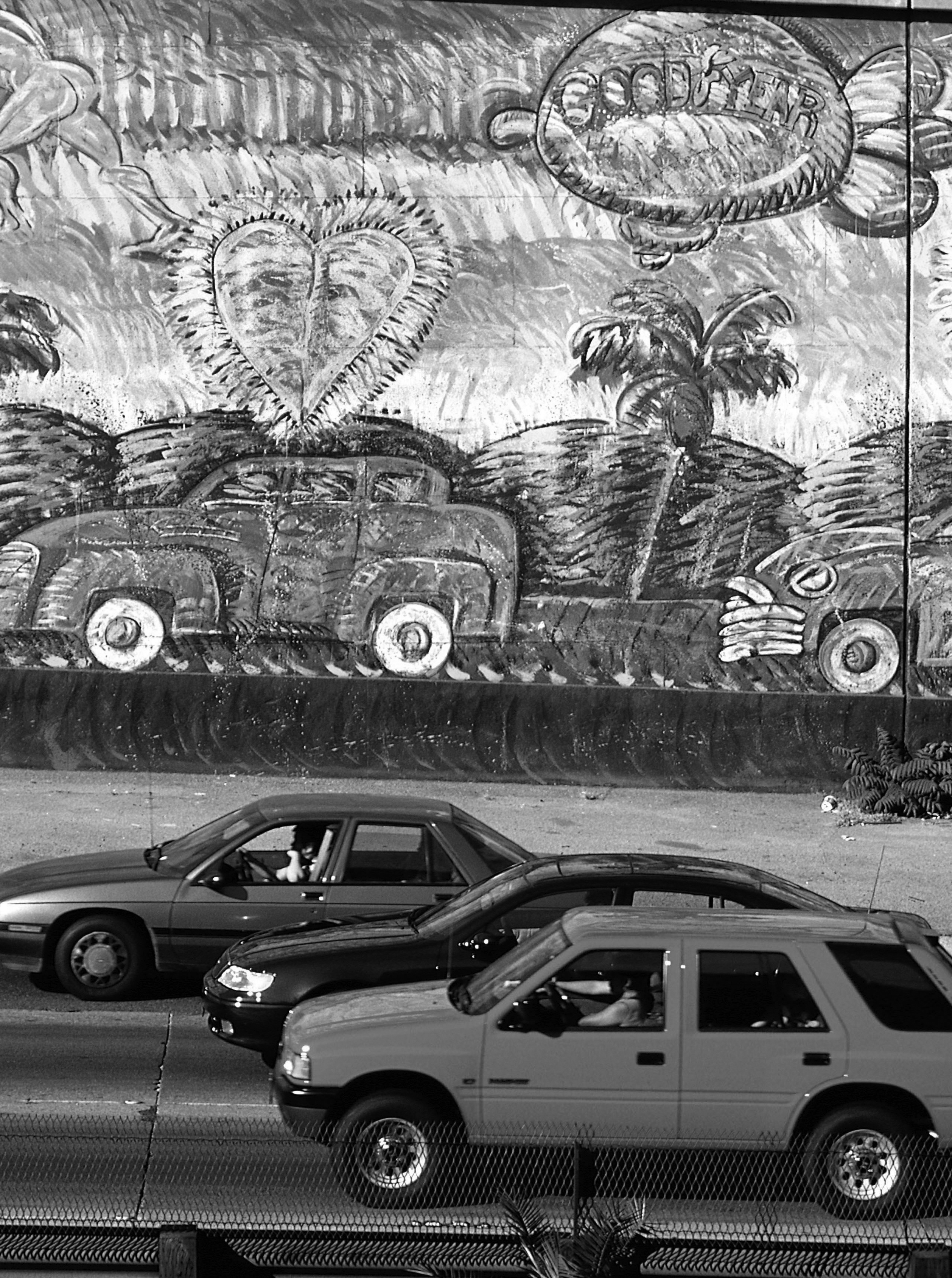
Above: Frank Romero’s Going to the Olympics mural was restored in 2013 after vandals had tagged it
Credit: Iconotec / Alamy
The city has continually struggled with its contradictory messages on public art. Where do the boundaries between advertising and art lie? What constitutes a fine art mural? What to do with artists, such as Shepard Fairey and Barbara Kruger, whose work is text heavy as a post-modern response to the visual linguistics of advertising? Is whitewashing censorship?
Many people lump all street artists together – from muralists to graffiti artists and taggers. But an insider knows it is a scene with many different strands. In their fight to revive the city’s reputation for murals, many divergent artists and subcultures banded together. Traditional muralists, empathic to suppressed voices, welcomed graffiti and street artists, and together they rallied the city to change the policy. It was testy at first, especially since taggers constantly took their spray cans to vintage murals.
The reputation of street art was bolstered enormously by Art in the Streets, a 2011 exhibition by the Los Angeles Museum of Contemporary Art. It gave aerosol new credibility and inspired new, large-scale street art in the downtown Los Angeles Arts District, by artists including JR, Dabs and Myla, INSA, Shepard Fairey, How and Nosm. The drafting of the mural ordinance began as the exhibition ended, and by the time it was passed, all forms of murals were recognised by the city – as long as artists registered them with the city and paid a $60 application fee. The works also cannot contain a commercial message and must remain for at least two years, as part of the city’s continuing battle to keep tabs on advertising. The rules apply to public areas with residential areas having to “opt in” if they want artworks on their walls and homes.
“Within the new ordinance, muralists are required to involve the communities in which the works will be created,” says Rojas-Williams. “Tagging is also reduced in this way. When communities are involved in the creative process there is a good deal less desire to vandalise or censure.” Muralists of different styles now plan to work together on pieces around the city. “Graffiti artists will continue to collaborate with pioneer muralists and to take the time to hone their skills, instead of looking over their shoulders, afraid of prison or fine threats,” says Rojas-Williams. In LA, graffiti is also often associated with gang culture. The police often stopped artists with spray cans – including those that had no gang connections and who had permission from a property owner.
Media companies sued the city, demanding that advertising signs be given the same free-speech protection as murals
But the new policy – which was inspired by a similar ordinance in Portland, Oregon – has not been without its problems. The first challenge came in January, when, without proper permits, the LA Freewalls project – which controversially brokers deals between businesses and street artists – installed three street-art works in downtown Los Angeles to promote a beer, a shoe company and a band’s new album. The works were criticised by the community, saying they violated the spirit of the new murals’ policy.
Los Angeles is now preparing for the 30th anniversary of the series of celebrated murals produced along the 101 Freeway for the 1984 Summer Olympic Games. In the last few years the murals have been beleaguered by vandals, weather damage and nearby constriction work, some have been damaged beyond repair but those that have been restored include artist Frank Romero’s vibrant depiction of a traffic jam, Going to the Olympics. The Mural Conservancy of Los Angeles has also recently announced it will be restoring its first graffiti-style work: They Claim I’m a Criminal by Man One at the Southern California Library.
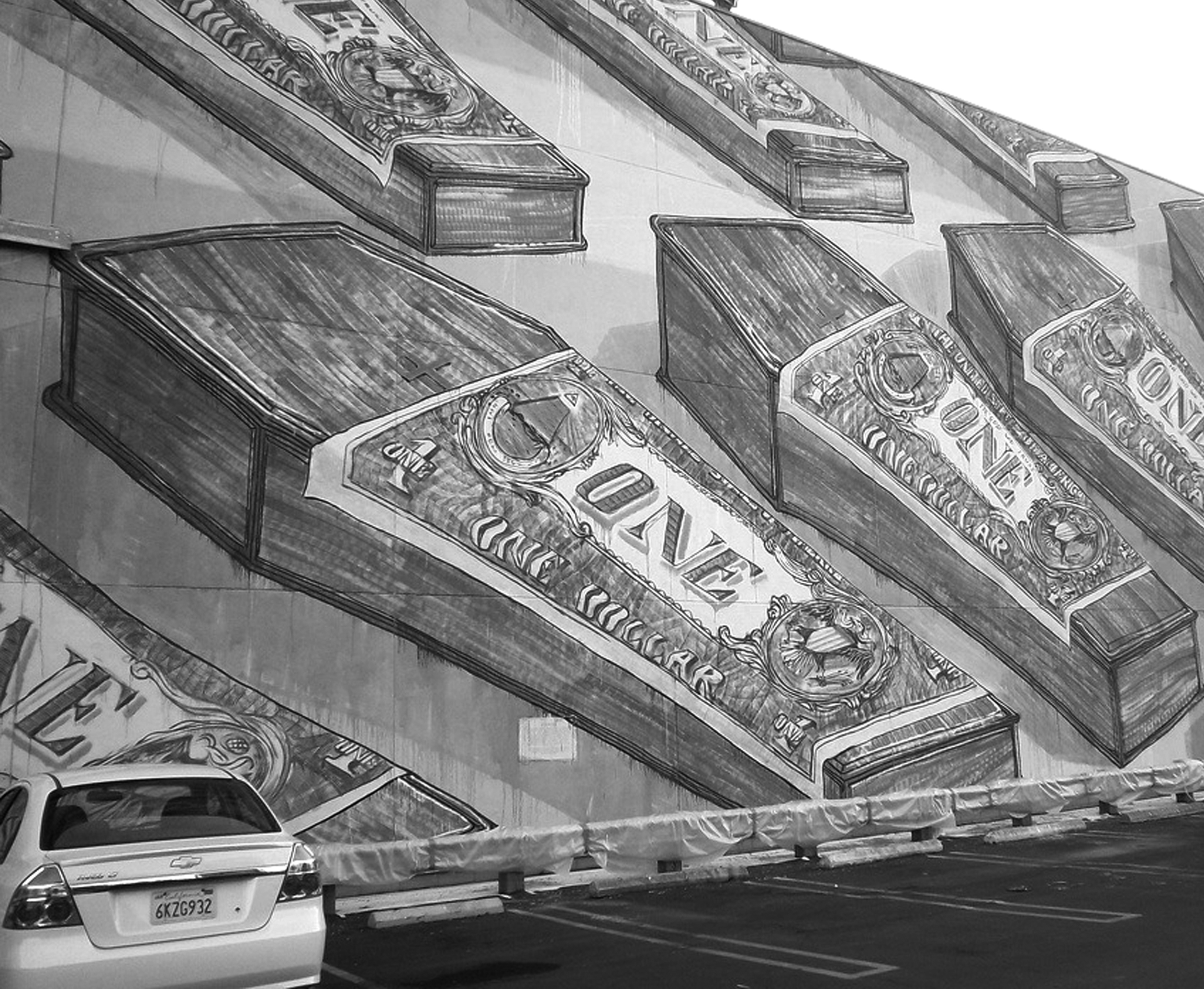
Above: Italian street artist Blu was commissioned by the Museum of Contemporary Art in 2010 to create this piece for their Arts in the Street festival, only for the museum to have it whitewashed on completion due to the image’s strong political message
Credit: Ed Fuentes
“Will Los Angeles reclaim its title as mural capital of the world?” asked a panel discussion of the same name at the LA Art Show in January. Locals think the city is well on its way to regaining its position.
