




Abstract
When the Berlin Wall came down, certain divides remained. But Europe’s dividing line has now shifted east, says
East of this more permeable barrier, communism may have been relegated to history, just as it was further west, but the perception remained that the social-collective shapes, indeed owns, people; that individuals must conform; and that, ultimately, the integrity and cohesion of the group are paramount. But the myths, lore and beliefs that help to cement states and national groups are not the same everywhere in the region – far from it. There are starkly conflicting sensibilities, for example, about the myth of medieval Kievan Rus (a state that covered large areas of present day Ukraine, Belarus and western Russia until the 13th century). Irrespective of historical perceptions and loyalties, however, in eastern parts of Europe feelings of group integrity and mission stand in stark contrast to the Western liberal sense that as individuals, within the framework of democratic consent, we possess and can invent ourselves.
Over the past decade or so in Russia the Kremlin has enlisted the Russian religious tradition, alongside other storylines, to encourage state cohesion and the priority of group goals over individual ambitions. The canonisation of Tsar Nicholas II (murdered by the Bolsheviks); memories of imperial glory; wartime struggles against Nazi Germany; a nostalgia for global power and the mellow togetherness of life in the USSR; Nikita Khrushchev’s “mistake” in giving Ukraine to Crimea in 1954 – all have been co-opted into the campaign. But underlying these narratives is a deeper cultural predisposition to communality and collectivism: a sense that the human personality and the group which defines it are somehow destined to fuse. According to the Orthodox Christian tradition still prevalent in Russia, human fulfilment and salvation rest in a merger between self, community and – at the religious level that underpins all this – deity. In this cultural context the Western political principles of opposition, bargaining, pressure and conflict between competing groups are bound to be anathema.
Eastern and central European countries, once under Imperial or Soviet Russian rule, uphold their own communitarian traditions. But with weak, historically unstable boundaries they are also in-between spaces where margins are smudged, cultures cross and opposing ideas clash. Demarcation is hazy (“senseless”, the exiled Czech writer Milan Kundera once said) because it has been so often disputed. The plains of eastern middle Europe make the perfect battlefield. Today, Ukraine’s cultural, linguistic and religious fault lines are widely known. The western Ukrainian city of Lviv was previously named Lemberg, or Lwów, or Lvov, depending on whether the administration was Austro-Hungarian, Polish or Russian. Beyond Ukraine, the east European experience as a whole is grounded in memories of changing borders, mutating roles and identities. Yet borderlands are more than just peripheries. They are centres of national identity and reinvention that reflect local needs and external geopolitical pressures. A hundred years ago a shooting in one such borderland ignited cross-European conflict.
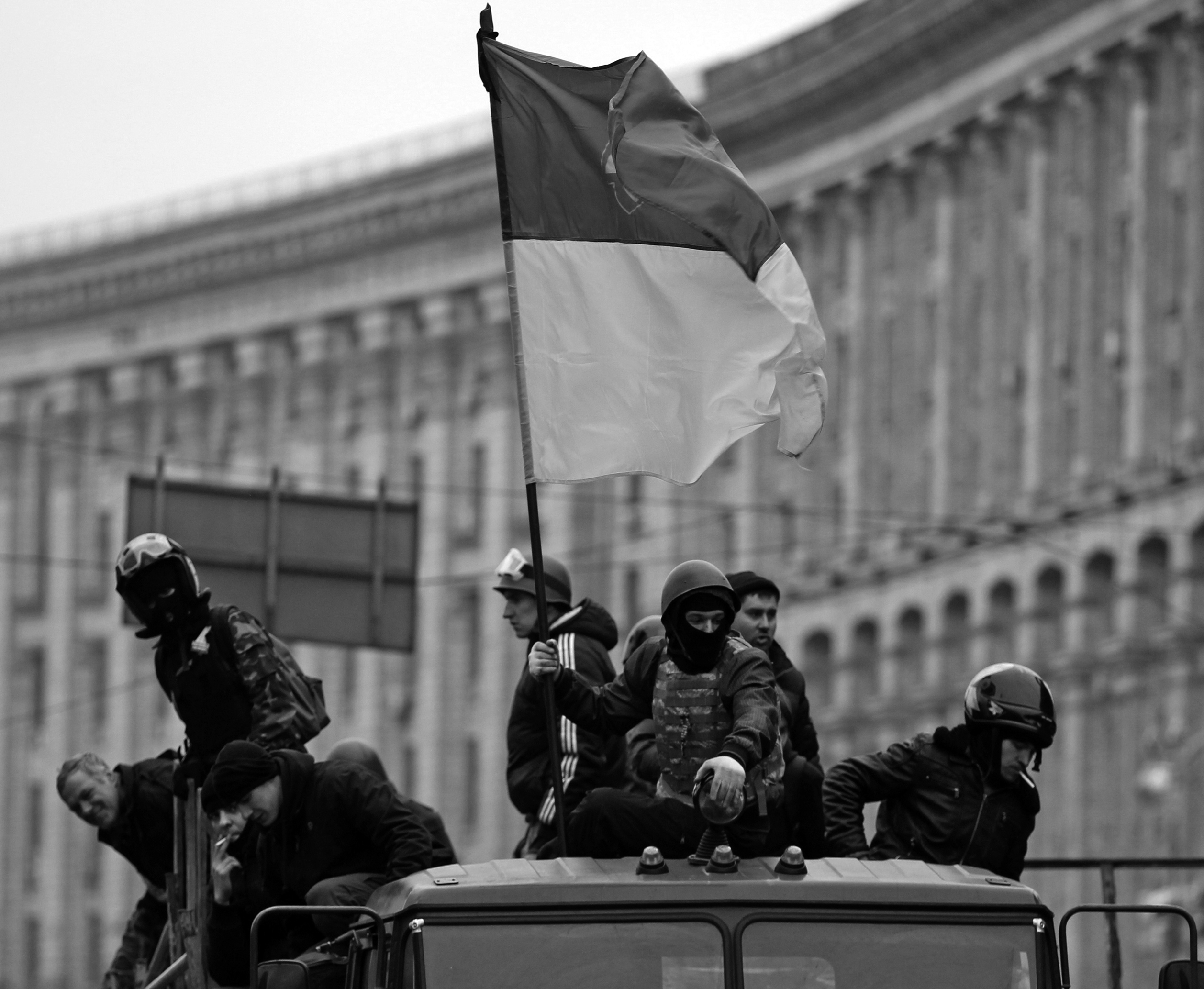
Above: Anti-government protesters carry a Ukrainian flag while driving through Independence Square, Kiev, in February
Credit: Vasily Fedosenko/Reuters
“For us Europe is emotion, not rules,” the Ukrainian philosopher Volodymyr Yermolenko wrote recently. “It is a far-off ideal, in which we have faith. Europe is a deity with whom we wish to unite.” Yermolenko’s words connect painfully, perhaps reluctantly, with that time-honoured east European consensus between individual and community, and between the community and some kind of masterminding power.
Pre-revolutionary Russian society was largely sustained by the myth of its identity as a “right thinking” nation. The word pravoslavie (Russian Orthodox Christianity), also means “right worship” or “right belief”. At the turn of the 20th century it was common for a rural Russian to identify himself simply as pravoslavny, one who is theologically “right”. This kind of prescriptive and collectivist thinking – which once made Marxism so palatable in the Russian context – has led anti-Soviet dissidents, as much as communist party functionaries and post-Soviet bureaucrats, to share a horror of Western political ideals like pluralism, individualism or tolerance. “If diversity becomes the highest principle there can be no universal human values,” the Soviet dissident writer Alexander Solzhenitsyn thundered in 1985. “If there is no right or wrong what restraints remain? If there is no universal basis for it there can be no morality.”
Vladimir Putin’s vision of a cohesive, hierarchical, supra-national United Russia is a direct politicised extension of this rationale. Eastern Christianity acknowledges that boundaries are elusive. “Right belief” has no geographical limits, it is consensual and universal. Russian culture by its nature impinges on ideas about unifying humanity. The 19th-century novelist Fyodor Dostoyevsky (avidly studied in Russia) believed his country had a unique mission in the world: “To become a true Russian … is … to become if you like universal man”, he wrote.
Today, Vladislav Surkov, the Kremlin’s chief apologist for authoritarian state capitalism, would probably agree. He has spoken of the Russian “aspiration to political wholeness” and “idealisation of goals” and is happy to blend religious idiom with Hegelian and New Age ideas. “Russian consciousness is clearly holistic [and] intuitive and opposed to [the] mechanistic [and] reductionist,” he has said. “Synthesis prevails over analysis, idealism over pragmatism, images over logic, intuition over reasoning, general over particular.” His remark: “Culture is fate. God made us Russian. Citizens of Russia” has been widely quoted.
West of that post-Berlin Wall gap between communitarian sensibilities and neo-liberal individualism, we prefer to think of morality in terms of personal choice, will and consent. The philosopher Michael Sandel has termed this the “voluntarist conception”, which implies that we are independent agents, free to choose, unbound by moral ties or collective responsibility. Within the Western framework of the rule of law, separation of powers, independent media and fair elections, we cling to the thought that we possess our lives and ourselves.
The Kremlin’s policy and propaganda are reflecting a similar reverence for state power, hardening the virtual walls and disconnects criss-crossing eastern Europe
The crumbling of “solidaristic” values in post-wall Poland seems to confirm the unassailable potency of this position. The astonishing social cohesion the country demonstrated in the 1980s proved specific to its times. Once feelings of liberty and independence prevailed, the moral unit represented by the Solidarity trade union (once 10 million strong) fragmented. The bond that had held it – oni, “they”, those godless communists – had melted away. In a neo-liberal context with a free market and few economic or social constraints, people felt apprehensive and threatened by those they had previously trusted. Workers sensed that the intellectuals with whom they had been allied with in the 1980s were no longer committed to their interests – and they were right.
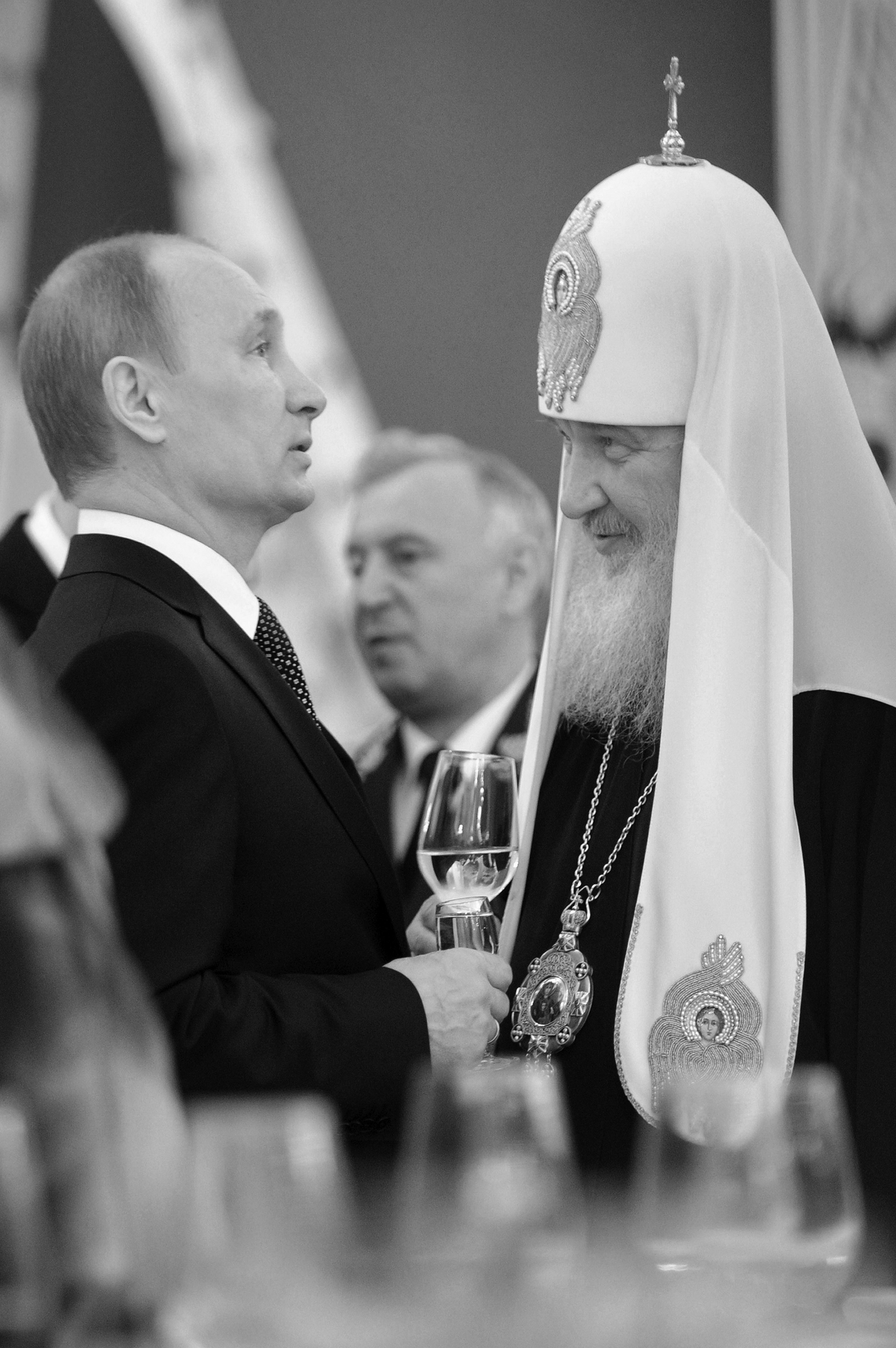
Above: Vladimir Putin with Russian Orthodox Bishop Patriarch Kirill
Credit: Kommersant Photo Agency/Rex
Solidarity had fought for values rather than labour contracts or working conditions. Its language had been elevated, with a moral, anti-discursive undertone. The emphasis was on asserting independence though unity. After 1989, people who had been partners in political resistance became competitors for jobs, money and prestige. Solidarity’s membership plummeted. A movement that had struggled and negotiated peacefully for participation in Western libertarianism and the free market, disintegrated in rows and recrimination. Speaking out in an organised way through interest associations was a skill few either had or wanted. Perhaps negotiating over wages or hours seemed insipid or trite in the wake of an ideological revolution.
“Culture is fate,” the voice of the Kremlin, Vladislav Surkov, has said. Yet how curious that, in 1984, the writer Milan Kundera used language very similar to Surkov’s to convey an entirely different allegiance. In an article entitled The Tragedy of Central Europe, which argued that Soviet satellite countries had been “stolen” from western Europe, he wrote: “Central Europe is not a state: it is culture or fate”.
What do these unlikely echoes from different ends of the east European political spectrum tell us? That you cannot choose where you are born? That central Europeans and Russians, despite their differences, share a common, deterministic streak? Or that these diametrically opposed figures – Kundera, originally from Czechoslovakia, and Surkov from Russia – share an underlying assumption that the community into which you merge, its way of expressing itself, its collective memory and its identity defines who you are, along with your loyalties and responsibilities. Communitarian sensibilities run deep. For central Europeans, Kundera explained in his article, “the word Europe is not a geographical but a spiritual notion”. For a country that “feels” European, to be excluded from Europe is to be “driven from its own destiny, beyond its own history”, he continued. “It loses the essence of its identity.” Three decades on, Volodymyr Yermolenko has observed that for people in the countries of the former Soviet Bloc: “Europe is still a vision, an ideal, a utopia…a kind of mystical ecstasy.”
To Westerners in the digital age, high-flown language of this kind can seem poignant but passé. Like the word “solidarity”, it resonates with images of striking Gdansk shipyard workers on their knees in prayer. But in a letter to the Polish journal Respublica Nowa published in February, a demonstrator in Kiev’s Independence Square, Aleksandra Kovaleva, expressed some of the ambivalence felt in Ukraine towards the West’s perceived lack of “solidaristic” ideals. “I can’t imagine a Europe in which people would be capable of fighting and dying for freedom and dignity,” Kovaleva wrote bitterly. “These concepts seem to have little relevance for a sleepy and well-fed Europe.”
Closer to the former imperial centre, group identity is increasingly firmly consolidated. Over the past decade, Russia has been defining itself in anti-European terms. According to the Sociological Institute of the Russian Academy of Sciences, over a third of Russians share the view that theirs “is a unique Eurasian civilisation”, marked out in contrast to a West that is grasping, meddling, immoral and sexually deviant. The Kremlin has denounced the hypocrisy of Western condemnation of “spheres of influence” in Europe, given the incorporation of the Baltic states, Poland and other former communist countries into NATO and the EU. Cold War-style rhetoric transmitted via Russian television to Ukraine or Belarus has played on deep-rooted anxieties about Western infiltration, as well as public suspicion of outsiders, gays or other degenerates with little respect for sacrosanct values. Gender boundaries have come to express the cultural conflict between social conservatives and social liberals. State-controlled Russian media like to suggest that, in the West, the gay lobby has made inroads into the corridors of powers. A programme screened on a major TV channel, the Repressive Minority, in June last year discussed “gay totalitarianism”, for example. A December headline in Komsomolskaya Pravda read: “Gay fuel in the Maidan fire: Ukraine called to join Europe by nationalists, anti-semites, neo-Nazis and homosexuals”.
Russia’s leadership is branding itself as a global moral authority transcending borders, nations and continents. In his State of the Nation speech in December, Vladimir Putin promised that Russia would lead in defending traditional, conservative principles against a stream of global “anti-democratic” propaganda calling on people “to accept without question the equality of good and evil”. Putin subsequently gained expressions of approval from erstwhile Republican presidential nominee and editor of The American Conservative, Pat Buchanan, who praised his moral clarity and asked: “Is Putin one of us?”
All this seems a far cry from the days of the socialist collective, but the paradoxes associated with divisions between individualism and collectivism, selves and others, inner and outer, often form a blurred picture. As group-focused ideology disintegrated in the 1980s, it was harmonised action and group solidarity that finally opened the Berlin Wall. Meanwhile in Moscow – a society still commanded by Marxist-Leninist ideology – informal organisations were multiplying, unofficial publishing flourished, and literature authorised by the censor hinted at probing, subversive and sometimes wacky ideas. Soviet atheism and religious repression animated a fascination with myth and spirituality, which later helped bring such influence and prestige to the Russian Orthodox Church. In 1987, the writer Tatyana Tolstaya – then at the start of what became an international writing career – remarked, exasperated, that Muscovites were “totally absorbed in saving their own soul”.
After 1989, people who had been partners in political resistance became competitors for jobs, money and prestige
This was the age of glasnost or “openness”. But amid calls for an end to public disinformation, revelations about conditions in labour camps, dismay about historical atrocities, enthusiasm for New Age ideas, and discussion about setting the world to rights, the Moscow “intelligentsia” were also showing unease about the growing power of a group of litterateurs with neo-Stalinist sympathies. The nationalist critic Pyotr Palievsky – then director of the Institute of World Literature and widely viewed as a member of this controlling group – once told me that there was conflict between “a revolutionary desire to assert oneself over Nature, and the religious urge to submit its wisdom”. But, he added firmly, one thing Soviet writers would never do was promote individualism, classical liberalism or democracy. Meanwhile, among more liberal Soviet critics, there was concern about a new political project linked with the neo-Stalinist group: not communism or socialism but “etatism”, which Irina Rodnanskaya, then senior editor at the journal Novyi Mir called “a religious adulation of the state”.
The walls around the elites isolate them from the majority, stoking feelings of rage
A generation on, the Kremlin’s policy and propaganda are reflecting a similar reverence for state power, hardening the virtual walls and disconnects criss-crossing eastern Europe and reaching way beyond. Within the region there are numerous divides: linguistic, cultural, religious, moral, economic, historical and philosophical. Equally, digital connectivity has provided “resonance chambers” for group feeling, and created decentralised communication patterns that can be used to embarrass the authorities and assemble crowds. But, unlike the panels of reinforced concrete that split Berlin between 1961 and 1989, until recently the barriers seemed flexible and permeable. How far will they now freeze?
And then there is that other, glaring gap: the social and economic fault-line between elites and voters, which seems the least penetrable barrier of all. Inequality colours our social perception, Richard Wilkinson and Kate Pickett have argued in The Spirit Level. Feelings of superiority and inferiority, dominance and subordination take over and shape our social relationships. In eastern Europe civic activism remains a dangerous job, and the organised expression of group interests is undeveloped. The walls that enclose elites holding funds stashed away in tax havens abroad, and isolate them from the majority, continue to stoke up feelings of untold rage.
The Russian information space has been filled with news about the activities of neo-Nazis and extreme nationalists in Ukraine. Yet the Independence Square protests in Kiev were very largely simply about justice. They expressed a desire to break out of the stifling, clannish, top-down system which, as the Ukrainian commentator Mykola Riabchuk has pointed out, “destroyed the court system, accumulated enormous reserves via corruption schemes and encroached heavily on human rights and civil liberties”. These days Ukrainians are likely to be yearning less for union with European cultural values than for regulation, rule of law, checks on power and a free-trade zone.
The problem is that the Kremlin’s arguments about historical bonds and the West’s disregard for Moscow’s status or interests cover up a basic contradiction. The solidaristic narrative of shared memory and emotion, loyalty and biding with your own, is shielding a hierarchical form of rule, which holds that once you are at the top you are accountable only to your personal will, beliefs or fantasies, not to voters or any notion of the inalienable human right to life and liberty. In other words if you have links high enough up the chain of command, you can enjoy entitlement and impunity, an array of life choices, as well as that lavish lifestyle in Zermatt or the Côte d’Azur. More importantly, as the Russian political columnist Kirill Rogov wrote recently, this kind of power structure also implies that in practice “the right to use force takes priority over the rights of citizens”. All of which makes the proclaimed communalist narrative – with its 19th-century take on Russian exclusivity and mission – look much like hollow rhetoric if not some kind of diversionary tactic. East of the new “wall”, do people need that old Slavophile story to live by?