




Abstract

Critics and cynics have long been expecting to relegate libraries to history. But despite funding cuts and technological challenges, many – particularly in Germany – are thriving, forward-looking public spaces, vital for the exchange of ideas, says
Fast-forward 20 years and it’s the diskettes, not the public libraries, that have become the thing of the past. According to the latest report by the Pew Research Center’s Internet and American Life Project, 54 per cent of Americans aged 16 and above had visited a library or mobile library in the past 12 months. In the same year, 288 million library visits were recorded in the UK and about 210 million in Germany. By comparison, 17 million football fans attended a match of the Bundesliga, the German football league, which is the most visited league in the world.
In Germany, modern libraries are the new town halls. They are central, neutral and atmospherically inviting – places where people of all generations and ethnicities can mix. In Berlin and Leipzig, events programmes have included debates on urban development and a range of other political issues, from a proposed cycle network to the impacts of asylum policy. Libraries in Berlin’s Kreuzberg district have played a significant role in encouraging intercultural exchange, by hosting a Tibetan new year’s celebration, multicultural family days and breakfast meetings for women from the Turkish community. Leipzig public library has also offered a platform to writers persecuted in their home countries.
But could these activities take place just as well in other places, as German national newspapers have suggested in recent months? “Libraries have no right to exist any longer” was the bold headline in an article by Kathrin Passig on Zeit.de at the end of 2013. Passig called libraries “paper museums” that nobody needs in the age of the internet. The article caused a stir, not only among experts, and was fiercely condemned. Strangely, the author inadvertently appeared to reveal that she had not visited a library for years – if she had she would have experienced a place crowded with young people reading, learning, surfing the internet and talking to each other. On the other hand, some criticism is valid: a large number of libraries do still remain outdated and poorly equipped. Sometimes they lack innovative staff. Above all, they lack the money for innovation, as policymakers do not recognise what modern, citizen-centric libraries can offer.
ABOVE: Seattle Central Library was designed as a “living room” for the city
Credit: iStock/Getty/LembiBuchanan

In the UK, the reputation of libraries has suffered and funding has been slashed. According to 2012-13 figures published by the Chartered Institute of Public Finance and Accountancy, more than 70 UK libraries closed in that period, making a total of some 200 closures since 2010. Book stock fell too, and there was a year-on-year decline of 6 per cent in visits. The drop is often presented as evidence that libraries are falling out of fashion, but a dip in numbers is inevitable with a reduction in the number of libraries.
In recent years, the socio-spatial appeal of libraries has been highlighted by widely acclaimed new buildings. Seattle Central Library, an incredibly bold, geometric glass building, opened in 2004. Architects Rem Koolhaas and Joshua Ramus reinvented the public library as a “living room” for the city, featuring hundreds of computers and plenty of space for reading. Other spectacular examples of new libraries can, or will, be seen in Singapore, Amsterdam, Stockholm, Stuttgart, Almere and Birmingham. Coming in late 2014, Aarhus library in Denmark, which bills itself as the “Library of Tomorrow”, will have a prime waterfront location, a state-of-the-art car park, a children’s library and creative labs. All of these premises stand out for their architecture and innovative services – from fully automated lending systems and seven-day-a-week opening through to language and computer courses and “maker spaces” (meeting places for techies). Berlin also has plans to include a new central library, costing around €300m, as part of the redevelopment of a former airfield in the heart of the city.
In an ever-changing technological and social environment, libraries are having to adapt to survive and maintain their role in people’s lives
ABOVE: Relaxing in the children’s library in Leipzig
Credit: Leipzig Public Libraries
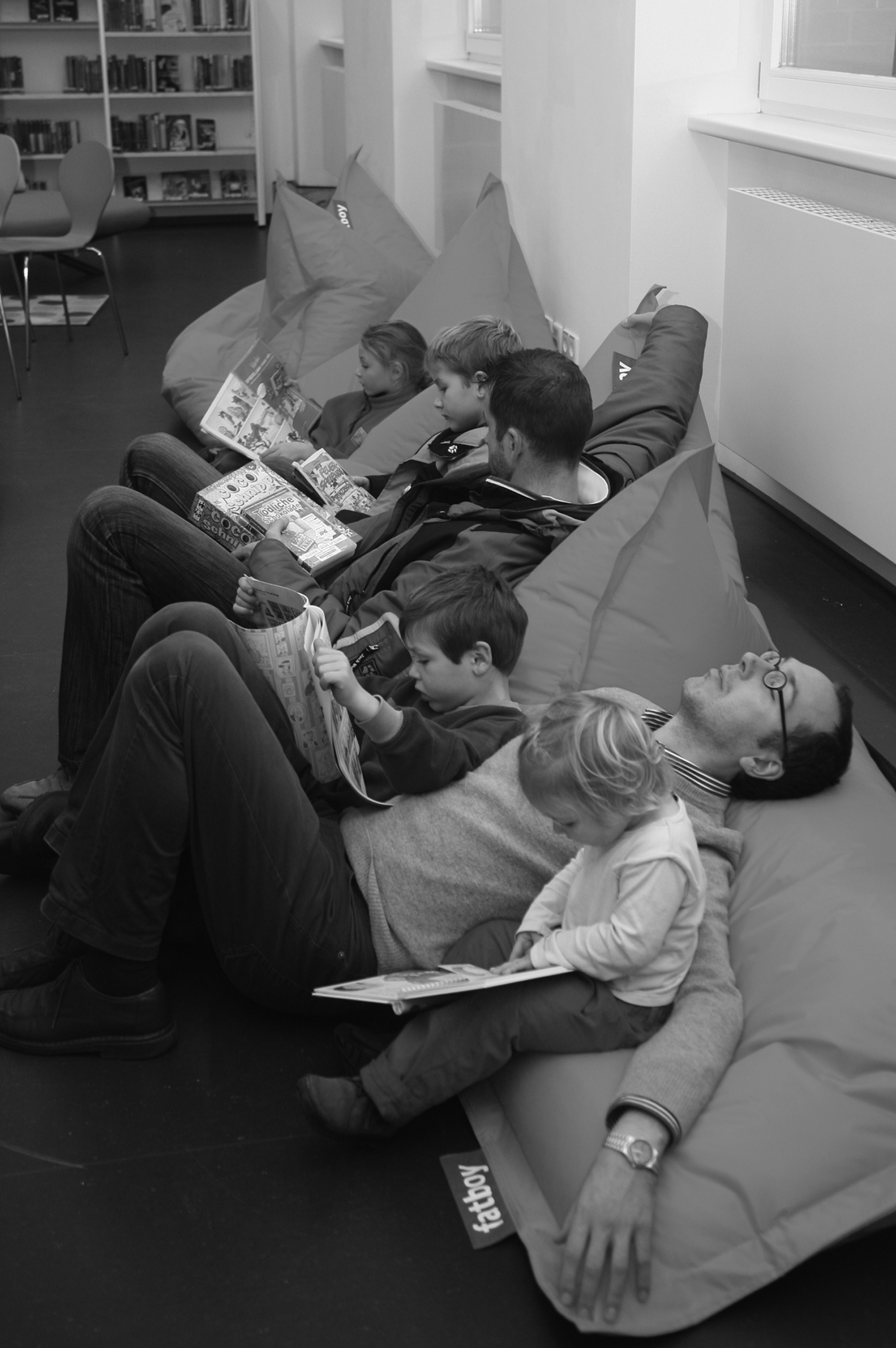
But in an ever-changing technological and social environment, libraries are having to adapt to survive and maintain their role in people’s lives. They are being forced to negotiate an increasing number of obstacles – technological, financial and legal. Many metropolitan libraries around the world have already made changes, for instance, by offering downloadable e-books on their websites via online catalogues or through specific apps. The e-books typically expire automatically at the end of the loan period and do not have to be returned. Thus the library has become a 24/7 service, with the potential to reach many more users – especially when also using social media to promote their services and events.
What now seems to happen at the click of the button hasn’t been easy to put into place. Libraries are still trying to negotiate a potential minefield of rights issues. Some publishers will not sell e-books to public libraries; others impose serious restrictions. The same e-book can have different publishers in different countries, so you may see an e-book on an American or British library’s website but the same title won’t be available to Canadian or German libraries. Ensuring compatibility with a wide range of different e-readers is also a major challenge.
Traditionally, libraries have had control over their own collections, deciding what books to buy and offer for public lending. But now some publishers say rights holders should decide how and where to extend access to a specific work. “Should this interpretation prevail, this would mean that publishers, and not librarians, primarily decide on digital collections in libraries,” says the European Bureau of Library Information and Documentation Associations (EBLIDA). “This would mean that libraries would no longer be able to guarantee free access to content, information, and culture.” The EBLIDA’s current campaign, The Right to e-Read, calls on policymakers to harmonise legal frameworks, particularly on copyright, across Europe. There is concern that if libraries do not provide free access to e-books, people who cannot afford them will be excluded and the digital divide will become even wider.
With digital services of such enormous importance, some argue that there is no need for libraries to have physical locations. But libraries are esteemed as a non-commercial “third place” – neither “home” nor “work” – which offer comfortable environments for reading, meeting, working and relaxing. Libraries, at their best, provide one of the few centres for communities that are politically neutral, non-commercial and open to everyone. Libraries foster participation and help to strengthen democracy. For those reasons alone they should be protected from public sector budget cuts.
In the words of the writer Neil Gaiman: “Libraries really are the gates to the future. We have an obligation to support libraries. To use libraries, to encourage others to use libraries, to protest the closure of libraries. If you do not value libraries, then you do not value information or culture or wisdom. You are silencing the voices of the past and you are damaging the future.”