




Abstract
On the 20th anniversary of South African democracy actor/director
Once it stood among much more desolate surroundings, a few dinky shops nestling nearby, selling dubious Africana to apartheid tourists, several grubby pubs and a jazz club called Kippy’s. In the theatre’s precinct the paving bore brass platelets with the names of donors, which have long since vanished, just the tiny shallow graves remaining. Gone together with the copper wiring that any self-respecting thief could nick from the sidings nearby. Or from anywhere, in fact, throughout the land. Hence South Africa’s matchless telephone-wire basketry, a craft perfected by poverty.
This theatre, famous for its protest plays during the apartheid years, sailed close to the wind until liberation in 1994. Then, once the enemy had gone, it lost its way. It’s beginning to find it again, under the new directorship of James Ncgobo, so it’s with a gusty sigh of relief that I can offer up a brief picture of the censorship it once had to face, where, thankfully, there is none anymore. Well, not thus far in theatres – although newspapers are hotting up as the next battleground, but that’s another story.
In those dark days, the censor’s office would act if an individual made a complaint in writing, having been present at a play, and, however silly the complaint, the board would need to follow it up. The Market was then left with the appeal process and picking up the pieces of a damaged run, all very costly. Banning orders were served on five or six plays, mainly between 1976 and 1980.
The first to be banned was Comedians by Trevor Griffiths, accused of bad language and blasphemy, with lawyer Ernest Wentzel defending the play. The hearing meandered on for four-and-a-half hours, the prosecution argument being that the use of slang and expletives was down to a “paucity of vocabulary”. At a certain point, an impatient chairman repaired to his office with the directorate and weird bargaining then ensued, along the lines of whether the Market CEO Mannie Manim would “forgo the ‘c-word’ on page five in order to retain the ‘f-word’ on page seven”. This was negotiated throughout the text until enough of it was left to continue the run – with the author’s bemused permission. All in all, it was a win, as the production was not forced to close and the theatre benefited from the surge of publicity. Best of all, the negotiations served as fodder for stand-up satirists.
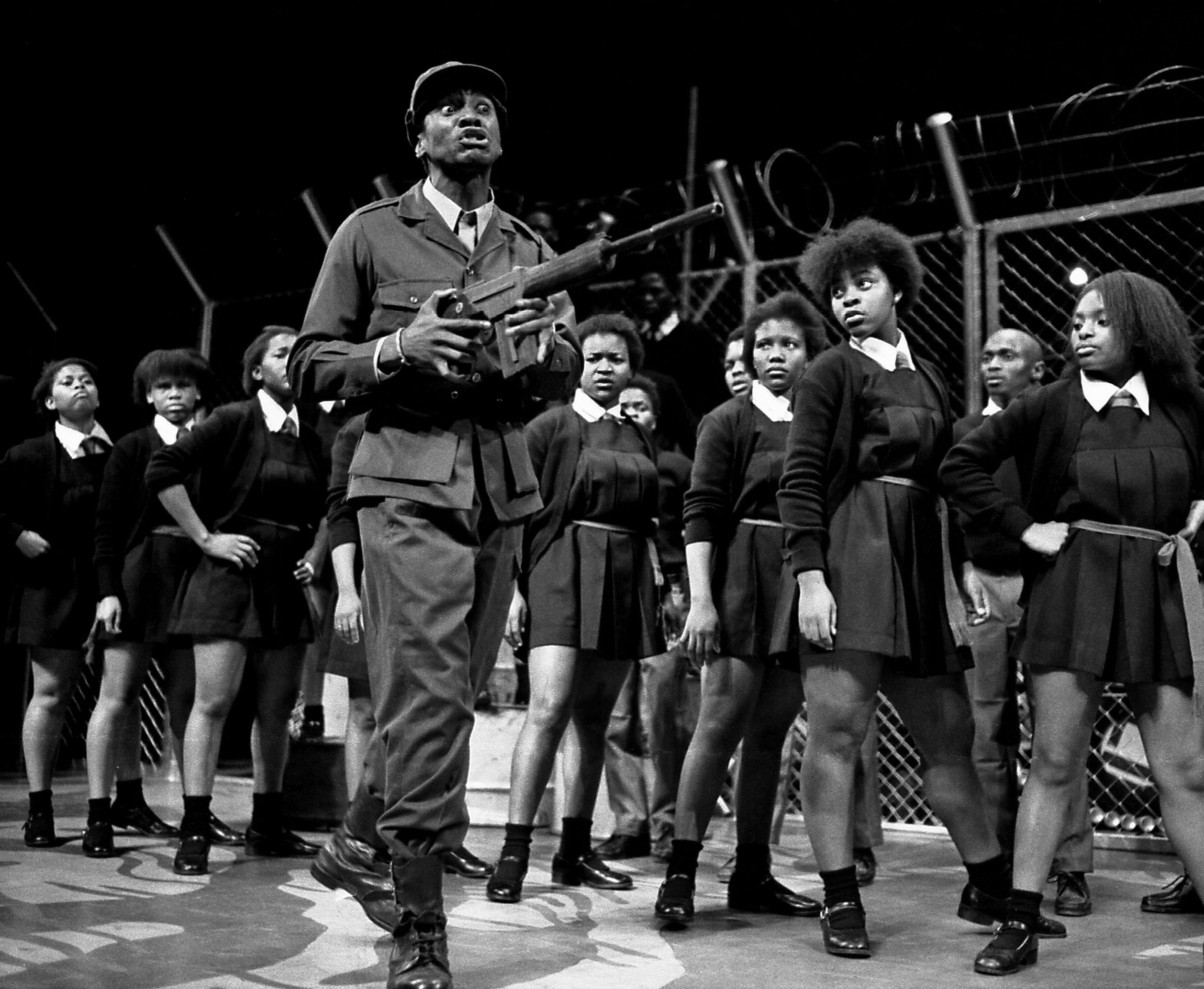
ABOVE: Sarafina, written and directed by Mbongeni Ngema, at the Market Theatre in 1987. The musical tells the story of students involved in anti-apartheid protests, inspired by the 1976 Soweto riots
Credit: Ruphin Coudyzer
After this victory, the Market, under the aegis of Manim, developed the argument that the appeal board should see the performance in question as the audience sees it, and so after each banning order he would call the chairman of the board and request one more performance, after which the appeal could be heard in the auditorium itself, where the play had been performed. With surprising fairness, the censor agreed to this. A full house – of everyone’s best friends, of course – would be asked to attend the special performance.
I recall a peach of a situation when a complaint was registered against Spike Milligan and John Atrobus’s daft comedy The Bed-Sitting Room, which was banned on two counts: one for blasphemy in that God was portrayed as an old man wandering around in striped pyjamas, and secondly for cannibalism in that a talking parrot called Harold Macmillan fell off his perch and was duly roasted and eaten. A magistrate was called out (I could swear still in his own striped pyjamas) at 11pm one night and the special performance was duly given, to gales of laughter, and then the hearing went ahead after the performance. Raymond Tucker, the Market’s lawyer, won the case that night, though there were many nail-biting moments when it proved difficult to keep a straight face.
Another banning, called Holy Moses and All That Jazz, a children’s musical based on Bible stories, was defended by a lawyer called Denis Kuny, who was a bass player in his spare time. The major premise of the banning was the title; the censors held that association with “jazz” denigrated Moses. You have to remember that we were living under Calvinist rule, our leaders a brace of Bible-thumpers. When it became clear that the Market was heading for another victory, the chairman of the appeal board asked Kuny if the theatre could please consider another title without the word “jazz”. Which is when Kuny launched into a short history of the great musical art form, to waves of applause from the audience. When he turned dramatically to the board at the end of his highly informed peroration, the chairman had to concede that the case was won.
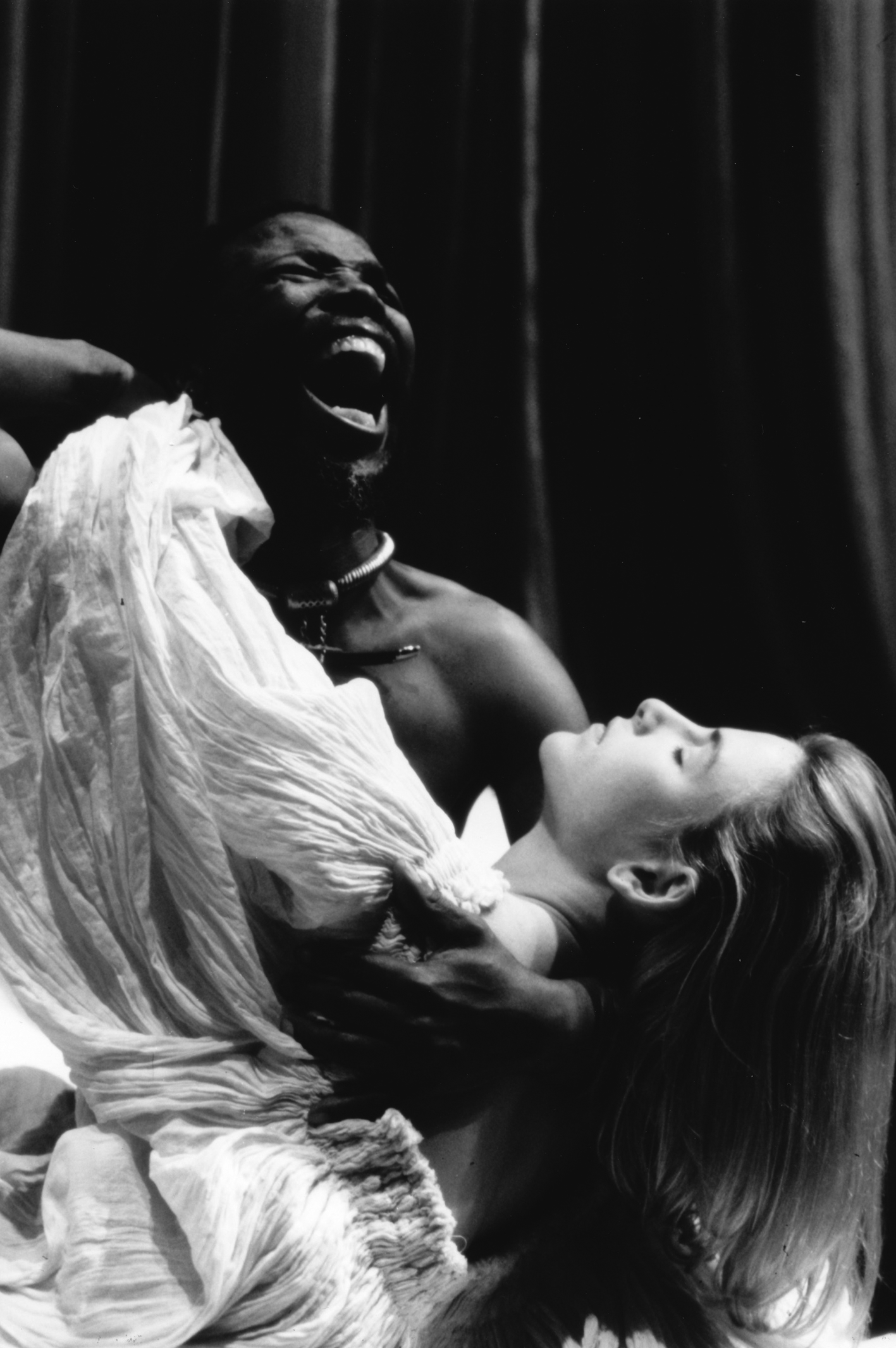
When I directed Othello – a play about race and sex if ever there was one – no bans were served, even after the sensational onstage kiss
Those who made the complaints were usually out to cause havoc to the Market willy-nilly, but here’s the surprise: very few of the political and “in-your-face” protest plays were ever censored. Powerful pieces that were staged without interference included The Island; Sizwe Banzi is Dead; Statements after an Arrest Under the Immorality Act; Miss Julie (the white actress Sandra Prinsloo needed armed bodyguards to escort her from the theatre); Woza Albert!; Asinamali!; Born in the RSA; You Strike the Woman, You Strike the Rock; The Sun Will Rise (the most outspoken piece of revolutionary “drama” the Market ever presented, by poets Matsemela Manaka, Maishe Maponya and Ingoapele Madingoane). Oh, and many others. The audience for these was the core of liberal Johannesburg, eager to seek solace in their guilt-assuaging, anti-establishment theatre.
My own view is that the complainants were too, shall we say, limited to realise that satire is a dangerous tool. And not only satire, high tragedy too. When I directed Othello in 1986-87 – a play about race and sex if ever there was one – no bans were served, even after the sensational onstage kiss between the black lead, John Kani, and blonder-than-blonde Joanna Weinberg. Never mind that seats banged up as affronted white couples left in protest, not a dicky bird of a banning was to be heard. Threatening letters galore, yes, and cross-looking cops in the precinct. But Shakespeare – bless him – was never listed as a bannable person under any sub-clause in any legal act. And is one surprised? I mean, who would dare?
I rather bank on the fact that what I have described above will seem somewhat infantile to readers, and for me these distant memories highlight an almost absurdist attitude to the regime’s priorities, which led to John Kani driving daily to Othello rehearsals from his home in Soweto wearing two T-shirts, the top one covering his black-green-yellow ANC one, in case a cop stopped him en route.
However, to be truthful, although you had to laugh – what my grandmother called a bitter laugh – it wasn’t so funny at the time, because stupidity can be cruel and it can wreak vengeance.
An incident comes to mind that might well highlight the almost childish delight one took in making that stupidity appear stupider: in the 60s, London boasted a splendiferous world theatre season under the direction of the late Sir Peter Daubeney, and funded by The Sunday Times. A South African company was invited to present their Zulu-ised Macbeth, a sensationally exciting version of the play, performed by a huge company, directed by Welcome Msomi, which received rapturous notices. One day Msomi phoned and asked me how I thought the company should respond as he had received a formal invitation from the South African ambassador to come to the embassy in Trafalgar Square for a reception in their honour.
But, that embassy building was terra non grata, not to say incognita. No self-respecting South African would set foot in it while the nationalists governed. Outside it, in Trafalgar Square, were permanent anti-apartheid vigils. I had never entered its portals. For the uMabatha Company to refuse the invitation might have been imprudent; no nation likes bad publicity and they had to go home after the run, and then who knows? He and I came to the conclusion that the company should accept, but make very sure that Nkosi Sikelel’ iAfrika (the then banned anthem of the ANC, and now the lead anthem of a free South Africa) should somehow be sung by the company during the course of the proceedings in that hallowed building.
ABOVE: Othello, directed by Janet Suzman in 1986, with John Kani in the lead and Joanna Weinberg as Desdemona
Credit: Ruphin Coudyzer
And that’s what happened. At what we thought seemed an appropriate moment, after many speeches, the full company of Zulus rose shyly to their feet and the tear-making beauty of African part-singing rose in great sonorous waves to the gilded Lutyens ceiling. Horror! The revolutionary song within the sacred sanctum of Afrikanerdom! Die swart gevaar (the black peril) had breached the walls! I shan’t forget the expressions on the faces of the rows of embassy staffers, who, with their crimplene-clad wives were forced to rise to their feet, par politesse, eyes swiveling nervously towards their grey-suited spouses, who were staring sternly straight ahead, quelling panic.
Since that small triumph I have considered that presence rather than absence is the more telling form of protest. I remember playwright Athol Fugard changing his mind about a cultural boycott of South Africa, having in the first place persuaded the likes of Peter Hall and Harold Pinter that a boycott must be instigated. I, too, changed my mind when I would go back to South Africa year after year and see how much the absence of ideas, of argument, was pleasing to the regime. Silence gave them nothing to worry about. Except for those troublesome actors down at the Market, life was fairly peaceful. Which was why, in 1987, I decided to break the Equity boycott by directing the production of Othello. I was a rookie, but I thought the subject more crucial than my inexperience, and luckily John Kani agreed. The story of a black man being humiliated by a white thug, written in the highest poetry a mind can imagine, seemed to us the perfect metaphorical mechanism for disturbing the peace, and having persuaded the ANC culture-desk-in-exile that Shakespeare was a protest playwright of the first water, so it proved. It hardly needs saying that cultural – I shall include academic – boycotts hurt those you least want to hurt, whereas economic and, in the case of South Africa, sports boycotts reach the ones who remain smug about what they’re part of.
The sleepy old Cape is host to some hard-hitting, post-apartheid writing
Here’s a nice paradox: an angry young black man rises to his feet at a political meeting before the second democratic elections – when still, as now, nothing much had been delivered to the poor – and he brandishes his fist and shouts: “We fought for freedom and look what we got! Democracy!” So you may say that South Africa remains as paradoxical as ever; no censorship per se but a darkening new Protection of State Information Bill, commonly known as the secrecy act, that threatens to jeopardise South Africa’s long treasured free press. It’s what President Jacob Zuma desires – he doesn’t like appearing in cartoons with a shower attachment growing out of his head and other such absurdities. After 20 years of freedom, the Market cannot be given more importance than it deserves, as, happily, it’s not the only theatre offering up food for thought. On the contrary, its new artistic director will have to do what all directors worldwide have to do: find a balanced programme that will pull in the punters. New work, old work and lots of fun to attract the young. Though, after all these years, I still have to confess to a thrill of real delight that this artistic director is black – a youth spent in South Africa dies hard, I fear.
Indeed, theatre may not be the toothiest place to bare your protest fangs; the streets and the public squares of the world are in a perpetual tumult of Twitter. Egypt and Ukraine have made the front pages, as the people forge their destiny. Yet, censors still crack down on playwrights in Turkey, Lebanon and many other countries. But, when allowed to function without state interference, the theatre remains the one orderly forum where you freely choose to plant your butt to take part in an attempt at understanding the world. Very Athenian. Once upon a time, when Athol Fugard started writing, it was the Space Theatre in Cape Town that sent his plays northwards to Johannesburg’s Market. Now that’s in reverse. The sleepy old Cape is host to some hard-hitting, post-apartheid writing.
At the Baxter Theatre, on the University of Cape Town (UCT) campus, the director, Lara Foot is a dynamo who has instigated an annual arts festival – Zabalaza – to celebrate black playmaking, and which explodes every March. She writes up a storm, too. Her most triumphant play, Tshepang, which deals with the horror of baby rape, has recently caused a mighty ruckus by being incorporated into a school exam syllabus, with a bald, out-of-context question causing a huge fuss.
Interestingly, arty Afrikaners flock to their own cultural fests at Oudshoorn and elsewhere so the language can show itself off without flinching – a beleaguered tribe on the back foot but aching to get on the front one. It’s a very expressive language and it possesses wonderful writers – Reza de Wet, Antjie Krog, André Brink spring to mind. The Fugard Theatre, on the fringe of District Six and founded by South African expat Eric Abraham, is presenting a newly commissioned play by Nicholas Wright, which harks back to the old era. Based on a true story, it tells of Pumla Gobodo-Madikizela’s work as a psychologist and her extended interviews in prison with Eugene de Kock, a cop so murderous he is known as Prime Evil. The dramatisation examines, with some shock, her feelings of unexpected sympathy for the man, and the play will run in London later this year.
The university town of Grahamstown, always on a knife-edge of financial meltdown, hosts its excitements through July’s National Arts Fest, where the fringe is nigh as rich as Edinburgh’s. There’s plenty of new writing there – some good, some bad.
The country is traumatised, yes, but it is traumatised in 11 languages and many races. That makes for a rich mix. We seek and we toil for excellence and sometimes we find it. I am forever on the look out and have lately been entranced with a new piece that has played Johannesburg, Cape Town and Edinburgh, and which London will see in the autumn. It’s called Solomon and Marion and yet again the multi-talented Lara Foot has to take her place as a leading playwright in the new South Africa with this one. I am in it and it seems to me a particularly South African genesis for a piece of playwrighting.
Ripple-dissolve to 2006 and a large company of actors is rehearsing Hamlet in a taped-up, mock-up of the Swan Theatre, Stratford in the women’s residence at UCT. Easter weekend is upon us, and we are fighting fit, having just completed what I, as director, considered a terrific run-through. Give the cast a break until Monday night, I say, and on Thursday we fly to the UK for the ‘big adventure’. We had been invited by the Royal Shakespeare Company to open their international Complete Works Festival, a singular honour. Excitement ran high. But one of us, a young man called Brett Goldin, playing Guildenstern, would not see Shakespeare’s birthplace, would never have his dream. He was murdered that weekend by two thugs in Cape Town, high on tik-tik, as crystal meth is known.
This fatal tragic event has fed into the mind of a writer and come out years later as a beautiful play. It’s both comedic and cathartic and, although I wish Brett’s life were not the price for it, I am astonished at how joyous trauma can become. That, one can but hope, is the future for South Africa. Another paradox.
Brief biography
Janet Suzman was born in Johannesburg in 1939.
After moving to the UK in 1959, she trained at the London Academy of Music and Dramatic Art. She became a member of the Royal Shakespeare Company in 1963, going on to play many of Shakespeare’s greatest heroines.
Her leading role in Nicholas and Alexandra in 1971 earned her a nomination for the Academy Award for Best Actress.
She also appeared in many British television productions, including 1986 BBC drama The Singing Detective.
In the late 1990s, she toured with her adaptation of Chekhov’s The Cherry Orchard, set in post-apartheid South Africa and called The Free State.
She is the niece of Helen Suzman (1917–2009), the prominent anti-apartheid campaigner who was twice nominated for the Nobel Peace Prize.