Abstract

Poet and author Lev Ozerov was one of the most important literary figures documenting the suffering of Ukrainian Jews in the Holocaust. But he is yet to win due recognition, says translator and poet
From 1943, Ozerov worked as a teacher, translator and critic. He did much to enable the publication of writers who had suffered or perished under Stalin and was the first editor to publish Russian poet Nikolay Zabolotsky on his return from the Gulag in 1946.
Ozerov has yet to win due recognition. His finest book, Portraits Without Frames, (published posthumously in 1999) constitutes a mini-encyclopedia of Soviet culture; it comprises 50 accounts, told with deceptive simplicity, of meetings with important figures, many – though not all – from the literary world. One poem tells how Yevgenia Taratuta, an editor of children’s literature, kept her sanity during brutal interrogations by reciting Pushkin and Mayakovsky to herself. A lighter poem tells of Boris Slutsky’s generosity in making his room available to couples who had nowhere to sleep together; one evening he returns home to find a note: “Boris, / you are a great humanist, / and the heavenly powers / will reward you. The sins of others, / sins that are not yours, / will bring you blessings.” The subjects of other portraits include Babel; Platonov; Shostakovich; Tatlin; the ballet dancer Galina Ulanova; and Kovpak, a Ukrainian partisan leader.
‘What do I need?’
‘Trousers, of course.
Doesn’t matter if they’re old,
or who’s worn them before.
They need to be strong –
that’s all.
My own have fallen to bits.
And put some tobacco,
the very cheapest,
in the pockets.’
So Nikolay Zabolotsky
conversed with himself,
about to send a letter to his wife
in the year 1940.
He was in Komsomolsk,
on the river Amur.
Even in this hell
he knew moments of triumph.
On the radio he once heard
a few stanzas from The Knight in the Tiger Skin
by Shota Rustaveli.
Heavens! Was he hearing right?
No mention of the translator,
a poet who’d been sent to the camps.
Like it or not, he mastered
a few different crafts.
All came in handy:
patience, silence, competence,
competence, deftness, silence.
‘Humble yourself, proud man!’
– yes, Fyodor Mikhailovich,
that can stand you in good stead.
It’s good advice.
If you want to speak,
keep silent.
There are ears everywhere,
ears and more ears.
And like it or not,
you must remember:
to keep silent in your cell,
to keep silent in the column,
to keep silent in the quarry.
It’s better to listen.
And if a word
tries to escape you,
don’t help it out.
First an inbreath,
then an outbreath.
And it’s over.
No, it’s not over.
Like it or not,
one learns
to mistrust man,
to mistrust the word.
Keep silent, but not even silence
will always help.
It’s crowded in the cattle truck.
It’s dark in the cattle truck.
It’s terribly cold –
and there’s nothing to eat.
Only black,
soot-covered icicles –
prisoners’ popsicles,
cattle-truck toffee.
Worse still
is having to meet
the stare of a criminal
who wants to hit you with a log.
‘They’ve given me 10 years.
And now I’m going to smash you.
Smash you hard.’
And there he was,
right in front of Zabolotsky,
about to do away with
some bespectacled intellectual.
His mates got in the way:
‘Calm down, brother – not now!’
Salvation
brings joy to the heart.
Within an hour
the lines had composed themselves.
Heavens, who knows anything
of the paths of poetry?
‘Forest Lake’ – who could have imagined it?
Composed in a stinking,
crowded cattle-truck.
So much
for Mount Olympus.
Later, when we met,
he never said one word
about the camps.
The master of the high style
was taciturn, slow
to respond, as if
he were short of words.
How very little he said.
And how fiercely he hated
our native braggarts.
I first met Zabolotsky
only when he returned from the camps.
He was considered a goner,
but his family needed him
and his friends needed him
and literature needed him.
‘Greetings, Nikolay Alexeyevich!’
A pause, a half smile,
and he quietly held out his hand.
That was easier for him
than saying words.
Words for him
had a different purpose.
‘Have you written anything new?’
I asked cautiously.
A long pause,
a pause that went on so long
I began to feel awkward
about having asked.
‘No!’ he said in the end,
sadly and in confusion.
And out of habit
I got to my feet and said loudly,
‘Amid these miracles, amid these living plants,
why seek new storms and new impressions?
Breathe the imperfect wisdom of this land,
O soul that never tires of questions.’
Zabolotsky listened
and remarked, as if by the way,
‘A poem. The title’s Lodeinikov.’
‘Yes, I know. Your Second Book.
Please allow me to read more.’
And I went on reciting,
without his permission,
shouting, working myself into a frenzy,
pacing up and down the room.
There was the breath of the North
in his poems, and the breath
of the South, the life of a market,
the life of a football field.
The exiled poet was free once more;
and he was listening to his own poems
as if they’d been written by someone else,
as if just recovered
from some safe hiding place.
I exhausted
the stores of my memory
and Zabolotsky went on his way.
That evening
he said to his daughter
over a cup of tea,
‘I thought I’d been quite forgotten,
but it seems people still remember me.’
I learned this only recently,
several decades after this meeting.
I heard this from Natalya Nikolayevna,
the poet’s daughter.
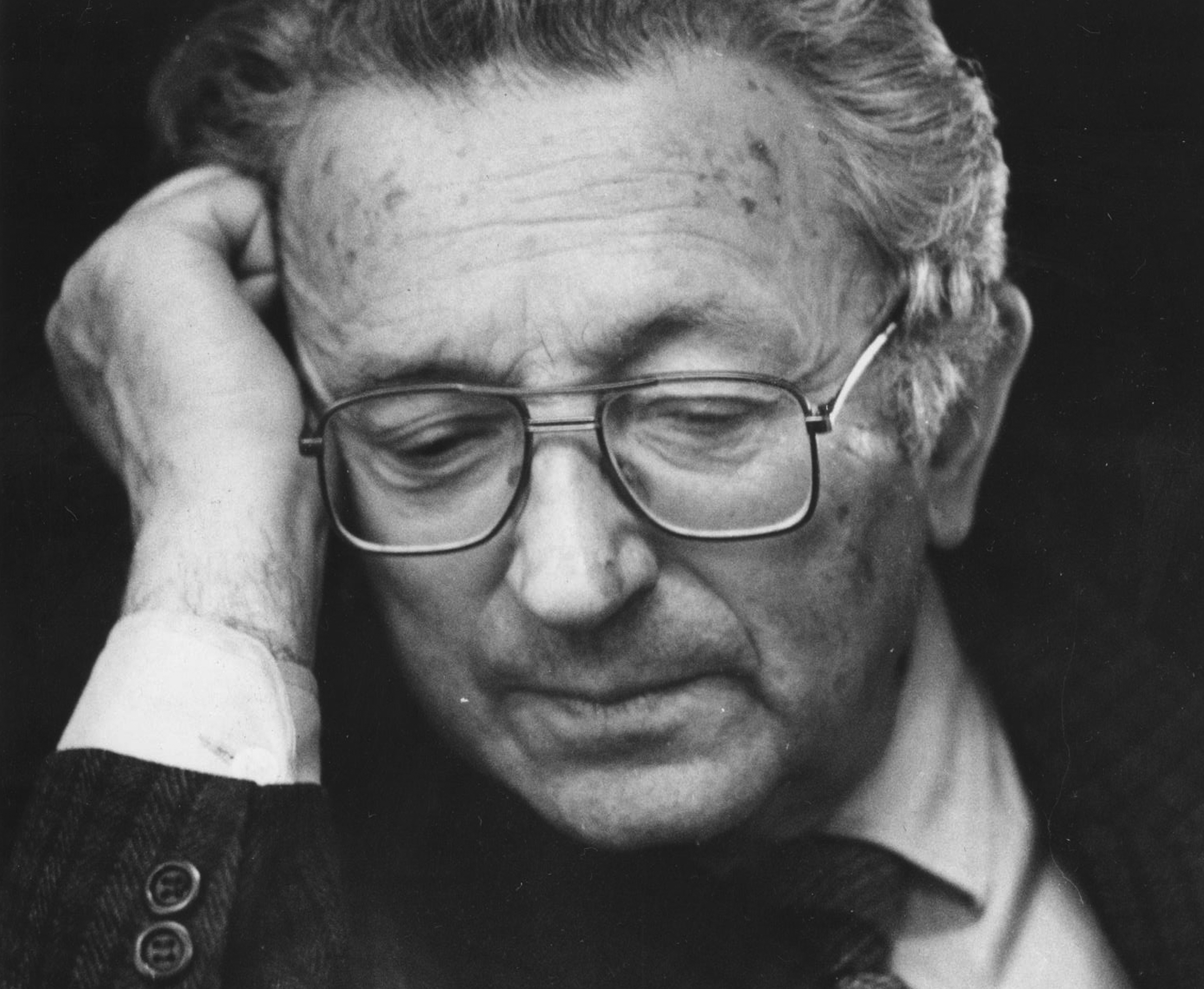
ABOVE: Lev Ozerov
Credit: photograph provided by Anna Ozerova